
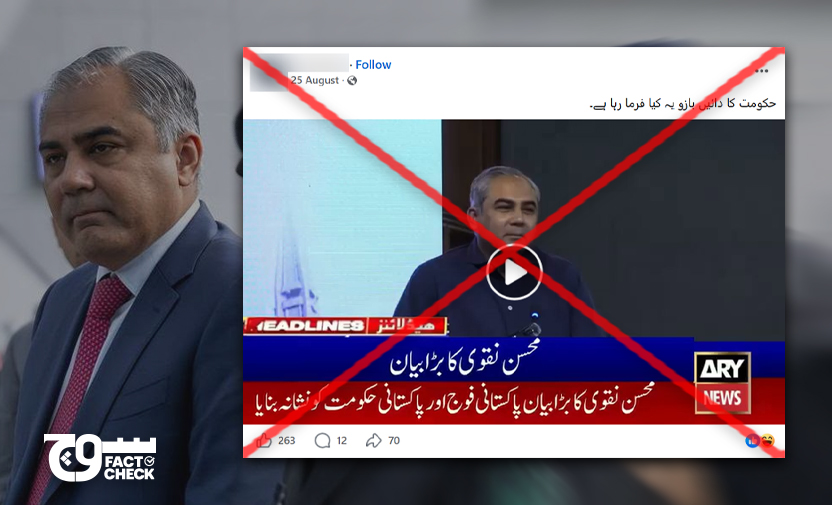
Claim: In a recent ARY News broadcast, Interior Minister Mohsin Naqvi issued a warning that Pakistan’s government will collapse if the status quo is maintained and the administration is not allowed to make decisions independently. He further acknowledged that the country has ongoing issues in Balochistan, Khyber Pakhtunkhwa (KP), and Pakistan-administered Kashmir.
Fact: The video has been manipulated using artificial intelligence (AI) tools. In the original footage, Naqvi spoke of structural issues, saying the decades-long governance system in Pakistan has collapsed and there is a need for all stakeholders to come together to resolve the issue of new units and provinces. He did not make specific reference to the incumbent government or allude to the establishment as the country’s decision-makers, as in the viral clip.
On 25 August 2026, multiple social media users shared a video of Interior Minister Mohsin Naqvi warning that Pakistan’s government will collapse if the status quo is maintained and the administration is not allowed to make decisions independently.
In the video, Naqvi also purportedly says the public “in all four of Pakistan’s provinces is worried and the trust in the government” has declined while acknowledging ongoing issues Balochistan, KP, and Pakistan-administered Kashmir, also known as Azad Jammu and Kashmir (AJK).
The clip also features a chyron displaying ARY News’ logo, making it appear as if it is from a broadcast by the media outlet. The ticker appearing at the bottom reads, “محسن نقوی کا بڑا بیان پاکستانی فوج اور پاکستانی حکومت کو نشانہ بنایا [Mohsin Naqvi’s big statement, targets the Pakistani Army and the Pakistani government.].”
The minister’s full remarks in Urdu are transcribed as follows, in English:
“My Pakistani brothers and sisters, the time has come today that we do not turn a blind eye to the reality. I can see clearly that the government will collapse before completing its tenure if it continues as it is. Today, the public in all four of Pakistan’s provinces is worried and the trust in the government and the system is declining. There is lawlessness in Balochistan and Khyber Pakhtunkhwa. People in Azad Kashmir [Pakistan-administered Kashmir] are out on the streets for their rights, while inflation and unemployment has taken over the entire country. The biggest question is this: is the government making the decisions for the country or the army? If the chosen government cannot make decisions on its own, then how long can it last for?”
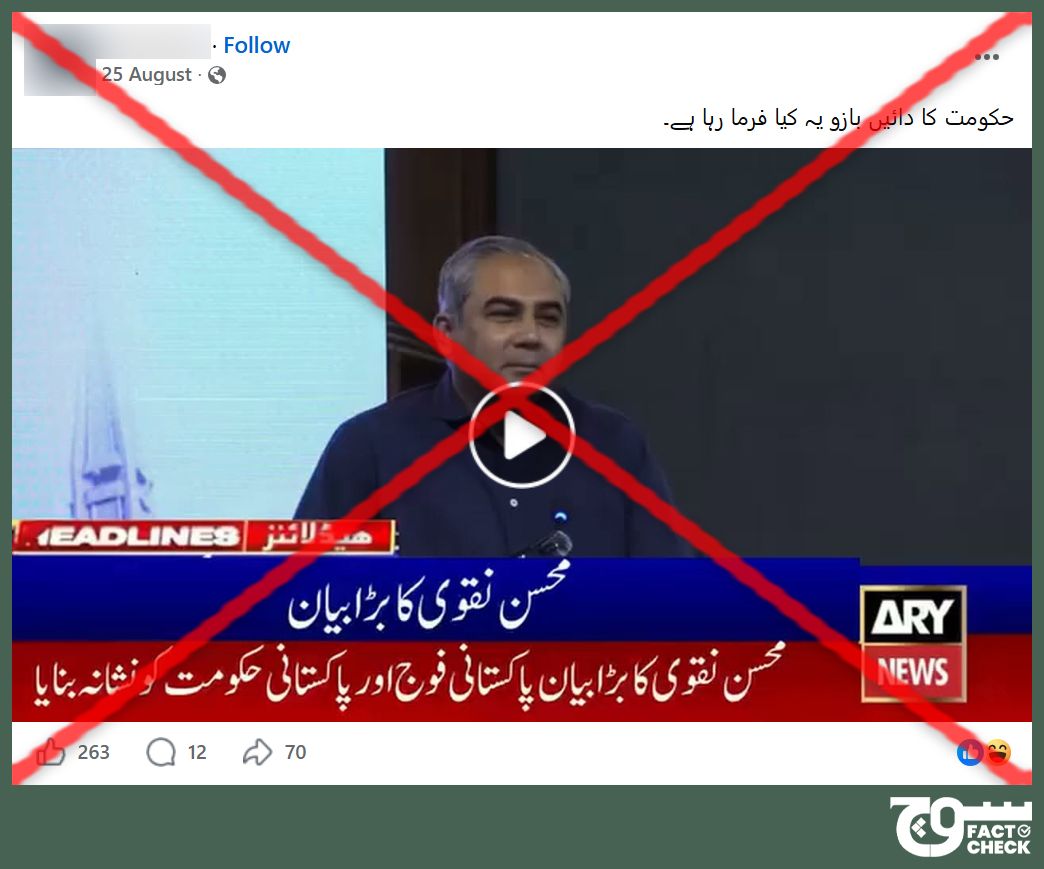
Screenshot of viral video
Some of the captions accompanying the viral video are as follows:
- “حکومت کا دائیں بازو یہ کیا فرما رہا ہے [What is the right [strong] arm of the government saying]”
- “سمجھ سے بالاتر ہے محسن نقوی اتنی صاف باتیں کیسے کرنے لگ پڑا ہے حکومت کو گھر بھیج کر ہی چھوڑے گا [It is beyond comprehension how Mohsin Naqvi has started speaking so bluntly; he won’t stop until he sends the government packing]”
The 28th Constitutional Amendment
The proposed 28th Amendment to the Constitution of Pakistan has been in discussion throughout 2026.
In November 2025, Senator Rana Sanaullah — a Pakistan Muslim League-Nawaz (PML-N) leader and Prime Minister Shehbaz Sharif’s Special Assistant on Political Affairs — had said a hypothetical 28th Amendment, focusing on “public issues such as local bodies, population, the National Finance Commission … health-related issues”, could be implemented if there was political consensus.
One of the main — and contentious — proposals in its initial stages is a restructuring of administrative boundaries and a possible change in resource distribution between the federal and provincial governments.
Planning and Development Minister Ahsan Iqbal has “proposed creating 12 to 15 new provinces or setting up 160 empowered district governments” for better governance, while Interior Minister Naqvi “raised the idea of an administrative ‘reset’” in July 2026, according to a DW report. The publication added that Defense Minister Khawaja Asif “has called for greater decentralisation and devolution of power to the grassroots”.
However, the Pakistan People’s Party (PPP) — to which President Asif Ali Zardari belongs — and some other political parties have opposed the creation of new provinces.
On 3 September, PPP leader Nisar Ahmed Khuhro moved a resolution in the Sindh Assembly, invoking Article 239(4) of the Constitution to reject “any proposal to divide the province or alter its territorial limits”. While Opposition members walked out, it was passed “unanimously” by those “present in the house”.
Fact or Fiction?
Soch Fact Check first observed that the Urdu words appear in the ticker bottom-upwards in the viral clip, alphabet-by-alphabet from right to left, contrasting with ARY News’ authentic broadcasts, in which the entire line of text pops up in one go. There is no day, date or time under the channel’s logo nor any English ticker.
In the viral video, we also noticed that when Naqvi mentions “the government and the system” — “حکومت و نظام” in Urdu — he pronounces the “and” (و) differently than a native speaker would. He says “hukumat wa nizaam”, which should actually be “hukumat o nizaam”. This is likely evidence of AI manipulation using the text-to-speech (TTS) method.
We then reverse-searched keyframes from the viral video and found authentic footage of him from the Pakistan Economic Summit 2026 — an event held on 30 July — broadcast by multiple news outlets, including Dunya News, SAMAA TV, Express News, and Dawn News English, and uploaded on journalist Zahid Gishkori’s YouTube channel.
The minister’s bodily movements in the viral 49-second clip exactly match those in the footage by the aforementioned sources at the 2:12, 0:26, 2:18, 2:43, and the 1:01 marks, respectively.
Footage from Naqvi’s speech is also available on his own Facebook page, where his original remarks can be heard between the 2:44 and the 3:33 marks.
Interestingly, we also found ARY News’ broadcast — starting at the 1:08 mark — but the viral clip does not match either the channel’s branding nor the camera angle.
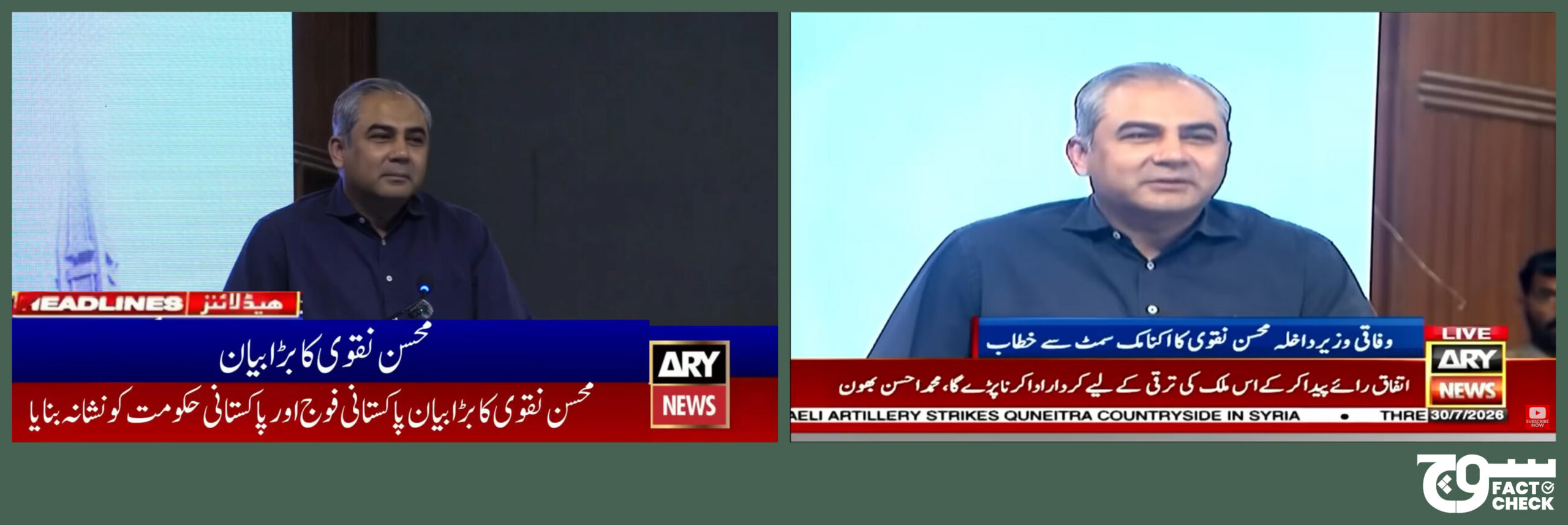
Comparison of screenshots from the viral video (L) and ARY News’ authentic broadcast (R)
The minister’s actual remarks in the 49-second clip are as follows:
“Because the system under which we are living has collapsed whether you agree or not. You… something that is being dragged on for 70 years… I’ll say it today as well, we all want democracy and I am its biggest supporter and will continue to be. But, even in democracy, there are three, four, five systems; only one system doesn’t exist. But we say, no, whatever happens, we have to drag it out, we have to run it, whether we import agricultural products worth 14 billion or we import wheat despite being an agricultural country or whatever you say. Everyone gave their opinion.”
Nowhere in his actual speech does Naqvi predict the fall of the incumbent government, acknowledge any issues in Balochistan, KP, and AJK or raise questions about who actually makes decisions in Pakistan. However, he does speak of how the decades-long governance system in Pakistan has collapsed and explain that all stakeholders needed to come together to resolve the issue of new units and provinces.
At the event, he “called for the creation of additional administrative units or provinces to overhaul the country’s outdated governance system”, according to The Express Tribune. He also noted that “Pakistan’s current governance model had effectively ‘collapsed’ after decades of failing to deliver”.
The publication mentioned that the minister highlighted “fundamental flaws” in the design of Pakistan’s system as it “had failed to function effectively for 70 to 80 years”.
“You will have to take [the matter of] administrative units, provinces or whatever you may call it, to the public. Unless [new administrative] units are made and they take ownership, and a new leadership comes, this will not happen,” The Express Tribune quoted him as saying.
In a Dawn report about the event, Naqvi was quoted as saying, “Things will not improve unless new leadership comes.” He said that the “youth could not be appeased with a monthly stipend of a few thousand rupees or by giving away laptops”, according to the publication.
Since Soch Fact Check was able to trace his original speech, we suspect that the viral clip was doctored using AI tools, especially the audio portion.
Sound engineer’s analysis
To corroborate our suspicions about AI manipulation, we sought a comment from Shaur Azher, a lecturer who teaches sound design and sound recording at the University of Karachi and the Shaheed Zulfikar Ali Bhutto Institute of Science and Technology (SZABIST). He also works as an audio engineer at our sister organisation, Soch Videos, and specialises in mixing and mastering audio.
Azher explained that for comparison purposes, Sample A is the claim and Sample B is Naqvi’s actual speech from 30 July 2026.
“Sample A is an AI-generated audio that has been further edited with multiple spliced cuts,” he said. “The evidence shows clear hard joints at several points, where the sound jumps from near-silence into speech.
“The background noise in Sample A is also unnatural as it disappears almost completely between phrases instead of remaining steady like a real-room tone. In addition, the voice is heavily compressed and lacks natural pitch and volume variation, he added.
Sample B, on the other hand, features “continuous recording with natural background sound and dynamics”.
To support his conclusion, he provided the following observations:
Noise floor / background sound:
- Sample A: Background noise is very low and often disappears completely between spoken parts, almost like digital silence.
- Sample B: Background noise stays present and steady throughout the speech.
- Sample A’s quiet sections are much quieter — especially in the low and mid frequencies — than Sample B’s.
Cuts and edits:
- Sample A has several sudden jumps in volume at specific timestamps such as 6.39 seconds, 13.51 seconds, 22.48 seconds, 37.08 seconds, and 42.68 seconds, as well as a softer joint at 46.00 seconds.
- These jumps go from near-silence to speech (changes of 15-21 decibels (dB)), which is typical of cuts or splices.
- Sample B has no such sudden jumps and its volume changes smoothly.
Loudness and dynamics:
- Sample A is heavily compressed and Naqvi’s voice stays at a more even level, whereas Sample B has more natural ups and downs in volume, indicating a wider dynamic range.
- Sample A peaks around -4.4 dB and stays more levelled but Sample B peaks closer to 0 dB and keeps more natural loudness variation.
Voice character and tone:
- Sample A sounds more monotone and flattened; its overall sound is darker and more mid-focused.
- Sample B has clearer natural changes in pitch and loudness; it has a more open, natural frequency balance.
Deepfake detection tools
Soch Fact Check first tested the audio in Hiya Deepfake Voice Detector using three samples:
- “I can see clearly that it will collapse before completing its tenure”
- “While inflation and unemployment have engulfed the entire nation…”
- “Is the government making the decisions for the country or the army?”
All three samples are “likely a deepfake”, the tool said, giving authenticity scores of 7, 8, and 25 out of 100.
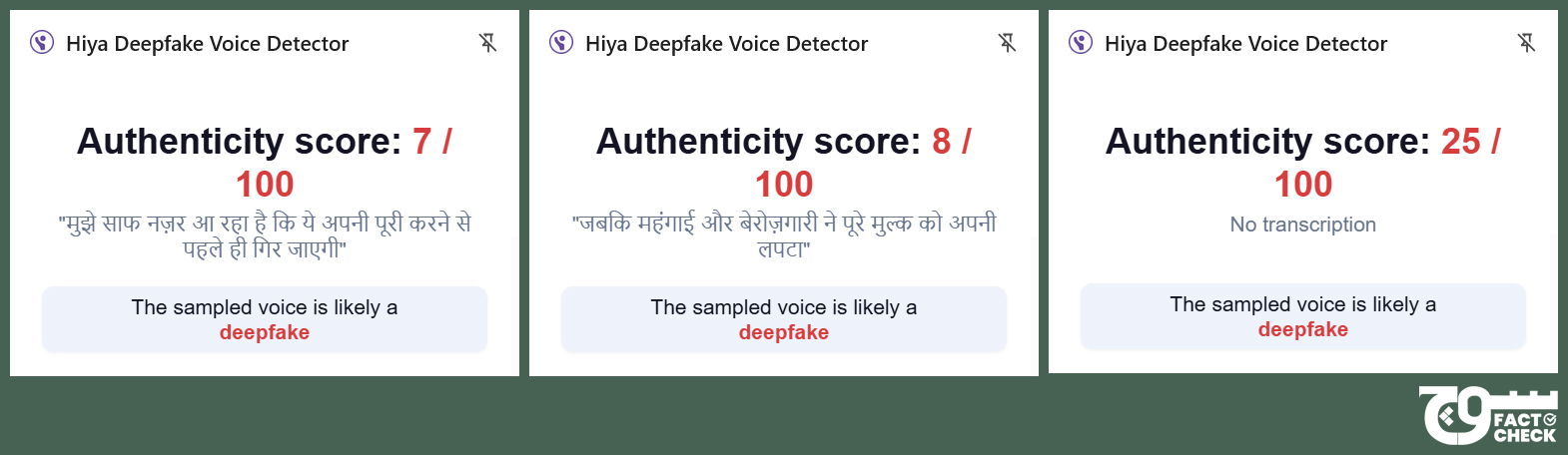
Results from Hiya Deepfake Voice Detector
We then ran the viral video through multiple deepfake detectors such as Hive Detect, NVIDIA Synthetic Video Detector, and DeepFake-O-Meter.
According to Hive Detect’s results, the content is 0% likely to be AI-generated video but 67.3% likely to have AI-generated speech.
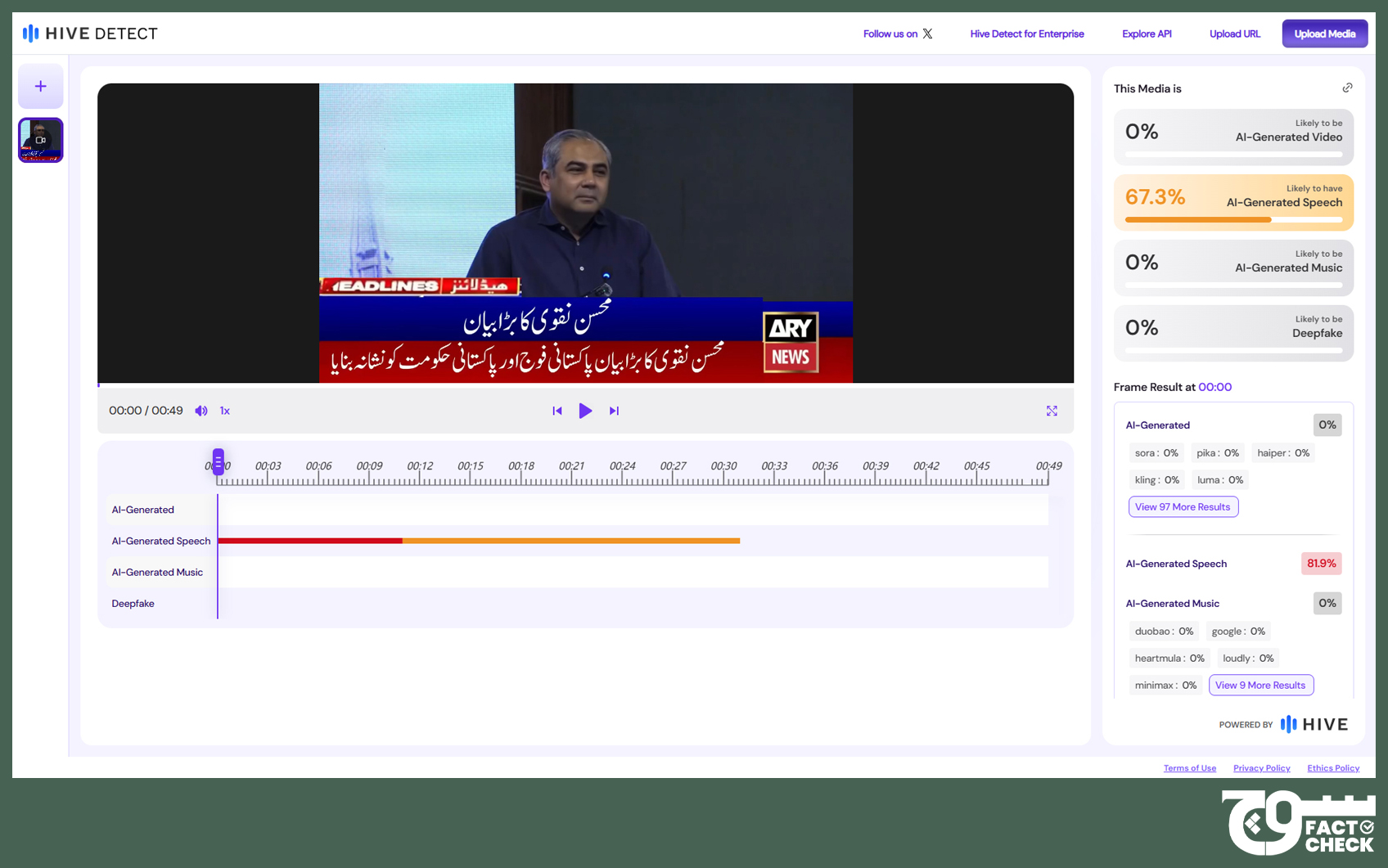
Results from Hive Detect
NVIDIA Synthetic Video Detector found the video to be “synthetic”, with a likelihood of 49.8%, which is “greater than threshold (30%), meaning it’s likely synthetic or AI-generated”.
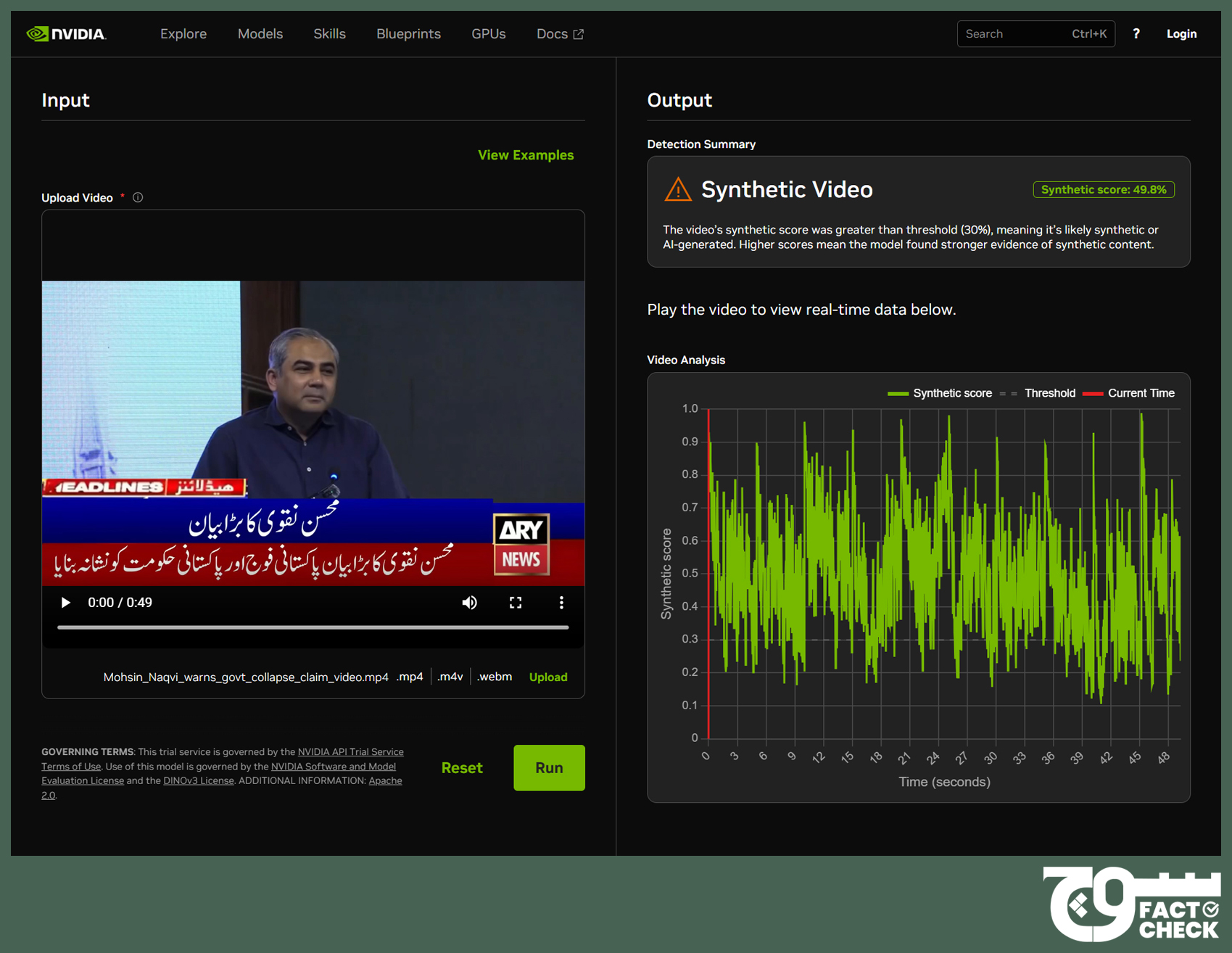
Results from NVIDIA Synthetic Video Detector
In addition, DeepFake-O-Meter, a tool developed by the University at Buffalo’s Media Forensics Lab (UB MDFL), also concluded the video is likely AI-generated, with “moderate” confidence. The seven detectors we used gave probabilities of 100%, 99.9%, 99.7%, 89%, 83.8%, 57.9%, and 44.9%.
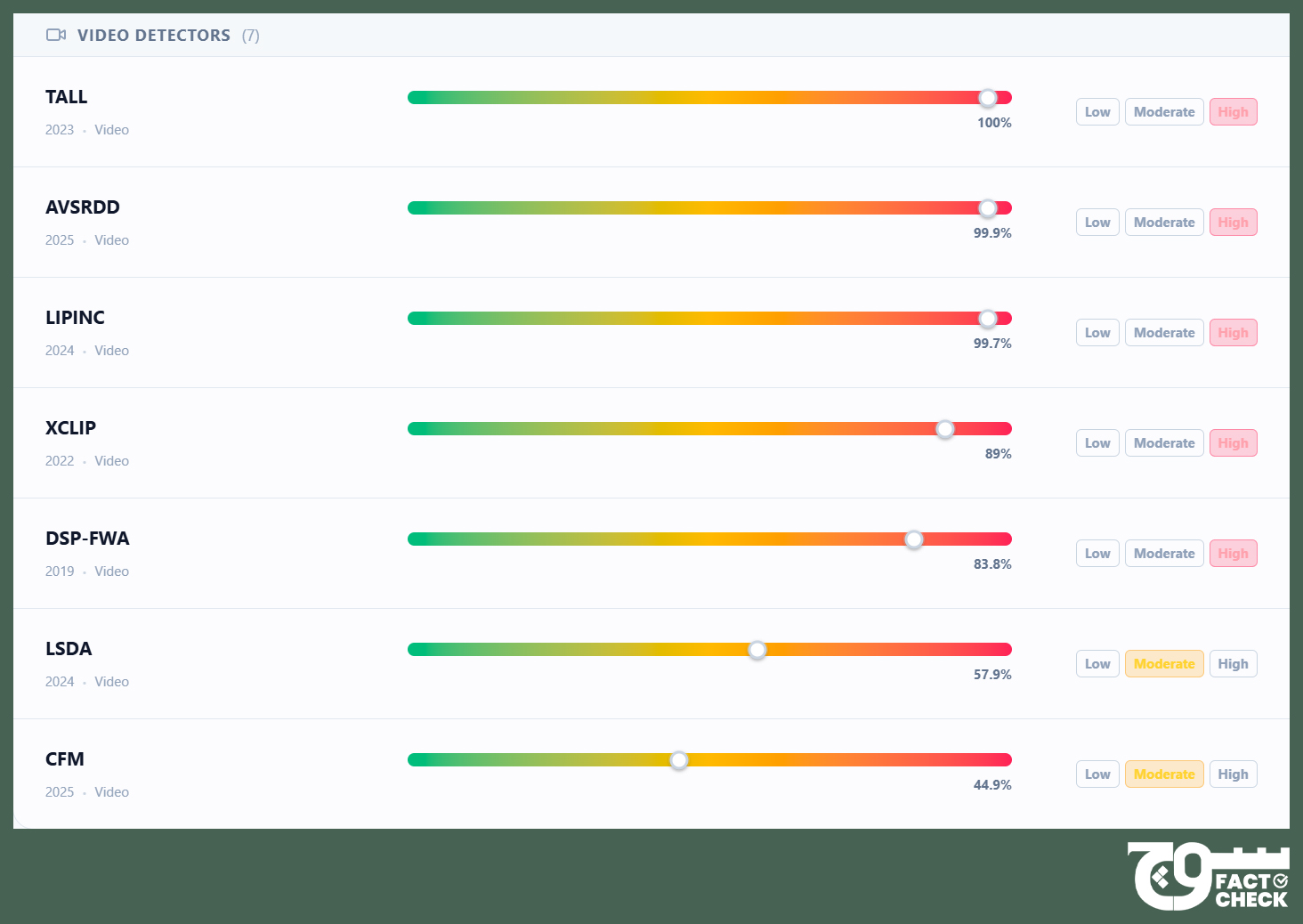
Results from DeepFake-O-Meter
Soch Fact Check, therefore, concludes that the video of Naqvi making shocking remarks is AI-manipulated.
Virality
Soch Fact Check found the video posted dozens of times on Facebook, Instagram, and Threads.
Earlier this month, Soch Fact Check investigated and debunked a similar clip of Defence Minister Khawaja Asif apparently acknowledging that Pakistan currently faces multiple “internal crises”, including in Balochistan, KP, and AJK, while praising India.
Prior to that, we debunked a synthetic clip fabricating Naqvi’s remarks on new provinces that went viral on social media in August 2026.
Conclusion: The video is AI-manipulated. In the original footage, Naqvi discussed structural issues, saying the long-standing governance system in Pakistan has collapsed and there is a need for all stakeholders to come together to resolve the issue of new units and provinces. He did not predict the fall of the incumbent government or allude to the establishment as the country’s decision-makers, as in the viral clip.
Background image in cover photo: realmohsinnaqvi
To appeal against our fact-check, please send an email to appeals@sochfactcheck.com