
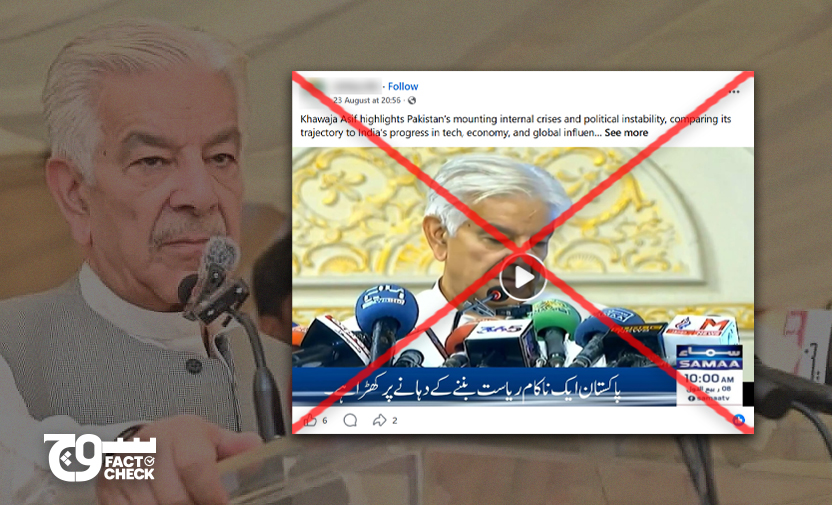
Claim: Defence Minister Khawaja Asif acknowledged that Pakistan currently faces multiple “internal crises”, including in Balochistan, Khyber Pakhtunkhwa, and Azad Jammu and Kashmir (AJK), and compared the country to its eastside neighbour, India, which he praised for its progress.
Fact: The viral video has been manipulated with artificial intelligence (AI) tools. In the authentic clip, which is from an event in Sialkot, Asif did not make any such remarks.
On 23 and 24 August 2026, social media users circulated a video showing Defence Minister Asif addressing an event, where he purportedly acknowledged multiple “internal crises” faced by Pakistan and praised India for its progress.
Asif’s comments from the viral clip — translated from Urdu to English — are transcribed as follows:
“My dear fellow compatriots, look at the situation of our country. We [Pakistan] and India gained independence at almost the same time but the distance between the two nations has become too much. Balochistan has slipped out of our hands, the public in Khyber Pakhtunkhwa are worried, and people in Azad Kashmir [Pakistan-administered Kashmir] are out on the streets for their rights. On the other hand, look at India, which has continuously strengthened its technology, infrastructure, economy, and its identity in the world. Today, we need to ask ourselves: Are we really a democracy? Instead of blaming others, we need to ask our government and our policies as to who has brought Pakistan to this stage?”
The caption accompanying the viral posts reads as follows:
“Khawaja Asif highlights Pakistan’s mounting internal crises and political instability, comparing its trajectory to India’s progress in tech, economy, and global influence. Self-reflection and accountability are urgently needed.”
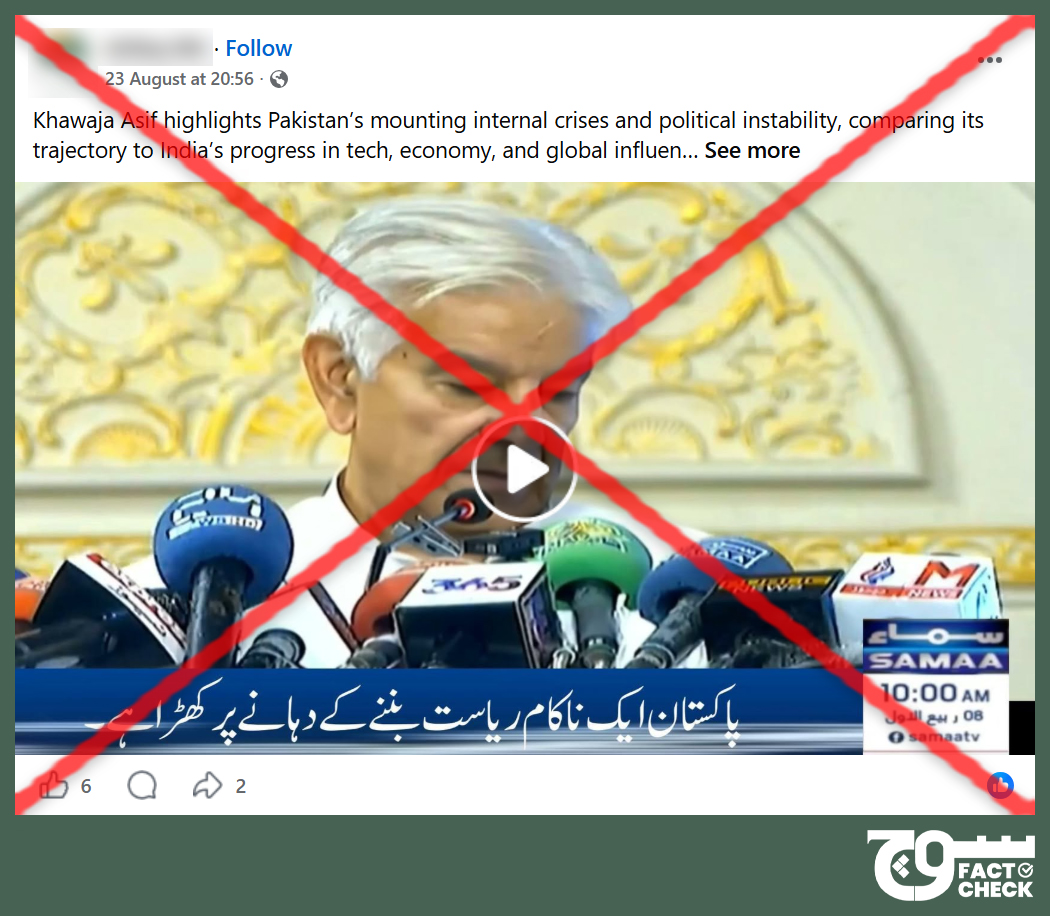
Screenshot of the viral post
A day later, a second video emerged of Asif allegedly telling reporters that the earlier clip — showing him acknowledging Pakistan’s “internal crises” and praising India — was authentic.
In the video, an anchorperson first states, “Major news coming in from Islamabad. A video attributed to Defence Minister Khawaja Asif is quickly going viral on social media. What do you have to say about the video going viral on social media?”
Asif then responds by saying, “It is actually my statement. I said whatever I said for the betterment of the country and I stand by my comments.”
The second video was accompanied by the following caption:
“Khawaja Asif, Pakistan’s Defence Minister, admitted in a viral video: ‘Yes, those were my words. Whatever I said, I said for the betterment of the country and I stand by my statement.’ A leader’s courage is shown when he takes responsibility for his own words.”
Fact or Fiction?
Soch Fact Check reverse-searched keyframes from the primary video and found it matched visuals of Asif speaking at an inaugural event of a healthcare initiative in Sialkot.
The YouTube channel Charsadda Journalist livestreamed the minister’s speech on 16 August 2026 and uploaded footage from the event as a standalone video as well. Nowhere in either of the clips did he mention Pakistan’s “internal crises” or India to make a comparison.
In fact, Asif only spoke of the city, its business community and its development over the years, as well as the Sialkot Medical City Limited (SMCL), a project by the Sialkot Chamber of Commerce and Industry (SCCI), as reported by other media outlets, including the state-run Associated Press of Pakistan (APP).
The remarks also appear in videos posted on the minister’s own social media accounts.
Hamid Nasir, a Sialkot-based Facebook user who appears to be a fan of Asif and is often seen with him, according to his profile, also posted a partial livestream of the politician’s speech.
Separately, we observed that Asif’s face appears waxy and his speech is robotic in the viral video.
Suspecting manipulation using AI tools, we tested the primary video in deepfake detectors, such as Hive Detect and NVIDIA Synthetic Video Detector.
According to Hive Detect’s results, the sample is 0% likely to be an AI-generated video, 1.9% likely to have AI-generated speech, 0.1% likely to contain AI-generated music, and 0.3% likely to be a deepfake. However, between the 0:50 and the 0:52 marks, it provided a 97.7% probability of AI-generated music.
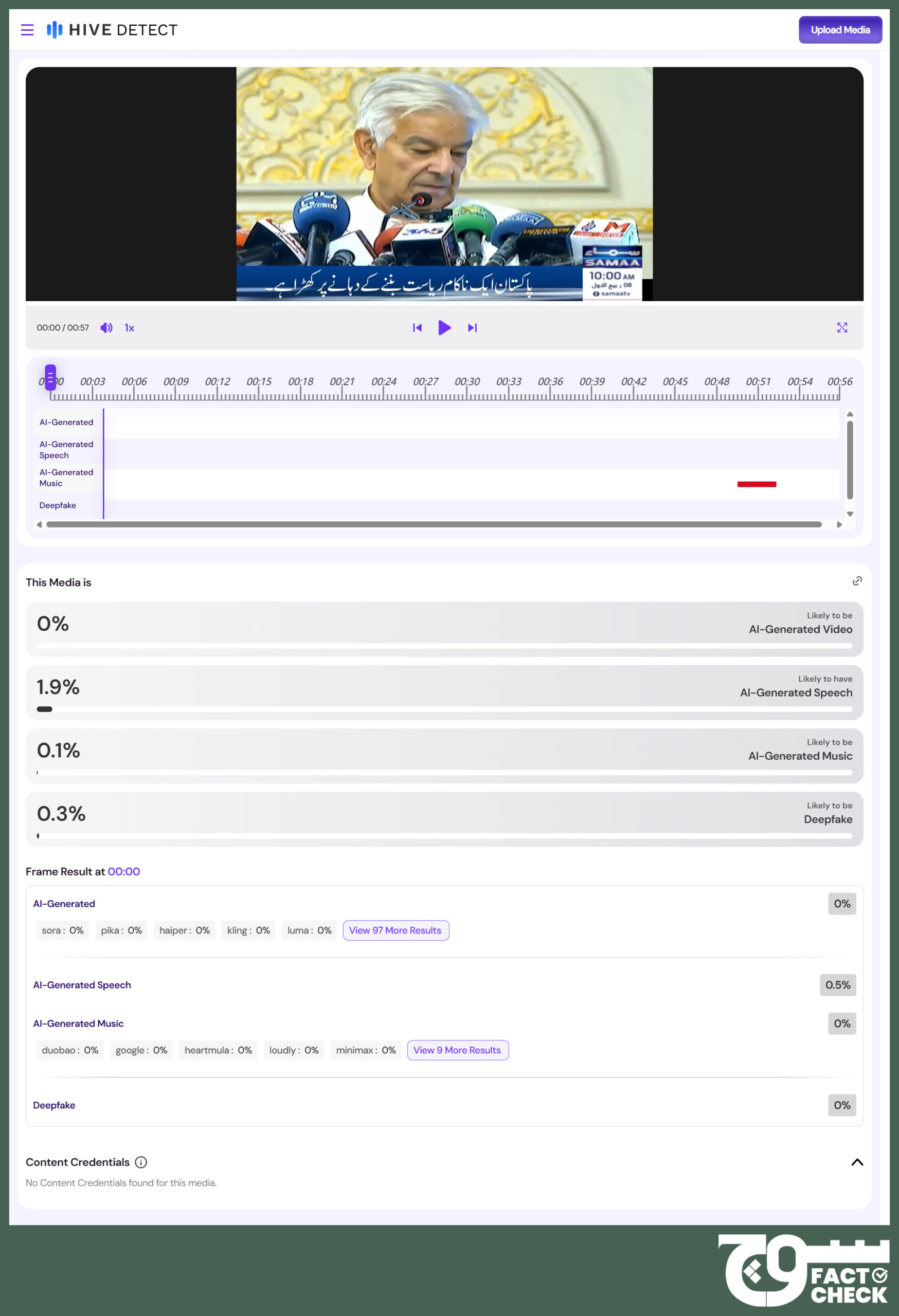
Results from Hive Detect
According to the NVIDIA Synthetic Video Detector, the sample is “real”, with a synthetic score of 21.5%, which is “lower than threshold (30%)”, suggesting “stronger evidence of real content”. At multiple but less frequent points, however, the score does go above 30%, indicating instances of possible manipulation.
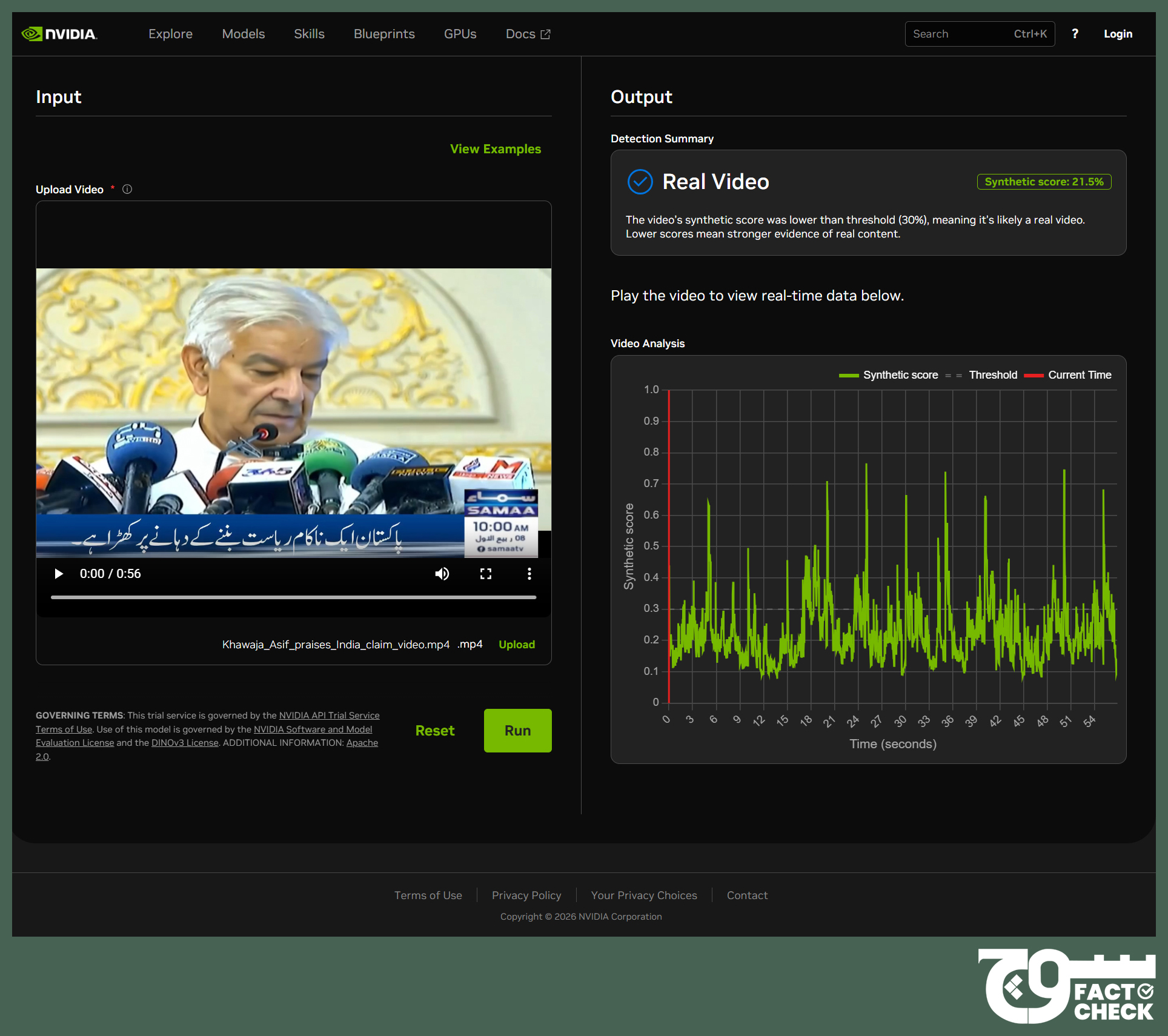
Results from NVIDIA Synthetic Video Detector
We also ran the viral clip through Global Online Deepfake Detection System (GODDS), a tool developed by Northwestern University’s Security & AI Lab (NSAIL) that uses a combination of various models along with human analysis to provide a holistic summary of the results.
GODDS employed 22 deepfake detection algorithms for the visual content and 70 for the audio component, while two trained analysts also examined the clip.
All predictive models for the visual and audio content said the video “is likely to be fake”:
- The video is likely to be fake with a probability above 0.5, according to 12 of the 22 predictive models; it is likely to be fake with a probability below 0.5, according to the 10 other predictive models.
- The audio is likely to be fake with a probability above 0.5, according to 62 of the 70 predictive models; it is likely to be fake with a probability below 0.5, according to the eight remaining predictive models.
According to GODDS’ human analysts, the video contains “several indicators” that show it may be artificially manipulated. For example:
- Between the 0:23 and 0:56 marks, there appears to be a filter on the face. This could also be attributable to sunlight or other lighting as well.
- The lip movements do not align with the sounds.
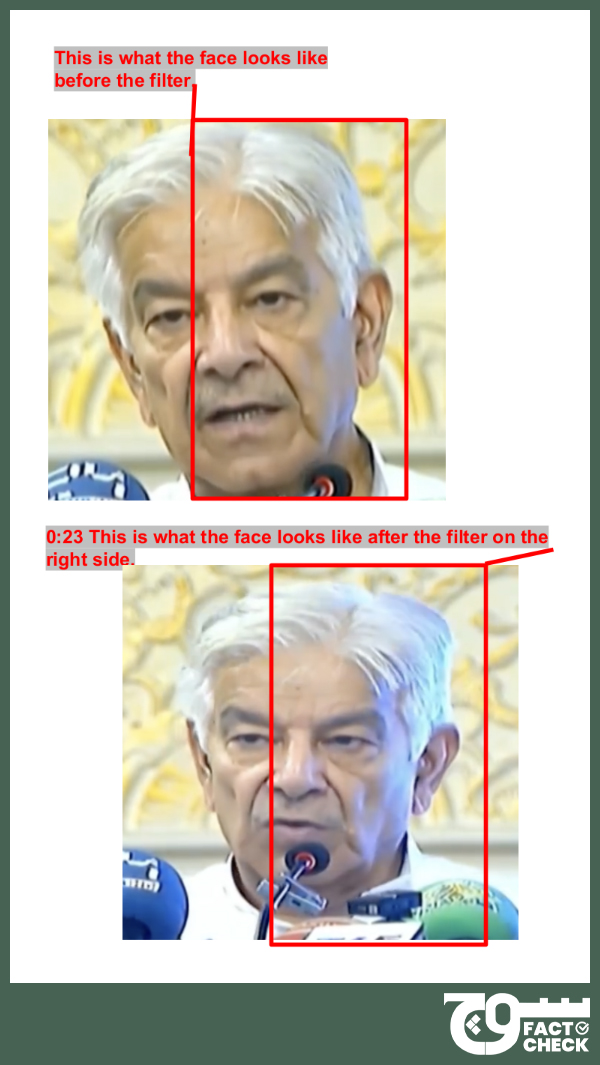
Results from GODDS
However, the artefacts “are largely obscured by poor video quality”, they observed. “Hence, it is difficult to discern possible artefact manipulation from the video’s heavy compression. These indicators can plausibly be explainable by other factors such as motion blur as well.”
“We believe this media is likely manipulated via artificial intelligence,” they concluded.
For further verification, Soch Fact Check also sought a comment from Shaur Azher, a lecturer who teaches sound design and sound recording at the University of Karachi and the Shaheed Zulfikar Ali Bhutto Institute of Science and Technology (SZABIST). He also works as an audio engineer at our sister organisation, Soch Videos, and specialises in mixing and mastering audio.
Azher explained that for comparison purposes, Sample A is the claim and Sample B is the actual video of Asif’s remarks.
“The robotic speed, the lack of natural breathing and mouth sounds, and the artificial background static all indicate that Sample A is a deepfake. It was synthesised by software and compared directly against the authentic real world recording of Sample B,” he said.
To support his findings, he provided the following observations:
- The voice fingerprint: When the core sound waves of both audio clips are compared, they do not match. The underlying mathematical structure of the AI-generated track in Sample A shows clear spectral patterns that are very different from the genuine biological signature found in Sample B.
- Breathing and speed: Sample A moves through the words unnaturally fast and does not leave normal spaces for breathing. The real recording in Sample B has a much more natural human rhythm. The speaker’s mouth pauses and he shows emotion and takes normal breaths. The cloned version keeps a very consistent and mechanical tempo that does not sound like natural human speech.
- Missing mouth sounds: Real human speech contains small sounds, such as lips parting or slight tongue clicks. These sounds are part of normal human speech; however, Sample A is suspiciously smooth and lacks these small imperfections. AI generation can smooth out these tiny sounds, resulting in a much cleaner and more sterile delivery than what one would normally hear from a real person, whereas these are present in sample B.
- Fake background static: A genuine recording captures the natural sound of the physical room where the person is speaking. Sample A, instead, has a layer of constant static over the voice. This artificial noise can act as a masking layer and cover some of the digital artefacts underneath the synthetically generated speech, whereas, in Sample B, it’s natural.
- Unnatural pitch: Sample A also has more emphasis in the higher frequencies, giving the voice a slightly synthetic or tinny quality. Instead of the rich and natural resonance found in Sample B, the deepfake has a more metallic quality, which is consistent with an artificially-generated voice.
Moreover, Pakistan’s Information Ministry and its fact-checking wing both labelled the clip as “fake”, saying “the voice in [the] video is AI generated”.
The second video, in which Asif allegedly told reporters that the clip from the previous day was authentic, is AI-manipulated as well.
We found the original footage published on 20 August 2026 by multiple outlets, such as Geo News, Capital TV, and Daily Mumtaz. It was also posted on Facebook by BOL Network reporter Umar Hayat Khan.
The 0:09 mark in the viral video, where Asif starts speaking, matches with the 0:55 mark, 0:43 mark, 0:30 mark, and the 0:30 mark in the clips posted by Geo News, Capital TV, Daily Mumtaz, and the Bol News reporter.
In the authentic video, the minister was asked about the Opposition parties’ actions. Responding to which, he says, “It’s the job of the Opposition to protest, they protest, they have a right to protest or not to protest over whatever they want.”
Suspecting manipulation using AI tools, we tested the second video in Hive Detect and NVIDIA Synthetic Video Detector.
According to Hive Detect’s results, the sample is 0.3% likely to be AI-generated video, 0% likely to have AI-generated speech, 0% likely to contain AI-generated music, and 1.2% likely to be a deepfake.
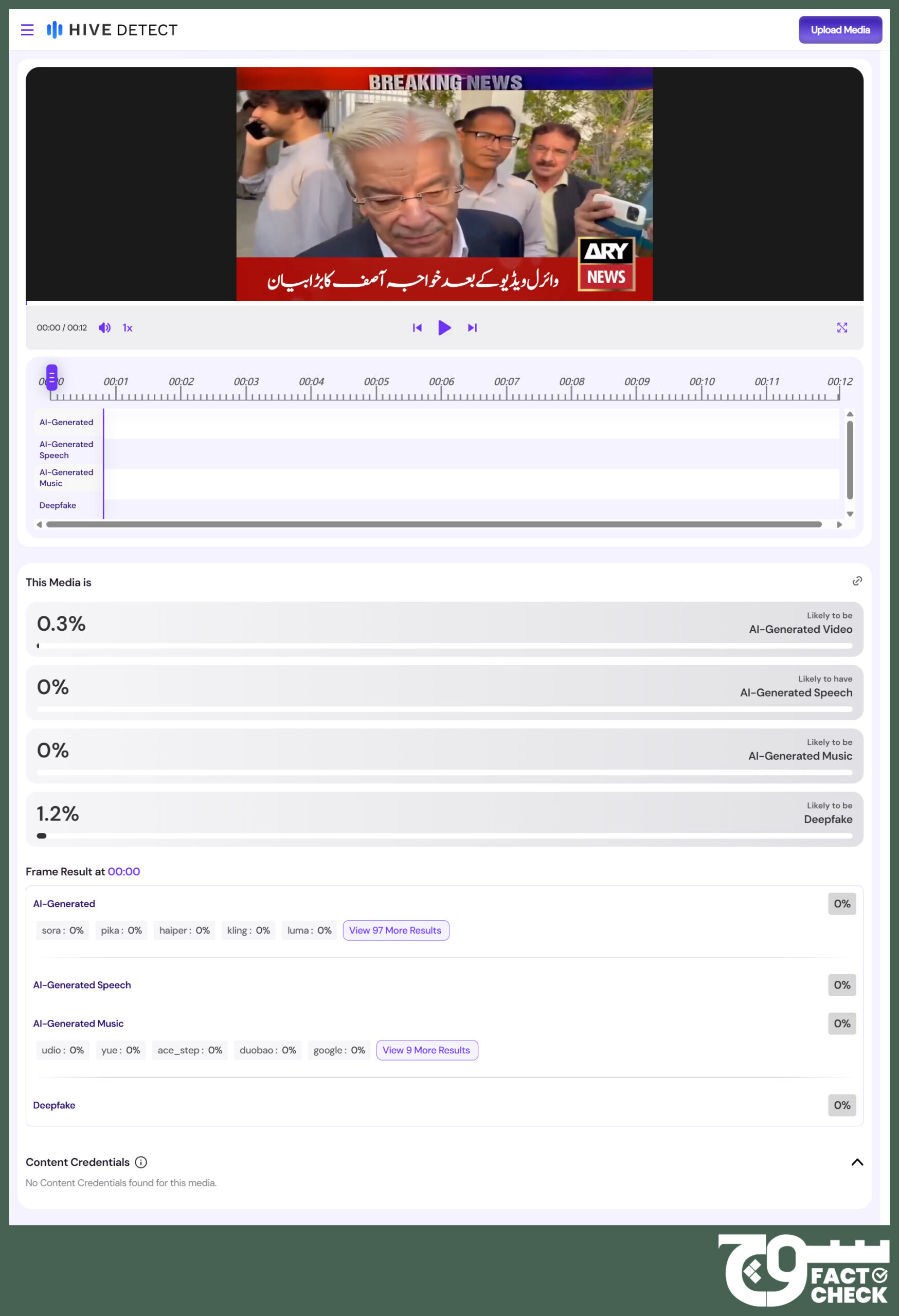
Results from Hive Detect
According to the NVIDIA Synthetic Video Detector, the clip is “synthetic”, with a score of 40.5%, which is “greater than threshold (30%), meaning it’s likely synthetic or AI-generated”.
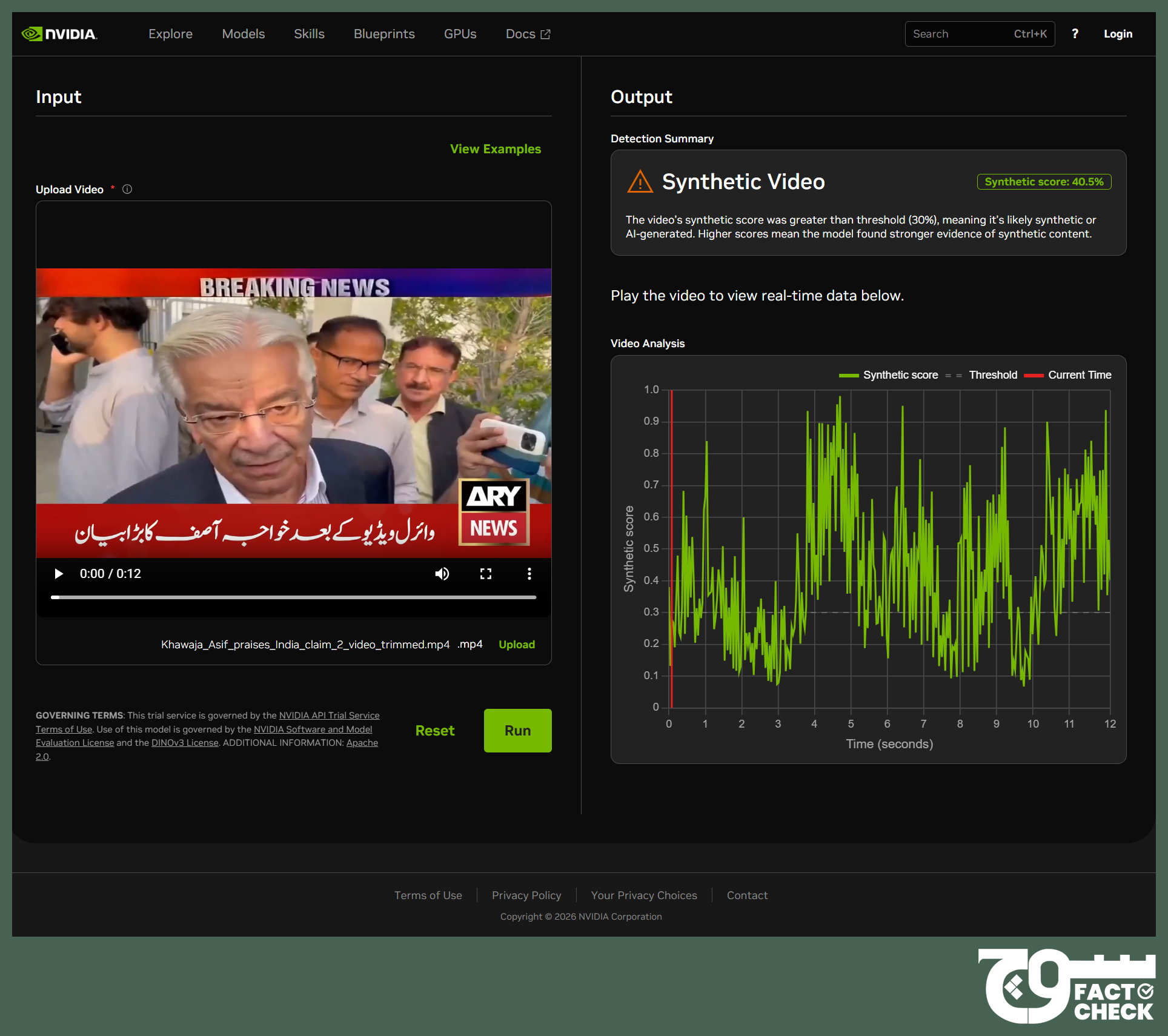
Results from NVIDIA Synthetic Video Detector
We ran the viral clip through GODDS, which employed 22 deepfake detection algorithms for the visual content and 70 for the audio component, while two trained analysts also examined the clip.
All predictive models for the visual and audio content said the video “is likely to be fake”:
- The video is likely to be fake with a probability above 0.5, according to five of the 22 predictive models; it is likely to be fake with a probability below 0.5, according to the 17 other predictive models.
- The audio is likely to be fake with a probability above 0.5, according to 63 of the 70 predictive models; it is likely to be fake with a probability below 0.5, according to the seven remaining predictive models.
According to GODDS’ human analysts, the video contains “several indicators” that show it may be artificially manipulated. For example:
- At the 0:21 mark, the face appears to morph into the hands of the person standing behind Asif and the face blends in with the background.
- The lip movements do not align with the sounds.
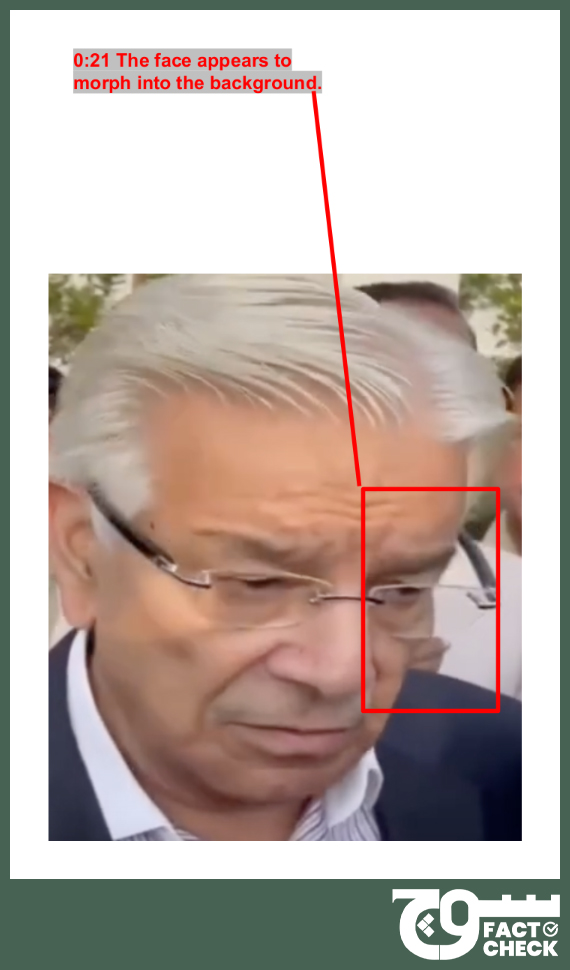
Results from GODDS
“The artefacts are largely obscured by poor video quality. Hence, it is difficult to discern possible artefact manipulation from the video’s heavy compression. These indicators can plausibly be explainable by other factors such as motion blur as well,” they said.
“We believe this media is likely manipulated via artificial intelligence,” the analysts concluded.
Azher, our sound engineer, analysed this clip as well. Again, for comparison purposes, Sample A is the claim and Sample B is the actual video of Asif’s remarks.
“Sample A is a deepfake. It was synthesised by software and compared directly against the authentic real world baseline recording of Sample B,” he said. To support his conclusion, he provided the following observations:
- Breathing and speed: Sample A moves through the words fast and does not leave any normal spaces for breathing. The real recording in Sample B has a much more natural human rhythm. The cloned audio removes much of this natural flow and ends up sounding mechanical.
- Missing mouth sounds: Real human speech contains small sounds, such as lips parting or slight tongue clicks. These natural imperfections are largely missing from Sample A, which, instead, sounds unusually smooth and clean. AI generation can remove these small transient sounds, meaning that Sample A lacks some of the subtle characteristics normally created by a moving human mouth. Whereas, in sample B, all of the same is present but, due to the noise floor being extreme, it would not be visible unless the noise is further isolated.
- Fake background static: Sample B shows genuine recording that captures the natural sound of the physical room where the person is speaking. Sample A, instead, has a constant layer of static over the voice. This noise can act as a masking layer and cover the digital artefacts that would otherwise make the synthetic origin more obvious.
Soch Fact Check, therefore, concludes that both viral videos of Khawaja Asif are AI-manipulated.
Virality
Soch Fact Check found that both videos were shared multiple times on Facebook, Instagram, and X (formerly Twitter).
Interestingly, we came across many posts by users who appear to be Afghan or based in Indian-administered Kashmir.
The claim was also shared sans the manipulated video on Facebook and Instagram.
Conclusion: The viral video has been manipulated using AI tools. In the authentic clip, which is from an event in Sialkot, Asif did not make any such remarks.
Background image in cover photo: khawajaAsifofficial
To appeal against our fact-check, please send an email to appeals@sochfactcheck.com
[…] this month, Soch Fact Check investigated and debunked a similar clip of Defence Minister Khawaja Asif apparently acknowledging that Pakistan currently […]