
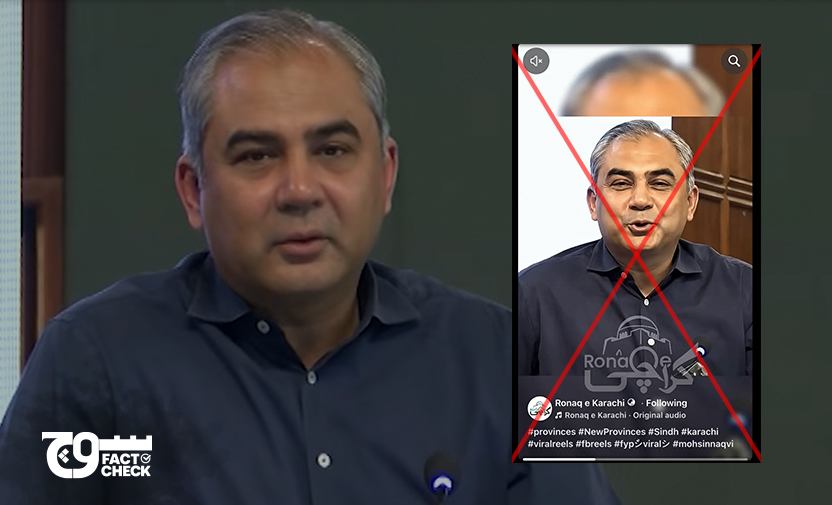
Claim: A video shows Interior Minister Mohsin Naqvi announcing that a decision to create new provinces in Pakistan has been made.
Fact: The clip contains footage from Naqvi’s 30 July 2026 address overlaid with synthetic audio. In the original video, Naqvi made no such announcement.
On 8 August 2026, a Facebook page named Ronaq e Karachi shared a 10-second video, appearing to show Interior Minister Mohsin Naqvi announcing the creation of new provinces in Pakistan, with hashtags including “#provinces”, “#NewProvinces”, “#Sindh”, “#karachi”, and “#mohsinnaqvi”.
In the clip he appears to say, “Sab kaam ho chuka hai. Pakistan mein soobay banein ge, bilkul banein ge, aur uska faisla ho chuka hai,”
[Translation: “Everything has been done. Provinces will be created in Pakistan, they absolutely will, and the decision has been made.”]
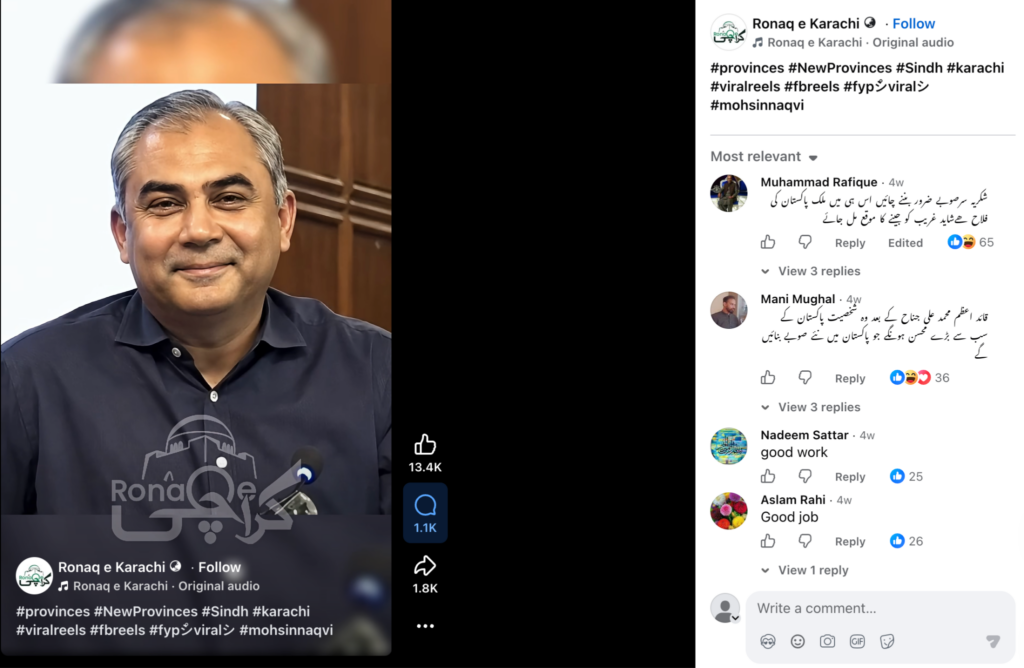
Screenshot of the Facebook reel shared by Ronaq e Karachi on 8 August 2026, showing Interior Minister Mohsin Naqvi with the manipulated audio.
Debate over new provinces
The video circulated amid a political debate over the creation of new provinces or administrative units in Pakistan.
On 30 July 2026, Interior Minister Mohsin Naqvi addressed the Pakistan Economic Summit, stating that the country’s existing governance system had “collapsed”. He called for political consensus on creating new administrative units or provinces and urged political parties to discuss structural reforms.
Fact or Fiction?
Soch Fact Check investigated the clip and found evidence indicating the footage was manipulated using artificial intelligence. We traced it to Naqvi’s 30 July 2026 address at the Pakistan Economic Summit as it shows him wearing the same dark blue shirt and speaking in the same setting with wooden background seen in the viral clip.
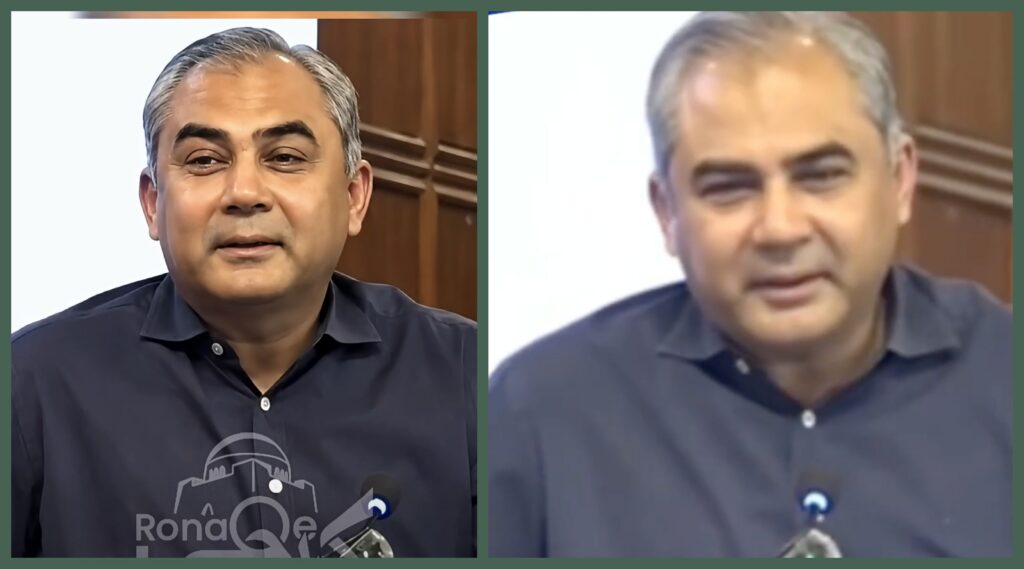
Left: The viral manipulated video shared by Ronaq e Karachi. Right: Original footage of Mohsin Naqvi’s 30 July 2026 address at the Pakistan Economic Summit.
Soch Fact Check reviewed Naqvi’s original speech and found he made no such announcement. Instead, he called for political parties to reach a consensus on the issue and said the question of new administrative units or provinces should be taken to the public. Soch Fact Check reviewed Naqvi’s original speech and found he made no such announcement. Dawn’s report on the address also records him saying that the issue of administrative units or provinces should be taken to the public and settled through political discussion.
Soch Fact Check reviewed Naqvi’s original speech and found he made no such announcement. At 6:36, while discussing new administrative units or provinces, Naqvi said:
“Lekin aap ko administrative units, soobay, is ko jo marzi naam de dein, is ko le ke jana paray ga awam ki satah par.”
[Translation: “But you will have to take the issue of administrative units, provinces, whatever you want to call them, to the public.”]
Later, at 11:04, he said:
“In ko in naye units, soobon se le ke apne mulk ka aik aik issue baith ke settle karna paray ga.”
[Translation: “They will have to sit down and resolve every issue facing the country, including these new units or provinces.”]
At no point in the original speech did Naqvi say a decision to create new provinces had already been made. The source footage, therefore, contradicts the statement attributed to him in the viral clip.
Soch Fact Check also reviewed recent news reports to determine whether Naqvi or the government subsequently announced a final decision to create new provinces. On 5 September, Dawn reported that Naqvi said new administrative units would only be created with public consent and political consensus. On 12 September, Dawn reported that Adviser to the Prime Minister on Political Affairs Rana Sanaullah said Parliament would decide the matter. Soch Fact Check found no announcement that a final decision to create new provinces had been made.
AI video analysis
A comparison of the viral and original clips shows that the underlying footage is genuine, including Naqvi’s clothing, background, camera angle, and broader facial movements. However, the words heard in the viral version do not appear in the original speech. The manipulation therefore appears to be concentrated around the speech rather than the entire video.
Soch Fact Check also examined the viral clip frame by frame. Between approximately 4.59 and 4.65 seconds, Naqvi’s mouth shape changes noticeably across consecutive frames while the rest of his face remains comparatively stable.
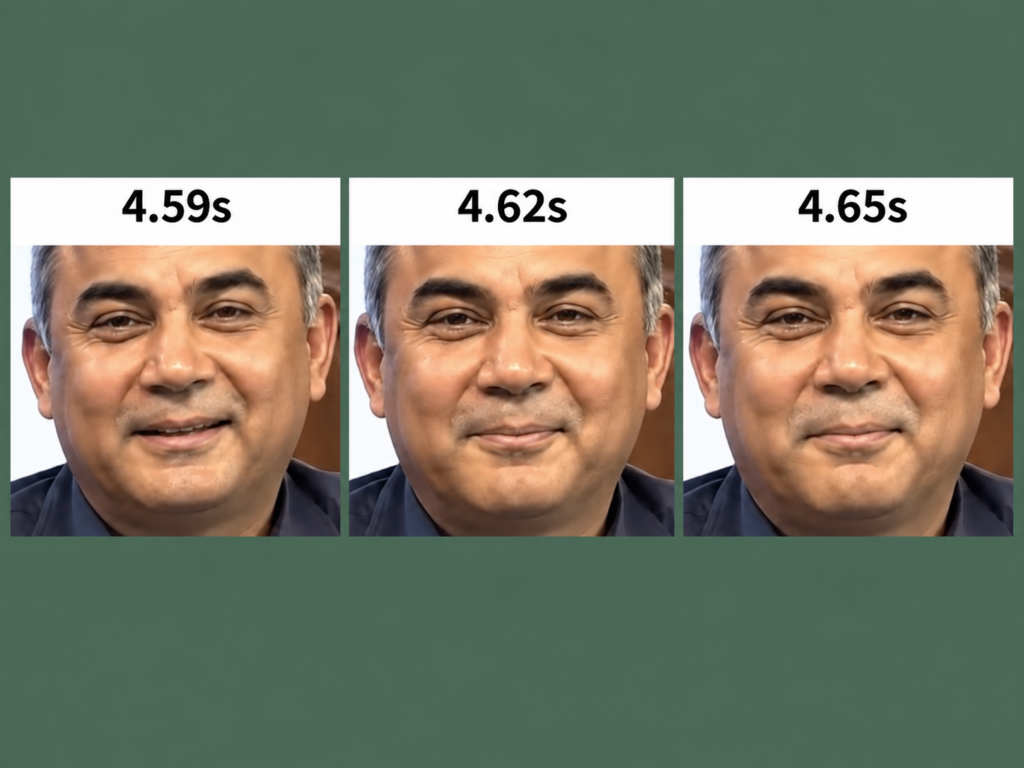
Consecutive frames from the viral clip at 4.59, 4.62, and 4.65 seconds, showing changes in Naqvi’s mouth shape while the rest of his face remains comparatively stable.
This visual irregularity is not, on its own, proof of AI manipulation, as compression and natural speech can also produce rapid changes in mouth shape. However, together with the fact that the words heard in the viral clip do not appear in the original speech, it provided grounds to test the video specifically for audio-visual and lip-sync manipulation.
Soch Fact Check further analysed the viral clip using DeepFake-O-Meter, a platform developed by the University at Buffalo Media Forensics Lab that runs media through multiple deepfake-detection models.
The AVSRDD (2025) model returned a score of 100%, which DeepFake-O-Meter classified as high. AVSRDD is an audio-visual deepfake detection method that examines correlations between speech and corresponding visual information, using separate encoders to analyse the audio and video components.
The LIPINC (2024) model also returned a score of 100%, classified as high. LIPINC is specifically designed to detect lip-syncing deepfakes by identifying spatial and temporal inconsistencies in the mouth region across video frames. Such manipulation involves altering a person’s lip movements to correspond with modified or newly generated audio.
However, the results were not uniform across all models. CFM returned 44.9%, which DeepFake-O-Meter classified as moderate, while AltFreezing returned a low rating of 24.1%. CFM is a face-forgery detection model designed to identify forgery-related features using spatial and temporal information. AltFreezing is designed to detect both spatial artefacts, such as signs of facial generation or blending, and temporal artefacts, such as discontinuities between video frames.
The contrasting results are consistent with the source-video comparison, which indicates that much of the underlying facial footage is genuine. CFM and AltFreezing returned lower scores for broader face-forgery and spatial or temporal artefacts, while AVSRDD and LIPINC, which focus on audio-visual correspondence and lip-sync inconsistencies, respectively, both returned the maximum score. This pattern points towards manipulation concentrated in the speech and mouth movements rather than generation of the entire video.
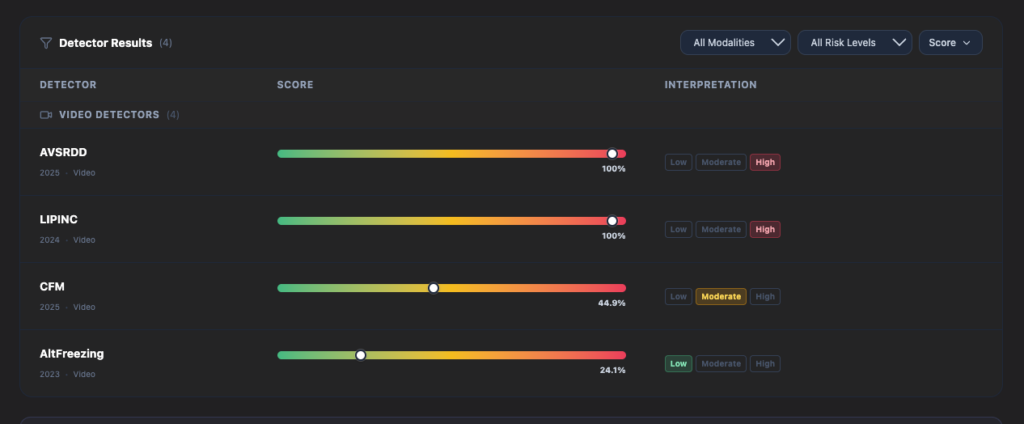
DeepFake-O-Meter results for the viral clip showing high scores from AVSRDD and LIPINC, while CFM and AltFreezing returned moderate and low scores, respectively.
Since the source-video comparison showed that the visuals originated from an authentic speech but the words heard in the viral version did not, Soch Fact Check tested the audio separately to determine whether the replacement speech showed signs of voice synthesis. Soch Fact Check also analysed the video’s audio using Hiya’s voice authenticity detection tool. Hiya’s digital authenticity model is designed to determine whether a voice is real or if it has been generated or modified using AI.
The tool returned an overall 98% voice-cloning detection score and classified the audio as “very likely AI-generated”. Hiya’s timeline showed scores of approximately 97% at the beginning of the clip, approximately 98% around four seconds, and approximately 99% around eight seconds, covering the portions in which Naqvi appears to make the viral statement.
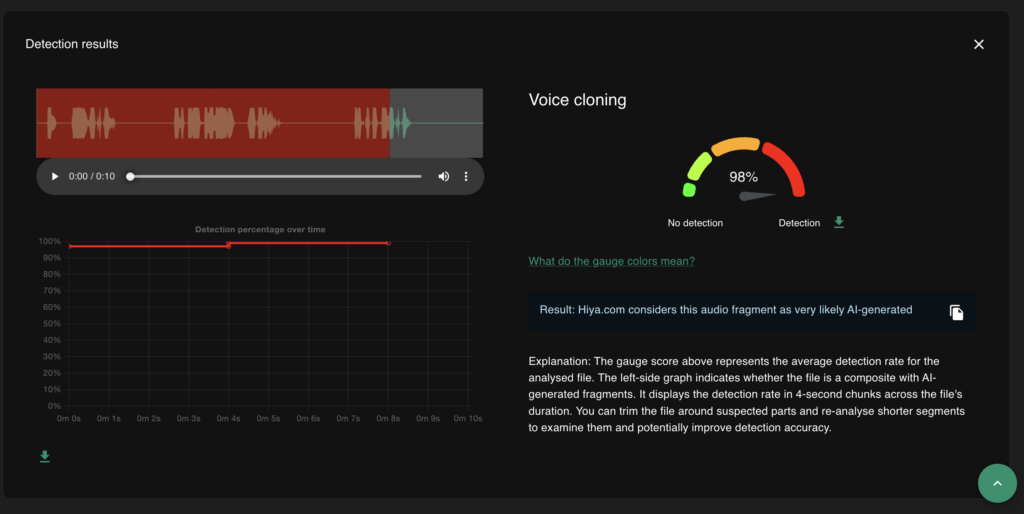
Hiya classified the viral clip’s audio as “very likely AI-generated”, returning an overall voice-cloning detection score of 98%.
Soch Fact Check also analysed the clip using Tencent’s Zhuque AI Detection Assistant. Zhuque classified it as “Likely AI-generated” and returned an AI probability of 93.56%.
Tencent says the detector is trained on millions of AI-generated and human-created images and videos and uses feature extraction and large-scale analysis to distinguish synthetic from human-created media. The company claims an accuracy rate of more than 98% for detecting AI-generated social media content, although this figure is based on Tencent’s own evaluation. Zhuque does not specifically identify voice cloning or lip-sync manipulation, so Soch Fact Check used it only as a broader, supplementary check of the video rather than evidence of how the manipulation was carried out. Tencent also cautions that the tool may produce false positives or false negatives and says its results should not be used as the sole basis for determining authenticity.
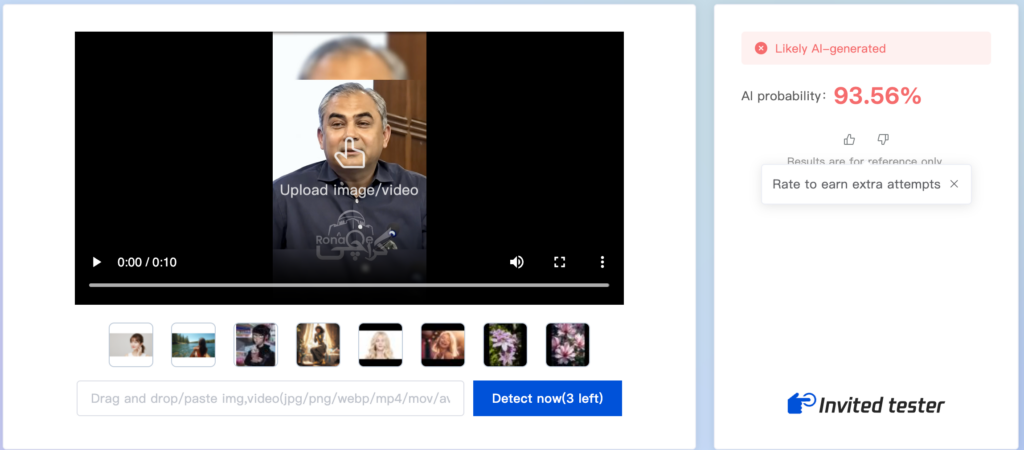
Results from Tencent’s Zhuque AI Detection Assistant
Multiple results support the source-video comparison. Models designed to identify broader face manipulation returned lower scores, while AVSRDD and LIPINC, which focus on audio-visual correspondence and lip-sync manipulation, both returned scores of 100%. Hiya separately classified the audio as very likely AI-generated, while Zhuque provided additional evidence of AI-generated features in the video.
Taken together with the original footage, the findings strongly indicate that genuine video of Naqvi’s 30 July address was used as the basis of the viral clip, while the speech was replaced with likely AI-generated audio and the corresponding lip movements were manipulated.
Virality
Soch Fact Check identified at least six posts sharing the manipulated video across Facebook, Instagram, TikTok, and YouTube. As of 9 September 2026, three Facebook posts had collectively garnered approximately 555,900 views, 13,500 reactions, 1,100 comments, and 1,800 shares.
Conclusion: The viral clip includes authentic footage from the interior minister’s 30 July 2026 address at the Pakistan Economic Summit, overlaid with synthetic audio. He did not announce that a decision to create new provinces had been made.
To appeal against our fact-check, please send an email to appeals@sochfactcheck.com