
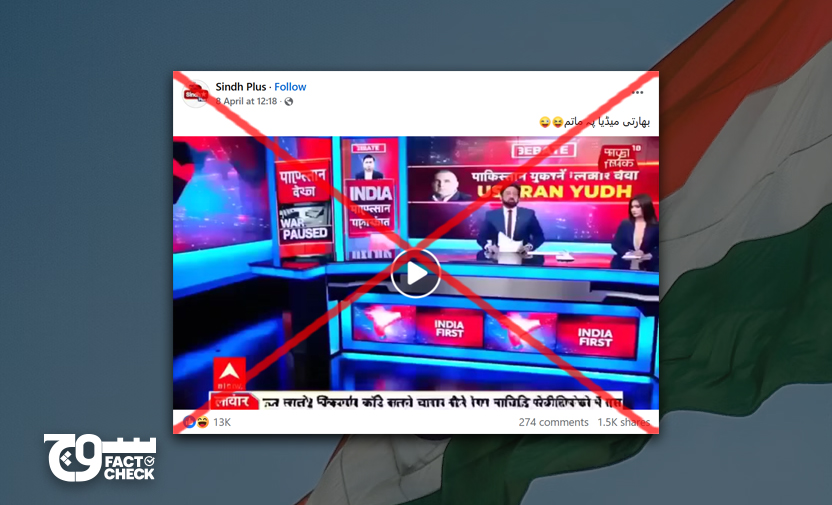
Claim: A video shows an Indian TV news anchor throwing a violent tantrum after Pakistan announced that its mediation between the United States and Iran led to a ceasefire.
Fact: The video is AI-generated.
On 8 April 2026, several social media users shared a video, which shows an Indian news anchor throwing a violent tantrum over reports that Pakistan successfully brokered a ceasefire between the US and Iran after over five weeks of war that involved Israel as well (archived here, here, here, here, here, here, and here, respectively).
The video shows an unidentified Indian anchor angrily talking about how Pakistan emerged as a key global negotiator by taking “a step that shook the world” — ceasefire — and how India was always “forced to stand in the corner”. He proceeds to smash studio equipment, including the chair he was sitting on.
A translation of his remarks is as follows:
“Friends, listen to this news that has come in that Pakistan has stopped the war between America and Iran… a step that shook the world. But, is this a win for us? No! We need to think, we need to ask, why are we forced to stand in the corner? This… we can’t take this anymore. How long will our voice be suppressed?”
Pakistan mediates ceasefire, hosts peace talks
Towards the end of the US-Israel war against Iran that started on 28 February and lasted over five weeks, US President Donald Trump repeatedly threatened the Islamic Republic with destruction.
On 7 April, he went as far as to say that “a whole civilisation will die tonight, never to be brought back again” if Iran did not give in.
However, Pakistan-led mediation efforts eventually culminated in a two-week ceasefire on 8 April, with the “Islamabad Talks” initially scheduled for 10 April, as announced by Prime Minister Shehbaz Sharif. The discussions officially started on 11 April.
Sharif expressed “deepest and sincere gratitude to our brotherly countries” — Türkiye, China, Egypt, and Saudi Arabia — “for extending invaluable and all out support” in achieving the ceasefire. He also thanked members of the Gulf Cooperation Council (GCC).
Pakistan’s capital, Islamabad, was put on high alert ahead of the arrival of the foreign delegations, with the one from the US led by Vice President JD Vance including Trump’s Special Envoy to the Middle East Steve Witkoff, as well as his son-in-law Jared Kushner, as confirmed by White House Press Secretary Karoline Leavitt. Tehran sent Iranian Parliament Speaker Mohammad Bagher Ghalibaf and Foreign Minister Abbas Araghchi.
Dawn reported that “10,000 security personnel have been deployed” in Islamabad and a “Blue Book” protocol — which concerns the president, prime minister, and visiting heads of state — is in place. It added that “all roads to [the] red zone, except for Margalla, [were] sealed”.
“About 6,000 personnel of the capital police, 900 Frontier Constabulary, and 3,000 personnel of the Punjab Constabulary, along with the Rangers and Pakistan Army troops, would perform duties. About 1,000 traffic police officials would also be deployed,” the publication stated.
Al Jazeera added that the delegations would be staying in Islamabad’s Serena Hotel and that 9 and 10 April were declared as “public holidays in the federal capital”.
Fact or Fiction?
Soch Fact Check observed a logo on the bottom-left corner resembling that of India’s ABP News — but with a name underneath that looks like “BICW” — and the anchors’ desk display has the text “India First,” which is a real show by India Today. However, we did not find evidence that either of the two channels broadcast such a segment and there is no existing news outlet called “BICW”.
We also noticed several tell-tale signs of content generated or manipulated using artificial intelligence (AI) tools.
For example, there is a lot of garbled text, such as the word “लाचार” — which translates to “helpless” — appearing in the bottom-left corner.
The initial phrase in the ticker includes characters that are difficult to distinguish; however, while Google Translate identified it as Nepalese, the programme is in Hindi.
Right at the start, the text on the screen behind the anchor features the title “US-IRAN YUDH,” which wobbles in the first few frames. It also consistently features illegible words such as “℈EBATE,” “ETTAL NE ROKA,” “PAUSTANE NBUDH,” “HWI WALINA,” “ERTAINE TI,” and “AHOKIWAL A.”
The paper in the anchor’s right hand momentarily turns black at the 0:03 mark and the same hand disappears at the 0:07 mark. The document also blends into the table at the 0:09 mark, before emerging as what appears to be a black tablet that makes a shattering sound when dropped on the floor.
The ticker at the bottom flashes “BREAKIN NEWS” at the 0:10 mark, with the anchor moving unnaturally fast from the 0:10 to 0:11 mark. Moreover, the back of his chair takes on the visuals from the background from the 0:12 to 0:16 mark.
The same chair also briefly changes shape at the 0:18 mark.
Moreover, throughout the anchor’s tantrum, his co-presenter does not show any emotion, but only robotically raises her right hand at the 0:18 mark.
Soch Fact Check also tested the video’s audio in Hiya Deepfake Voice Detector using two phrases: “Listen to this news that has come in that Pakistan has stopped the war between America and Iran” and “We need to think, we need to ask, why are we forced to stand in the corner?”
The phrases turned up scores of 4 and 16 out of 100, with the detector concluding that “the sampled voice is likely a deepfake”.
Sound engineer’s analysis
Soch Fact Check also sought a comment from Shaur Azher, a lecturer who teaches sound design and sound recording at the University of Karachi and the Shaheed Zulfikar Ali Bhutto Institute of Science and Technology (SZABIST). He also works as an audio engineer at our sister organisation, Soch Videos, and specialises in mixing and mastering audio.
Azher said the evidence he found in his analysis “conclusively points to the audio being generated by a neural text-to-speech (TTS) engine”. He further explained, “The AI-generated voice was subsequently routed through an aggressive digital mastering chain, likely involving severe saturation clipping and hard limiting to maximise a master bus to achieve -14 Loudness Units relative to Full Scale (LUFS) to simulate a low-quality, overblown broadcast microphone.”
He first provided a preliminary assessment and visual evidence review, which is as follows:
- Dynamic range compression: The waveform overlay in spectrogram reveals extreme brickwall limiting, meaning that the waveform resembles a solid block, which indicates that infinite ratio compression/clipping has been applied.
- Amplitude vs effort: At the time-stamped peaks (0:07.656, 0:09.737, 0:16.117), the perceived vocal screaming effort increases yet the waveform amplitude remains statically glued to the ceiling. This discrepancy between vocal strain and dynamic output is a primary indicator of synthetic generation.
- Loudness metrics: The -14 LUFS / -1.8 decibels (dB) True Peak measurement is exceptionally aggressive for a broadcast dialogue, prioritising perceived loudness over dynamic fidelity, characteristic of digital maximisation rather than standard broadcast levelling.
Azher provided the following observations to support his conclusion:
- Jitter and shimmer measurement:
Jitter: The vocal tract in this sample exhibits abnormally uniform fundamental frequency trajectories during sustained vowels, with natural micro tremors absent. However, the measured jitter appears artificially-high, exclusively during the screaming transients. This is not physiological jitter but the mathematical result of digital clipping introducing harmonic distortion.
Shimmer: True vocal shimmer is completely obliterated by the brickwall limiting. The cycle-to-cycle amplitude variation approaches 0.0% in the louder passages because the wave crests are entirely flattened.
- Phase coherence analysis:
The audio file is presented in a stereo format, but the phase correlation meter reads completely mono. A subtraction of the Left channel from the Right one yields absolute digital silence. There is no stereo width, no micro-delays, and no spatial acoustic cues.
- Breath signature and room tone fingerprint:
Breath analysis: Human speech requires inhalation, which creates distinct broadband noise bursts, especially prior to screaming or yelling. In this sample, the breath intake signatures are mathematically absent or drastically shorter than human physiological limits allow.
Room tone fingerprint: There is an absolute lack of acoustic space. When the anchor stops speaking, the noise floor drops immediately to digital black. There is no “room tail,” no reflection off the hard surfaces, and no ambient heating, ventilation, and air conditioning (HVAC) or electrical hum.
- Cepstral coefficient deviation testing (analysis of Mel Frequency Cepstral Coefficients, or MFCC):
Deviation: Natural vocal tracts shift shape dynamically, causing smooth transitions in the formants. The MFCC extraction for this sample reveals harsh transitions in the higher frequency formants as it is visible in the spectrogram as rigid, unyielding horizontal bands between 2 and 5 kilohertz (kHz).
Moreover, the vocal tract modeling is static. The formants do not smoothly modulate with the articulators (such as lips, tongue, and jaw) as they should in a biological subject.
Soch Fact Check, therefore, concludes that the video is AI-generated.
Virality
We found the video circulating here, here, here, here, here, here, here, and here on Facebook, here, here, here, here, and here on Instagram, and here, here, here on Threads.
It was also shared here, here, here, here, and here on X (formerly Twitter), here on TikTok, here on Snapchat, and here on YouTube, where it has gained over 30,300 views so far.
The clip was posted by accounts that often share fake news, such as @Tahirmughalpml8, @RShahzaddk, and @ZardSi, all of whom have previously peddled misinformation that was debunked by Soch Fact Check.
Interestingly, many public figures also fell for the AI-generated video. These include Murtaza Solangi, who is President Asif Ali Zardari’s spokesperson, former Information Minister, and a journalist, HUM News Investigations Editor Zahid Gishkori, Geo News reporters Waqar Satti and Awais Yousaf Zai, and Express News Islamabad Bureau Chief Aamir Ilyas Rana.
Rana, however, doubled down later, saying “our neighbour’s screams are our happiness” and that it did not matter if the video was real or AI.
Pakistani media outlets — such as Aaj TV, Pakistan Today, and Public News — also reported on the video as if it was real.
Conclusion: The video is AI-generated.
Background image in cover photo: Aamir Ahmad
To appeal against our fact-check, please send an email to appeals@sochfactcheck.com