
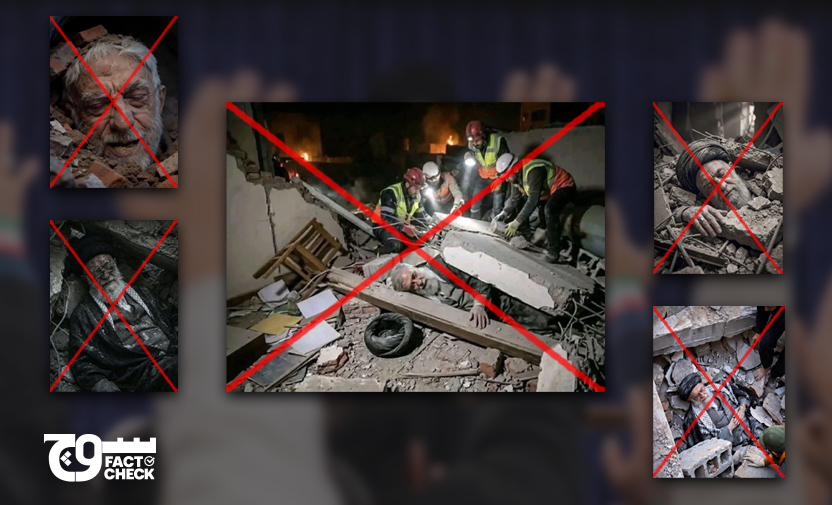
Claim: Multiple visuals show the dead body of Iran’s Supreme Leader Ali Khamenei, who was killed by the US-Israel joint airstrikes on the Islamic Republic on 28 February 2026.
Fact: None of the images are authentic.
On 1 March 2026, visuals emerged on social media allegedly showing the body of Iran’s Supreme Leader Ali Khamenei after Israel and the United States assassinated him and several top leaders in joint strikes on the country’s capital, Tehran, on 28 February (archived here, here, here, here, and here, respectively).
US, Israel attack Iran
On 28 February 2026, President Donald Trump announced on his social media platform, Truth Social, that “one of the most evil people in history, is dead”, following airstrikes on the Supreme Leader’s compound in Tehran as part of attacks codenamed Operation Epic Fury by the US and Operation Roaring Lion by Israel. He also urged “the Iranian people to take back their Country”, terming the moment as the “single greatest chance” to do so.
Alongside Khamenei, members of his family — including “his daughter, son-in-law, and grandson were also killed” in the joint attack by the US and Israel, according to Al Jazeera. Additionally, Defence Council Secretary Ali Shamkhani, army chief Abdolrahim Mousavi, Defence Minister Aziz Nasirzadeh, and Islamic Revolutionary Guard Corps (IRGC) Commander-in-Chief Mohammad Pakpour were also assassinated.
More than 860 people have died in Iran due to the relentless bombing by the US and Israel, according to Anadolu Agency, which cited Iranian Health Ministry spokesperson Hossein Kermanpour. On the other hand, The Wall Street Journal quoted rights group Human Rights Activists in Iran as saying over 1,000 civilians have been killed.
Israel had last attacked Iran in June 2025, bombing multiple military and nuclear installments in the Islamic Republic and killing multiple senior politicians in what later came to be known as the 12-Day War. The US had joined Israel in last year’s conflict.
War justifications
However, the US has not provided clear justifications for its attack on Iran, according to CNN, which said “the [Trump] administration has delivered anything but clarity”, “declined to enunciate a consistent set of goals and motivations”, and “spent the three days since shifting the goalposts and contradicting itself”.
On 1 March, Reuters reported citing sources that during closed-door briefings to Congress staff, Trump administration officials acknowledged “there was no intelligence suggesting Iran planned to attack US forces first”.
Then, on 2 March, according to ABC News, the US president laid out four objectives, saying, “First, we’re destroying Iran’s missile capabilities […] and their capacity to produce brand new ones and pretty good ones they make. Second, we’re annihilating their navy. […] Third, we’re ensuring that the world’s number one sponsor of terror can never obtain a nuclear weapon … And finally, we’re ensuring that the Iranian regime cannot continue to arm, fund and direct terrorist armies outside of their borders.”
And subsequently, on 3 March, US Secretary of State Marco Rubio told reporters that Israel was going to attack Iran anyway so the American forces joined in expecting retaliation from Tehran.
Impact and casualties
In the initial days, the two countries also bombed the Shajareh Tayyebeh girls’ school in the southeastern city of Minab, killing over 160 children. The United Nations noted that it was “deeply disturbed”, while Israel said it was “investigating the incident”. Meanwhile, Rubio explained that American forces “would not deliberately target a school”.
The strikes also targeted the historic Golestan Palace, a UNESCO World Heritage site in Tehran.
On the other hand, Iran launched “hundreds of missiles and unmanned drones” in attacks on US military bases in the Middle East, with one strike near a luxury hotel in Dubai where four people were injured, CNN and the BBC reported.
“Qatar, Bahrain, Jordan, and Kuwait […] said they had intercepted missiles fired towards them,” the BBC added.
“Eleven people were killed in Israel, officials said, and deaths were reported in the United Arab Emirates [UAE], Kuwait and Bahrain,” NBC News reported.
According to the Central Command (CENTCOM), as of 2 March, “six US service members have been killed in action”.
Forbes reported that at least 11 people died in Israel, three in the UAE, two in Iraq, and one each in Bahrain, Oman, and Kuwait. “Israeli strikes on Lebanon reportedly killed at least 52 people,” it added.
Fact or Fiction?
Soch Fact Check observed that such clear visuals of an assassinated leader and especially from a warzone are unlikely to surface and be distributed so quickly, hinting at the possibility that they may have been generated using artificial intelligence (AI) tools.
Moreover, no pictures of Khamenei’s body have been shared in official Iranian channels or international media after his death.
Therefore, we tested the first image in Hive Moderation, which yielded a probability of 99.8% that it was generated by artificial intelligence (AI) tools.
We then checked whether it contains SynthID, an imperceptible watermark embedded in all content generated by Google’s AI tools. This can be done through a detector, which currently works through Gemini in Pakistan.
SynthID Detector confirmed that the photo was made with Google AI, with a “very high” confidence level.
For the second picture, Hive Moderation said the likelihood of it being AI-generated was 99.9%.
We also tried Image Whisperer, a new AI detection tool launched by Henk van Ess, an online research expert and assessor of the International Fact-Checking Network (IFCN), of which Soch Fact Check is a signatory. It, too, said the picture was likely AI-generated, with a “very high confidence” of 97%. “While the visual composition mimics the aesthetic of disaster photography, the lack of authentic photographic metadata and the characteristic artifacts of generative AI indicate that this is a digital construct,” it added.
Moreover, a reverse-image search led us to a 3 January 2026 post by Pouria Zeraati, Israeli broadcast journalist, who captioned it as “The final plan.” It predates the US-Israel attack on Iran.
For the third image, we used DeepFake-O-Meter, developed by the University at Buffalo’s Media Forensics Lab (UB MDFL). We used four of the available detectors, which yielded probabilities of 31.6%, 42.8%, 100.0%, and 85.3%.
Hive Moderation said the likelihood of the photo being AI-generated was 99.9%, while Image Whisperer gave a “very high confidence” score of 99%. “The image appears to be a piece of digital media designed to evoke a specific emotional response or to serve as political commentary or misinformation,” it said.
Moreover, SynthID confirmed the picture was made with Google AI, with a “high” confidence level.
With regards to the fourth image, Hive Moderation gave it a score of 99.9% and SynthID also confirmed it was made with Google AI, with a “very high” confidence level.
The fifth visual yielded a probability of 99.4% on Hive Moderation. Additionally, Image Whisperer termed it a “composite image,” saying it was possible that it included “real subjects with replaced/AI-generated background”. It added, “Detection analysis concluded with 95% confidence that this is a composite image, likely combining a real subject or a digital likeness of a public figure with an AI-generated or digitally altered background.”
SynthID confirmed the photo was made with Google AI, with a “very high” confidence level.
Soch Fact Check, therefore, concludes that all the visuals are inauthentic and generated by AI tools.
Virality
Soch Fact Check found the first image circulating here, here, and here on Facebook, here, here, and here on Instagram, here on Threads, and here and here on X (formerly Twitter).
The second picture was shared here, here, and here on Instagram, here, here, and here on Facebook, here, here, and here on X, here on TikTok, here and here on YouTube, and here on LinkedIn.
We came across the third photo here on Facebook, here, here, and here on Instagram, here on Threads, here on TikTok, and here and here on YouTube.
The fourth visual was shared here on X and here, here, and here on Instagram.
Lastly, the fifth image was posted here, here, and here on Instagram, here on X, here and here on YouTube, and here on TikTok.
Conclusion: None of the images are authentic.
Background image in cover photo: khamenei_ir
To appeal against our fact-check, please send an email to appeals@sochfactcheck.com