
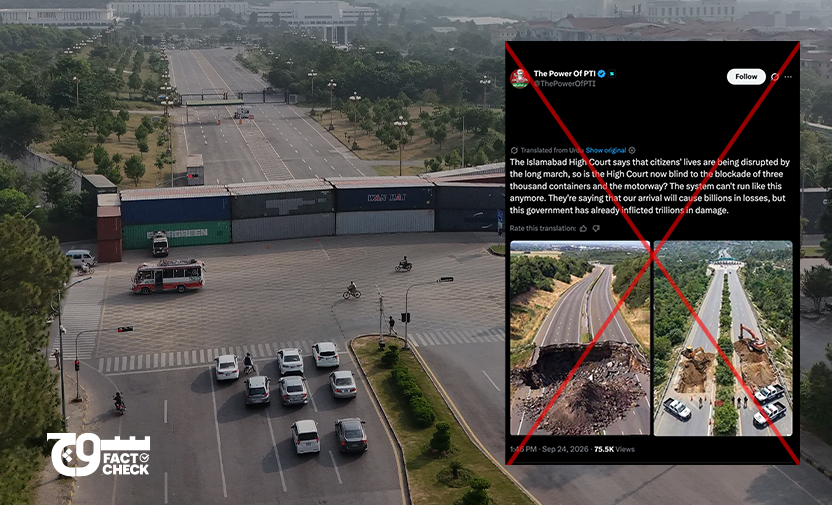
Claim: Two images suggest that the government is constructing trenches to block the PTI’s upcoming long march in Islamabad. One image shows an unidentifiable road with a trench in it while another shows a road being excavated in the presence of the police.
Fact: It is certain that Image 2 is AI-generated, and likely that Image 1 is. Moreover, there are no verified reports confirming that trenches have been dug to prevent the march as yet.
On 24 September 2026, PTI fan account ‘The Power of PTI’ posted two images on X. Image 1 (left) shows an unidentifiable road with a trench in it. Image 2 (right) shows police officers watching while bulldozers excavate a double road leading up to a toll plaza.
The caption states:
[Translated from Urdu: “The Islamabad High Court says that citizens’ lives are being disrupted by the long march. Is the High Court blind to the blockade caused by three thousand containers and the motorway? The system can’t operate like this anymore. They’re saying that our arrival will cause billions in losses, but this government has already inflicted trillions in damage.”]
Image 2, which is more detailed and thus appears more believable, was circulated widely.
PTI’s Long March on Islamabad
On 25 September 2026, the Pakistan Tehreek-e-Insaf (PTI) announced the postponement of their long-planned nationwide protest until 4 October. The protest, which was originally set to take place on 27 September, demands the release of party founder and former Prime Minister Imran Khan from prison. To that end, it seeks to mobilise citizens across the country in support of the “supremacy of the Constitution and law.”
In response to the original announcement, the government took major steps to restrict the scheduled protest, which have been considered extreme and repressive by commentators.
Most notably, there was a wave of preventive arrests targeting PTI organisers and associated figures, including Khan’s sisters. Amnesty International termed these arrests a “flagrant violation of human rights.”
The protest is set to include a “long march” on Islamabad. Government measures to limit Islamabad road access to protestors have included the establishment of roadblocks in the form of commercial containers across the capital city and the closure of the M-1 (Islamabad-Peshawar) motorway.
In addition, the Islamabad High Court (IHC) has issued a ruling stating that political parties cannot “occupy roads, highways, interchanges, toll plazas, or public buildings in a way that obstructed citizens’ movement, business activity, or access to hospitals and educational institutions.”
Interior Minister Mohsin Naqvi also stated that PTI protestors would not be allowed to “come to Islamabad and shut down the city for 10 days.”
The Question of Trenches
On 19 September, Hum News reported that the government was planning to dig trenches on key roads to block protestors from accessing Islamabad.
Subsequently, other news channels reported the same. According to an ARY News report on 20 September, the government was aiming to target roads leading from Khyber Pakhtunkhwa to Islamabad, such as the Grand Trunk (GT) Road, Chungi No. 26, Pirwadhai, I.J. Principal (IGP) Road, Aswal Mor, and Kati Pahari.
In the past, Pakistan’s government has been known to dig trenches in order to block protests, such as in the case of a TLP protest in October 2025 and, earlier, a PTI protest in February 2024.
Fact or Fiction?
There are currently no credible news reports stating that the government has acted on the reported plan to dig trenches. Soch Fact Check spoke to two journalists based in Islamabad for more information.
Urdu Voice of America reporter Asim Ali Rana confirmed that no trenches have been dug in the capital for this purpose. He added that the government does plan to take this step but is likely to do so only once the march has started, as the trenches would necessarily disrupt ordinary traffic.
Geo News reporter Shabbir Dar likewise stated that, while authorities have placed dirt on the side of the road here and there in Islamabad “for some other purpose,” no trenches have been dug near the motorway or in the middle of any roads. According to Dar, one reporter he is affiliated with had gone as far as Attock in the lead-up to the protest and had not seen any evidence of trenches.
Image 1
Images generated through Google’s Gemini contain a watermark known as SynthID, and the chatbot itself can be used to check if an image contains this watermark. In this case, Gemini concluded that the image “was edited or generated using Google AI.”
While the airbrushed texture of the image is also indicative of AI manipulation, the picture does not contain any major identifying details that can be analysed for inconsistencies.
AI detection tools Hive Moderation, Image Whisperer and Truth Scan did not flag it as inauthentic either.
Nevertheless, it is likely to be AI-generated given that there is no record of this image on the internet prior to this claim, and that it has been shared alongside an image which is provably fake (see below). Moreover, as emphasised earlier, there is no evidence to support the news of road excavation in Islamabad at the moment.
Image 2
A Hive Moderation analysis rated this image 99.9% likely to be AI-generated. According to the AI detection tool, there is also a 98.6% chance that it has specifically been generated using Gemini 3.
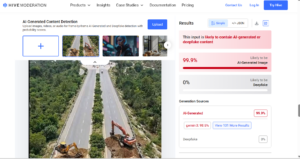
The result of the Hive Moderation analysis.
A verification check by Gemini confirmed that the image “was edited or generated using Google AI.”
Soch Fact Check then compared the upper portion of the image to a verified image of the Islamabad-Peshawar (M-1) toll plaza, sourced from Getty Images. The latter shows trucks blockading the toll plaza on 24 September, during the period that the M-1 was officially closed.
It can be inferred that the image in the claim is meant to depict this particular toll plaza because it leads to the closed motorway, and because the post’s caption refers to the Islamabad High Court.
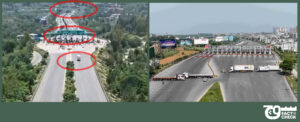
The image in the claim (left) vs a verified image of the M-1 toll plaza (right).
As the side-by-side comparison shows, the actual road is wider and more straight, and surrounded by buildings rather than just green areas. Other differences include the following: the board above the toll plaza appears to be red, black, and gray rather than green; beyond the toll plaza, the road curves left, not right; and the grass belt leading up to the toll plaza appears to have a pointed end.
The lower half of the image contains other tell-tale signs of inauthenticity as well. For example, the right guardrail is slightly distorted. In addition, all the cars are parked at the exact same angle, which seems unnaturally precise.
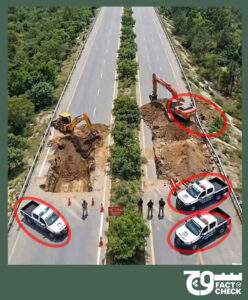
Signs of AI origin in the lower half of the image.
The results from Hive Moderation and Gemini’s in-built SynthID detector, combined with the inaccuracies and indications of AI manipulation in the image itself, confirm that the image is AI-generated.
Virality
The post by ‘The Power of PTI’ quickly gained traction, with 75,000 views and 3,400 likes by the time of writing. Image 2 was reshared more widely, likely because it contains identifying details such as the toll plaza and the police vehicles.
This image was posted on the social media profiles of three PTI leaders: Shahbaz Gill’s X account, where it gained 11,000 likes; Sardarzada Maula Bux Sumroo’s Facebook account, where it (alongside Image 1) gained 1,700 likes; and Qasim Khan Suri’s Instagram page, where the like count was 739.
Social media users also circulated the image across multiple platforms, especially Facebook, where it was posted over 30 times.
While government measures to restrict the long march have been considered excessive by rights groups, accurate reports of these measures have mingled with misinformation, causing confusion among the public. Read our other fact-checks related to the upcoming march here, here, here and here.
Conclusion: There is evidence to support the fact that both images are AI-generated, which is particularly strong in the case of Image 2. Moreover, reports indicate that the government has not dug any trenches to limit the protest as yet.
Background image in cover photo: Aamir Qureshi/AFP.
To appeal against our fact-check, please send an email to appeals@sochfactcheck.com