

Claim: Mobile and internet services across Punjab will be downgraded from 27 September.
Fact: The Punjab Home Department’s request concerns specified locations in Rawalpindi and throughout Attock district, not Punjab as a whole.
On 24 September 2026, a Facebook page called Sky News Urdu Pakistan (not associated with the UK’s Sky News) published a graphic on Facebook stating in Urdu, “A decision has been made to downgrade mobile and internet services in Punjab from 27 September.”
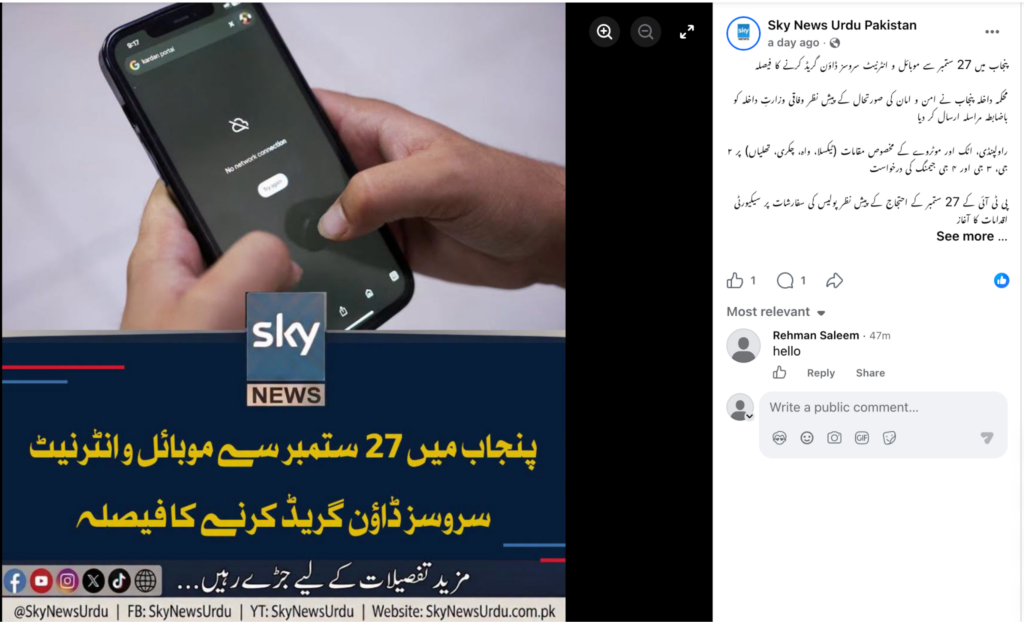
Sky News Urdu Pakistan Facebook post about mobile and internet restrictions from 27 September 2026.
Read on its own, the graphic gives the impression that the proposed restrictions apply across the whole province.
The accompanying Facebook caption subsequently identifies Rawalpindi, Attock, and specific locations along the motorway as being affected by the restrictions. However, those qualifications do not appear in the graphic, which is the post’s main visual element.
Soch Fact Check went on to verify this by investigating the geographical scope of the Punjab Home Department’s request.
Fact or Fiction?
Soch Fact Check reviewed a Punjab Home Department letter posted on their X account dated 21 September 2026 and addressed to the federal Ministry of Interior and Narcotics Control. The letter requests restrictions of telecommunications in Rawalpindi and Attock. It does not request the downgrading or suspension of telecommunications services throughout Punjab.
For Rawalpindi city, the department requested the jamming of 2G, 3G, and 4G networks at specified locations, with the date and time to be communicated later.
Another entry requests the downgrading or jamming of services from 9 am on 27 September at Barahma Bahtar to M-1, Gango, Ahata, Taxila City, Wah Saddar, Thallian, and Chakri. For Attock, the department requested the downgrading of mobile and internet services throughout the district from 27 September onwards.
These entries limit the request to Rawalpindi and Attock. The letter does not name any other district in Punjab.
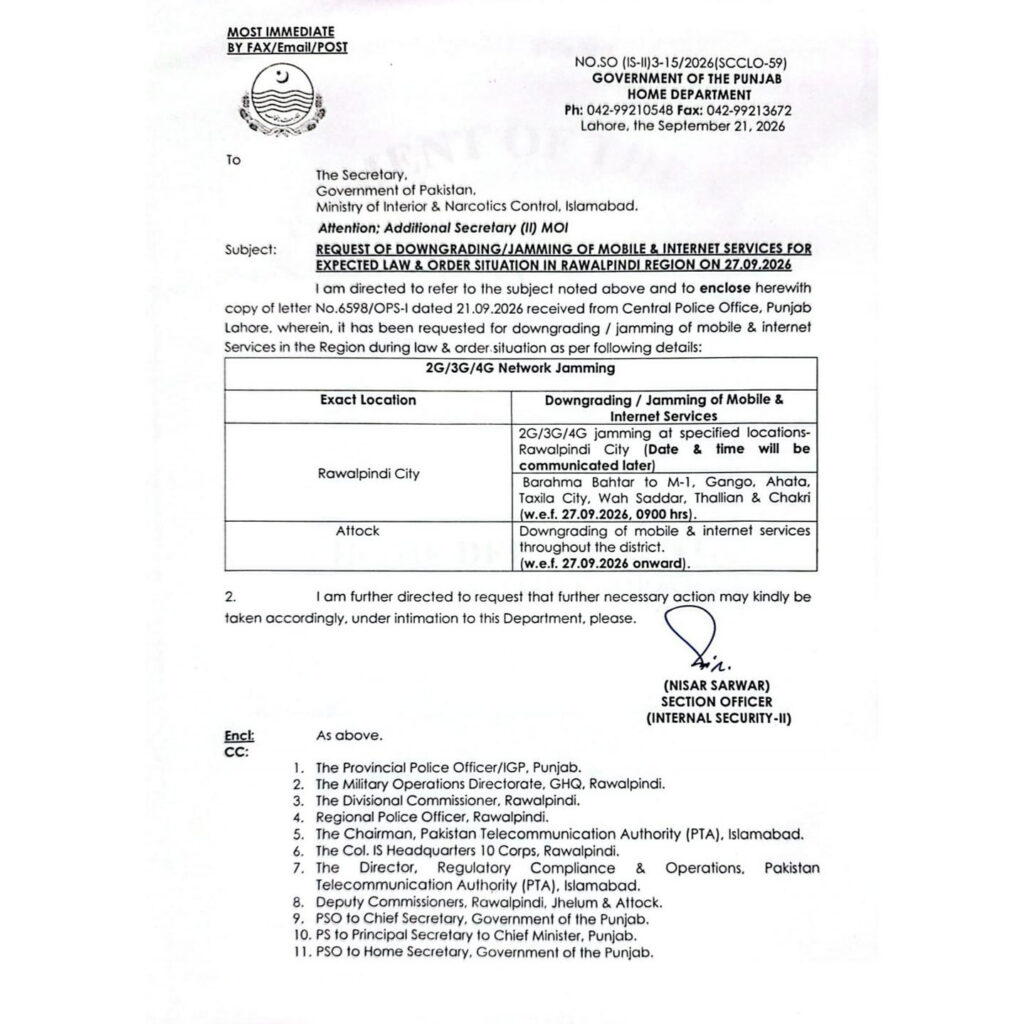
Punjab Home Department letter requesting mobile and internet restrictions in Rawalpindi and Attock from 27 September 2026.
Dawn, which also reviewed the letter, reported that the requested jamming and downgrading concerned specific locations in Rawalpindi and Attock district. Its report reproduced the same list of locations and separately noted that Section 144, unlike the telecommunications request, had been imposed throughout Punjab.
Urdu News also reported that the department requested network jamming at specified locations in Rawalpindi and the downgrading of services throughout Attock district. The Associated Press of Pakistan described the proposed restrictions as targeted measures covering Rawalpindi and Attock. Geo News similarly reported that the request concerned selected areas in the two districts, rather than the entire province.
The Sky News Urdu caption eventually identifies Rawalpindi, Attock, and specific motorway locations. However, its graphic states that mobile and internet services will be downgraded “in Punjab” without showing the geographical limitation contained in the letter.
Viewed independently of the caption, the graphic gives the impression that the measure applies across Punjab. The underlying letter only concerns Rawalpindi and Attock. Soch Fact Check therefore rates the graphic’s claim as misleading.
Measures taken ahead of PTI protest
Pakistan Tehreek-e-Insaf announced a nationwide protest, including a march towards Islamabad on 27 September 2026, to demand the release of party founder and former Prime Minister Imran Khan and, according to the party, mobilise supporters for the “supremacy of the Constitution.” PTI described the planned demonstration as peaceful, while federal and provincial authorities began making security and law-and-order preparations several weeks before the protest.
By early September, Islamabad police had already begun taking possession of shipping containers. On 9 September, the All Pakistan Goods Transport Owners Association told Dawn that police had impounded container vehicles ahead of the planned protest and called for their release. Two days later, Dawn reported that contractors had been asked to arrange more than 1,000 containers of different sizes for the capital. According to police sources quoted in the report, the containers were intended to seal the Red Zone, High Security Zone, entry and exit points, and major roads and highways used by protesters travelling towards Islamabad. More than 100 containers had already been placed near locations including Faizabad, Tarnol, Sangjani, and the Islamabad Traffic Police headquarters by 11 September.
The crackdown also extended to Imran Khan’s family. His sister Aleema Khan was detained for 30 days under the Maintenance of Public Order Ordinance on 20 September, while his sisters Dr Uzma Khan and Noreen Niazi were taken into custody under the same law the following day.
The preparations extended beyond roadblocks. Islamabad police’s anti-riot unit was instructed to audit its equipment and seek additional supplies, including long- and short-range tear gas shells and tear gas guns. Police intelligence units and the Special Branch were also asked to gather information about preparations for the protest and the activities of PTI leaders, workers, and activists. At the same time, the Rawalpindi administration issued 30-day preventive detention orders for more than 30 PTI workers and activists under Section 3 of the Maintenance of Public Order Ordinance.
Restrictions were also introduced elsewhere in Punjab. On 14 September, Dawn reported that the Punjab Home Department had imposed Section 144 across the province until 17 September, prohibiting gatherings of five or more people as well as the carrying or public display of weapons. Officials cited intelligence about possible security threats to large gatherings as the reason for the restrictions. The same report said preventive detention orders had been issued against dozens of PTI workers in different parts of Punjab, while Rawalpindi police cancelled officers’ leave ahead of the planned demonstration.
The Islamabad High Court also issued directions concerning the planned protest. In an order announced on 14 September and detailed later that week, the court held that political parties and their leadership could not occupy roads, highways, interchanges, toll plazas, or public buildings in a way that obstructed citizens’ movement, business activity, or access to hospitals and educational institutions. The court also directed provincial governments not to use public funds, officials, vehicles, machinery, or other government resources to facilitate the march, according to Dawn’s report on the ruling.
On 18 September, Interior Minister Mohsin Naqvi said the government would stop anyone attempting to march towards Islamabad “in every possible way,” and said contempt proceedings would be initiated against those who violated the IHC ruling. Dawn reported that his remarks came as the federal government and law-enforcement agencies continued preparations for the protest. A separate report said that the entrance to Islamabad’s Red Zone had been sealed with containers by 19 September.
Security measures intensified in the week immediately preceding the protest. On 23 September, the Punjab government imposed Section 144 across the province for another 13 days, from 23 September to 5 October, prohibiting gatherings of five or more people in public places, roads, highways, motorways, and open spaces. The same day, it emerged that Section 144 had also been imposed in Islamabad for two months under an order dated 18 September, banning gatherings, processions, rallies, and demonstrations in the federal capital. Dawn reported that the Punjab and Islamabad restrictions were imposed separately.
Similar restrictions were subsequently imposed in Sindh. On 25 September, Dawn reported that Section 144 had been imposed in the Karachi Division until 30 September, barring protests, demonstrations, sit-ins, rallies, processions, and other public gatherings involving more than five people. Restrictions were also imposed in Hyderabad and Sukkur divisions.
The Punjab government also sought the deployment of Pakistan Rangers in Rawalpindi, Attock, Jhelum, and Mianwali. On 24 September, the federal government approved the deployment of Rangers in Islamabad and several districts of Punjab from 20 September to 5 October. According to Dawn, the approval followed requests from the Islamabad administration and the Punjab Home Department. Authorities were also preparing extensive roadblocks and police deployments in the Rawalpindi division, with more than 43,000 police personnel expected to be deployed and containers positioned at multiple blocking points.
By 25 September, police had detained more than 150 PTI leaders and workers across the Rawalpindi division under Section 3 of the Maintenance of Public Order Ordinance, according to Dawn. Police and district administrations in Rawalpindi, Attock, Jhelum, Chakwal, and Murree were also carrying out road-blocking, deployment, and other preventive measures ahead of the planned march.
Virality
The claim circulated on Facebook, Instagram, and X (formerly Twitter). Soch Fact Check found at least nine posts using graphics or opening text that referred to the proposed restrictions as being “in Punjab” without identifying Rawalpindi and Attock. Some accompanying captions later provided the narrower geographical details. One X post had received more than 2,400 views at the time of writing.
Conclusion: The claim is misleading. The Punjab Home Department’s request is limited to specified locations in Rawalpindi and Attock district and does not cover the entire province. The graphics omit this geographical limitation and gives the impression of a Punjab-wide restriction, although its accompanying caption later identifies the affected areas.
To appeal against our fact-check, please send an email to appeals@sochfactcheck.com