
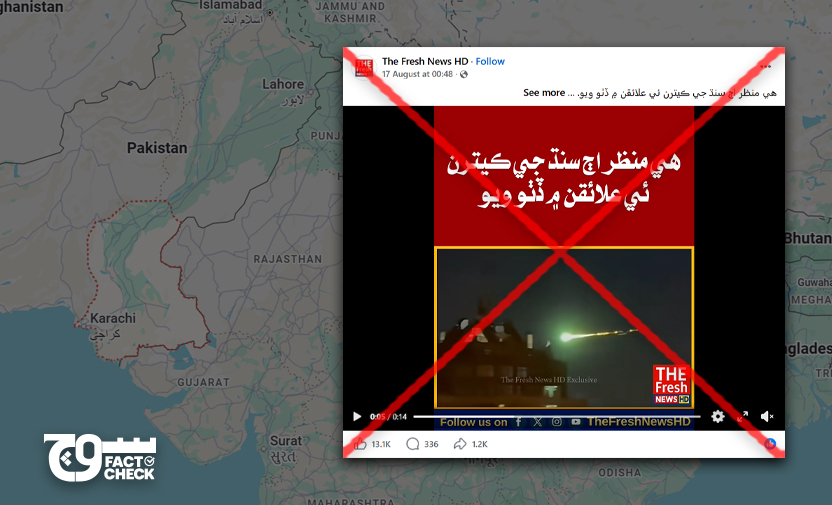
Claim: A meteor streaking across the sky was captured on camera in various parts of Sindh, Pakistan, according to two videos. A third image shows a bright orange object .
Fact: One of the videos is from 2025 and was filmed in Russia, while the second is from 2023 and shows an asteroid in France. The third image is AI-generated.
On 16 August 2026, multiple social media users posted a video of a mysterious green object streaking across the sky, claiming that it was a meteor seen in various parts of Pakistan’s southern Sindh province, including Larkana, Khairpur Mirs, and Thari Mirwah.
The accompanying caption reads as follows:
“هي منظر اڄ سنڌ جي ڪيترن ئي علائقن ۾ ڏٺو ويو. هي غالباً ميٽيئر (Meteor) آهي، جيڪو خلا مان ايندڙ پٿر جو ننڍڙو ٽڪرو هوندو آهي. اهو جڏهن ڌرتيءَ جي فضا ۾ داخل ٿئي ٿو ته هوا سان رگڙ سبب گرم ٿي روشن نظر اچي ٿو.
[This scene was seen in many parts of Sindh today. This is probably a meteor, which is a small piece of rock coming from space. When it enters the Earth’s atmosphere, it heats up due to friction with the air and appears bright.]”
Some other visuals also went viral with the same claim.
Fact or Fiction?
Soch Fact Check reverse-searched keyframes from the viral videos and found them to be old and unrelated to Pakistan.
The first video being debunked is from 27 October 2025, when a meteor was seen in Moscow, Russia, according to media reports.
Gulf News reported the unusual object’s “trajectory and disintegration”, as well as “vivid green colour and trailing sparks suggest it was a significant fireball event”. The article included a 27 October 2025 post on X (formerly Twitter) by geologist Sergio Almazan, who wrote, “Bright meteor crosses the skies of Russia. Tonight a bright meteor lit up the skies of Moscow.”
Almazan credited the footage to Kirill Bakanov, a “geographer, ecologist, amateur meteorologist”, who posts “weather news from Russia”, according to his X bio.
“[A] very bright and slow moving meteor over Moscow, Russia an hour ago,” Bakanov wrote.
Russian-language media outlets later reported that fragments of the meteor were found and likely reached the M-11 highway connecting Moscow to St Petersburg.
News website Dubna.ru wrote on the Russian social network VK that fragments of the “Moscow bolide” — an unusually bright meteor — “fell in the vicinity of the villages of Borovichi, Maksatikha, Pestovo, and Udomlya”.
The Solar Astronomy Laboratory (XRAS) of the Russian Academy of Sciences’ Space Research Institute (IKI) posted the meteor’s trajectory on a map on its Telegram account.
Another media outlet, Absatz.media, wrote, “Astronomer Stas Korotkiy told RIA Novosti that the meteorite fell on the roof of a house in a village in the Novgorod region, approximately 500 kilometers from Moscow. It was precisely this chance that led to its discovery.”
Samples of the meteorite were then “sent to the Vernadsky Institute of Geochemistry and Analytical Chemistry of the Russian Academy of Sciences for analysis”, according to Moskvich Mag.
The US version of the UK’s The Sun media outlet wrote that the owner of the house where a sample of the meteor was found had been paid an “undisclosed sum” after she “put the fragments up for sale”.
According to Kommersant, which quoted Russian state news agency TASS, Geochemical Institute (GEOKHI) laboratory researcher Konstantin Ryazantsev said, “The distance from the glowing spot to the specific sample’s impact is 550 km.”
“Laboratory director Kirill Lorenz reported that the meteorite was provisionally named ‘Okulovka’ after the village where its fragments were found,” Kommersant added.
As for the second video, available here, it is from 2023 and shows “an asteroid approximately one metre wide” streaking across the sky in France “without causing any damage”, Paris Normandie reported. Footage posted by AFP Arabic, Le Parisien, and USA Today corroborate the news.
The asteroid — named “2023 CX1” — turned “into a dazzling fireball that was spotted throughout Europe”, USA Today wrote in a 13 February 2023 article. AFP Arabic and 20 Minuten credited the footage to X account @tymlaly76700.
The viral image, on the other hand, is generated using artificial intelligence (AI) tools.
Soch Fact Check ran it through a tool designed by OpenAI to check if it was created using the company’s models.
The tool confirmed that it “found a SynthID watermark that originated from OpenAI”.
OpenAI added the “durable cross-platform SynthID watermarking to images through a partnership with Google”, the company announced in May 2026.

Results from OpenAI’s verification tool
Separately, while there were no confirmed reports that the supposed meteor was actually seen from locations in Sindh, Pakistani news website The Current posted on Instagram that the Perseid Meteor Shower — a yearly celestial event that peaked in mid-August this year — would be seen from parts in the country.
Facebook user Saeed Ahmed Abbasi — who, according to his visuals shared on his profile, takes space photos — posted some pictures of the Perseid Meteor Shower taken from Ranikot Fort in Sindh and wrote, “Caught a few astonishing fire balls and saw hundreds of them with [the] naked eye.”
Soch Fact Check, therefore, concludes that the viral visuals do not show a meteor seen in Sindh but are, in fact, old and unrelated to Pakistan. A third image is AI-generated.
Virality
Soch Fact Check found the visuals posted dozens of times on Facebook.
Some posts claimed it was seen in Larkana, Khairpur Mirs, and Thari Mirwah.
Pakistani media outlet WE News English also shared the video on its Facebook page.
The visuals were also shared on Instagram, Threads, X, TikTok, and YouTube.
Conclusion: One of the videos is from 2025 and was filmed in Russia, while the second one is from 2023 and shows an asteroid in France. The third image is AI-generated.
Background image in cover photo: Google Maps
To appeal against our fact-check, please send an email to appeals@sochfactcheck.com