
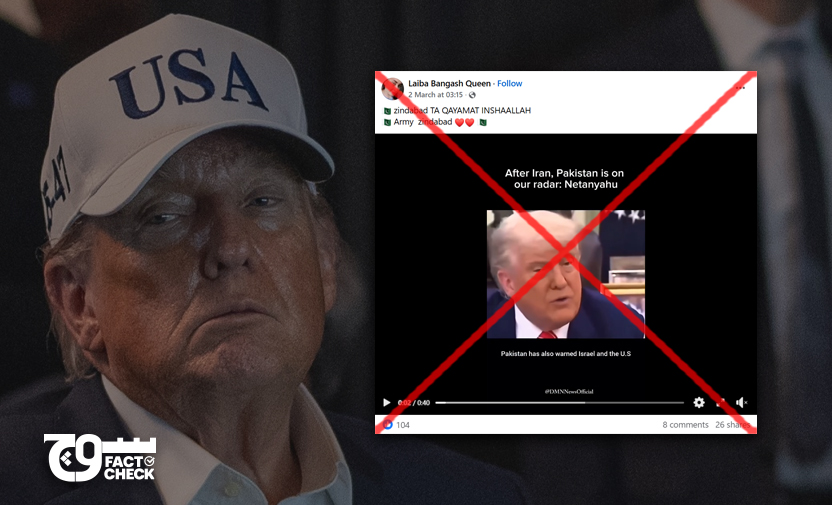
Claim: US President Donald Trump has said Islamabad warned Washington over comments allegedly made by Israeli officials about Pakistan being the second on its list to attack after Iran. He also said that their military is “already very high alert”.
Fact: The video is doctored. Trump did not make any such remarks.
On 2 March 2026, Facebook page ‘Laiba Bangash Queen’ posted (archive) a video showing US President Donald Trump admitting that Islamabad had warned Washington over comments allegedly made by Israeli officials about Pakistan being “number two after Iran”.
Trump’s alleged remarks in the video are transcribed as follows:
“Pakistan has also warned Israel and the US because Israel mistakenly said Pakistan is number two after Iran. Pakistan is fully alert with its air, land, and marine forces. Pakistan’s Defence Minister Khawaja Asif said if Israel attacks Iran again, Pakistan will totally destroy Israel. But here’s what I say (sic) Pakistan should not do that. Pakistan has no problem with us. Their army is already very high alert. In my opinion, Pakistan should not get involved. This is Israel and Iran’s war. We need peace in the region. We need to stop the fighting, not get in the middle. That’s the truth. That’s a smart move.”

The video is accompanied by the following caption: “🇵🇰 zindabad TA QAYAMAT INSHAALLAH 🇵🇰 Army zindabad ❤❤ 🇵🇰”
US, Israel attack Iran
On 28 February 2026, the US and Israel launched a joint offensive codenamed “Operation Epic Fury” and “Operation Roaring Lion,” respectively, and assassinated Iran’s Supreme Leader Ayatollah Ali Khamenei and his family members, as well as numerous top military and security officials, leading to the appointment of his son, Mojtaba Khamenei, as the successor on 9 March.
The conflict has seen significant casualties, with Iran’s Health Ministry reporting over 2,000 deaths — including 160 children in a school bombing in Minab — and 26,500 wounded people, as well as the displacement of 3.2 million people, alongside the targeting of the historic Golestan Palace.
In retaliation, Iran closed the Strait of Hormuz to most international traffic and launched drone and missile strikes against US bases and regional targets, causing casualties across Israel and the Gulf states while destabilising global oil prices that impacted Pakistan as well.
Although the US later proposed a 15-point peace plan via Pakistan to address nuclear and maritime concerns, Iran rejected the “maximalist” terms, insisting on reparations and establishing its sovereignty over the Strait of Hormuz.
Amidst these hostilities, the Trump administration has faced scrutiny over its conflicting justifications for the strikes, ranging from preemptive defence to the destruction of Iran’s naval and nuclear capabilities, with State Secretary Marco Rubio eventually suggesting the US joined the fray to support an inevitable Israeli initiative.
Later, after closed-door briefings to Congress staff, it emerged that Trump administration officials had acknowledged “there was no intelligence suggesting Iran planned to attack US forces first”.
Fact or Fiction?
Soch Fact Check did not find any reliable reports by reputable media outlets containing such remarks by Trump.
We then reverse-searched keyframes from the viral video and ascertained that it was doctored, likely using authentic footage from Trump’s remarks on 30 May 2025. We found matching visuals posted by Bloomberg, Forbes Breaking News, Fox News, and CNBC TV, which posted a YouTube short and livestreamed the event.
Trump was speaking during an event held on 30 May 2025 to celebrate Elon Musk, a tech billionaire who was once an advisor to the US president and a leader of the so-called “Department of Government Efficiency.” His attire and the background verify our findings.
Deepfake detections tools
To corroborate whether the video was indeed doctored using artificial intelligence (AI), we tested it using two detection tools: Deepfake-O-Meter and Hiya Deepfake Voice Detector.
Deepfake-O-Meter — which is developed by the University at Buffalo’s Media Forensics Lab (UB MDFL) — said its overall system assessment was that the video is “likely AI-generated”, with “high” confidence. We selected seven detectors, which gave probabilities of 99.9%, 99.8%, 99.6%, 99.1%, 73.9%, 68.1%, and 49.4%.
In Hiya Deepfake Voice Detector, we tested two phrases:
- “Pakistan’s Defense Minister Khawaja Asif said”
- “In my opinion, Pakistan should not get involved. This is Israel and…”
The authenticity scores for both were 1 out of 100 and the conclusion was that “the sampled voice is likely a deepfake”.
GODDS’ analysis
We also tested the video in the Global Online Deepfake Detection System (GODDS), a tool developed by Northwestern University’s Security & AI Lab (NSAIL) that uses a combination of various models along with human analysis to provide a holistic summary of the results.
GODDS used 22 deepfake detection algorithms for the visual content and 70 for the audio component. Two trained analysts also examined the clip.
All predictive models for the visual and audio content said the video “is likely to be fake”:
- The video is likely to be fake with a probability above 0.5, according to 2 of the 22 predictive models; it is likely to be fake with a probability below 0.5, according to the 20 other predictive models.
- The audio is likely to be fake with a probability above 0.5, according to 62 of the 70 predictive models; it is likely to be fake with a probability below 0.5, according to the 8 remaining predictive models.
According to the human analysts, the video contains “several indicators” that show it may be digitally manipulated via AI.
Throughout the video, “the boundary between the eyelids and face blurs” as Trump blinks and his “hair and the boundary between his hair and forehead [also] appear blurred”, they said.
As he speaks, “his teeth seem to change shape and blur together, despite an otherwise mostly clear appearance (e.g., 0:05, 0:06, 0:08, 0:13, 0:15, 0:16, 0:17, 0:35, etc.), they said.
“As [Trump’s] neck overlaps with his shirt, there appears to be an unnatural visual overlay on his collar (e.g., 0:05, 0:20, 0:22, etc.),” they added, noting that his voice also appears to “lack natural tonal and cadence variations characteristic of human voices”.
Interestingly, the GODDS analysts also observed that the video includes music “behind the speech audio that could hide vocal manipulations”.
Sound engineer’s analysis
Soch Fact Check also sought a comment from Shaur Azher, a lecturer who teaches sound design and sound recording at the University of Karachi and the Shaheed Zulfikar Ali Bhutto Institute of Science and Technology (SZABIST). He also works as an audio engineer at our sister organisation, Soch Videos, and specialises in mixing and mastering audio.
Azher explained he marked the viral video being investigated as Sample A and the authentic broadcast media as Sample B, using a 20-second duration from each for comparison.
“Sample A is conclusively determined to be a synthetic fabrication,” he said. “The lack of acoustic room tone, the absence of natural biological breath/click signatures, unnatural phase coherence, and distinct vocoder breakdown during complex pronunciations confirm that it was generated using a text-to-speech (TTS) AI model and does not represent an authentic recording of the individual.
“Sample B displays all necessary acoustic and digital hallmarks of an authentic, naturally captured recording,” he noted.
The sound engineer backed up his findings with the following observations:
- Preliminary acoustic and spectrographic observations
Frequency distribution: Sample A exhibits unnaturally elevated energy coefficients in the lower-to-mid frequency range (20 hertz (Hz) to 3,000 Hz average). Sample B presents a much more balanced frequency distribution indicative of natural acoustic space and distance between the speaker and the microphone.
Reverberation and acoustic environment: Sample A lacks any discernible room tone, hall reverberation or spatial reflections; it is acoustically “dead.” Sample B contains a natural, consistent reverb footprint across all frequency fields, consistent with a physical room recording.
Biological artefacts: Sample A demonstrates an absence of natural biological speech markers, including mouth clicks, wetness, and natural pitch variations. Conversely, Sample B contains natural pauses, breaths, and mouth clicks.
Linguistic artefacts: During the pronunciation of non-English terms (e.g., Urdu names/words), Sample A exhibits distinct vocoder breakdown (robotic, smeared artefacts), revealing the limitations of the underlying TTS training data.
- Jitter and shimmer measurement
Sample A displays unnaturally perfect pitch stability (jitter < 0.2%) and amplitude consistency. The generation model fundamentally fails to replicate the chaotic microvariations of a human glottis, indicating mathematical synthesis.
Sample B displays natural micro-fluctuations (jitter ~1.04%, shimmer ~3.8%), consistent with human vocal fold physiology.
- Phase coherence analysis
Sample A exhibits unnatural phase alignment across multiple frequency bands. This is a common artefact of neural vocoders (like the HiFi-GAN or WaveGlow models) used in AI voice cloning that reconstruct waveforms from mel-spectrograms but struggle with natural phase reconstruction.
Sample B shows natural phase dispersion caused by sound traveling through air to a microphone capsule.
- Room tone fingerprint comparison
Sample A drops to absolute digital zero (absolute silence) between phrases, an impossibility in standard broadcast recordings unless aggressively gated, which is inconsistent with the rest of the file’s dynamic range.
Sample B contains a consistent room tone fingerprint (HVAC rumble, faint background hum, acoustic reflections).
- Cepstral coefficient deviation testing (MFCC Analysis)
While the lower MFCCs, which dictate the basic phonetic sound in Sample A, mimic the target speaker reasonably well, the higher order MFCCs — which capture the unique, biological geometry of the speaker’s throat and sinus cavities — deviate significantly from the baseline established in Sample B. Sample A’s higher MFCCs fall outside the parameters of physical human anatomy, confirming the voice was digitally synthesised.
Interestingly, Soch Fact Check noted that Trump’s remark that “Israel mistakenly said Pakistan is number two after Iran” appears to be based on yet another misleading claim, which we debunked in June 2025.
Therefore, we conclude that the viral clip is doctored.
Virality
Soch Fact Check found the claim circulating here, here, here, and here on Facebook, here and here on Instagram, and here on Threads.
It was also shared here and here on X (formerly Twitter).
Conclusion: The video is doctored. Trump did not make any remarks pertaining to Pakistan being Israel’s next target or issuing any warnings to Israel and the US.
Background image in cover photo: DonaldTrump
To appeal against our fact-check, please send an email to appeals@sochfactcheck.com