
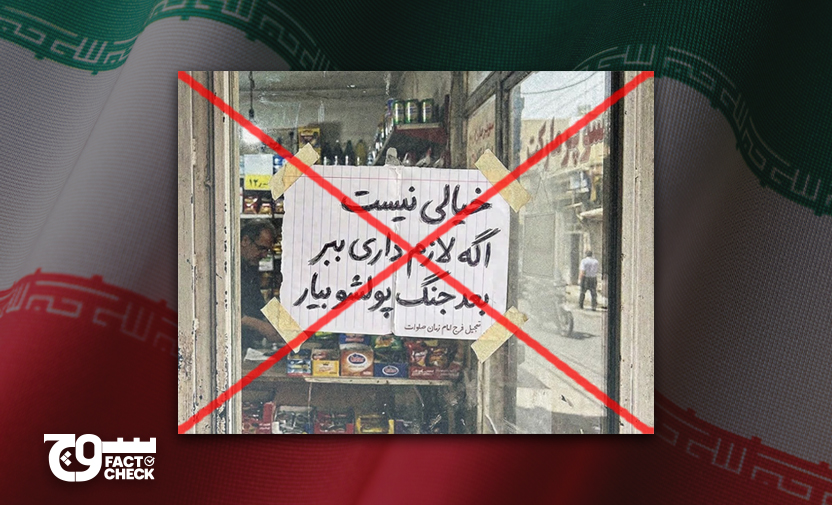
Claim: An Iranian shopkeeper put up a sign telling people to “take whatever” they need and “pay later after the war” that the US and Israel are waging against the Islamic Republic of Iran.
Fact: The picture of the shop and the related sign is AI-generated.
Towards the end of March 2026, multiple leading Pakistani news outlets reported on how a shopkeeper in Iran put up a sign outside his store, telling people to “take whatever” they needed and “pay later after the war” that the US and Israel are waging against the Islamic Republic.
The Pakistani news outlets that aired and published the claim include ARY News, Daily Jang, Hum News, Times of Karachi, GTV News, Daily Ausaf, Startup Pakistan Recorder, and Discover Pakistan. The archived links are available here, here, here, here, here, here, here, and here, respectively.
The purported sign in the viral image reads as follows:
“خیالی نیست اگه لازم داری ببر بعد جنگ پولشو بیار تعجیل فرج امام زمان صلوات
[Don’t worry. Take it if you need it and bring the money after the war.]”
Below this message is the phrase “تعجیل فرج امام زمان صلوات [Blessings for the hastening of the reappearance of Imam Zaman]”.
Imam-e-Zaman, or Imam-e-Zamana, refers to the eschatological messianic figure, Muhammad al-Mahdi (AS), who is in occultation and will rise at the end times to establish peace and save Islam.
US, Israel attack Iran
On 28 February 2026, the US and Israel launched a joint offensive codenamed “Operation Epic Fury” and “Operation Roaring Lion,” respectively, and assassinated Iran’s Supreme Leader Ayatollah Ali Khamenei and his family members, as well as numerous top military and security officials, leading to the appointment of his son, Mojtaba Khamenei, as the successor on 9 March.
The conflict has seen significant casualties, with Iran’s Health Ministry reporting over 2,000 deaths — including 160 children in a school bombing in Minab — and 26,500 wounded people, as well as the displacement of 3.2 million people, alongside the targeting of the historic Golestan Palace.
In retaliation, Iran closed the Strait of Hormuz to most international traffic and launched drone and missile strikes against US bases and regional targets, causing casualties across Israel and the Gulf states while destabilising global oil prices that impacted Pakistan as well.
Although the US later proposed a 15-point peace plan via Pakistan to address nuclear and maritime concerns, Iran rejected the “maximalist” terms, insisting on reparations and establishing its sovereignty over the Strait of Hormuz.
Amidst these hostilities, the Trump administration has faced scrutiny over its conflicting justifications for the strikes, ranging from preemptive defence to the destruction of Iran’s naval and nuclear capabilities, with State Secretary Marco Rubio eventually suggesting the US joined the fray to support an inevitable Israeli initiative.
Later, after closed-door briefings to Congress staff, it emerged that Trump administration officials had acknowledged “there was no intelligence suggesting Iran planned to attack US forces first”.
Fact or Fiction?
Soch Fact Check searched for credible reporting by reputable media outlets regarding the supposed Iranian shop but did not find anything relevant except for the rehashed image.
We also noticed that the word “سوپر مارکت [supermarket]” on the glass behind the sign appears to be written the wrong way as it should be flipped for potential shoppers reading it from outside.
The image was then tested using Hive Moderation to see if it was created using artificial intelligence (AI) tools. The detector said there was a 49.3% likelihood but, specifically, noted a 68.2% probability that it was generated using Gemini 3 — Google’s “most intelligent model yet” — among different models.
To check whether it contains SynthID, an imperceptible watermark embedded in all content generated by Google’s AI tools, we ran it through a dedicated detector, which currently works through Gemini in Pakistan.
The SynthID Detector confirmed that the photo was made with Google AI, with a “very high” confidence level.
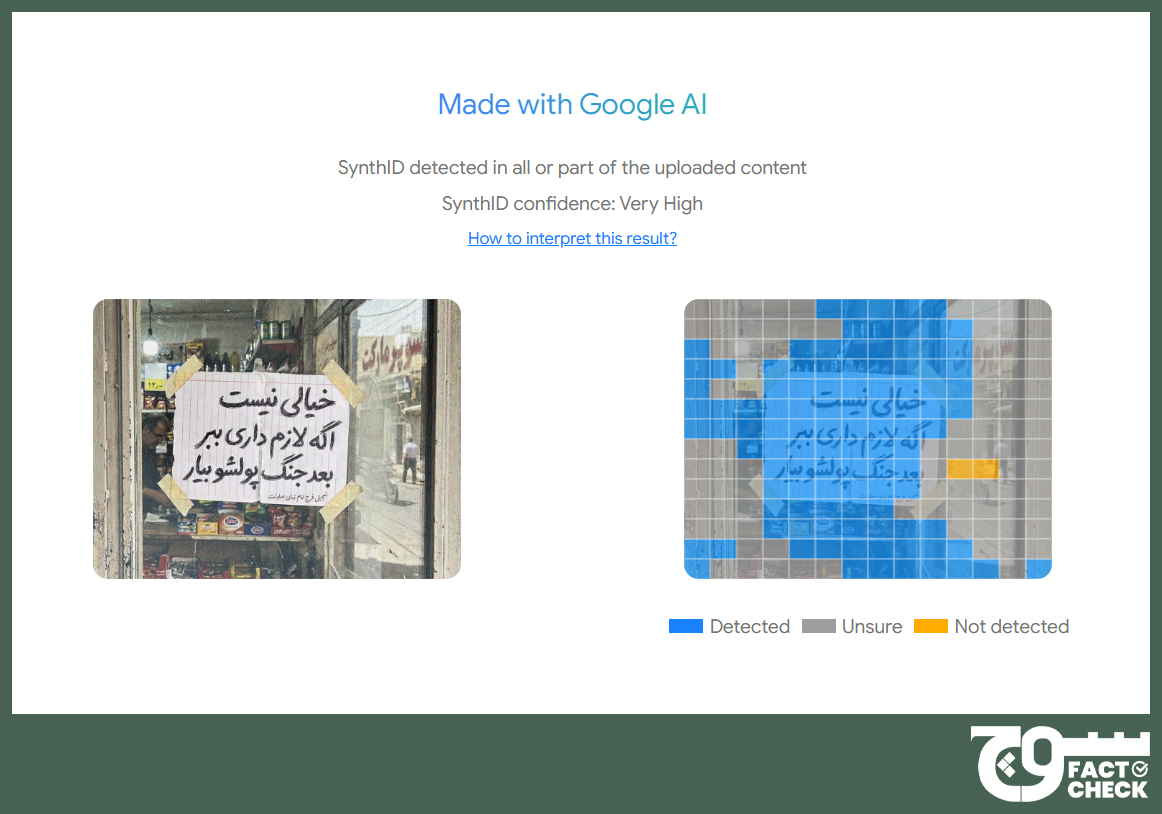
Soch Fact Check, therefore, concludes that the viral visual is fake.
Virality
Soch Fact Check found the claim circulating here, here, here, here, here, here, here, here, here, here, and here on Facebook.
It was also shared here, here, here, here, and here on Instagram, here, here, and here on Threads, and here, here, and here on X (formerly Twitter).
On YouTube, we found it here and here, while it was also posted on TikTok here and here.
The visual also made the rounds on LinkedIn here, here, and here.
Conclusion: The picture of the shop and the related sign is AI-generated.
Background image in cover photo: engin akyurt
To appeal against our fact-check, please send an email to appeals@sochfactcheck.com