
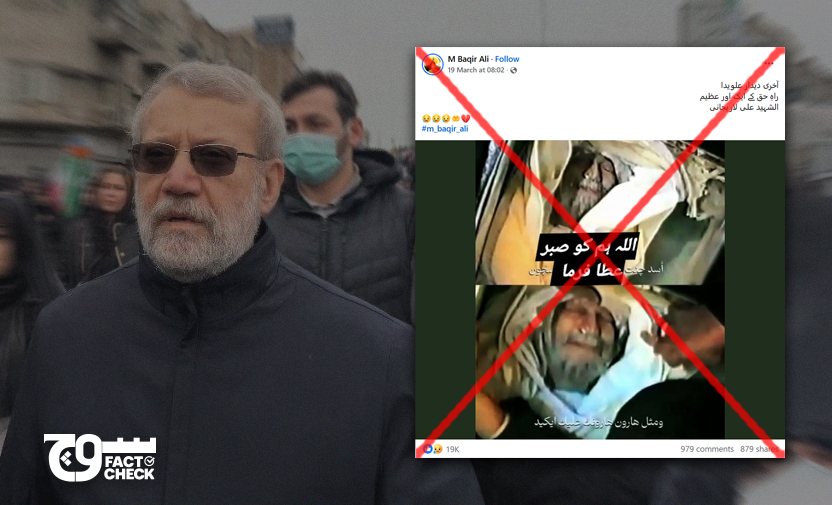
Claim: Two pictures show the dead body of Iran’s national security chief Ali Larijani, who was killed by Israel on 17 March 2026.
Fact: The images are not of Larijani’s body as they predate his assassination. The visuals likely show Iraqi religious cleric Imam Shirazi, who passed away in 2001.
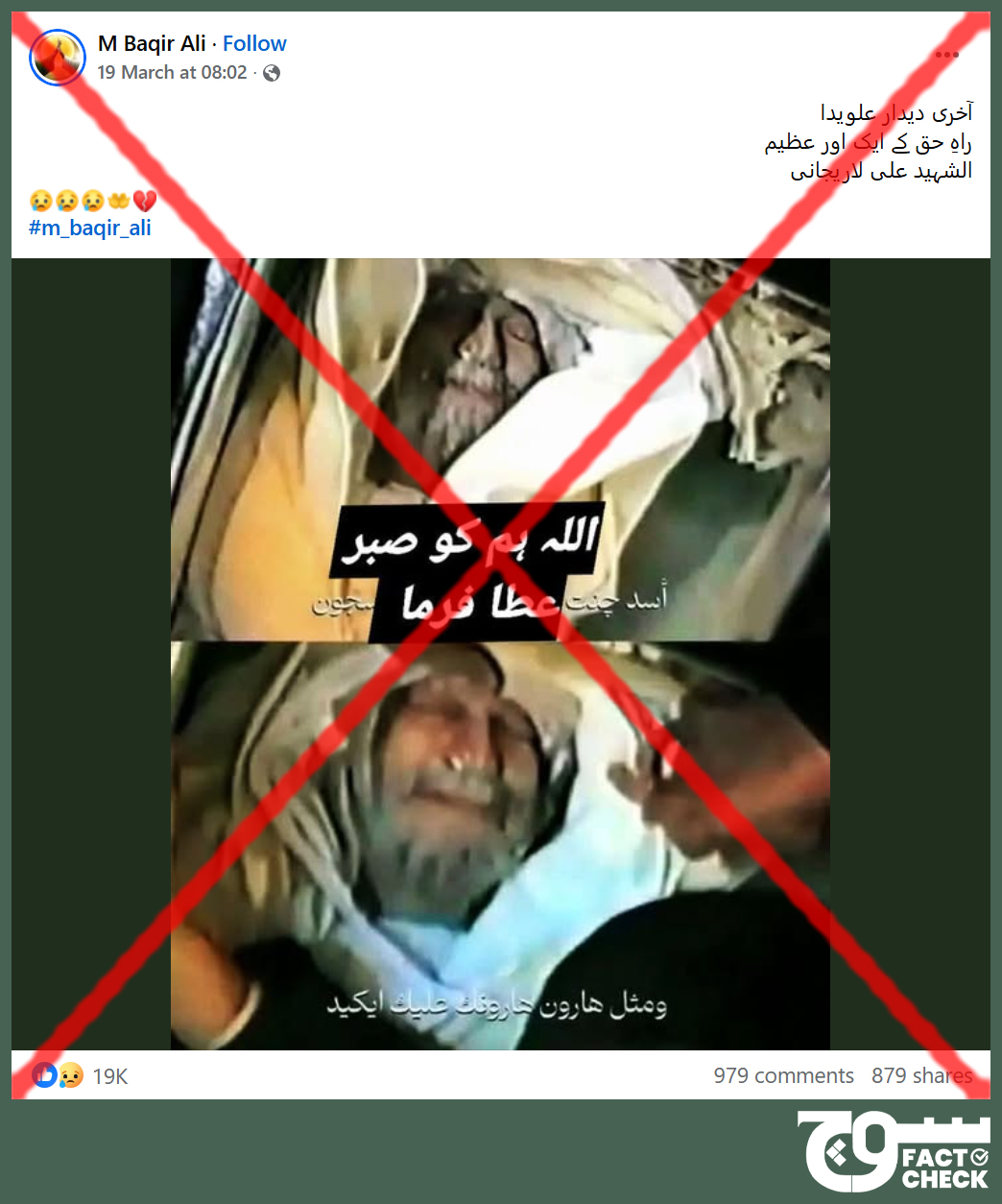
On 19 March 2026, Facebook user ‘M Baqir Ali’ posted (archive) pictures of what they claimed was the dead body of Iran’s Supreme National Security Council (SNSC) Secretary Ali Ardashir Larijani, who was assassinated by the US and Israel during the war that started on 28 February.
The accompanying caption reads as follows:
“آخری دیدار علویدا راہِ حق کے ایک اور عظیم الشہید علی لاریجانی 😢😢😢🤲💔
[Last farewell to another great martyr of the path of truth, Ali Larijani 😢😢😢🤲💔]”
In a 17 March post on X (formerly Twitter), the Israeli military said its air force “carried out a precise strike guided by military intelligence” to kill Larijani “while he was located near the capital city of Tehran”.
According to Al Jazeera, Iran’s Mehr News Agency reported that the SNSC had confirmed Larijani’s assassination in a statement and said, “After a lifetime of striving for the elevation of Iran and the Islamic Revolution, he finally reached his long-cherished wish, answered the call of truth, and proudly attained the blessed rank of martyrdom in the service front.”
In an 18 March report, Iran’s Tasnim News Agency said Qom Governor Akbar Behnamjoo announced that Larijani would be buried in the shrine of Hazrat Fatima Masoumeh (RA) next to the grave of his father-in-law, Morteza Motahhari. He was laid to rest the next day, according to a video posted by state-run Press TV.
US, Israel attack Iran
On 28 February, the US and Israel launched a joint offensive codenamed “Operation Epic Fury” and “Operation Roaring Lion,” respectively, and assassinated Iran’s Supreme Leader Ayatollah Ali Khamenei along with his family members.
Numerous top military and security officials were also killed in the airstrikes, leading to the appointment of the former Supreme Leader’s son, Mojtaba Khamenei, as the successor on 9 March.
Among those assassinated were Defence Council Secretary Ali Shamkhani, Iran’s Army Chief Abdolrahim Mousavi, Defence Minister Aziz Nasirzadeh, Islamic Revolutionary Guard Corps (IRGC) Commander-in-Chief Mohammad Pakpour, and head of the Supreme Leader’s military office, Mohammad Shirazi, and many others.
Shortly after Khamenei was assassinated, Larijani addressed the country, saying the US and Israel had set “the heart of the Iranian nation ablaze”. Promising retaliation, he vowed, “We will burn their hearts. We will make the Zionist criminals and the shameless Americans regret their actions.”
In the following days, other members of Iran’s top leadership were also assassinated by the US and Israel. The deceased included Larijani himself, Intelligence Minister Esmail Khatib, the commander of the IRGC’s Basij militia, Gholamreza Soleimani, and IRGC spokesperson Ali Mohammad Naini.
The conflict has seen significant casualties, with Iran’s Health Ministry reporting over 1,200 civilian deaths — including 160 children in a school bombing in Minab — and the displacement of 3.2 million people, alongside the targeting of the historic Golestan Palace.
In retaliation, Iran closed the Strait of Hormuz to most international traffic and launched drone and missile strikes against US bases and regional targets, causing casualties across Israel and the Gulf states while destabilising global oil prices that impacted Pakistan as well.
Although the US reportedly proposed a 15-point peace plan via Pakistan to address nuclear and maritime concerns, Iran rejected the “maximalist” terms, insisting on reparations and control of the Strait of Hormuz as its “natural and legal right”.
Amidst these hostilities, the Trump administration has faced scrutiny for providing conflicting justifications for the strikes, ranging from preemptive defence to the destruction of Iran’s naval and nuclear capabilities, with State Secretary Marco Rubio eventually suggesting the US joined the fray to support an inevitable Israeli initiative.
It later emerged from closed-door briefings to Congress staff that Trump administration officials acknowledged “there was no intelligence suggesting Iran planned to attack US forces first”.
Fact or Fiction?
Soch Fact Check reverse-searched both images and found a match in the thumbnail of a YouTube video (archive) from 1 October 2019, with the title “assassination of Sayed Mohammad shirazi”.
“Sayed Mohammad shirazi” refers to Grand Ayatollah Sayyid Sadiq al-Husayni al-Shirazi, an Iraqi Shia marja — or top religious cleric — who died on 17 December 2001 in Qom, Iran.
The viral images appear at the 13:53 and 14:26 marks in the 2019 video.
Checker News, an Iraqi verification and digital media literacy platform, also debunked the claim.
Soch Fact Check, therefore, concludes that the viral images do not show Larijani’s dead body.
Virality
Soch Fact Check found the visuals circulating here, here, here, here, and here on Facebook and here and here on Instagram.
It was also posted here and here on X.
Iranian journalist Amir Farshad Ebrahimi, the founding member of paramilitary group Ansar-e Hezbollah, also shared the pictures on X, where it was also posted by accounts based in Nigeria and West Asia.
Conclusion: The images are not of Larijani but likely shows the body of Iraqi religious cleric Imam Shirazi who passed away in 2001.
Background image in cover photo: ProgramsPressTV
To appeal against our fact-check, please send an email to appeals@sochfactcheck.com