
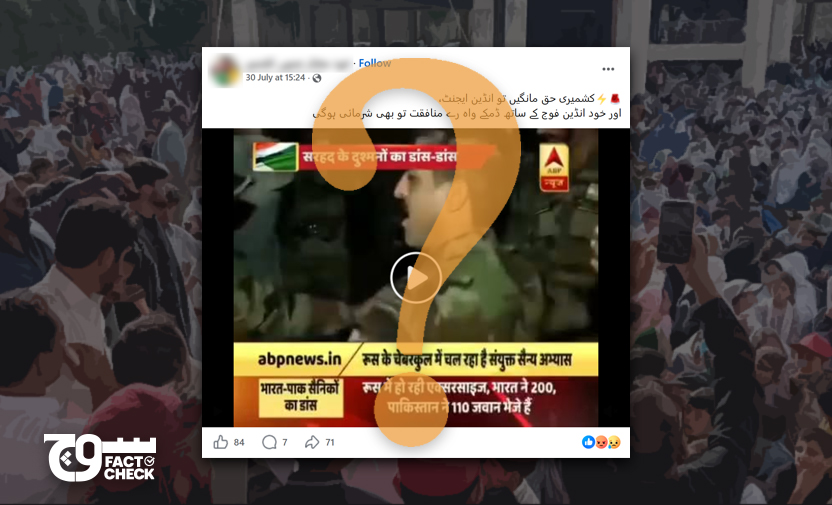
Claim: A video shows Pakistani and Indian soldiers dancing together at a time when there is unrest in Azad Jammu and Kashmir in 2026.
Fact: The video predates the 2026 Kashmir unrest. It actually shows Pakistani and Indian soldiers dancing to Bollywood songs at an event during the Shanghai Cooperation Organisation (SCO) military exercises held in August 2018.
On 30 July 2026, multiple Kashmir-focused Facebook pages posted a video showing Pakistani and Indian Army soldiers dancing to a Bollywood song. It is accompanied by the following caption:
“🚨⚡کشمیری حق مانگیں تو انڈین ایجنٹ، اور خود انڈین فوج کے ساتھ ڈمکے واہ رے منافقت تو بھی شرمائی ہوگی
[🚨⚡If Kashmiris demand justice, then [they are labelled] Indian agents, while they [Pakistan Army] dance with the Indian Army themselves. Wow, the hypocrisy, even you will be ashamed.]”
Unrest, violence in Kashmir
Ahead of the general elections in Pakistan-administered Kashmir, also known as Azad Jammu and Kashmir (AJK), that were boycotted by the opposition parties, the region erupted into severe unrest.
The elections were originally scheduled to take place in one round on 27 July but later divided into three phases due to security concerns. The successive polls were nonetheless marred by sporadic instances of violence. The third round of voting took place on 10 August.
According to Reuters, analysts expected the ruling Pakistan Muslim League-Nawaz (PML-N) to win a majority despite delays in voting in some constituencies.
The party already “secured 25 seats in the 53-seat assembly as of Wednesday [12 August], but was widely expected by analysts to win more constituencies in at least two further rounds of voting and be granted additional reserved seats”, it wrote.
“The PPP has so far secured 12 seats — fewer than expected, for which PPP leaders have blamed the PML-N, accusing it of vote rigging. The PML-N has rejected those accusations,” the publication added.
Security forces imposed a significant crackdown on the protests, led by the Joint Awami Action Committee (JAAC), that were sparked by long-held political and economic grievances.
The JAAC has alleged that at least 31 of its protesters have been killed and 400 injured amid the clashes, Arab News reported. Umar Nazir Kashmiri, a core member of the group, accused the government of opening “fire on unarmed demonstrators” as they marched toward Muzaffarabad, it added.
Since the beginning of the unrest in June, “more than 45 people have been killed and hundreds injured”, according to Al Jazeera.
Read our background on the June clashes in Pakistan-administered Kashmir here.
A 29 July report by Dawn quoted AJK Police spokesperson, Senior Superintendent of Police (SSP) Riaz Mughal, as saying, “In 2026 only, 26 of our personnel were martyred, while 157 were seriously injured, and 629 faced minor injuries.” He alleged that the JAAC had snipers amongst them and that almost 70% of the protesters were “criminals”.
Rights organisations like Amnesty International and the Human Rights Commission of Pakistan (HRCP) reported heavy use of lethal force against demonstrators, alongside communication and internet blackouts across major areas, such as Mirpur and Rawalakot.
Amnesty also urged the Pakistani government to “lift [the] communications blackout” and “allow media and independent observers into the area” in order to conduct an “independent verification of the full extent of the situation on the ground”.
The UN Human Rights Chief Volker Türk has called for “prompt, thorough and impartial investigations into all deaths that have occurred due to the unrest, both amongst protesters and members of security forces”, according to spokesperson Jeremy Laurence.
The BBC said there was an atmosphere of fear among the population and that the vehicles and property of the candidates contesting the AJK elections “have been set on fire, while some candidates were subjected to violence”, while attributing the blame to the JAAC.
On the other hand, Information Minister Attaullah Tarar accused India of providing “funds and instructions” for the protests, The Guardian reported.
According to The Express Tribune, the federal and AJK governments have claimed that militants — especially “Fitna al-Khawarij” — have infiltrated the demonstrations in the region, that weapons were recovered from protesters, and that “they had opened fire on security forces”.
“Fitna al-Khawarij” is a term the government uses to refer to the banned Tehreek-e-Taliban Pakistan (TTP), also known as the Pakistani Taliban.
Minister of State for Interior Tallal Chaudhry spoke alongside Tarar during the 28 July press conference, saying that those participating in the demonstrations would not be considered “protesters but rioters” and urging citizens to stay away and safe from the government crackdown.
Chaudhry also promised “all-out support to [the] AJK government for maintaining peace and order”, according to the state-run Radio Pakistan.
On 30 July, the AJK Assembly adopted a formal resolution calling for the immediate establishment of an independent, impartial Truth Commission to “investigate the recent unrest, examine all deaths, injuries and property losses, and recommend relief and reforms”.
On 2 August, the Information and Broadcasting Ministry’s External Publicity (EP) Wing issued “Foreign Media Facilitation Guidelines, 2026.”
The guidelines require “all foreign or international print, electronic, and digital media, including social media & web based platforms”, to register themselves with the EP Wing and obtain a no-objection “official assignment especially for the work outside Islamabad, Lahore, and Karachi”. The ministry said the accreditation may be suspended or cancelled if it “acts against the ideology, sovereignty, security, or public order of Pakistan”, among other reasons.
See a report by Soch Fact Check’s sister organisation, Soch Videos, on the new guidelines here.
The same day, the ministry posted an advisory on X (formerly Twitter), saying Al Jazeera engaged in “selective reporting” and “yellow journalism” and that it “sought to misrepresent the AJK elections and the voting process”. It added that the international media outlet’s news stories “confirm(ed) the agenda of external actors with vested interests”.
Al Jazeera’s website is now inaccessible in Pakistan; however, its social media channels can be viewed.
Fact or Fiction?
Soch Fact Check reverse-searched keyframes from the viral video and found that it predates the 2026 unrest in AJK.
The video is, in fact, from August 2018 when India and Pakistan participated in a joint anti-terrorism military exercise — called “Peace Mission 2018” — held at the Chelyabinsk region’s Chebarkul range in Russia after becoming full members of the Shanghai Cooperation Organisation (SCO), according to multiple media outlets.
Citing Indian media, The Express Tribune wrote that “the participating troops attended a function arranged by the Indian army on the second last day of the exercises, where they celebrated by dancing together”.
The military exercises “turned into a meeting ground for soldiers from India and Pakistan who came together on Tuesday to enjoy an evening filled with Bollywood songs and dancing”, Scroll.in reported.
The video, originally posted by Neeraj Rajput, then an associate editor at ABP News, was also published on the outlet’s YouTube page.
Soch Fact Check, therefore, concludes that the video is unrelated to and predates the ongoing unrest in Pakistan-administered Kashmir in 2026.
Virality
Soch Fact Check found the video posted in the false context over a dozen times on Facebook, five times on Instagram, and once on Threads.
It was also shared on X by three users, at least two of whom are from Afghanistan.
Conclusion: The video predates the 2026 Kashmir unrest. It actually shows Pakistani and Indian soldiers dancing to Bollywood songs at an event during the SCO anti-terrorism military exercises held in August 2018.
Background image in cover photo: RawalakotCommunity
To appeal against our fact-check, please send an email to appeals@sochfactcheck.com