
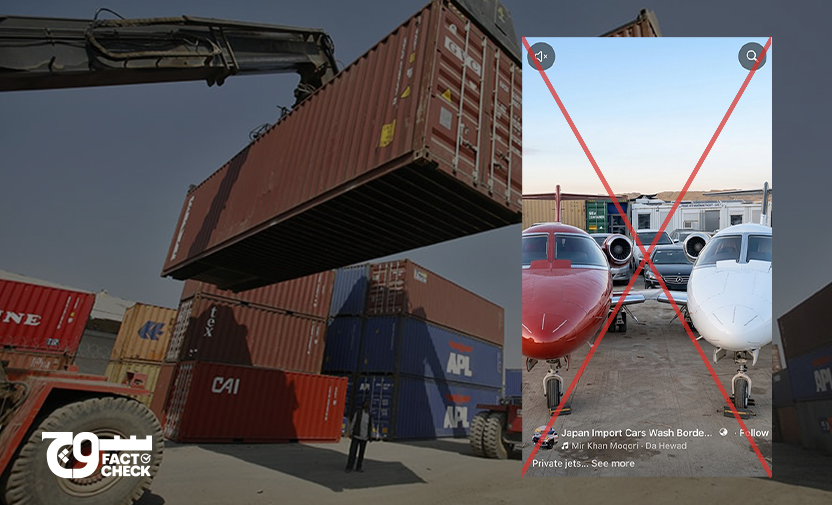
Claim: Private jets were found hidden inside a warehouse near Chaman, Balochistan.
Fact: The video is AI-generated and does not show real aircraft. Google’s Gemini detected an embedded SynthID watermark in the visuals, while forensic tools FauxLens and HiveDetect also assessed that the footage is AI-generated
On 6 September 2026, the Facebook page Upstein shared a reel claiming that private jets had allegedly been found hidden inside a warehouse near Chaman, Balochistan.
The caption said, “In a surprising development, private jets have allegedly been found hidden inside a warehouse near Chaman, raising questions about their ownership, purpose, and how they were transported and stored at the location. The reported discovery has sparked curiosity and speculation, with authorities expected to investigate the circumstances surrounding the aircraft. Details about the number of jets, their condition, and who may be responsible remain unclear. Further information and official confirmation are awaited as the situation develops. #viral #trending #reels”
The reel shows several jet-like aircraft among shipping containers, cars, and other structures. Large text over the footage reads, “PRIVATE JETS ALLEGEDLY FOUND NEAR CHAMAN.”
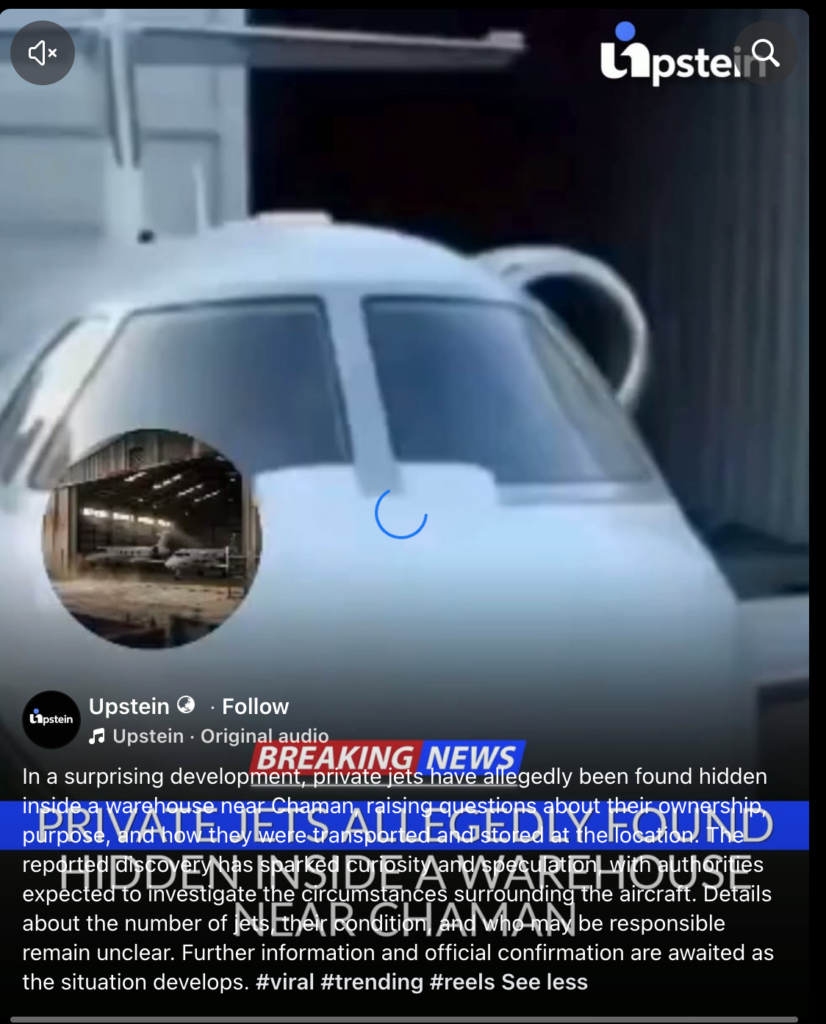
Screenshot of a Facebook reel shared by Upstein on 6 September 2026 claiming that private jets had been found hidden inside a warehouse near Chaman, Balochistan.
Fact or Fiction?
Soch Fact Check examined the timestamps of copies of this video. The earliest copy identified was posted by the TikTok account Muhammad idrees nasari AI on 6 September 2026. The timestamp encoded in the video’s numerical identifier corresponds to approximately 12:24 pm Pakistan time.
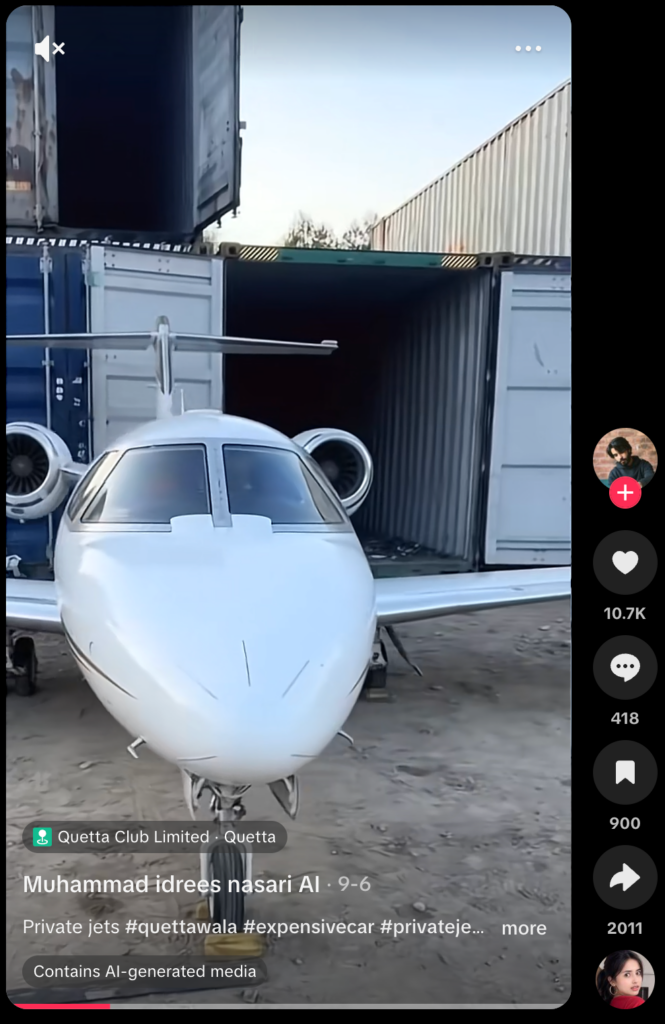
Screenshot of the earliest copy located by Soch Fact Check on TikTok, which currently displays a “Contains AI-generated media” notice.
TikTok currently displays a “Contains AI-generated media” notice on the post.
An X (formerly Twitter) account posted the same footage at approximately 11:27 pm Pakistan time that day and described it as showing smuggled private jets near Chaman.
The 6 September TikTok post therefore predates some of the copies that presented the footage as a genuine discovery without displaying an AI-generated media notice. However, Soch Fact Check could not establish whether TikTok’s notice was present when the video was originally uploaded. It is the earliest copy located during this investigation, but may not be the original source of the footage.
Visual examination
Soch Fact Check examined the video frame by frame and found several visual inconsistencies in the aircraft and their surrounding structures.
One of the clearest frames shows the red and white jets positioned beside each other at 0.5 seconds. The right wing of the red aircraft and the left wing of the white aircraft appear to meet, but their respective edges do not remain clearly separated or show a convincing overlap in depth. Instead, the metallic outlines of both wings appear to dissolve into a single blurred intersection, making it difficult to determine where one aircraft ends and the other begins. The effect gives the appearance of two separate aircraft structures merging into one another.
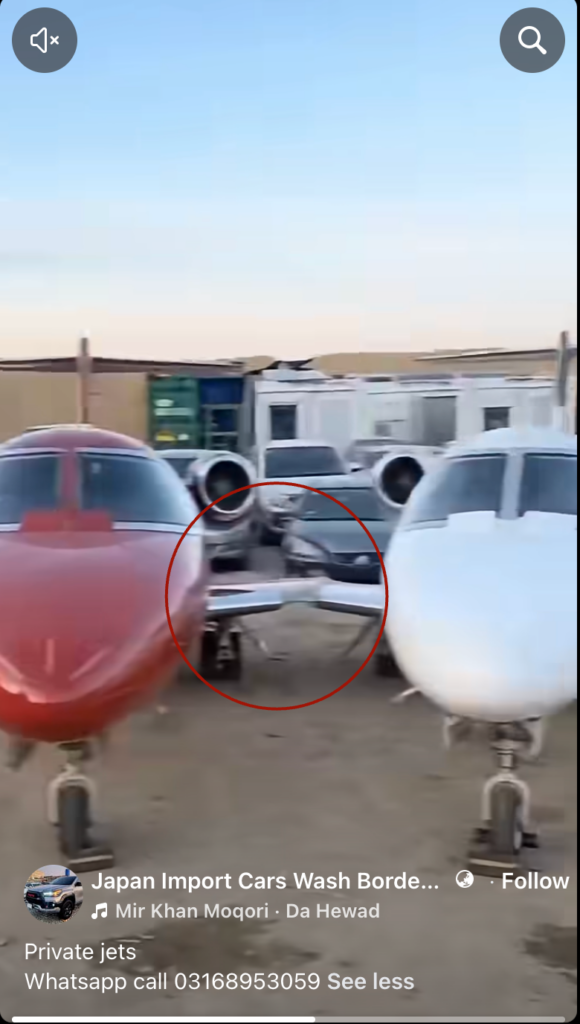
Frame from the viral video showing the adjacent wings of a red and white aircraft appearing to merge rather than maintaining clearly separated edges.
The anomaly is also visible across consecutive frames. As the camera moves, the relationship between neighbouring wings, engines, and fuselages does not remain stable. Parts of the aircraft appear to lose coherent boundaries, blend into nearby structures, or change shape rather than maintaining consistent geometry throughout the pan.
Further inconsistencies appear towards the end of the video. Dark text-like markings on the tail of a white aircraft become visible as the camera passes, but the characters do not resolve into stable, legible markings across consecutive frames and instead appear distorted as the viewpoint changes. Smaller background details, including vehicles, shipping containers, and other structures, also lose definition or appear to shift between frames.
Some individual distortions could result from motion blur, compression, or the low resolution of the circulating footage. However, the apparent merging of two neighbouring aircraft wings in a relatively clear frame, combined with the repeated instability of aircraft structures across the moving sequence, prompted us to conduct further checks for signs of AI generation.
AI analysis
Soch Fact Check analysed the video using Google’s Gemini verification tool, FauxLens, and HiveDetect.
First, we uploaded the clip to Google’s Gemini app and asked it to verify whether the footage was AI-generated. Gemini reported that the visuals were edited or generated with Google AI and, when asked specifically about provenance, confirmed that a SynthID watermark was detected in the video’s visuals. Google describes SynthID as an imperceptible digital watermark embedded directly into AI-generated or AI-edited media. For video verification, Gemini scans both the visual and audio tracks for SynthID and can identify whether Google AI was used to create or alter parts of the footage. Google also says the watermark is designed to remain detectable after common changes such as compression, cropping, filters, and changes to frame rate.
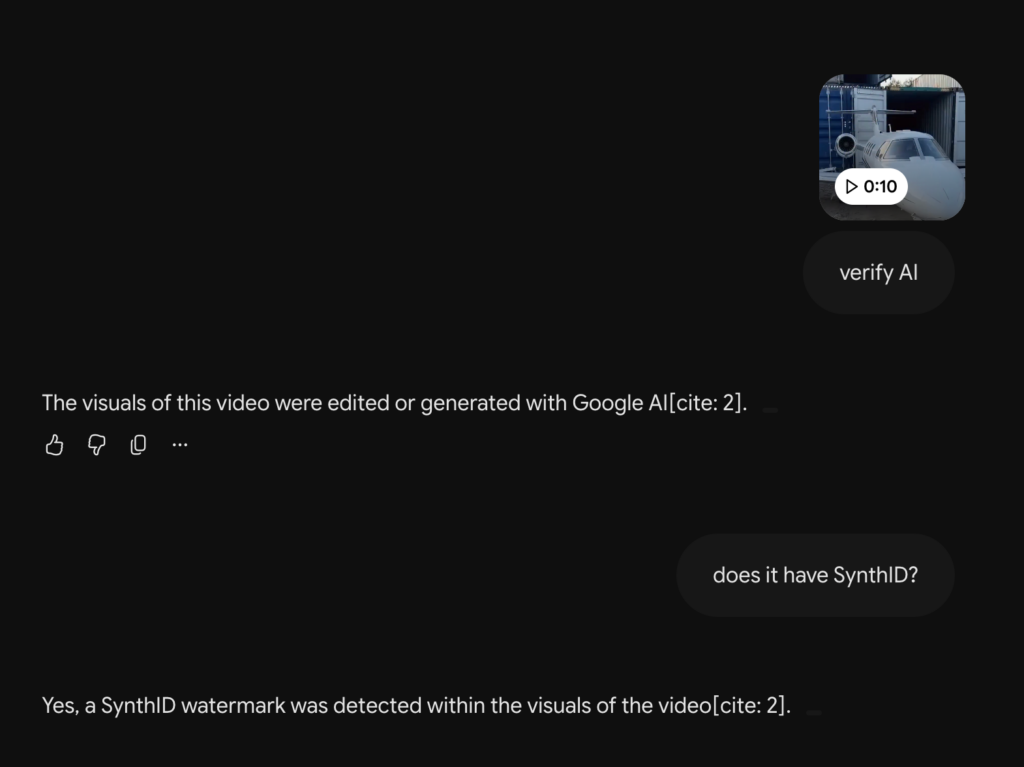
Screenshot of Google’s Gemini verification tool stating that the video’s visuals were edited or generated with Google AI and that a SynthID watermark was detected in the footage.
The SynthID result proves that Google AI was involved in creating or editing at least part of the visual footage. However, it does not by itself establish whether the entire video was generated from scratch or whether existing footage was subsequently altered using Google AI, as SynthID is a system for identifying content that has been generated or altered using its AI tools.
We also analysed the clip using FauxLens, which assessed it as being “Likely AI-generated” with a 95% confidence score. FauxLens flagged the video’s visual content as showing patterns consistent with AI generation, while its metadata check could not establish the origin of the file. FauxLens says its broader forensic approach examines provenance first and combines multiple signals rather than relying on a single visual clue. Its published methodology includes checks of metadata, compression history, camera-sensor noise, frequency-domain patterns, and visual inconsistencies, with the findings combined into an overall evidence assessment. FauxLens also cautions that its confidence score reflects the weight of the detected evidence and should not be interpreted as a literal probability that the media is AI-generated.
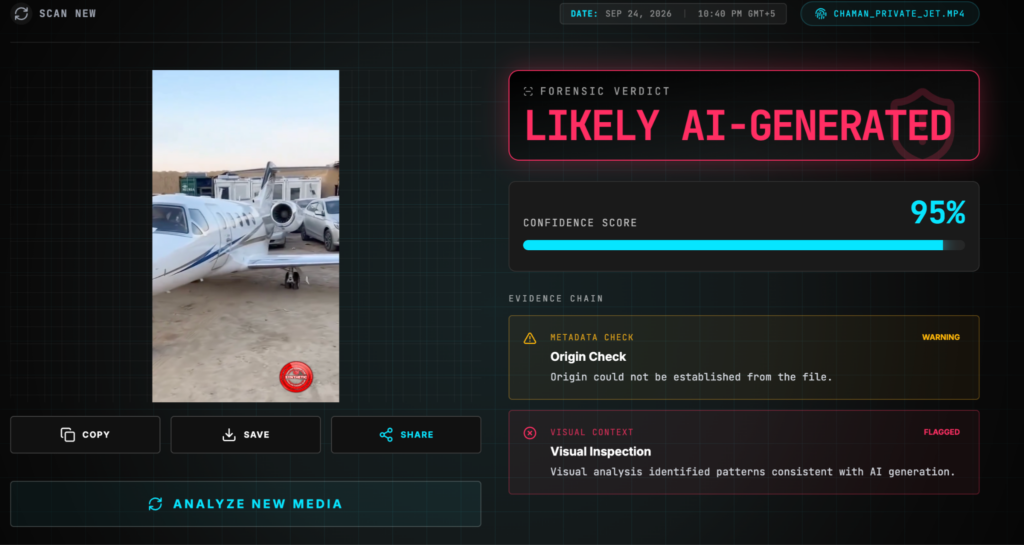
Screenshot of FauxLens assessing the footage as “Likely AI-generated” with a 95% confidence score.
The video was then tested using HiveDetect, which returned a 98.8% likelihood that the video was AI-generated. HiveDetect states that its video-analysis system divides submitted footage into frames, processes those frames through its detection model, and returns confidence scores for whether the visual content is AI-generated. Its system also separately attempts to identify the generative model that may have produced the media. Hive’s documentation recommends a 0.9 threshold for AI-generated video detection. HiveDetect additionally returned 0% for AI-generated speech, AI-generated music, and deepfake detection, indicating that its AI finding concerned the visual footage rather than synthetic audio or face manipulation.
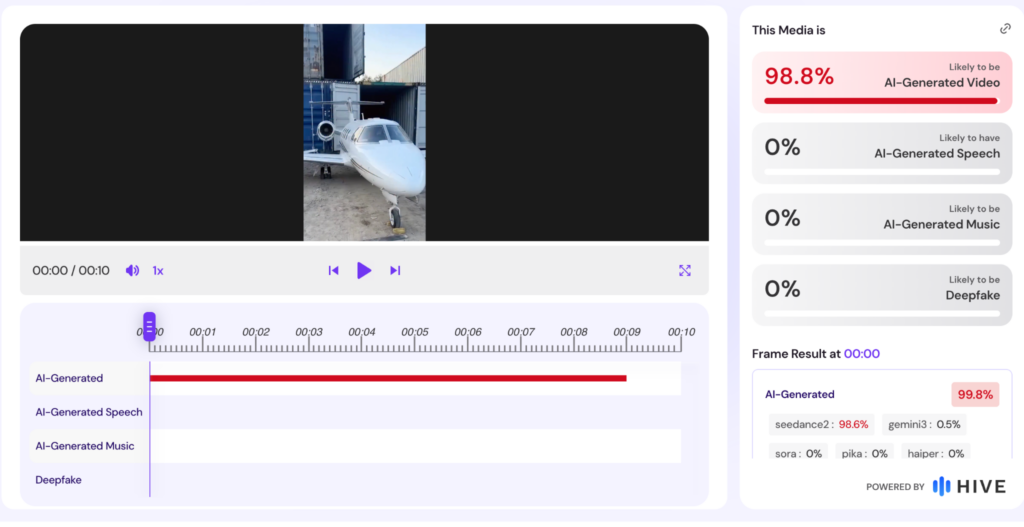
Screenshot of HiveDetect returning a 98.8% likelihood that the video was AI-generated.
The three technical findings were also consistent with the visual abnormalities identified during our frame-by-frame examination. We treated the FauxLens and HiveDetect scores as supporting evidence because automated AI detectors can produce false positives and false negatives. The SynthID finding carries different evidentiary weight because it is an embedded provenance signal specifically designed by Google to identify content created or altered using its AI systems. Taken together, the SynthID detection, two independent AI-detection results, and the visual inconsistencies found during frame-by-frame examination provide strong evidence that the footage was created or altered using AI and does not authentically document private aircraft found near Chaman.
Virality
The claim circulated on Facebook, Instagram, TikTok, and X. One X post received over 123,000 views, while copies on TikTok and Instagram also attracted thousands of likes, comments, and shares. Another TikTok upload received nearly 10,000 likes and over 1,900 shares, although the platform currently displays a notice stating that the post contains AI-generated media. Soch Fact Check therefore treated that upload as evidence of the video’s circulation rather than as an unlabelled example of the false claim.
Conclusion: The claim is false. The viral video does not authentically show private jets found near Chaman. Frame-by-frame examination revealed merging aircraft structures and distorted markings, while Gemini detected an embedded SynthID watermark and forensic tools such as FauxLens and HiveDetect assessed the footage as being AI-generated.
To appeal against our fact-check, please send an email to appeals@sochfactcheck.com