
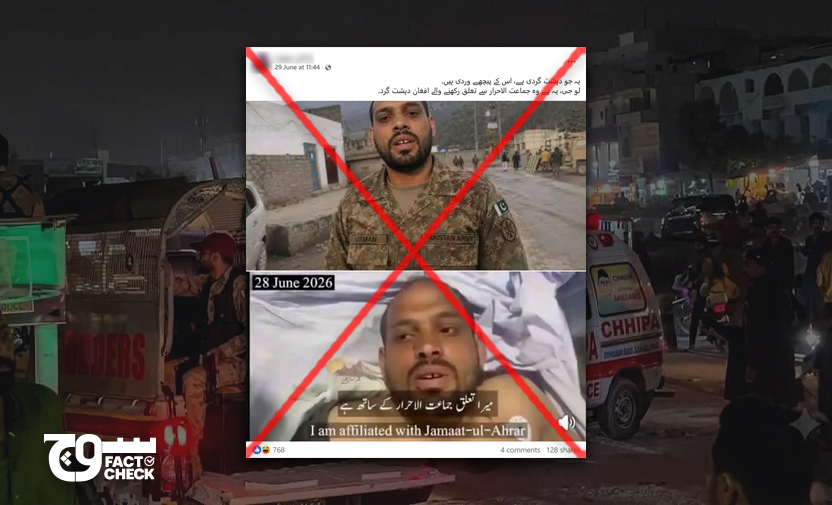
Claim: An image shows the injured suspect who was detained following the June 2026 attack on a Rangers’ facility in Karachi is actually a Pakistan Army soldier.
Fact: The picture of the suspect wearing a Pakistan Army uniform was generated using artificial intelligence (AI) tools. Moreover, there’s no evidence of his association with the military.
On 29 June 2026, multiple Facebook posts shared a visual comprising two images of the suspect arrested in an injured state over his alleged involvement in the 27 June attack on the Pakistan Rangers Camp in Karachi’s Mosamiyat neighbourhood.
One of the images in the visual is a screenshot from his video confession and the other depicts him wearing a Pakistan Army uniform. The posts implied that he was actually a soldier who was forced into making a statement admitting that he was an Afghan national belonging to the Jamaatul Ahrar (JuA).
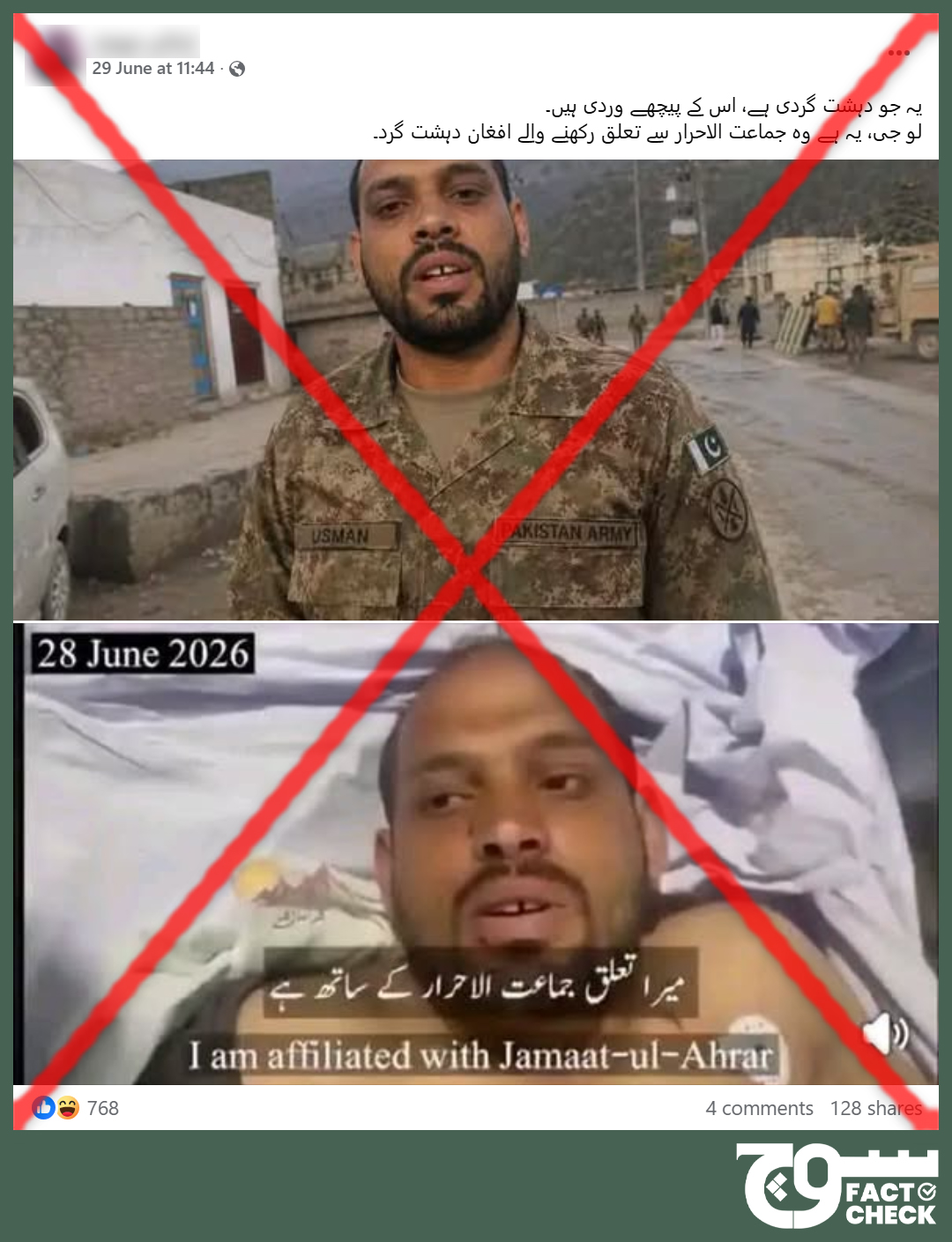
Screenshot of one of the viral Facebook posts.
The JuA is a “splinter terrorist group of the Tehreek-e-Taliban Pakistan (TTP) based in Lalpura, Nangarhar Province, Afghanistan”, according to a United Nations (UN) sanctions list. It claimed responsibility for the Saturday attack, Al Jazeera reported.
Attack on Rangers’ Karachi facility
On the evening of 27 June 2026, militants attacked the Pakistan Rangers Camp by ramming a “vehicle-borne improvised explosive device (VB-IED)” into the main gate of the local paramilitary force’s facility, which is located in Karachi’s Gulistan-e-Jauhar neighbourhood.
The initial attack alarmed the area’s residents, who “reported hearing the sounds of an explosion and gunfire at around 8pm”, according to Dawn. Following the blast, armed assailants tried to breach the perimeter security by opening fire.
Security personnel associated with the Rangers, Special Security Unit (SSU), and the Anti-Terrorist Force (ATF), immediately engaged them in an intense gun battle.
According to the Pakistan Army’s media wing, the Inter-Services Public Relations (ISPR), the terrorists involved were “Khwarij belonging to Indian proxy, Jamaatul Ahrar [JuA]”.
“Fitna al-Khawarij” is the term the government uses to refer to the TTP, also known as the Pakistani Taliban.
The Rangers’ response was successful in “eliminating three Kharjis and capturing one Kharji, who is an Afghan national, in injured condition”, the ISPR said. During the exchange of gunfire, three soldiers “embraced Shahadat [martyrdom]” and four others were wounded, it added, vowing “retribution operations”.
According to Arab News, Sindh Chief Minister Murad Ali Shah directed Karachi’s additional inspector-general of police (AIGP) and the province’s top cop to “submit a detailed report as soon as the assault was reported”.
Arab News journalist Naimat Khan Malazai posted a video on X (formerly Twitter) of “the interrogation of an injured suspect”, who confirmed belonging to the JuA and “identifies himself as Usman Ali and states he travelled from Jalalabad, Afghanistan, with three other individuals whom he names as Abdul Hadi, Janan, and Umar Farooq”.
“According to his account, the group arrived at a safe location about a week prior to the assault, lodging in an under-construction building. He says that the weapons used in the attack were transported from Waziristan by Abdul Hadi, who he says had previously visited Karachi to arrange local logistics,” Malazai wrote.
The video was also shared by Dawn News’ English channel.
According to The Express Tribune, the Sindh Counter Terrorism Department (CTD) registered five cases with regards to the Karachi attack.
The wounded suspect who was taken into custody “alleged that commanders Umar Qari, Maulvi Ahrar, and Abdul Wajid dispatched them to Pakistan to carry out the attack” and “that Afghanistan-based members of the organisation — Mullah Tahir Afghani, Mullah Abdul Mannan, and Umar Afridi — provided training for the attack”, the publication added.
The state-run Pakistan TV reported that according to the detained suspect, “the weapons used in the attack were brought from Waziristan”.
In a 29 June statement, Foreign Ministry spokesperson Tahir Andrabi said “a strong demarche was issued” to the Afghan chargé d’affaires.
“A similar demarche was conveyed by Pakistan’s Ambassador Mr Ubaid-ur-Rehman Nizamani, to the Afghan Ministry of Foreign Affairs,” it said, adding, “These demarches were issued in light of the fact that Afghan nationals, including one apprehended alive, participated in this attack, proving yet again that Afghan soil and Afghan nationals continue to be used to orchestrate terrorist attacks inside Pakistan.”
“This attack is the most significant in Karachi since an explosion targeting a Chinese convoy in October 2024, which killed two Chinese nationals,” Reuters noted.
Fact or Fiction?
Soch Fact Check observed certain tell-tale signs of AI-generated content. These are listed as follows:
- The angle of his face in the viral image is almost identical to how it appears in his confessional video, suggesting a screenshot was used to generate the photo of him in a Pakistan Army uniform.
- There is also soft unnatural light on his face from the left side compared to the cloudy background.
- The uniform he is wearing has obvious discrepancies. For example, the tag on his left breast pocket features the words “PAKISTAN ARMY”, whereas real ones state “PAK ARMY”.
- The shoulder sleeve insignia (SSI) shows a distorted logo of the Pakistan Army.
- The truck on the right in the background is missing its rear wheels.
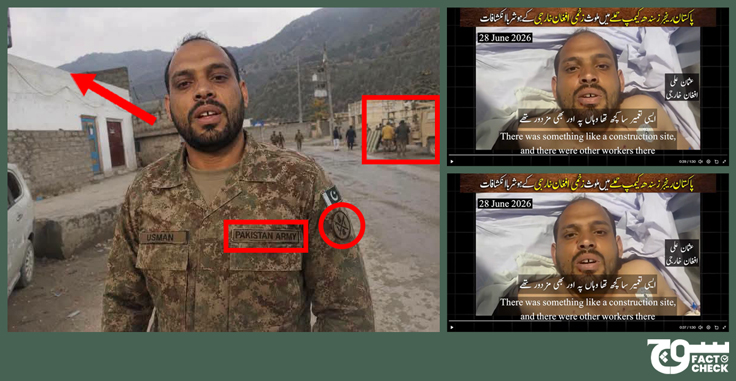
Various tell-tale signs of AI-generated content identified by Soch Fact Check (left) and screenshots from the authentic confession video of the suspect (right). The arrow in the visual on the left identifies the apparent light source.
Consequently, Soch Fact Check ran the image in Hive Moderation, which said it was 99.8% likely to contain AI-generated or deepfake content. Specifically, there is a 99.8% probability of the “gptimage2” model being used.
The “gptimage2” source refers to OpenAI’s image generation model, which is why we then ran it in the company’s own verification tool.
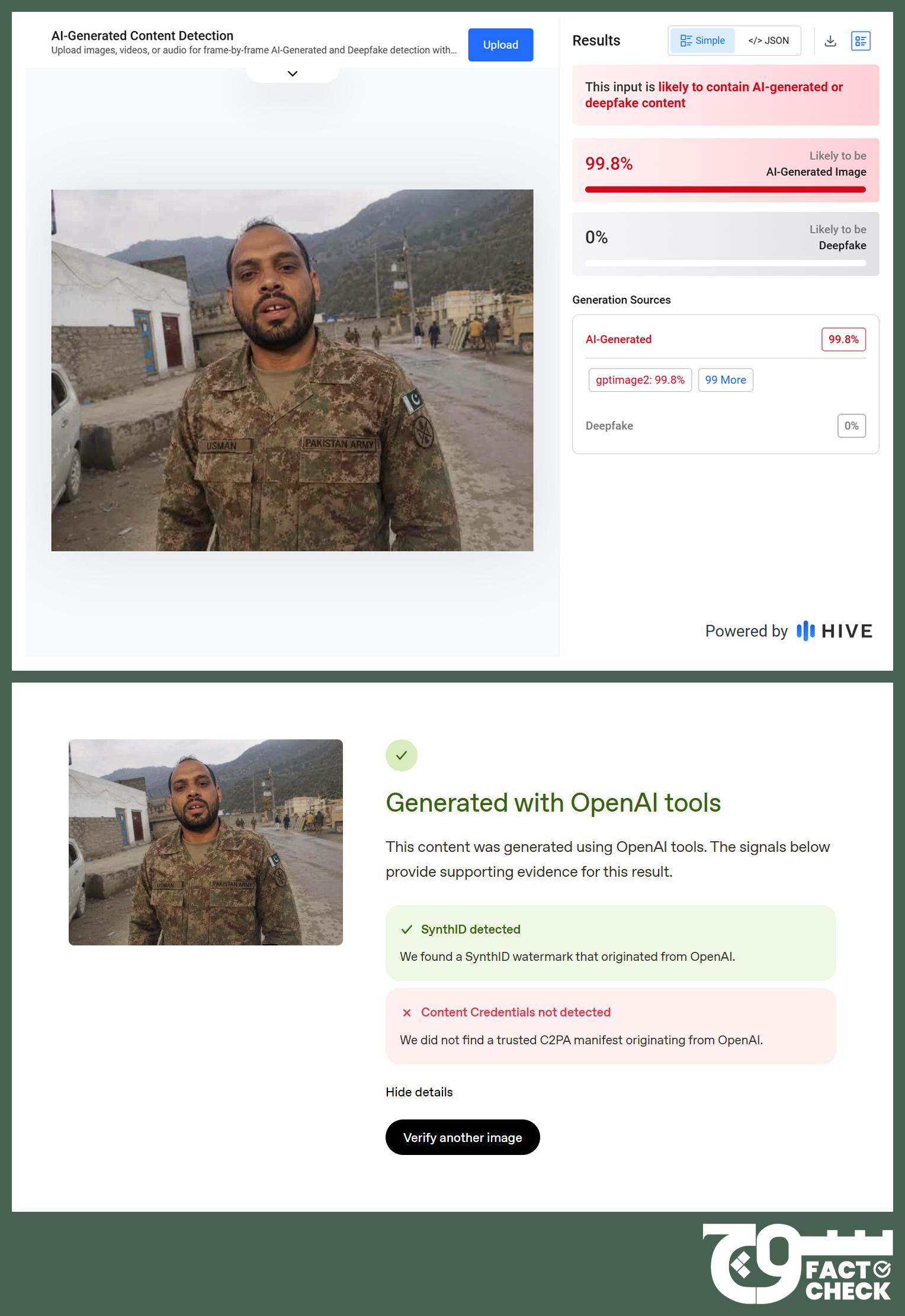
Screenshots of results from Hive Moderation and OpenAI’s verification tool.
The tool analysed the image and concluded that it “was generated using OpenAI tools” as it “found a SynthID watermark that originated from OpenAI”.
Additionally, we did not find any news reports of the man being affiliated with the Pakistan Army.
Soch Fact Check, therefore, concludes that the image is AI-generated and the claim is false.
Virality
Soch Fact Check found that the claim was shared not only in standalone Facebook posts by both Pakistani and Afghan users but posted in comments under many others as well.
The Facebook posts, which also appeared in different groups on the platform, gathered hundreds of thousands of reactions collectively.
It was also shared on X and TikTok by Afghan users.
The claim was also posted on Instagram.
Conclusion: The picture of the suspect in a Pakistan Army uniform is AI-generated.
Background image in cover photo: TikTok
To appeal against our fact-check, please send an email to appeals@sochfactcheck.com