
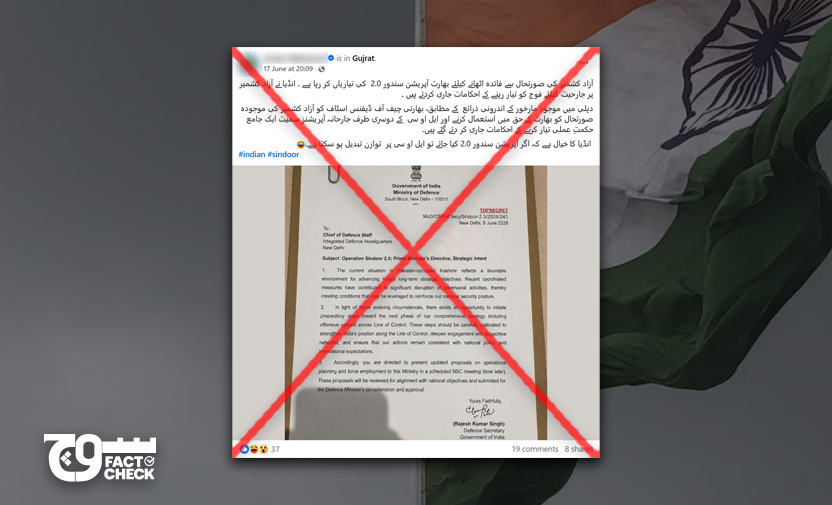
Claim: A leaked document with the letterhead of India’s Defence Ministry suggests that New Delhi has ordered its military to use the June 2026 unrest in Rawalkot in Pakistan-administered Kashmir as an opportunity to prepare for an “Operation Sindoor 2.0”.
Fact: The letter is AI-generated.
On 17 and 18 June 2026, multiple Facebook users posted a picture of a letter, purportedly issued by India’s Defence Ministry, directing its army chief to use the unrest in Rawalkot in Pakistan-administered Kashmir as an opportunity to prepare for Operation Sindoor 2.0.
The subject line of the letter reads, “Operation Sindoor 2.0; Prime Minister’s Directive, Strategic Intent,” and it is signed by India’s Defence Secretary Rajesh Kumar Singh.
The accompanying caption reads as follows:
“آزاد کشمیر کی صورتحال سے فائدہ اٹھانے کیلئے بھارت آپریشن سندور 2.0 کی تیاریاں کر رہا ہے ۔ انڈیا نے آزاد کشمیر پر جارحیت کیلئے فوج کو تیار رہنے کے احکامات جاری کردئے ہیں ۔ دہلی میں موجود مارخور کے اندرونی ذرائع کے مطابق، بھارتی چیف آف ڈیفنس اسٹاف کو آزاد کشمیر کی موجودہ صورتحال کو بھارت کے حق میں استعمال کرنے اور ایل او سی کے دوسری طرف جارحانہ آپریشنز سمیت ایک جامع حکمتِ عملی تیار کرنے کے احکامات جاری کر دئے گئے ہیں۔ انڈیا کا خیال ہے کہ اگر آپریشن سندور 2.0 کیا جائے تو ایل او سی پر توازن تبدیل ہو سکتا ہے۔😂
[India is preparing for Operation Sindoor 2.0 by taking advantage of the situation in Azad Kashmir. India has issued orders to the army to be ready for aggression on Azad Kashmir. According to Markhor’s internal sources in Delhi, the Indian chief of defence staff has been ordered to prepare a comprehensive strategy, including using the current situation in Azad Kashmir to India’s favour and [engaging in] offensive operations on the other [Pakistani] side of the LoC. India believes that if Operation Sindoor 2.0 is carried out, the balance on the LoC may change. 😂]”
India-Pakistan conflict of May 2025
In May 2025, India and Pakistan engaged in the most intensive four-day conflict in decades, exchanging drones, fire, shelling, and missiles that brought the two nuclear-armed nations to the brink of an all-out war.
The conflict was triggered by the killing of at least 26 people by assailants at a resort in Pahalgam in the Indian-administered Jammu and Kashmir on 22 April 2025. New Delhi blamed Pakistan for the attack, a claim Islamabad has consistently denied.
During the conflict, India also sent Israeli-made Harop drones to Pakistan, which were reportedly shot down by the army. Soch Fact Check visited and investigated two crash sites each in Karachi, Rawalpindi, and Lahore; read our on-ground report here.
On 10 May, US President Trump announced a ceasefire, which was then confirmed by Pakistan’s Foreign Minister Ishaq Dar and later by India’s Foreign Secretary Vikram Misri.
Trump’s announcement came after US State Secretary Marco Rubio spoke separately to Pakistan Army Chief Field Marshal Syed Asim Munir, Foreign Minister Dar, and Indian External Affairs Minister Subrahmanyam Jaishankar.
On the other hand, Pakistan expressed gratitude to the US, with Prime Minister Shehbaz Sharif thanking Trump “for his leadership and proactive role” as well as Vice President JD Vance and Rubio “for their valuable contributions for peace in South Asia”.
Clashes in Pakistan-administered Kashmir
On 7 June 2026, severe deadly clashes erupted between law enforcement officers and protesters in Rawalakot in Pakistan-administered Kashmir when crowds gathered outside the Combined Military Hospital (CMH).
The clashes occurred after police arrived at the location to disperse a sit-in protesting the death of an activist associated with the Joint Awami Action Committee (JAAC), which was banned by the AJK government two days prior.
According to security officials and human rights reports, the ensuing clashes resulted in at least 11 deaths — consisting of protesters and police officers — alongside dozens of injuries.
Over 70, including 23 security officials and 50 protesters, were injured, police chief Liaqat Malik said.
The state-run Pakistan TV reported on 9 June that videos showing an alleged assault on the Azad Jammu and Kashmir (AJK) police personnel in Rawalakot on 7 June and the “desecration” of a deceased officer’s body had surfaced. It termed the incident a “preplanned attack”.
The same day, the AJK government ordered that “sedition charges be filed against [JAAC leader Shaukat Nawaz] Mir and another leader of the group, Mehran Arshad Khawaja, accusing them of inciting rebellion through speeches and online content”. It also announced a reward of PKR 10 million “for information leading to the arrest of four wanted members”.
According to a police statement, initial evidence indicated that “some of the five were in contact with ‘a hostile intelligence agency from a neighboring country’, without providing further details”.
The demonstrations originally took off against the 12 reserved seats in the legislature of Pakistan-administered Kashmir “for refugees from Indian-administered Kashmir who now live in other parts of Pakistan”. The JAAC has also demanded the abolition of these as they are not representative of actual residents of the region.
The AJK Supreme Court then ruled that those 12 reserved seats were constitutionally protected and an amendment was required to abolish them. Prior to that, the May 2026 talks between the JAAC and the government were unsuccessful.
The unrest escalated after the government deployed federal paramilitary forces ahead of a planned region-wide strike, said Amnesty International, which criticised the JAAC’s proscription in its statement as “disproportionate, unlawful, and a violation of the right to freedom of association”.
Amnesty also noted that authorities have targeted journalists reporting on the protests, with Sohrab Barkat arrested over alleged “defamation” and dissemination of “false and fake information”.
Alongside the arrest of over 100 members of the banned group, authorities suspended internet and mobile network signals and issued strict travel advisories restricting movement into the region until 27 July, when regional elections are scheduled. The JAAC’s head office was sealed by the AJK Police, according to the state-run Radio Pakistan.
JAAC leader Shaukat Nawaz Mir termed the government actions “a massacre”, while Poonch sector commissioner Sardar Waheed Khan rejected the claim, terming it “misleading” and saying the state was trying to “restore law and order”.
Pakistan TV reported on 14 June that “armed individuals linked to the banned JAAC opened fire on an armoured vehicle during a police flag march in Rawalakot” and showed a video of armed men gathered at an unidentified location.
The state-run channel also reported on an alleged leaked recording between JAAC leader Sajid Azam, also the president of “Trade Union Thorar District Poonch”, and Hameed Kashmiri, a member of the banned group, discussing how they had “five hundred riflemen” ready and that they would demand to “vacate Rawalakot in two hours”.
Local officials reported mid-June that the main protest gatherings in Rawalakot had significantly dwindled, leading to a partial relaxation of curfew-like restrictions to allow for limited commercial hours.
On 18 June, AJK Prime Minister Faisal Mumtaz Rathore said Rawalakot was the “staging ground” of the JAAC’s “Campaign of Chaos” and that, from there, “they planned to march towards Muzaffarabad”.
“Even though the offer for negotiations still stands, we are not in [a] hurry (they should be) and the State will not capitulate. We’ll show flexibility to only those who want to de-escalate and want peace. We fully support the voices that demand fair rights, but we’ll never tolerate those who spread anarchy,” he added.
Fact or Fiction?
Soch Fact Check first checked if any reputable media outlets, including those from India, had reported on the letter as such a leak would have made headlines. However, we did not find any verifiable report.
We also identified different errors in the document that likely would not be present in official correspondence.
For example, the words “TOPSECRET” in red at the top-right corner are missing a space in the middle. Similarly, “Line of Control” is missing a “the”, which should precede the name.
Lastly, the words “time later” in brackets, referring to a “scheduled NSC meeting” appear to be very informal.
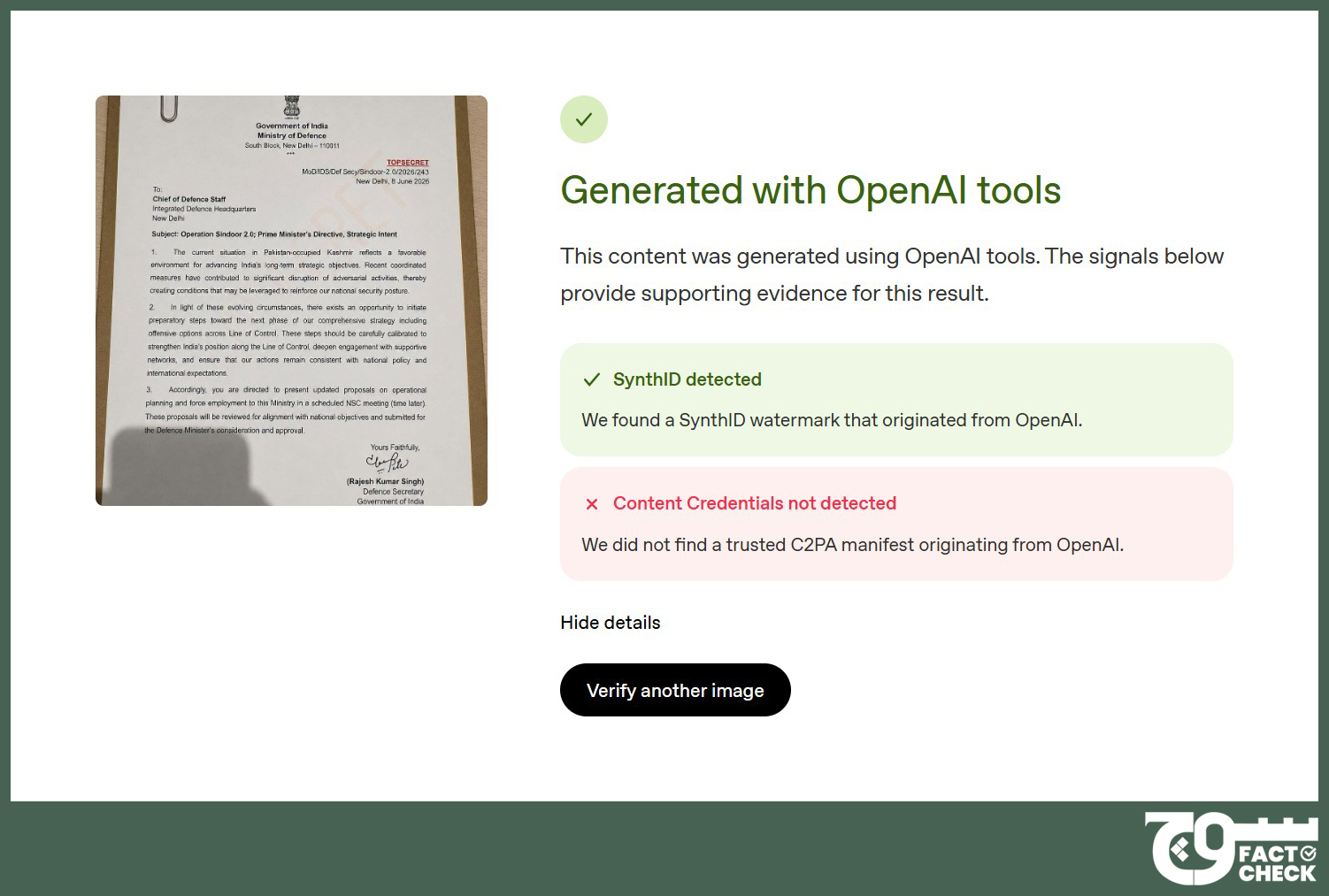
Suspecting the picture was generated using artificial intelligence (AI) tools, we ran the image in a tool designed by OpenAI to check if it was created using the company’s tools.
It confirmed that the picture was “generated using OpenAl tools”, saying it “found a SynthID watermark that originated from OpenAl”.
OpenAI added the “durable cross-platform SynthID watermarking to images through a partnership with Google”, the company announced in May 2026.
According to Google DeepMind, “SynthID embeds digital watermarks directly into AI-generated images, audio, text or video. The watermarks are embedded across Google’s generative AI consumer products and are imperceptible to humans – but can be detected by SynthID’s technology.”
The presence of this watermark confirms that the letter is AI-generated .
Virality
Soch Fact Check found that the fake letter was shared in over 20 Facebook posts, four Instagram posts, and one Threads post.
On X (formerly Twitter), the letter was viewed more than 24,000 times across different posts.
Interestingly, a website called Khyber News published an article, citing the letter as authentic.
Conclusion: The letter is AI-generated.
Background image in cover photo: Tejj
To appeal against our fact-check, please send an email to appeals@sochfactcheck.com