
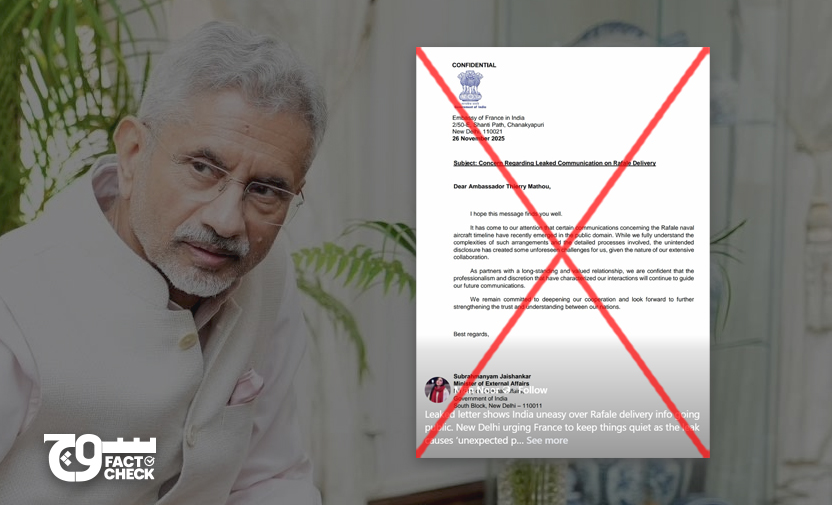
Claim: Indian External Affairs Minister Subrahmanyam Jaishankar has penned a letter to French Ambassador Thierry Mathou about leaked communications pertaining to a deal with France involving Rafale jets. It states that the “unintended disclosure has created some unforeseen challenges for us”.
Fact: The letter attributed to Jaishankar is fake as it has several inconsistencies when compared with his past correspondence. Moreover, no credible news outlet has reported on the alleged leak.
In early December 2025, multiple social media users alleged that Jaishankar wrote a letter to the French Ambassador to India, Thierry Mathou, expressing “concern regarding leaked communication on Rafale delivery” (archived here, here, and here).
Captions accompanying some of the viral social media posts remarked on the impacts of the supposed leak on India’s global standing and diplomatic relations, its claims about transparency and security policy, and the sensitivity of its domestic policy.
Other users commented on how the incident has led to embarrassment for India and “the potential risks such leaks pose to international relations”.
The contents of the purported letter by Jaishankar — marked “confidential” and dated 26 November 2025 — are reproduced below:
“I hope this message finds you well.
“It has come to our attention that certain communications concerning the Rafale naval aircraft timeline have recently emerged in the public domain. While we fully understand the complexities of such arrangements and the detailed processes involved, the unintended disclosure has created some unforeseen challenges for us, given the nature of our extensive collaboration.
“As partners with a long-standing and valued relationship, we are confident that the professionalism and discretion that have characterized our interactions will continue to guide our future communications.
“We remain committed to deepening our cooperation and look forward to further strengthening the trust and understanding between our nations.”
India’s Rafale deal
India signed an “Intergovernmental Agreement” with France for the procurement of 26 Rafale jets for its navy, manufactured by Dassault Aviation, according to a 28 April 2025 press release.
The French Embassy in India stated, “Deliveries of the Rafale M jets will begin in 2028 and are expected to be completed by 2030. Training of Indian Navy aircrew will be conducted in both India and France.”
“The comprehensive agreement also includes training, simulators, associated equipment, weapons, and a five-year Performance-Based Logistics (PBL) support package. It further provides for additional equipment for the Indian Air Force’s existing fleet of Rafale aircraft,” it added.
Mathou, the French ambassador, and Indian Defence Secretary Rajesh Kumar Singh presided over the signing ceremony, with the former terming the deal “a significant new milestone in the strategic partnership between” the two countries. “It also highlights the ability of the French industry to align with India’s evolving needs,” he said.
Fact or Fiction?
Soch Fact Check did not find any verifiable news reports from reputable media outlets regarding such a letter from Jaishankar nor were there any articles on a purported leak of communications surrounding the Rafale deal.
We also observed several inconsistencies in the letter when comparing it with past correspondence from the Indian foreign minister. For example, he writes his name as “S. Jaishankar,” in his official communications, not “Subrahmanyam Jaishankar,” as in the document in the claim.
The Indian FM also includes his signature in such letters, usually on the bottom-right side. Moreover, the dates in such correspondence are usually right-indented as opposed to the viral document.
The purported letter also shows the State Emblem of India on the top-left corner as opposed to its position in the centre in official correspondence. The foreign minister’s designation appears on the top-right corner.
Previous letters show the recipient’s address on the bottom-right corner.
Examples of correspondence from the past can be seen here, here, here, here, here, here, and here for comparison.
Lastly, BOOMLive — which is accredited by the International Fact-Checking Network (IFCN), of which Soch Fact Check is also a signatory — has debunked the letter in question.
We, therefore, conclude that the letter in question is fake.
Virality
Soch Fact Check found the fake letter shared here and here on Facebook, here, here, and here on Instagram, here on TikTok, and here and here on X (formerly Twitter).
Conclusion: The letter attributed to Jaishankar is fake as it has several inconsistencies when compared with his past correspondence. Moreover, no credible news outlet has reported on the alleged leak
Background image in cover photo: @drsjaishankar
To appeal against our fact-check, please send an email to appeals@sochfactcheck.com