
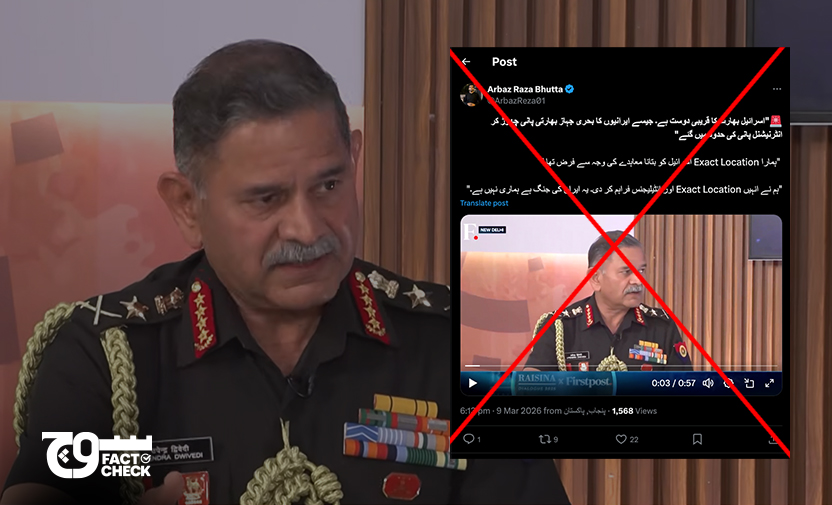
Claim: Indian army chief General Upendra Dwivedi admitted that India shared Iranian warship Iris Dena’s location with Israel.
Fact: The claim is false. The audio in the viral clip was likely synthetically generated and overlaid onto genuine footage of the Indian army chief.
A Facebook user shared a video with the following caption:
“بھارت نے اعتراف کیا کہ اس نے ایران کی پشت پر چھرا گھونپا اور ایرانی جہاز کا مقام اسرائیل کے ساتھ شیئر کیا جسے پھر مار گرایا اور تباہ کر دیا گیا۔
، اسرائیل کے اسٹریٹجک اتحادی ہونے کے ناطے، یہ ہمارا فرض تھا کہ ہم اسرائیل کو اپنے نئے اسٹریٹجک معاہدے کے ایک حصے کے طور پر ان کے مقام کے بارے میں آگاہ کریں۔
جنرل اوپیندر حرامی کتا”
[Translation: India admitted that it stabbed Iran in the back and shared the location of an Iranian ship with Israel, which was then shot down and destroyed. As a strategic ally of Israel, it was our duty to inform Israel about its location as part of our new strategic agreement.
General Upendra]
In the video, the Indian army chief says:
“We are closely monitoring the situation in Iran. Israel is our close ally. Iranian naval ship being sunk is indeed unfortunate, but it was done in international waters. As long the Iranian ship remained in Indian waters, they remained protected, but when they crossed the international waters, as Israeli strategic allies, it was our duty to inform Israel about their exact location as a part of our newer strategic deal. So, you are wrong to assume that Iranian naval ships were destroyed within Indian territory. What Israel does in international waters is their business. We can provide Israel with location or intelligence, but we had no part in Israeli and US joint torpedo attack. They did their business. It is Iran’s war and India has nothing to do with it. Our focus remains on Pakistan and Israel will help us in achieving that goal. We remain grateful to Prime Minister Benjamin Netanyahu for helping us seek permission of importing Russian fuel.”
US-Israel war with Iran
On 28 February 2026, the US and Israel launched coordinated airstrikes across multiple locations in Iran, reportedly targeting military installations and strategic infrastructure. The attacks marked a dramatic escalation in regional tensions and triggered a broader conflict between Iran and US and Israel. In the opening hours of the campaign, a missile strike destroyed the Shajareh Tayyebeh girls’ elementary school in Minab in southern Iran. The strike occurred during school hours and caused the collapse of the building’s roof, killing at least 165 people, mostly schoolchildren, and injuring dozens more. Investigations by international journalists and open-source analysts later indicated that the strike was likely caused by a US Tomahawk missile aimed at a nearby military facility.
Following the airstrikes, Iran retaliated with missile and drone attacks against US military bases and infrastructure across the Gulf including installations in countries hosting American forces. The conflict has also spread to Israeli territory through Iranian missile launches. Over 1,300 have died in Iran while US forces have reported at least 13 military personnel killed during the escalation. The fighting has also displaced millions of civilians, damaged infrastructure across several parts of the region, and caused air travel disruptions around the world.
Iran has also sought to exert economic pressure by disrupting shipping through the Strait of Hormuz – one of the world’s most critical oil transit routes through which roughly one-fifth of global oil and liquefied natural gas shipments pass. Disruptions in the strait have therefore triggered a sharp increase in global oil prices and heightened volatility in energy markets. For Pakistan, which relies heavily on imported fuel from Gulf suppliers, the surge in oil prices has had immediate economic consequences. Rising global prices have already contributed to increases in domestic petrol and diesel prices, while economists warn that prolonged disruptions could widen Pakistan’s trade deficit, place additional pressure on the rupee, and intensify inflation in an already fragile economic environment.
The conflict has also involved maritime incidents, notably the sinking of the Iranian warship Iris Dena on 4 March in international waters off Sri Lanka’s southern coast. According to the BBC, “Indian Foreign Minister S Jaishankar said Iran had sought permission for three of its ships to dock at Indian ports on 28 February – the day the US and Israel began a war on Iran – and permission was granted by India on 1 March.” Iris Dena had at least 130 members on board and was struck by a US submarine resulting in 87 casualties. The incident marked an escalation beyond air and missile exchanges. It raised concerns about the widening scope of the war and its implications for regional security and shipping routes.
Fact or Fiction?
Soch Fact Check reverse-searched keyframes from the viral clip and found the original video shared on YouTube on 7 March 2026 by the Indian news outlet Firstpost. It was titled: “India’s Army Chief Speaks on Op Sindoor, Pakistan and Future of Warfare | Raisina Dialogue 2026.”
In the video, the Indian army chief discussed lessons from Operation Sindoor, India’s evolving military doctrine, and the future of warfare. He highlighted India’s approach to responding to terrorism, organisational changes in the army and emerging domains of conflict such as cyber operations and artificial intelligence. He also spoke about India’s two-front security challenges involving China and Pakistan emphasising the need for preparedness.
However, he did not mention sharing the location of any Iranian naval ship with Israel. A keyword search of his statement also did not yield credible Indian or international media reports supporting the claim.
Suspecting that the video is manipulated, Soch Fact Check tested the clip through DeepFake-O-Meter, which analysed it using multiple AI-based detection models. The results for the video are as follows:

DeepFake-O-Meter results
We used DSP-FWA (2019), which focuses on detecting deepfakes by identifying face-warping artifacts introduced during the deepfake generation process. It rated the video 99.9% fake. This model uses digital signal processing (DSP) techniques to spot inconsistencies caused when synthesised faces are resized and blended into original images or videos.
The video was also tested through the LIPINC (2024) model, which is a deep learning based method to detect lip-syncing deepfakes by identifying the spatial-temporal discrepancies in the mouth region of deepfake videos. This model rated the video 100% fake.
Audio forensics analysis:
Shaur Azher, an audio engineer at our sister company Soch Videos, examined the viral clip by comparing it against the original FirstPost footage.
The spectrograms below show:
Sample A: Footage from the FirstPost
Sample B: Viral clip
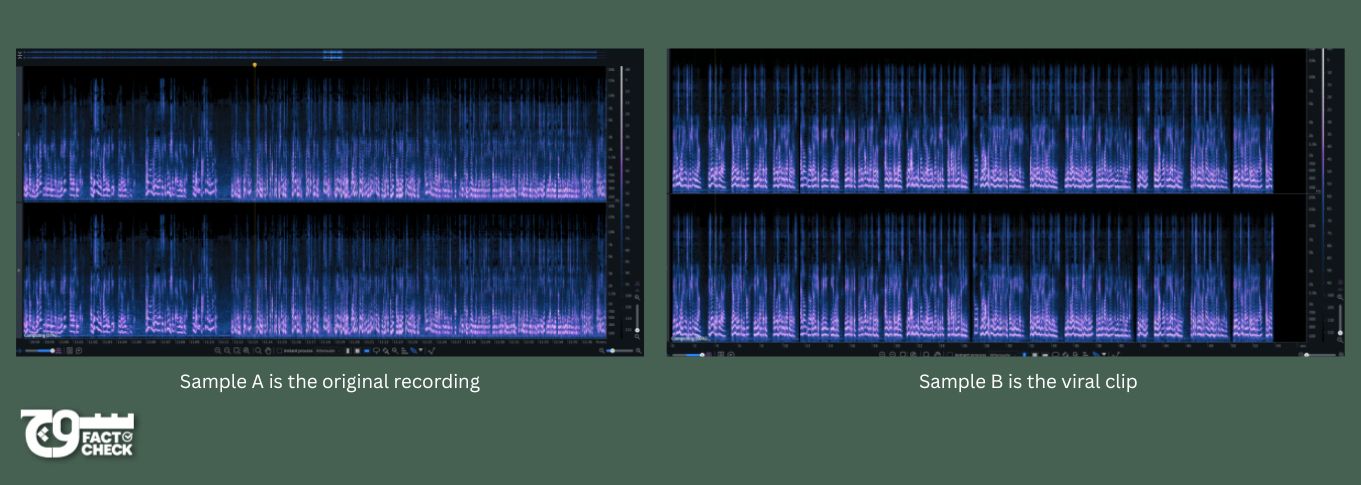
Spectrograms of the original footage and the viral clip
Jitter, shimmer, and harmonic rigidity
Sample A: Visual analysis of the spectrogram demonstrates irregular, organic fluctuations in the harmonic lines. These natural variations in frequency (jitter) and amplitude (shimmer) are consistent with the physiological mechanics of human vocal cords.
Sample B: The spectrogram exhibits abnormally rigid, tightly packed, and uniform harmonic structures. This lack of natural micro-imperfections is a documented artifact of neural vocoders used in text-to-speech (TTS) synthesis, which attempt to mathematically smooth acoustic anomalies.
Pitch contour and breath fingerprints
Sample A: The audio contains organic physiological markers, notably audible and natural inhalations that align temporally with the speaker’s cognitive pauses (e.g., pausing before listing missions). The pitch prosody dynamically matches the emphasis required for the subject matter.
Sample B: The audio exhibits a flat, continuous pitch contour with a monotonous delivery. The pacing lacks the necessary physiological breath pauses required for a human to deliver dense, continuous paragraphs, indicating a synthetic generation pipeline that failed to accurately model respiratory acoustics.
Phase coherence and cepstral coefficients (MFCCs)
Sample A: Phase alignment remains naturally coherent, capturing subtle environmental reverberation and dynamic spectral envelope shifts consistent with human articulation.
Sample B: The audio profile contains slight phase mismatches and a hollow, metallic resonance. This occurs because generative AI models often synthesize Mel-spectrograms first and reconstruct the audio waveform secondarily, resulting in static Mel-frequency cepstral coefficients (MFCCs) that do not properly reflect the dynamic shifting of a human vocal tract.
Azher concluded that the convergence of acoustic artifacts (harmonic rigidity, lack of breath fingerprints, phase distortion) and the highly fabricated geopolitical semantic structure strongly indicate that Sample B was synthetically generated. Conversely, Sample A displays all physiological and acoustic markers of an authentic human recording.
Given that the Indian army chief did not make the statement attributed to him in the original footage, and based on DeepFake-O-Meter results and Azher’s audio analysis, Soch Fact Check concludes that the viral clip is manipulated. It combines an authentic video with synthetic AI-generated audio.
Virality
The viral claim was shared here, here, here, here, here, and here on Facebook. Archived here, here, here, here, here, and here.
On X, it was shared here, here, and here. Archived here, here, and here.
On Instagram, it was shared here, here, and here. Archived here, here, and here.
It was shared here (archive) on Threads.
Conclusion: The viral claim that the Indian army chief admitted India shared Iranian warship Iris Dena’s location, which sank on 1 March, with Israel is false. Synthetic AI-generated audio has been overlaid onto genuine footage of General Dwivedi.
–
Background image in cover photo:
To appeal against our fact-check, please send an email to appeals@sochfactcheck.com