
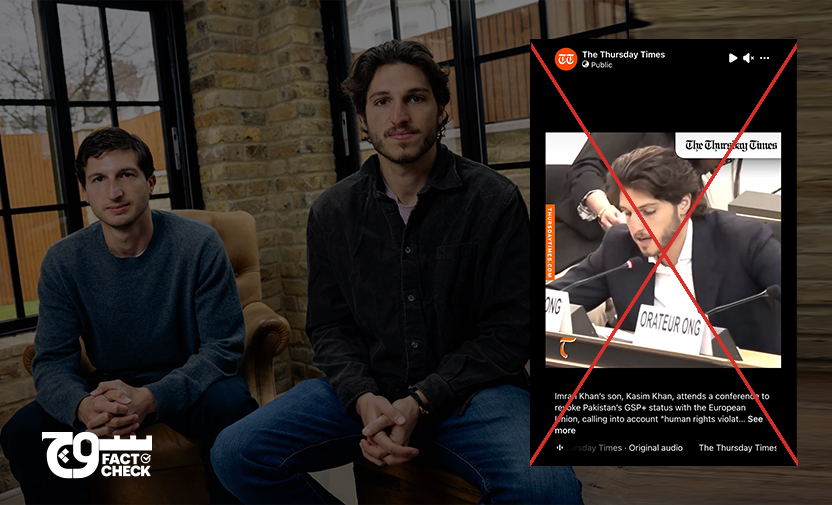
Claim: A video shows Imran Khan’s son Kasim Khan calling for the revocation of Pakistan’s GSP+ status with the European Union at a recent conference.
Fact: The caption of the post makes a false claim. The video is taken from Kasim’s speech during the 61st session of the United Nations Human Rights Council, on March 25, 2026, but nowhere in the clip does he ask for such a revocation. None of the publicly available video recordings of the session in question show him making any such demand either.
The Facebook page of a digital news channel The Thursday Times, shared a video (archive) of Kasim Khan speaking at the 46th meeting of the 61st Session of the United Nations Human Rights Council. The video was shared with the following caption with the following caption:
“Imran Khan’s son, Kasim Khan, attends a conference to revoke Pakistan’s GSP+ status with the European Union, calling into account “human rights violations”: specifically with regard to his father’s imprisonment.”
The caption suggests that the video shows Kasim Khan calling for the revocation of Pakistan’s GSP+ status during his address. However, he asks of no such thing nor does he mention GSP+.
However, another clip from a separate event has been going viral on social media as well. The video is from an event that took place at the sidelines of the 61st session of the Human Rights Council, in which Kasim does mention the GSP+ status in Pakistan, but does not call for its revocation.
In the full version of the session, which is 1:32:52 hours long, available on Pakistan Tehreek-e-Insaaf’s YouTube channel, Kasim starts speaking at the 22:42 mark of the video. His speech is transcribed below as follows:
“I sit before you today. My father, Imran Khan, the former prime minister of Pakistan, has been in detention for 960 days. He sits in a small cell designed for solitary confinement, infested with insects and under constant surveillance. He has been held in these conditions for more than two and a half years. Why? Because he dared to challenge the Pakistani military’s strangle hold on political right. My brother and I have not seen our father since November of 2022. We visited him in Pakistan after he survived an assasination attempt. The last time I spoke with him was a brief phone call cut off prematurely. We go months without any contact. When we recently tried to travel to Pakistan to visit him, the government deliberately refused to process our visas. Denying a prisoner’s children the right to see him is collective punishment. From the limited contact we have, I know my father is suffering, but he refuses to talk about his own conditions. He asks us about us, about our grandmother who passed away last year, and about our lives. That is who he is. So the details of what he endures comes not from him, but independent observers and the United Nations itself. I want to be clear about something. My father’s case is not an isolated incident. It is just the most visible example of a much wider pattern of repression in Pakistan since 2022. As Zulfi [Bukhari] explained, thousands of political prisoners remain in detention. Civilians have been tried and convicted in military courts. Journalists have been silenced, abducted, or driven into exile. The February 2024 elections were rigged to prevent my father’s party from taking over, and that was clear. What I want those present to understand is that my father’s treatment is the military’s test to see what they can get away with. Pakistan made binding commitments under the GSP+ framework to uphold the international human rights conventions ratified, including the international convent on civil and political rights, and the convention against torture. My father’s arbitrary detention, his solitary confinement, the denial of medical care, the blocking of family visits, the trial of civilians in military courts; each of these violate those treaty obligations. My brother and I are not political people. We never wanted to come before bodies like this one, but my father’s life demands that we take action. We cannot stand by as his health deteriorates, and he is kept away from us. If the situation were reversed, we know he would not stop fighting until we were free. That is the very least we can do for him. Thank you.”
Imran Khan’s sons’ campaign
Imran Khan’s sons, Kasim Khan and Sulaiman Khan, presently live with their mother and Khan’s former wife, Jemima Goldsmith. In December 2025, they shared that they had applied for a visa, and are planning to visit Pakistan in January to meet their father as they were concerned that he is being held in a “death cell”.
However, later in an X post, Kasim claimed that the government is deliberately denying them a visa, in which he also expressed grave concerns regarding Imran’s health.
Kasim wrote in his post, “My brother and I are trying to travel to Pakistan to see our father. For 914 days, he has been held in solitary confinement while his health deteriorates and he is denied access to independent medical care. Now the government is deliberately refusing to process our visas. Denying a prisoner treatment is cruel. Denying his children the right to see him is collective punishment.”
Their mother, Jemima, backed Kasim’s allegation on X, and appealed to Prime Minister Shehbaz Sharif directly to allow her sons to visit their father because “his health is in decline.”
She wrote in her post, “My sons Sulaiman & @kasim_khan_1999 applied for visas in January (again… ) to allow them to visit their father @ImranKhanPTI in Pakistan. The Pakistan consulate states that online visa processing normally takes 7–10 working days. It has now been 60 days. This despite the public promise that they could safely travel there to see their father after 4 years, made by both Defence Minister @khawajaMAsif to @mehdirhasan & PM spokesperson @mosharrafzaidi to @SkyYaldaHakim. Meanwhile, they are not allowed to speak to him on the phone, nor send him a letter. They haven’t seen him since 2022 after he was shot in an assassination attempt. This is an appeal directly to Pakistan’s PM @CMShehbaz to please allow Imran Khan’s two sons to see their father asap, particularly since, by all accounts, his health is in decline.”
Information Minister Ataullah Tarrar then replied to Jemima in a quote tweet, stating that Kasim and Sulaiman can visit Pakistan with their NICOP (National Identity Card for Overseas Pakistanis) cards.
He wrote, “Imran Khan’s phone call will be arranged on Eid Day with his children as done in the past as well. His children are welcome to visit Pakistan on their NICOP Cards as Pakistani citizens for which no visa is required. However they will fully comply with the laws of Pakistan during their stay.”
Responding to Tarrar, Jemima claimed that with NICOP cards, her son will have no “British protection.”
She added, “We all know that the reason you are refusing their visas and recommending they travel on NICOP cards (which they don’t have presently) is because that way they will have no British protection if you choose to arrest them on arrival.”
On the other hand, Kasim did speak with Imran Khan, on the occasion of Eid, and shared his message on X.
He wrote: “The judges in this country should be ashamed of themselves. Time and time again we have gone to the judiciary. But they have sold their souls for their paid personal privileges. They have sold their integrity. They know they cannot break me, so they turn to my wife. How can they allow this inhumane treatment to Bushra BiBi, simply to blackmail me. She spends 24 hours a day in isolation, except for 30 minutes with me per week – and even that is often ignored. It is unislamic to harm women, children and the elderly – and their motives are plain and clear. The judges are responsible for the justice in a society. They should be ashamed of themselves.”
GSP+ and its importance
Developing nations are given a specific incentive to “pursue sustainable development and good governance” in exchange for the European Union’s GSP+ (Generalised Scheme of Preferences Plus) designation, which eliminates import taxes on two-thirds of the tariff lines of their exports.
Governments with this status need to implement 27 international conventions pertaining to human rights, labor rights, good governance, and the environment.
According to a 2022 study by the commerce ministry, Pakistan can benefit from duty-free or minimum tariff on European exports, including as clothing, home textiles, and surgical tools, in exchange for adhering to the 27 treaties.
Due to concessional tariffs, Pakistani textile exports increased by 108% after the EU granted the status in 2014. In October 2023, the European Parliament unanimously decided to provide developing nations, including Pakistan, GSP+ status for another four years, until 2027.
Fact or Fiction?
Soch Fact Check visited the United Nations website to access the full-length recorded video of the session, titled “46th Meeting of the 61st Session of United Nations Human Rights Council,” available under the tab of UN Web TV.
During the 02:51:22 hours long video, Kasim Khan starts speaking after the Vice-President of the Human Rights Council, Ms. Riia Salsa-Audiffren, gives the floor to him.
Kasim starts speaking at the 18:08 mark of the video. His speech is transcribed below as follows:
“I am deeply concerned by the alarming rise of intolerance and persecution in Pakistan. We are witnessing a systematic campaign to dehumanise and silence specific segments of the population. My father, Imran Khan, has been in prison for nearly 1,000 days. He is the primary target of a regime that treats dissent, not as political disagreement, but as a grave crime to be crushed. I have not seen my father in over 3 years. He is held in a solitary confinement cell, a cell built for death row inmates. UN experts have warned the inhumane conditions could amount to torture. This is not neglect. It’s deliberate persecution designed to strip a human being of his dignity. The intolerance extends beyond him. Pakistan has expanded its blasphemy laws to life imprisonment, and they have branded citizens as terrorists, fostering a climate of hatred. We ask this council, and the OHCHR, to urge Pakistan to end this persecution immediately. They must comply with the UN working groups opinions, and they must release my father and all political prisoners. Thank you.”
Nowhere in his address does he mention the GSP+ status of Pakistan.
In fact, Barbara Bonte, who is a member of the European Parliament, delivers opening remarks at the session that took place at the sidelines of the 61st session of the Human Rights Council, in which she mentions the GSP+ status of Pakistan, and calls for its suspension.
After introducing the Pakistanis present in the room, which included Dr Nasim Baloch, Chairman of the Balochistan National Movement, former Special Assistant to Prime Minister Zulfi Bukhari, and Kasim Khan, Bonte mentioned that they are present in the room today to address the issue of human rights violations in Pakistan.
She then calls for the suspension of Pakistan’s GSP+ status, on the mark of 5:07: The transcription below is as follows:
“I took part in last year’s UN events on this issue, and I believe the message from that remains valid today. At that time, I said that the European Commission now stands at a crossroads, and my call is clear: Suspend Pakistan GSP+ trade privileges until the country meets its commitments to human rights, minority protection, and genuine educational reform. The time to act is now, and I conclude that suspending GSP+ is not about punishment for its own sake, it is a tool to create leverage for change, and I stand by those words, and I stand by them because the human rights situation is not improving. The concern today is not merely that past commitments have not been fully met, but that in key areas the situation is deteriorating. And yet, while the European Parliament has repeatedly raised concerns, the commission has too often preferred continuity, dialogue and administrative caution over clear enforcement, and that is a contradiction we must confront. The Parliament has spoken, the evidence has accumulated, the mechanism has operated as if renewal defaults; still I remain hopeful. I remain hopeful that the next version of GSP+ will not be treated as an automatic rollover for Pakistan, and I remain hopeful that through the efforts of Parliamentarians, lawyers, journalists, campaigners and victim representatives, the commission will finally apply the principle on which the GSP+ was founded; that trade preferences must be earned, and not pursued. If Pakistan is to continue from the future GSP+ arrangements, it should do so on merits alone; on evidence, on compliance, and on real implementation of the international obligations it has undertaken. That is what is at stake here today. Thank you.”
Most importantly, the recording of the full session shows PTI’s Zulfi Bukhari disagreeing with Bonte’s remarks. In his address during the same session, Bukhari states that contrary to the popular opinion being expressed during the event, he does not agree with the suggestion of suspending the GSP+ status of Pakistan.
At the mark of 19:32, Bukhari says: “I have a contrary belief and opinion to everyone else that has spoken before, and I’m sure many that will speak after me. Pakistan must remain with the status of the GSP+ framework. In fact, more of it is better for the country, in particular for women who work in the export sector. It is the only way where you’ll keep any kind of check and balance when you are in the framework. Suspending the GSP+ status for Pakistan is a disaster, not only for the 250 million people that work so hard and deserve it, but for the country overall for any kind of checks and balances as I mentioned. The GSP+ means a lot to my people, I know it better than most, and I fully endorse it. But what I do say is that the checks and balances must take place, and there must be a better framework to make sure that Pakistan abides by the ICCPR (International Covenant on Civil and Political Rights), the convention against torture, and the ILO (International Labour Organizations) conventions.”
Bukhari then gets cut in the middle by the chairperson who clarifies that the European Commission is not talking about revoking the GSP+ status completely, but is suggesting a suspension i.e. a temporary halt, until the Pakistani government ensures it can abide by the human rights conventions.
However, he again reiterates that it would “affect too many people.”
“Again, let it be a suspension, let it be taking it out of the framework of GSP+, it affects too many lives. We, as Pakistan Tehreek-e-Insaf, have always put our country first, and will always continue to put our country first at whatever cost it may be,” he adds.
Virality
On X, it was shared here, here, here, here, here, here and here.
On Facebook, it was shared here, here, and here.
On Instagram, it was shared here, here, and here.
Conclusion: Based on the official recordings of the Human Rights Council sessions, Kasim Khan did not call for the suspension of Pakistan’s GSP+ status nor did he mention the word “revoke” anywhere.
Background image in cover photo:
To appeal against our fact-check, please send an email to appeals@sochfactcheck.com