
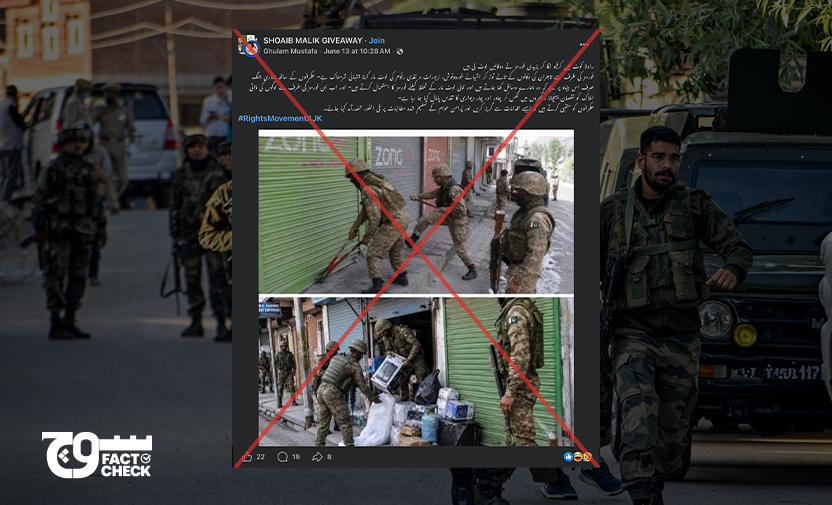
Claim: Two images show soldiers from the Pakistan Army trying to break into the local shops in Rawalakot and loot valuables amid the recent unrest in Azad Jammu and Kashmir.
Fact: These images are manipulated by AI.
On 13 June 2026, Facebook user Ghulam Mustafa posted images that show Pakistani soldiers allegedly looting local shops. The images were posted with the following caption:
“راولا کوٹ میں کرفیو لگا کر یزیدی فورسز نے دوکانیں لوٹ لی ہیں
فورسز کی طرف سے تاجران کی دکانوں کے تالے توڑ کر اشیائے خوردونوش، زیورات و نقدی رقوم کی لوٹ مار کرنا انتہائی شرمناک ہے- حکمرانوں کے ساتھ ہماری جنگ صرف اس بنیاد پر ہے کہ وہ ہمارے وسائل کھا جاتے ہیں اور اپنی لوٹ مار کے تحفظ کیلئے فورسز کا استعمال کرتے ہیں- اور اب ان فورسز کی طرف سے لوگوں کی ذاتی املاک کو نقصان پہنچانا ، گھروں میں گھُس کر چادر اور چار دیواری کا تقدس پامال کیا جا رہا ہے-
حکمرانوں کو متنبی کرتے ہیں کہ ایسے اقدامات سے گریز کریں اور پُرامن عوام کے تسلیم شدہ مطالبات پر فی الفور عملدرآمد کیا جائے۔
[Translation : Yazidi forces have looted shops after imposing curfew in Rawalakot. It is extremely shameful for the forces to break the locks of traders’ shops and loot food items, jewelry and cash. Our war with the rulers is only on the basis that they consume our resources and use the forces to protect their loot. And now these forces are damaging people’s personal property, entering homes and violating the sanctity of the chador and four walls. We warn the rulers to avoid such measures and immediately implement the recognized demands of the peaceful people.]
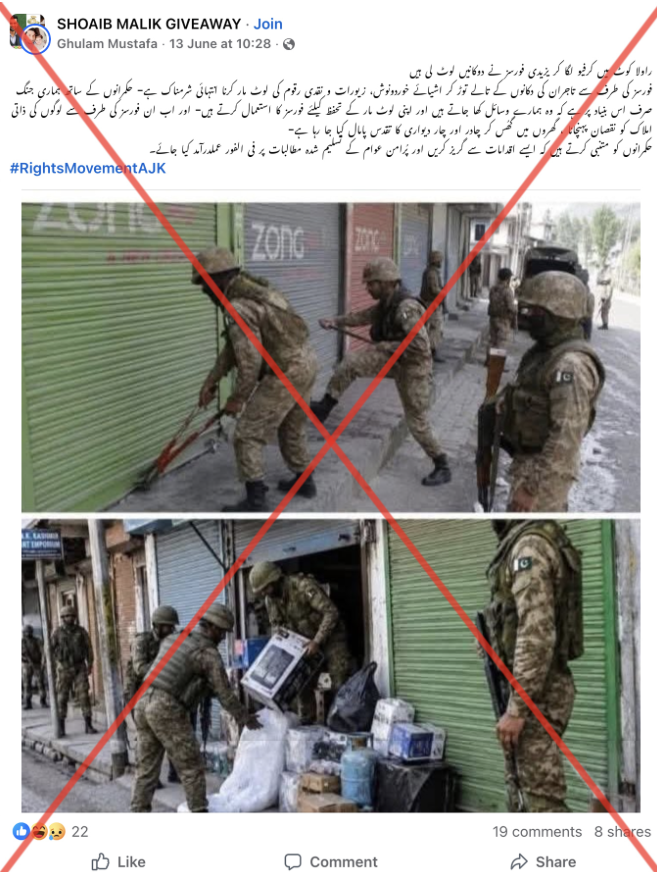 Screenshot from Facebook post
This article only fact-checks the authenticity of the images; we have not independently investigated claims of looting made in the caption
Clashes in Pakistan-administered Kashmir
On 7 June 2026, severe, deadly clashes erupted between law enforcement personnel and protesters in Rawalakot in Pakistan-administered Kashmir when crowds gathered outside the Combined Military Hospital (CMH).
The clashes occurred after police arrived at the location to disperse a sit-in protesting the death of an activist associated with the Joint Awami Action Committee (JAAC), which was designated as a proscribed organisation two days prior.
According to security officials and human rights reports, the ensuing clashes resulted in at least 11 deaths — consisting of protesters and police officers — alongside dozens of injuries.
Over 70, including 23 security officials and 50 protesters, were injured, police chief Liaqat Malik said.
The state-run Pakistan TV reported on 9 June that videos showing an alleged assault on the Azad Jammu and Kashmir (AJK) police personnel in Rawalakot on 7 June and the “desecration” of a deceased officer’s body had surfaced. It termed the incident a “preplanned attack”.
The same day, the AJK government ordered that “sedition charges be filed against [JAAC leader Shaukat Nawaz] Mir and another leader of the group, Mehran Arshad Khawaja, accusing them of inciting rebellion through speeches and online content”. It also announced a reward of PKR 10 million “for information leading to the arrest of four wanted members”.
According to a police statement, initial evidence indicated that “some of the five were in contact with ‘a hostile intelligence agency from a neighboring country’, without providing further details”.
The demonstrations originally took off against the 12 reserved seats in the legislature of Pakistan-administered Kashmir “for refugees from Indian-administered Kashmir who now live in other parts of Pakistan”. The JAAC has also demanded the abolition of these as they are not representative of actual residents of the region.
The AJK Supreme Court then ruled that those 12 reserved seats were constitutionally protected and an amendment was required to abolish them. Prior to that, the May 2026 talks between the JAAC and the government were unsuccessful.
The unrest escalated after the government deployed federal paramilitary forces ahead of a planned region-wide strike, said Amnesty International, which criticised the JAAC’s proscription in its statement as “disproportionate, unlawful, and a violation of the right to freedom of association”.
Amnesty also noted that authorities have targeted journalists reporting on the protests, with Sohrab Barkat arrested over alleged “defamation” and dissemination of “false and fake information”.
Alongside the arrest of over 100 members of the banned group, authorities suspended internet and mobile network signals and issued strict travel advisories restricting movement into the region until 27 July, when regional elections are scheduled. The JAAC’s head office was sealed by the AJK Police, according to the state-run Radio Pakistan.
Mir, the JAAC leader, termed the government actions “a massacre”, while Poonch sector commissioner Sardar Waheed Khan rejected the claim, terming it “misleading” and saying the state was trying to “restore law and order”.
Pakistan TV reported on 14 June that “armed individuals linked to the banned JAAC opened fire on an armoured vehicle during a police flag march in Rawalakot” and showed a video of armed men gathered at an unidentified location.
The state-run channel also reported on an alleged leaked recording between JAAC leader Sajid Azam, also the president of “Trade Union Thorar District Poonch”, and Hameed Kashmiri, a member of the banned group, discussing how they had “five hundred riflemen” ready and that they would demand to “vacate Rawalakot in two hours”.
Local officials reported mid-June that the main protest gatherings in Rawalakot had significantly dwindled, leading to a partial relaxation of curfew-like restrictions to allow for limited commercial hours.
On 18 June, AJK Prime Minister Faisal Mumtaz Rathore said Rawalakot was the “staging ground” of the JAAC’s “Campaign of Chaos” and that, from there, “they planned to march towards Muzaffarabad”.
“Even though the offer for negotiations still stands, we are not in [a] hurry (they should be) and the State will not capitulate. We’ll show flexibility to only those who want to de-escalate and want peace. We fully support the voices that demand fair rights, but we’ll never tolerate those who spread anarchy,” he added.
Fact or Fiction?
For the first step of this investigation, Soch Fact Check reverse-image searched both visuals to try to locate the source. However, the reverse-search did not yield any results.
IMAGE 1 ANALYSIS
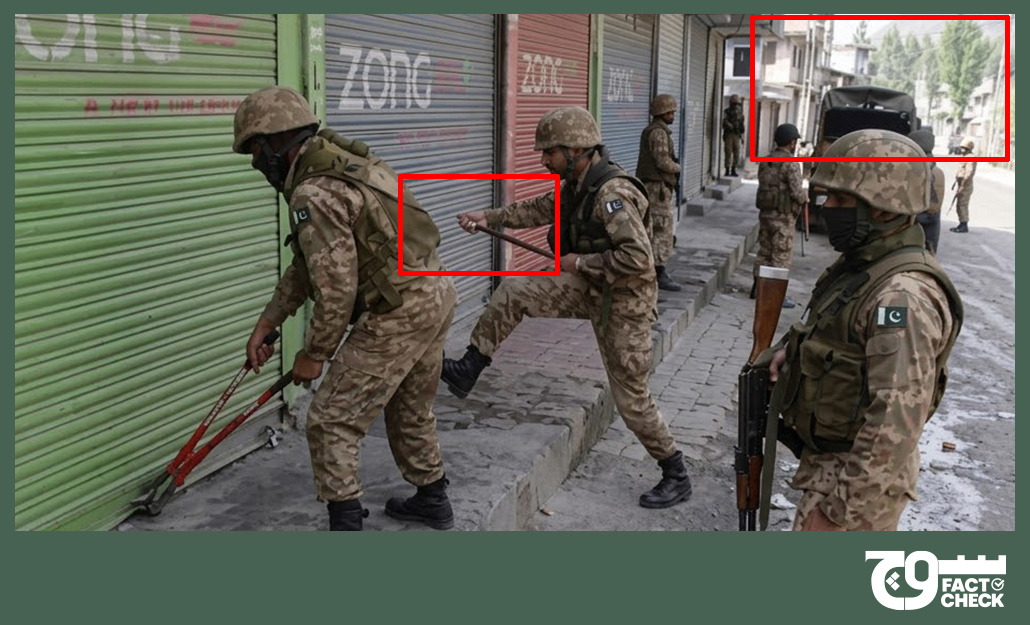 Image 1 showing signs of manipulation highlighted in red
It is more difficult to verify news from the region at the moment, due to the internet blackout in Rawalakot. Soch Fact Check first reached out to an independent journalist Jalaluddin Mughal, who is currently based in Muzaffarabad, and specifically covers Azad Kashmir. He has covered the issues in Azad Kashmir in The New York Times and Urdu VOA. He verified the images and gave his analysis on the picture.
“This image does not appear to be a genuine photograph from Rawalakot for several reasons. First, the mountains visible in the background do not resemble the landscape typically seen around Rawalakot. Second, since a curfew has been imposed from 9 June 2026, and media access to the city has been restricted, it would be highly unlikely for such a photograph to have been taken on a street in Rawalakot during this period and posted on 13 June 2026.
Additionally, the street shown in the image does not look like a location within Rawalakot. I have also been unable to find any credible source verifying the image’s origin. Based on these observations, there are strong reasons to believe that the image is either manipulated or being circulated out of context to misrepresent the current situation in Rawalakot.”
His analysis shows a possibility of the picture being fake, as the reporter’s search, as well as Soch Fact Check’s, was inconclusive.
IMAGE 2 ANALYSIS
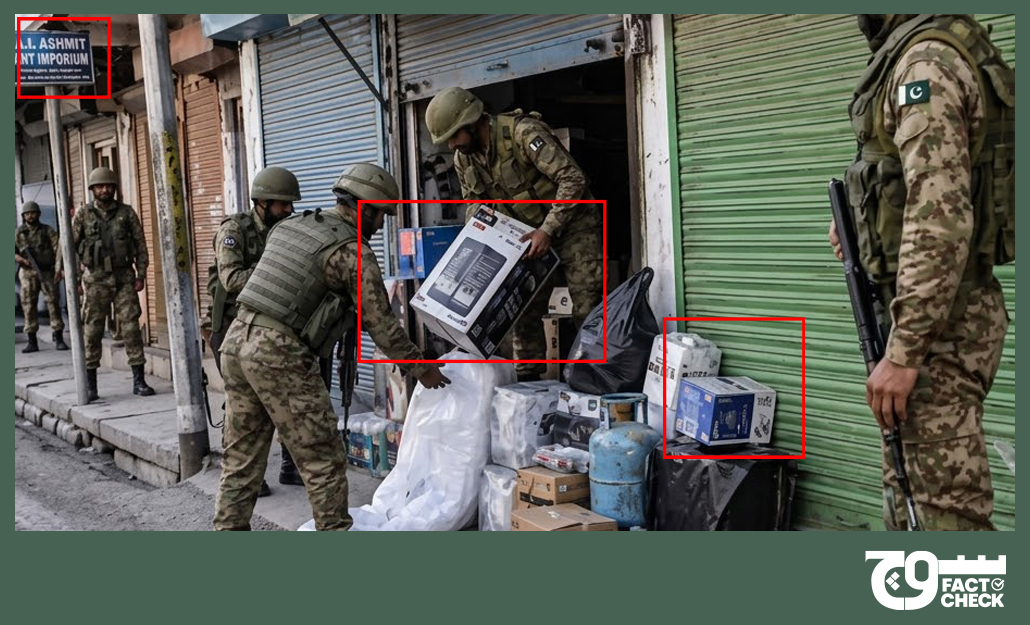 Image 2 showing signs of manipulation highlighted in red
Firstly, we investigated the sign of the shop named “AI Ashmit Imporium” at the top-left corner of the image. A search on Google Maps revealed there is no such store in Rawalakot, which further means that this image has been manipulated.
Soch Fact Check focused on the flag patch on the uniforms of the soldiers: one does not signify the Pakistani flag, and the flag patch on the arm of the soldier holding the box lacks depth and dimension.
Results from AI Detection Tools
According to Google DeepMind , SynthID embeds digital watermarks directly into AI-generated images, audio, text or video. The watermarks are embedded across Google’s generative AI consumer products, and are imperceptible to humans, but can be detected by SynthID’s technology.
OpenAI added the “adding durable cross-platform SynthID watermarking to images through a partnership with Google”, the company announced in May 2026.
To validate the picture as AI-generated, Soch Fact Check ran the image through the OpenAI tool designed to check if it was created using the American company’s artificial intelligence tools.
The results confirmed that a SynthID watermark originating from OpenAI was found in the image, proving that an existing picture has been manipulated or has been modified using AI.
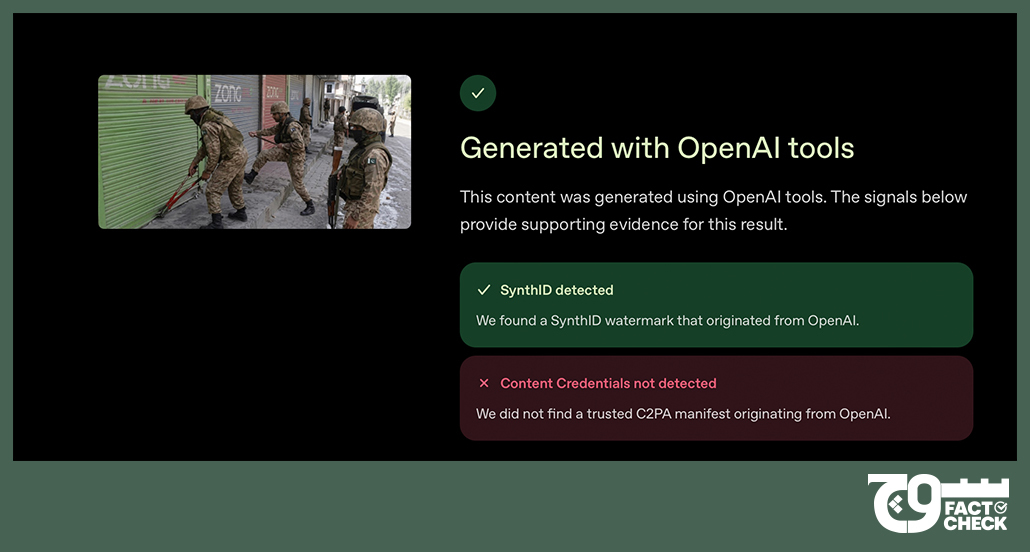 OpenAI identified the presence of a SynthID watermark in the image
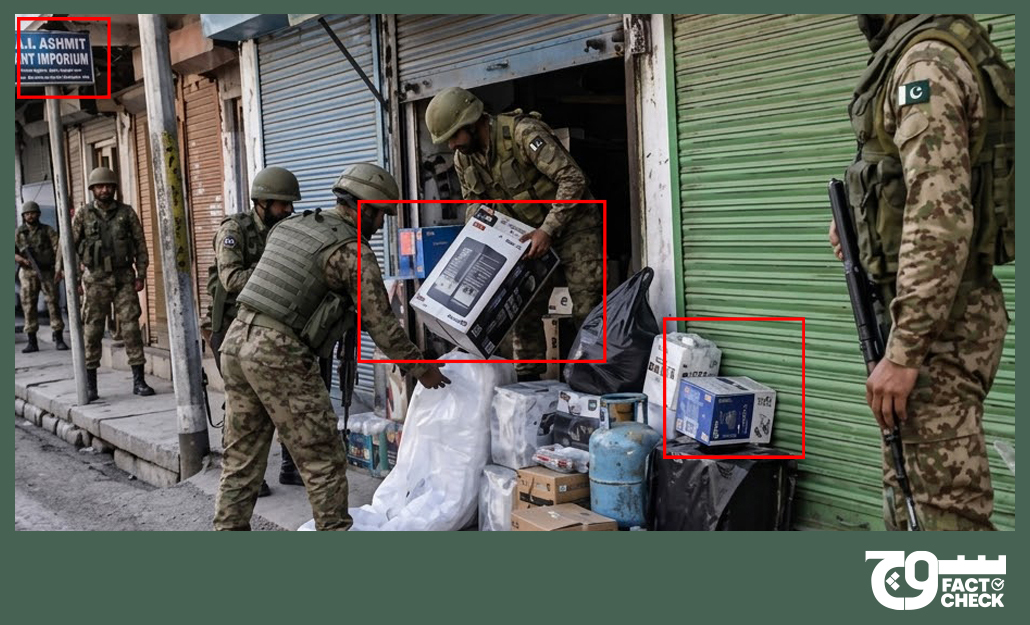 OpenAI’s identified the presence of a SynthID watermark in the image
Therefore, Soch Fact Check concludes that artificial intelligence was used to manipulate an existing photo. Additionally, comments from the journalist, along with our own analysis, suggest that the area depicted in the images is not Rawalakot.
Virality
Upon investigation, Soch Fact Check, only found two posts on X with the most views at 55.7K views with 1.1k retweets.
The post circulated widely on Facebook, with 12 posts found in total. The main claim was posted in a group called ‘Shoaib Malik Giveaway’, which has 83K members.
Soch Fact Check has debunked other fake news surrounding the recent unrest in Rawalakot.
Conclusion: Soch Fact Check concluded that these images have been AI-manipulated.
To appeal against our fact-check, please send an email to appeals@sochfactcheck.com