
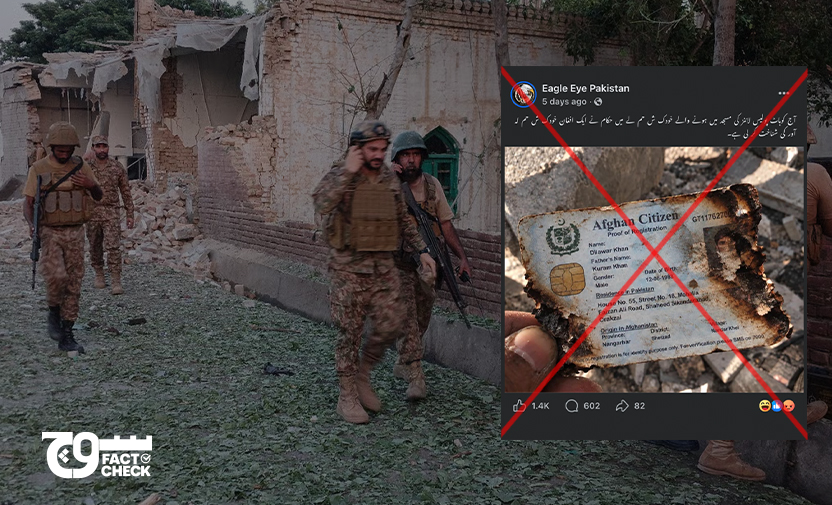
Claim: Image shows the ID card of an Afghan suicide bomber recovered from the explosion site at Kohat Police Lines.
Fact: The image is AI-generated.
On 18 September 2026, a Facebook page named Eagle Eye Pakistan shared an image of a Proof of Registration (PoR) card of an Afghan citizen which was charred from the corner. The caption reads:
“آج کوہاٹ پولیس لائنز کی مسجد میں ہونے والے خودک ش حم لے میں حکام نے ایک افغان خودک ش حم لہ آور کی شناخت کر لی ہے۔”
[Translation: “Authorities have identified an Afghan suicide bomber involved in the suicide attack that took place today at the Kohat Police Lines mosque.”]
Kohat Police Lines attack
On 18 September 2026, a suicide bombing and gun attack killed 23 people, including 17 policemen, and injured over 100 people after an explosives-laden vehicle detonated near a mosque in the Old Police Lines in Kohat, KhyberPakhtunkhwa. The explosion was then followed by terrorists entering the compound. International publications like AFP and DW reported the death toll to be 31.
The KP police stated in an X post that eight terrorists were killed in retaliatory action by police and security forces during an overnight clearance operation.
A local militant group named Ittehad-ul-Mujahideen Pakistan, linked to the Pakistani Taliban, Tehreek-e-Taliban Pakistan (TTP), claimed responsibility for the attack.
In a statement, the Ministry of Information & Broadcasting (MoIB) condemned the “barbaric” terrorist attack during Friday prayers.
“Pakistan has repeatedly raised grave concerns over the use of Afghan territory by Fitna al-Khawarij and other terrorist groups to plan and launch terrorist attacks inside Pakistan. The presence of terrorist sanctuaries, alongside their recruitment and support infrastructure in Afghanistan, poses a direct threat to Pakistan’s security. These concerns have been conveyed repeatedly to the Afghan Taliban regime and their interlocutors. They must dismantle these networks rather than deflect responsibility,” an excerpt from their statement reads.
Fact or Fiction?
Soch Fact Check first looked for credible news reports about an Afghan PoR card being recovered from the site of the explosion but couldn’t find anything. A few visual elements like the warped emblem on the top left corner lacking sharp detailing and the unusually smooth thumb blending around the edge where it touches the card suggested the image might be AI-generated.
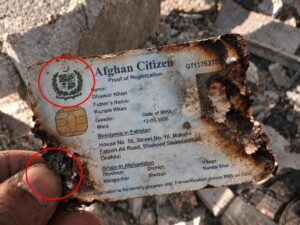 Visual discrepancies in the image under investigation.
We first ran the image through Hive Moderation’s AI-Generated Content Detection tool, which concluded that the image is “99%” likely to be AI-generated.
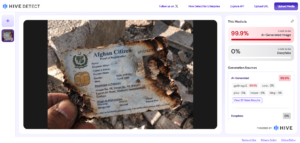 Result by Hive Moderation.
We also ran the image through AI or Not, developed by Bioptic, an American tech company founded by former Google product director Andrey Doronichev.
It gave a rating of 69% AI and 0% deepfake, stating that the image is likely AI-generated.
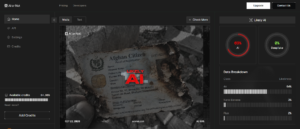 Result by AI or Not.
To confirm the results further, Soch Fact Check ran the image through a tool designed by OpenAI to check if it was created using the American artificial intelligence company’s tools. It confirmed that the picture had been “generated using OpenAI tools,” as it “found a SynthID watermark that originated from OpenAI.”
A SynthID watermark is an invisible logo detected in OpenAI’s verification tool which indicates that the media file (such as an image or audio) was generated using supported OpenAI tools.
 Result by OpenAI.
The absence of credible news reports about recovering a PoR card from the explosion site, the visual discrepancies in the image, and the results from AI detection tools confirm that the image is AI-generated.
Virality
Soch Fact Check first came across a viral X post with as many as 61,100 views and 100 reshares. The image received more views on Facebook where it got 2,300 and 1,400 likes via separate posts.
Conclusion: The image of an Afghan citizen’s PoR card recovered from the explosion site of Kohat Police Lines is AI-generated.
To appeal against our fact-check, please send an email to appeals@sochfactcheck.com