
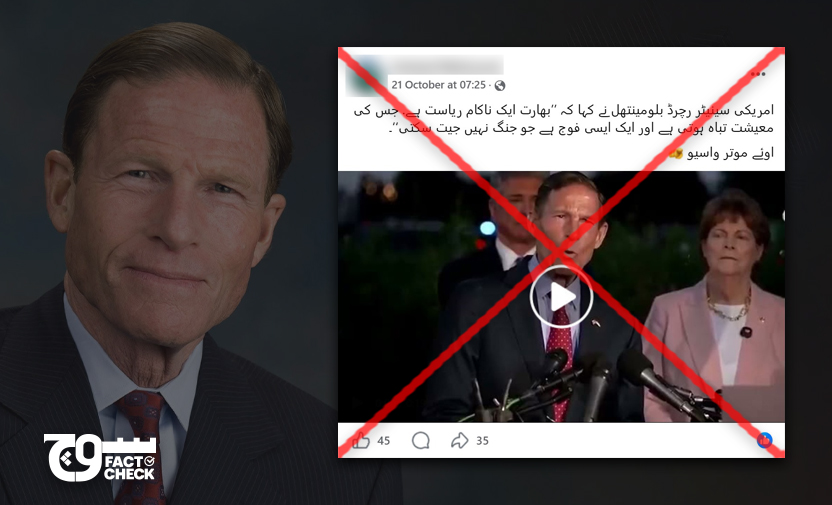
Claim: US Senator Richard Blumenthal has called India “a failed state”, criticising its army for being “a paper tiger that can’t win a single battle” and warning the country to “stop begging for our oil and gas”.
Fact: The video was altered using AI tools, specifically as his lips are synced to the remarks he didn’t make.
On 20 and 21 October 2026, social media accounts shared a video of US Democratic Senator Blumenthal speaking unfavourably about India and criticising its economy and military.
His exact remarks in the purported clip are as follows:
“India is a failed state. Its economy is collapsing and its military is a paper tiger that can’t win a single battle. Stop begging for our oil and gas. Go find someone else to subsidise your incompetent (sic). The world is moving on and India will be left behind exactly where it belongs.”

Screenshot of one of the viral posts
Some of the captions accompanying the video are as follows:
- “امریکی سینیٹر رچرڈ بلومینتھل نے کہا کہ ’’بھارت ایک ناکام ریاست ہے. جس کی معیشت تباہ ہوتی ہے اور ایک ایسی فوج ہے جو جنگ نہیں جیت سکتی‘‘۔ اوئے موتر واسیو 🫵 [American Senator Richard Blumenthal has said, “India is a failed state, with a collapsing economy and an army that cannot win a war.” Hey, you urine-drinkers 🫵]”
- “India is a failed state with a collapsing economy and a military that cannot win a battle,’ said US Senator Richard Blumenthal”
- “امریکی سینیٹر رچرڈ بلومینتھل: بھارت ناکام ریاست، گرتی معیشت اور جنگ نہ جیت سکنے والی فوج کا حامل ہے۔ [American Senator Richard Blumenthal: India is a failing state, with a declining economy and a military incapable of winning a war.]”
Fact or Fiction?
Soch Fact Check suspected the video’s authenticity after observing the waxy texture of Blumenthal’s face, his unnatural expressions, and specifically how his lips are synced to the remarks he didn’t make.These features particularly hint at manipulation using artificial intelligence (AI) tools.
Reverse-searching keyframes from the viral clip led us to X (formerly Twitter) posts by World Is One News (WION) Foreign Affairs Editor Sidhant Sibal — citing the senator as its source — and the Indian National Congress’ (INC) Kerala chapter from 17 September 2026.
Blumenthal’s comments in the X posts were corroborated in a 17 September 2026 article by BBC Gujarati, which wrote that the American politician “advised India and China to buy oil and gas from countries other than Russia” in remarks “after the US House of Representatives passed a bill imposing sanctions” on the country.
We found the original footage of the American politician’s speech on his X account on 17 September and Getty Images here and here.
Sibal and INC Kerala shared the original version of the footage, in which he says, “China and India, to you: You better clean up your act! Buy your oil and gas somewhere else.” The BBC Gujarati article also notes the same.
Nowhere did Blumenthal call India a failed state or make the remarks attributed to him in the viral video.
Deepfake detection tools
To test AI manipulation, we ran the clip through multiple deepfake detection tools such as Deploy Detect (formerly Hive Detect), NVIDIA Synthetic Video Detector, and DeepFake-O-Meter.
According to Deploy Detect’s results, the media “is likely to contain AI-generated or deepfake content”. It found a 90.7% likelihood that the video has AI-generated speech.
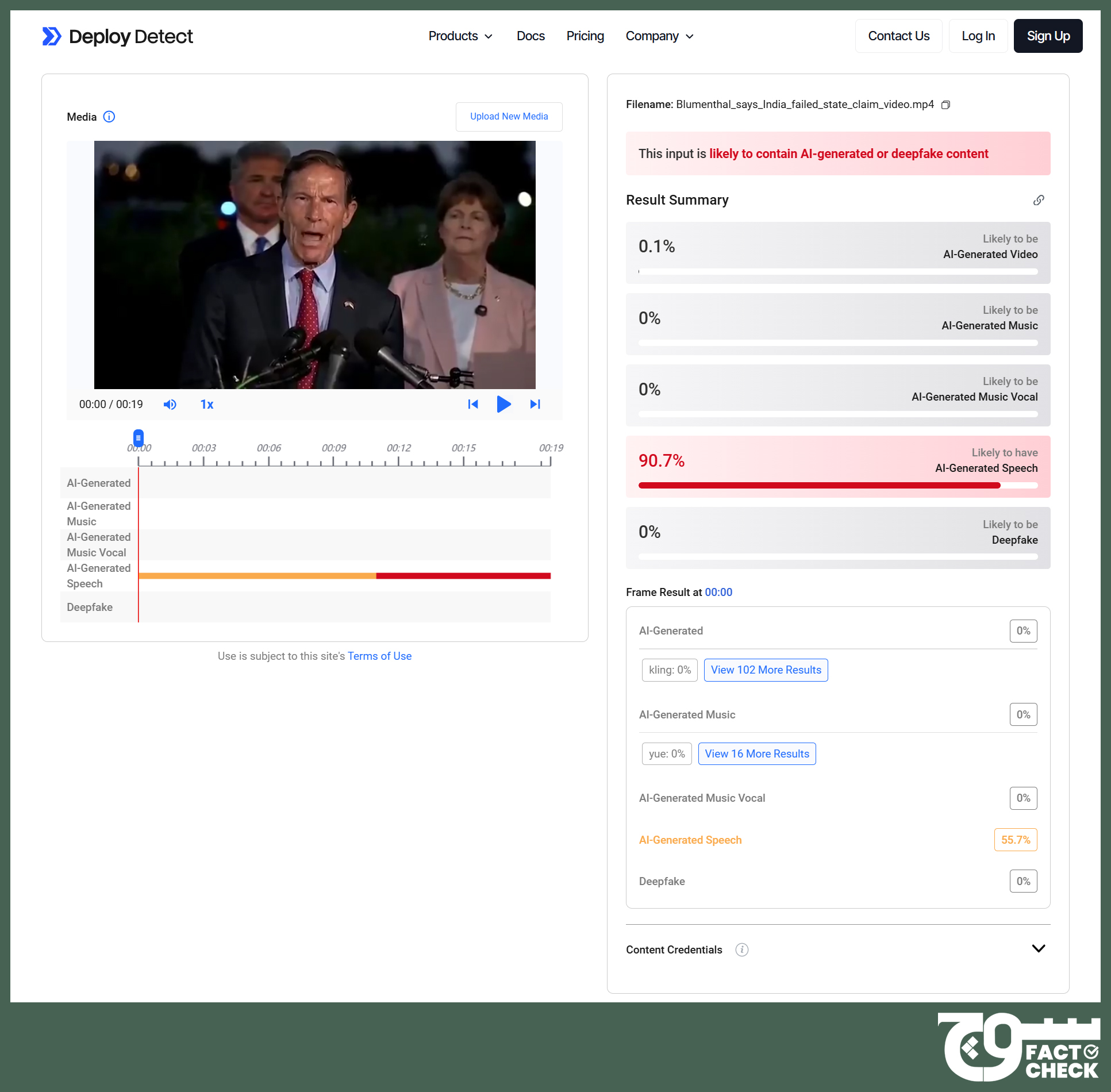
Screenshot of results from Deploy Detect
NVIDIA Synthetic Video Detector also found the sample to be authentic, with a score of 11.3%, which is “lower than threshold (30%), meaning it’s likely a real video”.
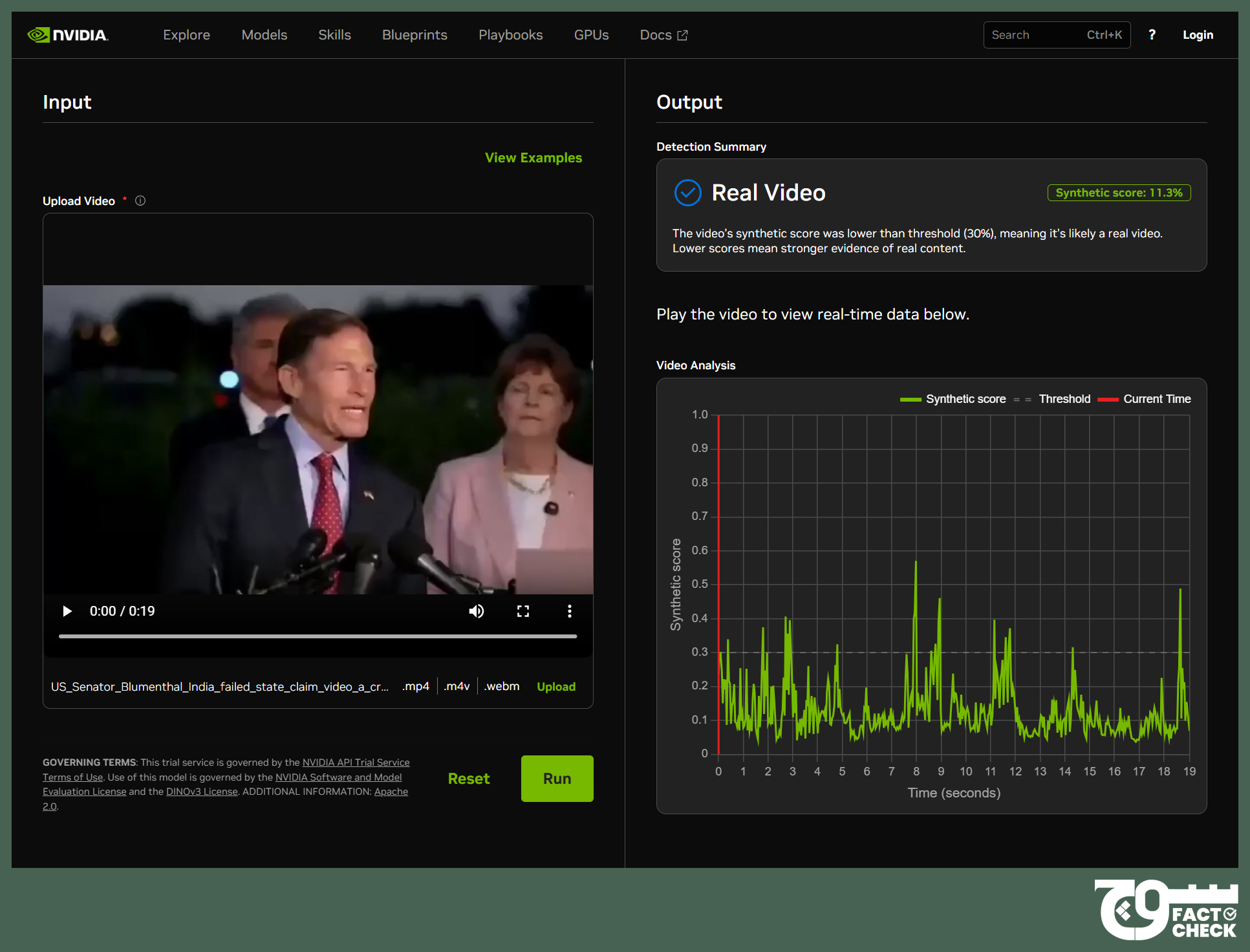
Screenshot of results from NVIDIA Synthetic Video Detector
However, DeepFake-O-Meter found “mixed signals,” with “low” confidence. According to 10 of its detectors that we used, the probabilities of the sample being AI-generated are 99.7%, 61.3%, 46.2%, 37.3%, 32.1%, 29.1%, 27%, 17.6%, 11%, and 0.7%.

Screenshot of results from DeepFake-O-Meter
Although some of the detection tools indicated a low likelihood of AI manipulation, their results were not conclusive. We, therefore, sought an independent assessment from an audio expert, who analysed the clip’s characteristics and compared them with Blumenthal’s original remarks.
Sound engineer’s analysis
We sought a comment from Shaur Azher, a lecturer who teaches sound design and sound recording at the University of Karachi and the Shaheed Zulfikar Ali Bhutto Institute of Science and Technology (SZABIST). He also works as an audio engineer at our sister organisation, Soch Videos, and specialises in mixing and mastering audio.
Azher explained that for comparison purposes, Sample A is the claim and Sample B is Blumenthal’s actual remarks from September 2026. He said differences in the energy and intensity of speech, a lack of ambient noise, elevated loudness, equalisation or synthesis filtering, and a “cluttered” spectrogram are indicative of AI manipulation.
To support his conclusion, he provided a list of observations:
- Constant frequency-band elevation / monotone character: Sample A maintains a far more stable energy distribution across frequency bands, which produces a “constant elevation” and monotone quality. This is quantified by its significantly lower Mel-Frequency Cepstral Coefficients (MFCC) of variation (7.29 versus Sample B’s 11.00 B). Natural speech, by contrast, continuously modulates formant energy and intensity as the speaker moves relative to the microphone and changes articulation.
- Absence of ambience, crowd or traffic noise: The room-tone fingerprint of Sample A is essentially featureless digital residual noise (spectral flatness at 0.106), while Sample B retains structured low-level ambience, with crowd applause and distant traffic components (flatness at only 0.001). This confirms that no ambience-matching process was applied to Sample A, indicating that the background is either synthetic silence or a very clean, unnatural noise floor.
- Integrated frequency range and phase behaviour: Sample A’s effective bandwidth ends near 12 kilohertz (kHz), whereas Sample B extends cleanly to approximately 16 kHz. Phase coherence is higher in Sample A (0.770 vs Sample B’s 0.707), supporting the finding that Sample A is essentially “completely in phase”, while Sample B shows the minor inter-channel offsets expected from a real stereo or spaced-microphone capture.
- Loudness difference (LUFS / RMS): Sample A sits noticeably louder and more compressed, with a root-mean-square (RMS) of approximately -25 decibels (dB), as opposed to that of Sample B (approximately -31 dB), consistent with the -20 Loudness Units relative to Full Scale (LUFS) versus -26.9 LUFS. This elevated and more constant loudness further contributes to the monotone.
- Separate equalization (EQ) treatment visible on both files: The mean-spectrum curves and noise-floor profiles diverge markedly. Sample A has an elevated high-frequency residual energy and a higher average spectral centroid, while Sample B follows a more natural downward slope. These differences indicate independent equalisation or synthesis filtering rather than a shared recording chain.
- Greater spectrum cluttering: Spectrograms and noise-floor analysis show Sample A filling the frequency space more uniformly and densely, producing the “cluttered” appearance. Sample B’s residual spectrum is sparse and structured, typical of a real acoustic environment with natural absorption and distance effects.
Given that Soch Fact Check traced the original speech and obtained a sound engineer’s analysis, which pointed to the use of AI, we conclude that the viral video of Blumenthal criticising India is AI-manipulated.
Virality
Soch Fact Check found the video posted multiple times on social media platforms, including Facebook, Instagram, Threads, and X.
Two Facebook posts in particular were shared in the Chinese language.
We also came across two X posts that appear to be from users who claim to live in India.
Conclusion: The video is altered using AI tools, specifically as his lips are synced to the remarks he didn’t make.
Background image in cover photo: SenBlumenthal
To appeal against our fact-check, please send an email to [email protected]