
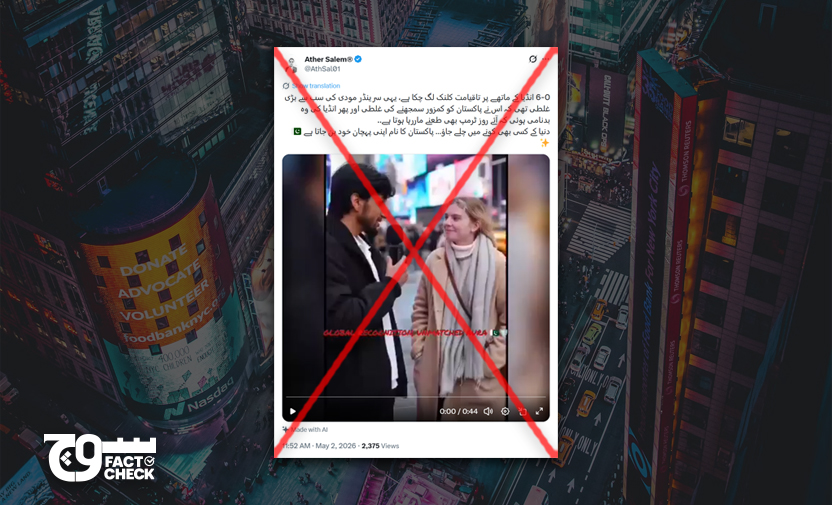
Claim: Americans overwhelmingly prefer Pakistan and its military over India and Israel, according to a video compilation of street interviews.
Fact: The video was generated using artificial intelligence (AI) tools. It has no basis in reality and the original creator’s social media profiles are almost entirely full of AI slop.
On 2 May 2026, X (formerly Twitter) account @AthSal01 posted a 44-second-long video showing a Pakistani man in the United States interviewing people in the streets, primarily in a location that looks like Times Square.
The man, who is not identified in the X post, can be heard asking New Yorkers whether they prefer Pakistan over India and if Pakistan’s military is better than that of India or Israel.
@AthSal01 captioned the video as follows:
“6-0 انڈیا کے ماتھے پر تاقیامت کلنک لگ چکا ہے، یہی سرینڈر مودی کی سب سے بڑی غلطی تھی کہ اس نے پاکستان کو کمزور سمجھنے کی غلطی اور پھر انڈیا کی وہ بدنامی ہوئی کہ آئے روز ٹرمپ بھی طعنے ماررہا ہوتا ہے.. دنیا کے کسی بھی کونے میں چلے جاؤ… پاکستان کا نام اپنی پہچان خود بن جاتا ہے 🇵🇰✨
[6-0 has been branded as a mark of eternal disgrace on India’s image, this was the biggest mistake of Surrender Modi that he made the mistake of considering Pakistan weak and then India faced such infamy that Trump keeps taking jabs at it day after day.. Go to any corner of the world… Pakistan’s name becomes its own identity 🇵🇰✨]”
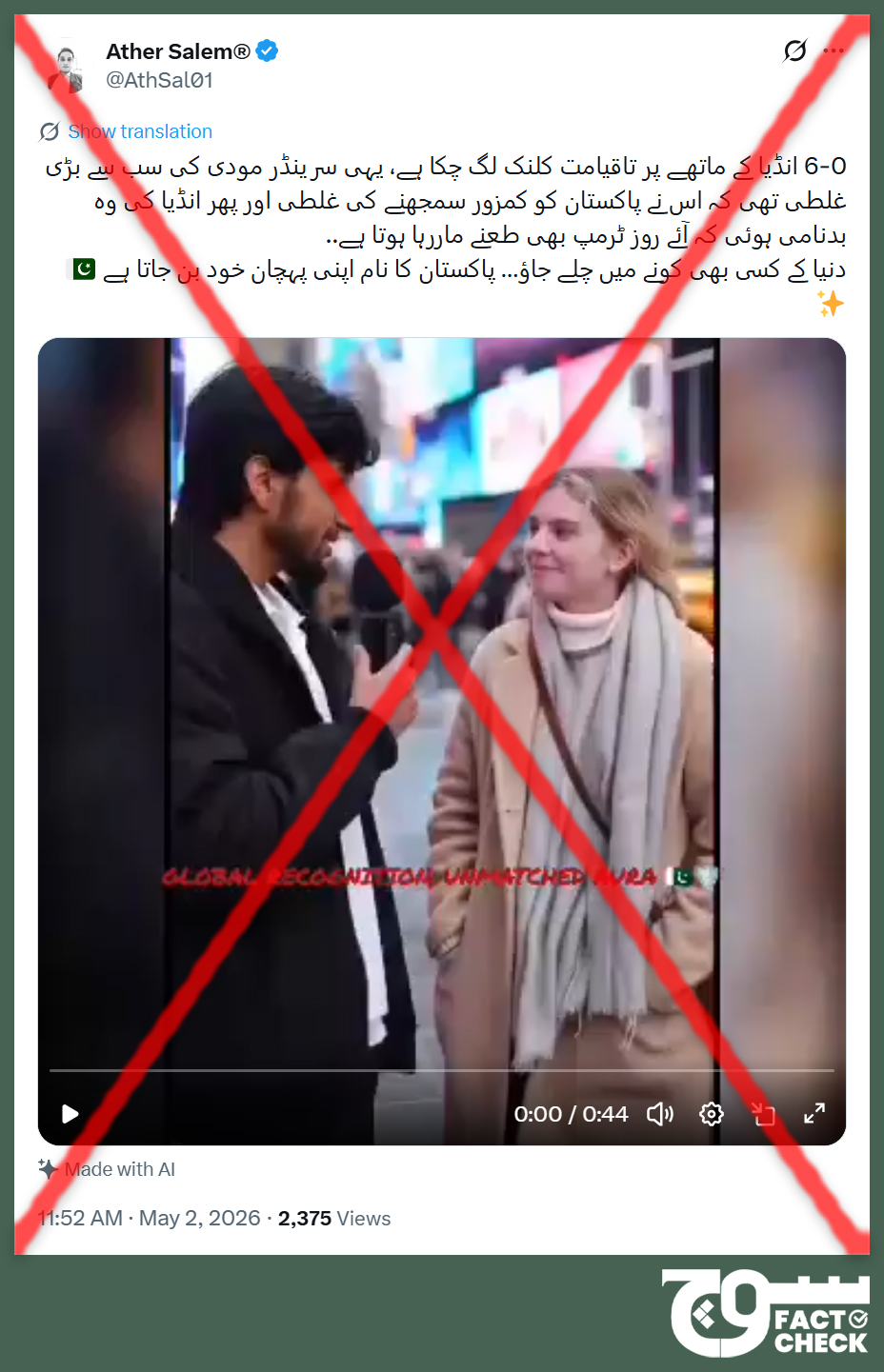
The “6-0” mentioned in the X post’s caption and repeated by the interviewer and respondents is a reference to Pakistan’s claim of shooting down six Indian jets in May 2025.
India-Pakistan conflict of May 2025
In May 2025, India and Pakistan engaged in the most extensive four-day conflict in decades, exchanging drones, fire, shelling, and missiles that brought the two nuclear-armed nations to the brink of an all-out war.
The conflict was triggered by the killing of at least 26 people by assailants at a resort in Pahalgam in the Indian-administered Jammu and Kashmir on 22 April 2025. New Delhi blamed Pakistan for the attack, while Islamabad has consistently denied the claim.
During the conflict, India also sent Israeli-made Harop drones to Pakistan, which were reportedly shot down by the army. Soch Fact Check visited and investigated two crash sites each in Karachi, Rawalpindi, and Lahore; read our on-ground report.
On 10 May, US President Trump announced a ceasefire, which was then confirmed by Pakistan’s Foreign Minister Ishaq Dar and later by India’s Foreign Secretary Vikram Misri.
Trump’s announcement came after US State Secretary Marco Rubio spoke separately to Pakistan Army Chief Field Marshal Syed Asim Munir, Foreign Minister Dar, and Indian External Affairs Minister Subrahmanyam Jaishankar.
On the other hand, Pakistan expressed gratitude to the US, with Prime Minister Shehbaz Sharif thanking Trump “for his leadership and proactive role” as well as Vice President JD Vance and Rubio “for their valuable contributions for peace in South Asia”.
Pakistani, Indian officials say jets downed
Speaking at different events, PM Sharif said Pakistan downed at least six Indian jets. Islamabad has also denied New Delhi’s claims that it suffered any losses of planes but “acknowledged” its bases were hit.
CNN cited “a high-ranking French intelligence official” who told the outlet that “one Rafale fighter jet operated by the Indian Air Force was downed by Pakistan”. Later, Reuters reported that a US official, who spoke to the publication on the condition of anonymity, said “there was high confidence” that Pakistan brought “down at least two” jets.
On the Indian side, multiple top officials have acknowledged losing at least one fighter jet during the four-day conflict with Pakistan, only stopping short of providing a number for the planes.
Gen Chauhan himself has confirmed that India lost fighter jets during the May conflict but did not specify how many of them were downed, according to his interviews with Bloomberg and Reuters at the Shangri-La Dialogue in Singapore.
“What is important is that, not the jet being down, but why they were being down. […] Why they were down, what mistakes were made — that are (sic) important. Numbers are not important,” Bloomberg quoted him as saying. According to Reuters, he said, “What was important is, why did these losses occur, and what we’ll do after that.”
Indian Defence Secretary Rajesh Kumar Singh said in response to a question by CNBC-TV18 about losing fighter planes, “You have used the term Rafales in the plural, I can assure you that is absolutely not correct.”
Captain Shiv Kumar, India’s defence attache to Indonesia, however, acknowledged that some jets were downed. “I do agree we did lose some aircraft,” he said at a seminar in Indonesia, according to The Wire.
Moreover, in response to a question about Pakistan’s claim of downing Indian fighter jets, Indian Deputy Chief of the Air Staff Air Marshal Awadhesh Kumar Bharti stated that his country’s armed forces were “in a combat situation and losses are a part of combat”, Brut India reported. However, he did not reveal any further information.
Fact or Fiction?
Reverse-searching keyframes led Soch Fact Check to instances of the same video posted on Facebook and TikTok, apparently by the same user called “Z 4 ZAFAR”. The former is one minute and 18 seconds long and the latter is nine seconds long; they were shared on 9 April 2026 and 18 February 2026, respectively.
The Facebook caption reads, “Best of the month Feb #PakVsIndia #newyork #publicinterview #Pakistan #army”, while the TikTok post is captioned, “After samash indian 6 jets Pakistan Army is more valuable than any other army my #pakvsind #publicreaction #newyork #pakistan #india”.
The video contains several tell-tale signs of AI-generated content, such as unsynchronised lip movement, unnatural expressions, arms melting into one another, and illegible text.
Sound engineer’s analysis
To corroborate our suspicions about AI-generated content, we reached out to Shaur Azher, a lecturer who teaches sound design and sound recording at the University of Karachi and the Shaheed Zulfikar Ali Bhutto Institute of Science and Technology (SZABIST). He also works as an audio engineer at our sister organisation, Soch Videos, and specialises in mixing and mastering audio.
In his analysis, Azher used examples of authentic interviews conducted at Times Square for comparison purposes. There were “multiple technical anomalies, including impossible SNR [signal-to-noise ratio] metrics of 36 to 46 decibels (dB) for the depicted environment, absence of high-frequency harmonic content above 15,000 hertz (Hz), severe temporal desynchronisation, and statically-locked -14 LUFS [Loudness Units relative to Full Scale] mastering,” he said, leading him to conclude that “the audio is not a genuine field recording”.
He also pointed out several visual inconsistencies, including a change in the microphone in at least eight instances, the interviewer’s mouth hardly moving despite the sound of dialogue at the 0:22-second mark, and “temporal and synchronisation anomalies” between 01:08.75 and 01:18.23.
According to a manual audit of the audio timeline, there were severe synchronisation failures and structural inconsistencies, such as:
- Multiple distinct cuts and visual microphone changes occurred between 00:00.00 and 01:18.23. However, the acoustic profile of the microphone remained identical across all changes.
- A desynchronisation event was observed at 00:19.38.
- Dialogue duplication wherein the phrase “6-0 no rivalry” is repeated identically by different visual subjects — one male and female each — at different timestamps, indicating looped or copy-pasted audio events.
To support his findings, he provided the following observations:
Spectrogram and frequency response
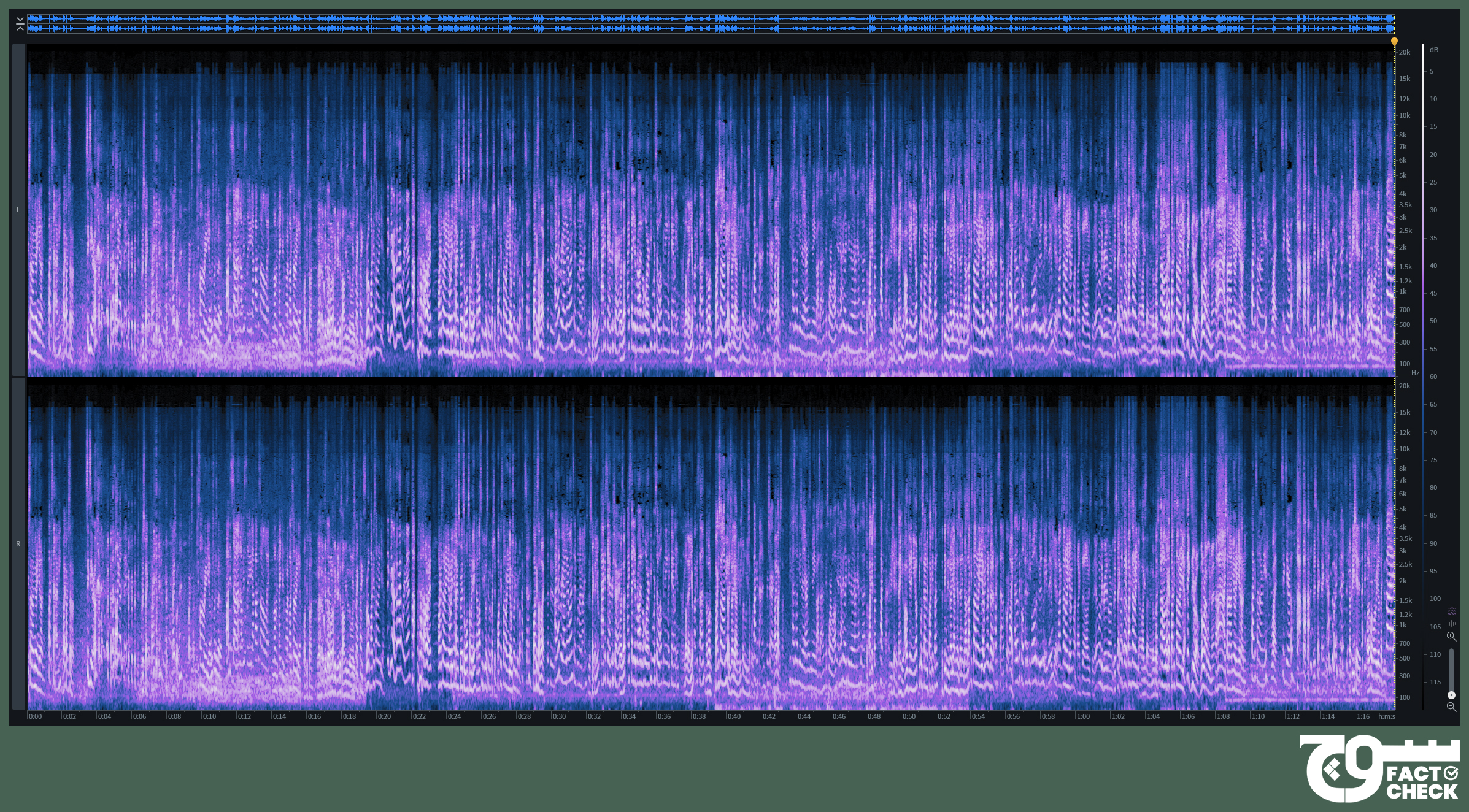
A screenshot of the spectrogram provided by Shaur Azher for the audio extracted from the viral video featuring Zafarullah interviewing Americans
An analysis of the spectrogram screenshot provided reveals a hard horizontal cutoff in the frequency range of 15,000-16,000 Hz.
- Genuine, uncompressed human speech recorded on professional equipment extends into the 20,000 Hz range.
- This specific 15,000 Hz shelf is highly characteristic of bandwidth-limited text-to-speech (TTS) AI generators or heavy lossy compression.
- Furthermore, respiratory artefacts — such as breaths and natural sibilance — are completely absent from the higher frequency bands.
SNR and environmental isolation
The dynamic range of the primary dialogue is statically locked at approximately -14 LUFS — a standard broadcast mastering level — rather than a raw field recording level. Evaluating the environmental authenticity through SNR:
- The dialogue operates consistently near -14 decibels relative to full scale (dBFS), while the ambient noise floor rests heavily suppressed between -50 and -60 dBFS.
- This results in an estimated SNR of 36 dB to 46 dB. Achieving this level of isolation in an environment with a high sound pressure level (SPL) like Times Square — typically 70 to 80 dB SPL ambient — with visibly distant microphones violates fundamental acoustic physics. The background noise is a secondary, independent audio layer.
Jitter and shimmer
- Human vocal folds naturally exhibit a jitter (pitch micro-fluctuation) of 0.5-1.5%. The monotonous delivery indicates observed values well below 0.5%, pointing toward synthetic generation.
- Natural human speech shimmers (volume micro-fluctuation) between 3.0 and 5.0%. The lack of micro-dynamic volume changes suggests artificial generation, with observed values likely falling under 2.0%.
Mel-Frequency Cepstral Coefficients (MFCC) analysis
A MFCC analysis maps the specific digital fingerprint of the human vocal tract (throat, tongue, and lips). While the video depicts individuals of different genders and physical bodies, the identical acoustic properties of their voices strongly suggest that high-order MFCC extraction yields identical underlying acoustic models. The mathematical vocal tracts producing these sounds do not match the visual subjects, confirming the same voice engine or actor was used across multiple visuals.
Phase coherence and proximity effect
Despite visual evidence of the microphone moving relative to the subjects, there is zero alteration in the audio signal’s proximity effect, low frequency buildup or phase alignment. The physical distance between the sound source and the receiver does not correlate with the recorded audio.
Deepfake detectors
Additionally, we ran the video through different deepfake detection tools to strengthen our conclusion about the video being AI-generated.
To test the video in Hive Moderation, we broke it down into three clips less than 30 seconds each. Each snippet, according to the tool, “is likely to contain AI-generated or deepfake content” with probabilities of 99.4%, 99.9%, and 99.9%, respectively.
In DeepFake-O-Meter, a tool developed by the University at Buffalo’s Media Forensics Lab (UB MDFL), we used seven detectors, which yielded probabilities of the video being AI-generated of 100%, 100%, 100%, 99.8%, 97.7%, 69.4%, and 62.9%.
Soch Fact Check also tested the viral clip in Global Online Deepfake Detection System (GODDS), a tool developed by Northwestern University’s Security & AI Lab (NSAIL) that uses a combination of various models along with human analysis to provide a holistic summary of the results.
GODDS used 22 deepfake detection algorithms for the visual content and 70 for the audio component, while two trained analysts also examined the clip.
All predictive models for the visual and audio content said the video “is likely to be fake”:
- The video is likely to be fake with a probability above 0.5, according to seven of the 22 predictive models; it is likely to be fake with a probability below 0.5, according to the 15 other predictive models.
- The audio is likely to be fake with a probability above 0.5, according to 63 of the 70 predictive models; it is likely to be fake with a probability below 0.5, according to the seven remaining predictive models.
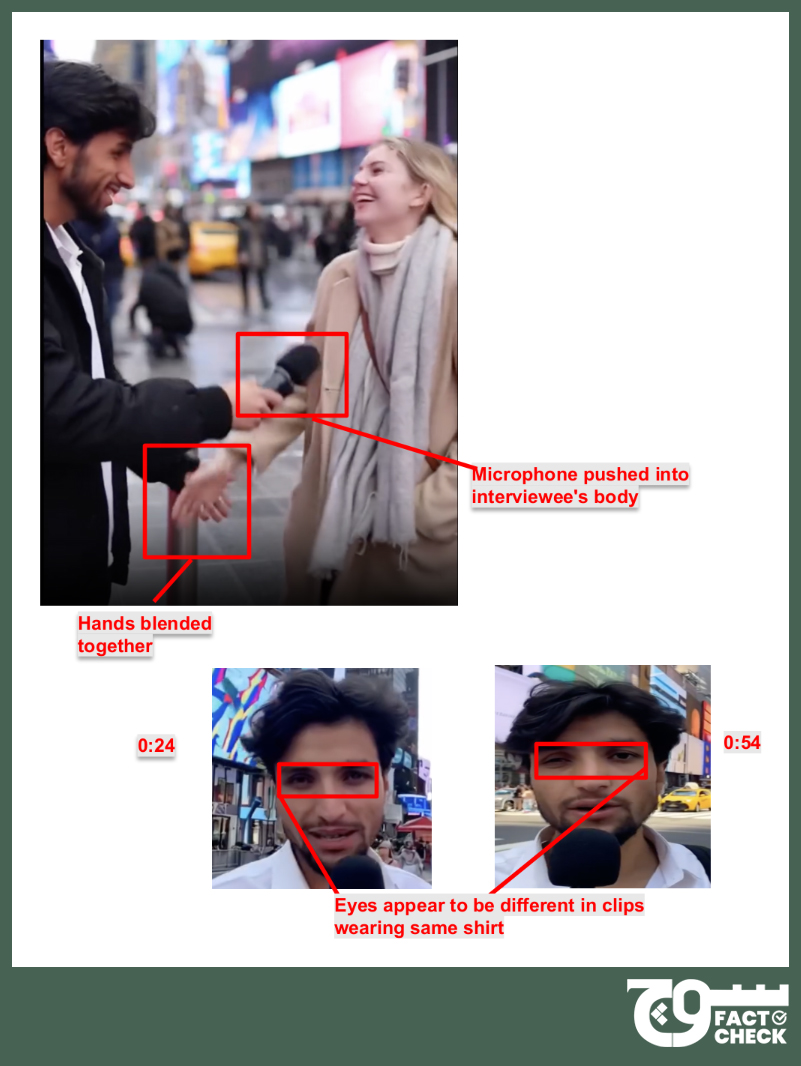
Screenshot of some tell-tale markers of AI-generated content, as identified by the Global Online Deepfake Detection System (GODDS) analysts
According to GODDS’ human analysts, the video contains “several indicators” that show it may be digitally manipulated via AI. For example:
- The hands are blended together at the 0:05 mark and the interviewer seems to have two right hands at the 0:06 mark
- Between the 0:06-0:08 marks, the interviewer appears to push the microphone into the interviewee, which is abnormal for interviews.
- From the 0:24 to the 0:54 mark, the interviewer’s eyes change frequently, but the outfit remains the same, suggesting the same person.
- Between the 0:27-0:28 marks, the interviewee suddenly changed while the background traffic remained the same, suggesting a discrepancy in the video.
- The voice of the interviewee appears distorted from the 0:37 to the 0:39 mark.
- At the 0:31 mark, the text on the background advertisement panel is unintelligible and does not look like English characters, while Times Square advertisements are usually in English.
- Between the 0:47-0:48 marks, the person on the left carried a pouch that did not exist in the previous scene, suggesting a discrepancy.
- At the 1:05 mark, the interviewer’s left ear appears to be indented inwards, which is not commonly seen among regular humans.
The GODDS analysts further noted that due to the high volume of content that Zafarullah creates, “it is likely that there would be greater news coverage were this media authentic”; however, “this video could be part of a larger pattern of misinformation”. They concluded, “We believe this media is likely generated via artificial intelligence.”
Soch Fact Check, therefore, concludes that the video is AI-generated and does not show real American people or their views on Pakistan.
Pakistani AI slopper
When Soch Fact Check scoured through the Facebook, TikTok, and Instagram profiles of Zafarullah, which is his actual name according to his first video posted on 19 May 2025, it turned out that he has uploaded similar AI-generated content. Almost all of it includes interviews of foreigners, specifically New Yorkers, about their views on Pakistan, with the respondents almost always praising the country and somehow slipping in “6-0” in their replies.
This is called “AI slop,” which is mass-produced, low- to mid-quality content — including video, images, audio or text — generated using AI “often with little regard for accuracy” as “it’s fast, easy, and inexpensive to make” and “exploit(s) the economics of attention on the Internet”, according to The Conversation.
According to a 2024 investigation by 404 Media, a “popular way to make money spamming Facebook is by being paid directly by Facebook to do so via its Creator Bonus Program, which pays people who post viral content”. However, Meta announced it would remove “monetisation privileges and stop recommending content from accounts that repeatedly post unoriginal content to the company’s platforms”, Forbes reported in 2025.
In a blog post, the World Economic Forum (WEF) wrote that the purpose of AI slop is “to provoke you to engage, comment, and share”. And it needs to be “just good enough to attract and keep users’ attention”, as seen in multiple instances, thereby letting such creators earn money from platforms that offer monetisation, The Conversation added.
When creators see their content going significantly viral, some of them may add a strategic narrative to “influence public debate or manipulate people” and their perception, leading to what the DW Akademie terms as “slopaganda”.
DW Akademie’s senior consultant Steffen Leidel, who heads its community of practice on AI, says slopaganda is “an endless stream of cheaply-generated, emotionally-charged AI content flooding spaces and eroding trust”.
Interestingly, Pakistanis becoming AI sloppers — a term for people who almost persistently use generative AI tools to create all their content — is not new but has been written about recently. A 2026 article in The Guardian about a deep-dive by the Bureau of Investigative Journalism (TBIJ) revealed that creators in South Asia are making videos and images that boost “far-right talking points in Britain and contribute to the increasingly hostile atmosphere for immigrants”.
“They’re part of a booming cottage industry producing commercial AI slop,” the publication wrote, adding that the investigation focused on “two very successful ‘sloperations’ targeting British audiences from Pakistan and Sri Lanka”.
“They make money from the online ads that Meta places next to high-performing content. Meta shares a proportion of the ad revenue with the creators and also makes direct payments to creators to reward posts that receive a lot of engagement,” it added.
Regarding the creator of the video in the claim, Soch Fact Check noted that Zafarullah, whose posts have accumulated hundreds of thousands of views, has 200,000 followers cumulatively across the three social media platforms. The man created his Facebook page in April 2025 and appears to have started making such AI-generated videos in February 2026, uploading one almost every two to three days.

Screenshots of Zafarullah’s Facebook, Instagram, and TikTok profiles
Despite evidence in his posts through May 2025 to January 2026 that suggest he has been in Pakistan, the creator has set the location of his current city and hometown as “New York, NY, United States.”
Meta allows creators to earn through various programmes and Zafarullah himself has posted a reel to show he received “3 bonus at the same time”, meaning he is enrolled in one or more of these. Nonetheless, he has claimed that his content is not AI-generated.
Virality
Soch Fact Check found that the clip has been shared by dozens of social media users across Facebook, Instagram, YouTube, TikTok, and X.
Reels by the original creator — Zafarullah — who often splices and merges snippets from one video into another have raked in millions of views in total.
X posts carrying the same video have garnered over 14,000 views, while those on TikTok have gained more than 1,500 likes.
Conclusion: The video is generated using artificial intelligence (AI) tools. It has no basis in reality and the original creator’s social media profiles are almost entirely full of AI slop.
Background image in cover photo: Andre Benz
To appeal against our fact-check, please send an email to appeals@sochfactcheck.com