
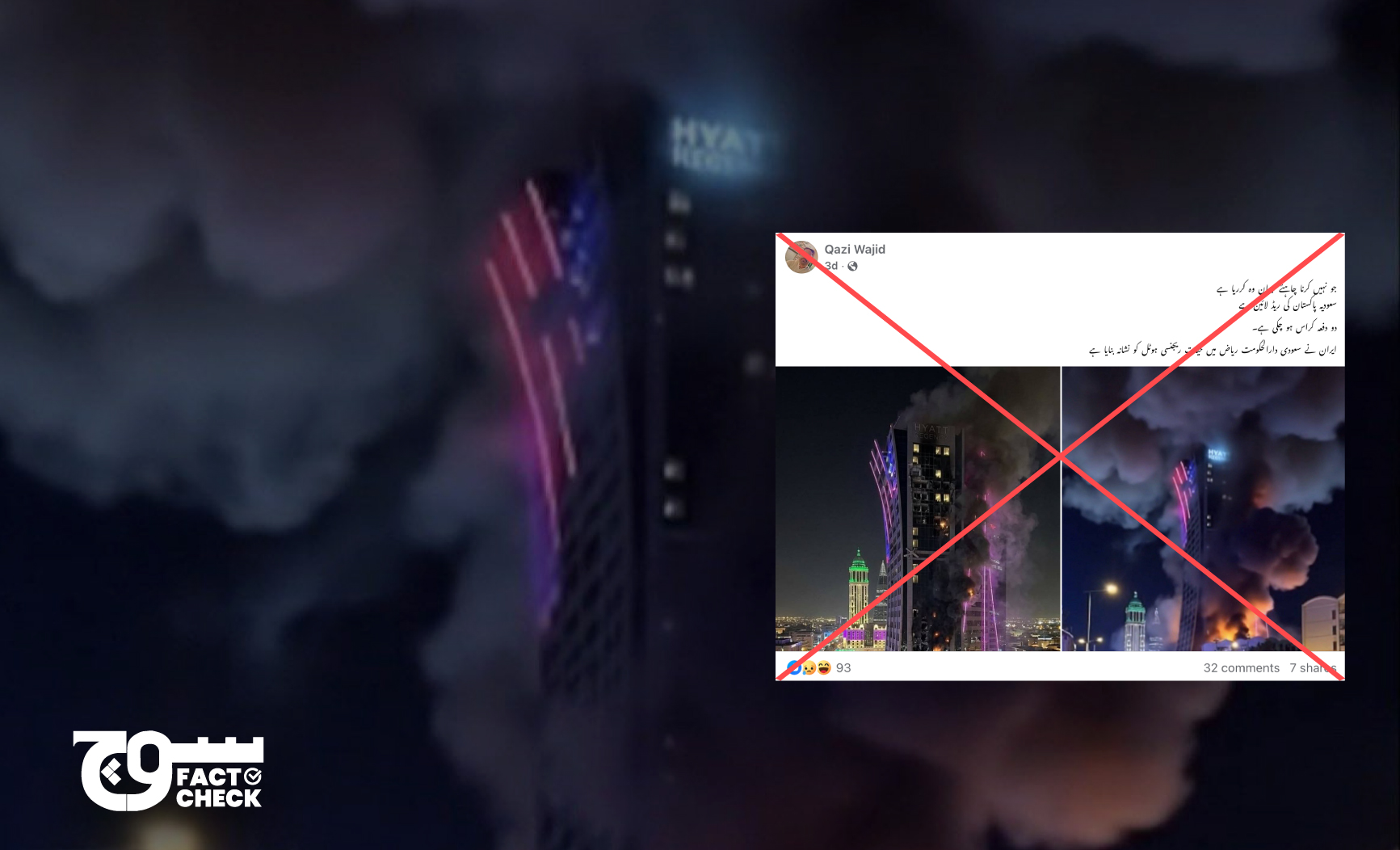
Claim: A viral image circulating online claims to show a hotel in Riyadh, Saudi Arabia, burning after it was hit by an Iranian missile.
Fact: The image is AI-generated and does not document a real missile strike or a verified incident.
On 2 March 2026, Facebook user Qazi Wajid shared an image showing a high-rise building engulfed in smoke and flames, with the caption:
“جو نہیں کرنا چاہیئے ایران وہ کر رہا ہے
سعودیہ پاکستان کی ریڈ لائن ہے
دو قدم سعودی کو پیچھے ہونا ہے۔
ایران نے سعودی دارالحکومت ریاض میں حیات ریجنسی ہوٹل کو نشانہ بنایا ہے”
[Translation: “Iran is doing what it shouldn’t. Saudi Arabia is Pakistan’s red line. Saudi has to step back two steps. Iran has targeted the Hyatt Regency hotel in Riyadh, the capital of Saudi Arabia.”]
The post presents the visuals as evidence that Iran attacked the Hyatt Regency hotel in Riyadh.
US–Israel strikes on Iran and the retaliation wave
The current wave of viral, high-stakes content around Iran is unfolding against the backdrop of a rapidly widening conflict that began on 28 February 2026, when the United States and Israel launched strikes on targets inside Iran. US officials framed the campaign as necessary to degrade Iran’s nuclear and missile capabilities and protect US partners and Israel from what Washington described as an escalating threat. However, reporting citing briefings to US lawmakers said the Pentagon told Congress there was no intelligence suggesting Iran was preparing to attack US forces first, complicating the administration’s public rationale for the operation.
Iran responded with retaliatory missile and drone attacks across the region. Coverage described strikes or attempted strikes in multiple Gulf states, particularly those hosting US forces, as well as incidents in and around Saudi Arabia. In the aftermath of the initial strikes, Iranian state media confirmed the death of Iran’s Supreme Leader Ayatollah Ali Khamenei and announced a formal mourning period. The opening phase of the operation also targeted senior Iranian officials: President Donald Trump claimed dozens of leaders were killed (including a public figure of 48), while Iranian outlets and reporting confirmed the deaths of Khamenei and several senior figures, including key military and security officials.
As the conflict escalated, rights groups and media reports described mounting casualties and extensive damage, including to civilian infrastructure. By 4 March, one rights group estimate cited by major financial media put the civilian death toll in Iran at more than 1,100. Reporting also documented attacks affecting non-military sites, including the strike on the Shajareh Tayyebeh girls’ school in Minab, and damage to civilian facilities such as the Gandhi Hospital area in Tehran. Pakistan condemned the widening regional escalation and urged de-escalation; as the conflict spread, Deputy Prime Minister and Foreign Minister Ishaq Dar also warned Iran against attacking Saudi Arabia, citing a Pakistan–Saudi security pact.
The conflict has also triggered a fast-moving information environment, with claims spreading faster than verification and recycled visuals circulating with limited sourcing, conditions that have fuelled misinformation. This article fact-checks one such example: a viral image claiming an Iranian missile struck a hotel in Riyadh.
Fact or Fiction?
Soch Fact Check analysed the attached visuals to determine whether they support the claim. Notably, the post provides no video footage of the alleged strike and relies only on still images, which do not show the moment of impact or establish what caused the fire.
In addition, Soch Fact Check searched for credible news reporting on any missile strike in Riyadh matching the claim, but found no verified reports from major outlets or official statements confirming that a hotel had been hit. We also conducted reverse image searches of the circulated visuals to assess whether they had appeared previously or been published by reputable media organisations; these searches did not surface any matching coverage from credible sources, suggesting the images were circulating primarily on social media rather than through verified reporting.
A closer review of the images shows anomalies consistent with AI-generated or AI-manipulated content. Most obviously, the smoke appears unusually uniform and “painterly,” lacking the natural transparency gradients and chaotic dispersion typically seen in real fire scenes. The boundary where the smoke overlaps the building also shows blending artifacts, with portions of the edges appearing slightly warped and fine details becoming smeared.
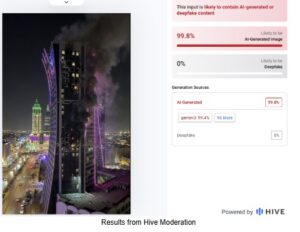
Multiple AI detection tools said it is AI-generated. Hive Moderation rated the image at 99.8%, which means that the photo is “likely to contain AI-generated or deepfake content”.
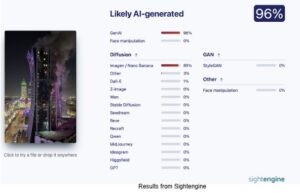
Sightengine returned a score of 96%, indicating a high likelihood of the image being AI-generated.
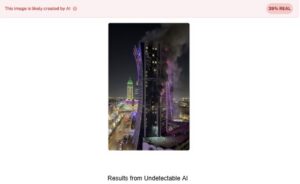
Another tool, Undetectable AI, returned the result “38% real,” which means that “this image is likely created by AI.”
The viral image does not provide credible evidence of a missile strike in Riyadh. The results of three AI-detection tools, combined with visible inconsistencies in the visuals, and the absence of credible news reports confirming such an incident, lead Soch Fact Check to conclude the images are likely AI-generated
Virality
Soch Fact Check found the AI-generated image being shared on X (formerly Twitter) here, here, here, and here.
On Facebook, the claim circulated here, here, and here
On Instagram and Threads, the image appeared here, here, and here
Conclusion: The image being shared online claiming that the Hyatt Regency Riyadh was struck by an Iranian missile is likely AI-generated. The viral posts provide no video evidence of a strike and rely only on still images, which do not establish what caused the fire.