
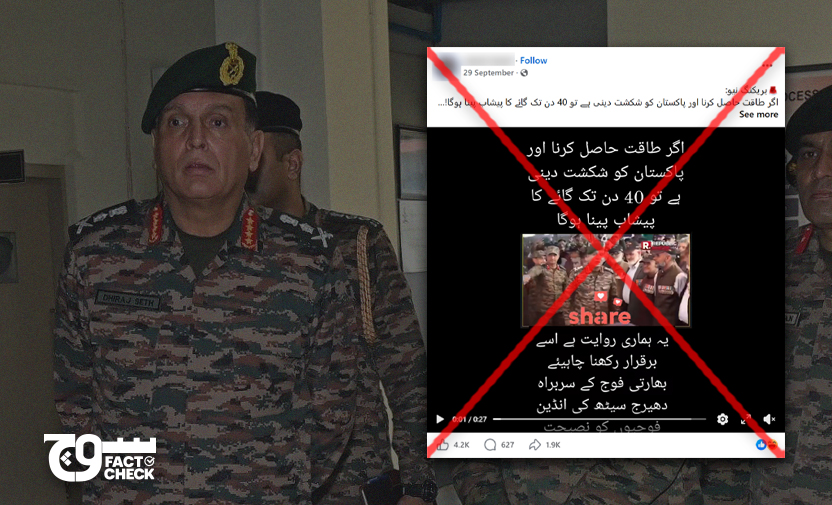
Claim: A video shows Indian Army Chief Gen Dhiraj Seth recounting an incident from the 1965 war with Pakistan when a major “survived on cow urine for 40 days”, saying that is “how a well-respected army behaves” and urging soldiers to “keep this practice alive”.
Fact: Gen Dhiraj Seth’s speech is doctored. In the original video, which is from 25 September 2026, he did not make any such remarks and, instead, spoke to veterans and patients at a surgical camp at the Forward Surgical Center (FSC) Tangdar in Karnah in Indian-administered Kashmir.
On 28 and 29 September 2026, social media accounts and users shared a video of Indian Army Chief Gen Dhiraj Seth addressing a crowd of men and recounting an incident from the 1965 war with Pakistan when a major “survived on cow urine for 40 days”.
Gen Seth then observes that that incident shows “how a well-respected army behaves” and says, “I believe our modern army men must keep this practice alive.”
His full remarks are as follows:
“Well, you know, in our days, we had no food, no water. There has been a famous incident of Major Rajendar Pratap Singh; it is said that he survived on cow urine for 40 days in war against Pakistan in 1965. He was thirsty and a cow came and he kept her in his bunker for 40 days to counter Pakistani gunners. This is how a well-respected army behaves. I believe our modern army men must keep this practice alive.”
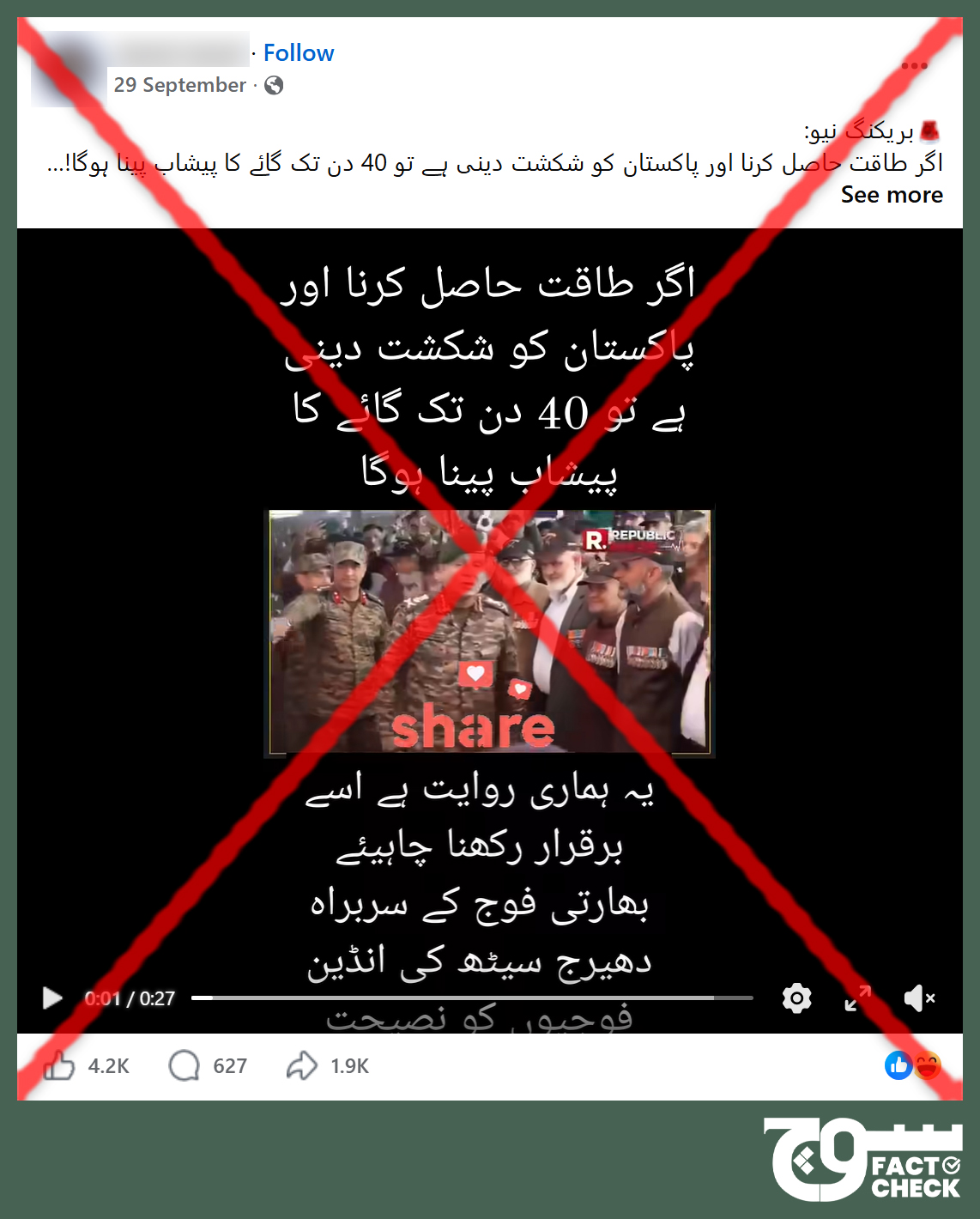
Screenshot of one of the viral posts
Some of the captions accompanying the viral posts are as follows:
- “🚨بریکنگ نیو: اگر طاقت حاصل کرنا اور پاکستان کو شکشت دینی ہے تو 40 دن تک گائے کا پیشاب پینا ہوگا! کیونکہ میجر راجیندر پرتاپ نے 1965 کی @جنگ کے دوران 40 دن تک گائے کا پیشاب پیا تھا۔ کیونکہ ہمارے پاس کچھ کھانے پینے کو نہیں تھا۔ یہ ہماری روایت ہے اسے برقرار رکھنا چاہیئے بھارتی فوج کے سربراہ دھیرج سیٹھ کی انڈین فوجیوں کو نصیحت۔۔۔۔🐂 موواآآآآآآ😅🤣😂😅😉 ایسی غلیظ قوم اور ایسے غلیظ ناپاک مشرک دشمن سے ہمارا واسطہ ہے۔ [🚨 Breaking News: If you want to gain strength and defeat Pakistan, you must drink cow urine for 40 days! This is because Major Rajendar Pratap drank cow urine for 40 days during the 1965 war because there was nothing else for us to eat or drink. This is our tradition and it must be upheld. Indian Army Chief Dhiraj Seth’s advice to Indian soldiers… 🐂 Moo-ooo-ooo! 😅🤣😂😅😉 We are dealing with such a filthy nation and such a vile, impure unbelievers’ enemy.]”
- “پاکستان کو شکست دینے کیلئے 40 دن گائے کا پیشاب پینا کا پڑے گا ، بھارتی فوجی سربراہ کا بڑا بیان [To defeat Pakistan, one would have to drink cow urine for 40 days, a major statement by the Indian Army Chief.]”
- “اگر ہم نے پاکستان کو شکست دینی ہے تو 40 دن تک گائے کا پیشاب پینا ہوگا، کیونکہ میجر رنجیندر پرتاپ نے 1965 کی جنگ کے دوران 40 دن تک پیشاب پیا تھا۔ 😂😂😂😂 یہ ہماری روایت ہے اسے برقرار رکھنا چاہیے۔بھارتی فوج کے سربراہ دھیرج سیٹھ کا بیان. [If we want to defeat Pakistan, we must drink cow urine for 40 days, because Major Rajendar Pratap drank it for 40 days during the 1965 war! 😂😂😂😂 This is our tradition and it should be upheld. Statement by Indian Army Chief Dhiraj Seth.]”
Fact or Fiction?
Soch Fact Check found Gen Seth’s remarks to be odd and noted that his bodily movements did not appear to match what he was saying either. Moreover, the clip includes a forward-to-rewind effect — a video-editing feature also known as the ‘bounce’ or ‘boomerang’ effect — at the 22-second mark when it starts playing in reverse despite the Indian army chief speaking continuously.
We also observed a ‘Republic Pulse’ logo on the top-right of the video and found a homonymous Facebook page that describes itself as “your source for real-time updates, political insights & ground reports from Kashmir and around the world”.
The Facebook page posted the original video on 25 September 2026; the matching bodily movements start approximately at the 0:13 mark and end at the 0:39 mark. The clip is accompanied by the following caption:
“Chief of the Army Staff (COAS) General Dhiraj Seth, PVSM, UYSM, AVSM, visited Karnah, Kupwara, and interacted with Ex-Servicemen and veterans in the forward area. During the visit, the COAS also witnessed the ongoing OP DRISHTI Mega Eye & Cataract Surgical Camp at FSC Tangdar, highlighting the Indian Army’s commitment to the welfare of veterans and communities in remote border areas.”
Using the aforementioned information, we found similar footage of Seth’s visit posted on 25 September 2026 on the X (formerly Twitter) accounts of local Indian news outlets Asian News International (ANI), Press Trust of India (PTI), and Gulistan News.
According to ANI’s post from the same date, the Indian army chief “visited the Advanced Surgical Eye Camp being conducted by [the] Indian Army under Op Drishti 2026. The initiative provides specialised ophthalmic care to Serving Personnel, Veer Naris, Veterans, Dependents and civilians, particularly those in remote and difficult-to-reach areas of Jammu & Kashmir”.
Moreover, Kashmir News Observer (KNO) reported on 25 September that he “interacted with veterans and ex-servicemen and took note of their welfare and healthcare-related concerns during his visit to the forward area”.
Gen Seth did not make the remarks attributed to him in the viral social media clips in any of the videos cited above.
Sound engineer’s analysis
Suspecting manipulation through artificial intelligence (AI) tools, we sought a comment from Shaur Azher, a lecturer who teaches sound design and sound recording at the University of Karachi and the Shaheed Zulfikar Ali Bhutto Institute of Science and Technology (SZABIST). He also works as an audio engineer at our sister organisation, Soch Videos, and specialises in mixing and mastering audio.
Azher explained that for comparison purposes, Sample A is the claim and Sample B is the ‘Republic Pulse’ video from 25 September 2026. The two files “differ technically but are acoustically consistent with each other”, he said, adding that the differences he noticed indicated that they underwent “different encoding and processing chains but do not show which file, if either, is synthetic”.
“The two files are very close on tonality, room tone, and long-term spectrum [as noted in a list of observations below]. Neither shows splice points, vocoder-style periodicity lines or overly-smoothened spectral trajectories. The breath test found no clear events in either file.
“Some differences lean slightly one way or the other. Sample A has more natural-looking stereo behaviour and pitch variability, while Sample B has a smoother high-frequency structure and a perfectly mono signal. Each of these can be explained by ordinary re-encoding, normalisation or capture conditions, so none of them is decisive.
“In light of the evidence provided, it is determined that the two videos are distinct but the first four of the 13 observations below indicate likelihood of manipulation. The last point suggests that Sample A is likely an AI deepfake, as opposed to Sample B, which is an authentic recording,” he added.
To support his findings, he provided the following list of observations:
- In Sample A, the frequency range is from 20 hertz (Hz) till 13,000 Hz, whereas in Sample B, it goes up to 18,000 Hz, proving that the latter is a raw broadcast recording.
- The Loudness Units relative to Full Scale (LUFS) for Samples A and B are at -14 decibels (dB) and -11 dB, respectively. This shows that the mic gain was increased on a boom microphone attached to the camera for the general’s dialogue pickup. This method is used if there are multiple people and the speaker’s remarks are supposed to be clear.
- Spectral cluttering is observed between 10,000 and 13,000 Hz in Sample A but absent in Sample B.
- In Sample A, the frequency bands are highly elevated from 20 to 3,500 Hz, whereas in Sample B, they seem mildly elevated throughout the spectrum.
- The tonality is highly similar in both Samples A and B.
- The room tone of Sample A matches that of Sample B, i.e., it remains within 1 and 3 dB below 5,000 Hz. This means that Sample A is not a dry voice with no background.
- Sample A has no gaps, apart from 0.14 seconds of digital silence at the very start of the file.
- The Mel-Frequency Cepstral Coefficients (MFCC) trajectories of Sample A are not overly smoothened.
- There are no vocoder periodicity lines in either file.
- Neither file shows confirmed breath sounds, so the relevant test doesn’t identify a significant difference.
- Natural stereo behaviour: Sample A’s channels are independent above 4,000 Hz (coherence 0.53 at 4,000 to 8,000 Hz). A mono vocoder output doesn’t produce this on its own, so Sample A appears to have gone through a real capture or stereo encode. A lossy re-encode can do the same, so this would be moderate at best.
- More natural speech dynamics: Sample A’s pitch variability is higher (46 Hz vs 32 Hz standard deviation) and its MFCC trajectories change faster (delta spread 2.12 vs 1.93). Reduced variability is sometimes seen in synthetic speech, though it also depends on what is being said.
- Sample A contains straightforward speech as the general is speaking to the group of men around him; however, in Sample B, Seth’s audience responded to him after he asked them questions.
Deepfake detection tools
We ran the viral video through multiple deepfake detectors such as Hive Detect, NVIDIA Synthetic Video Detector, DeepFake-O-Meter, and DetectVideo AI.
According to Hive Detect’s results, the sample “is 0.3% likely to be [an] AI-generated video”.
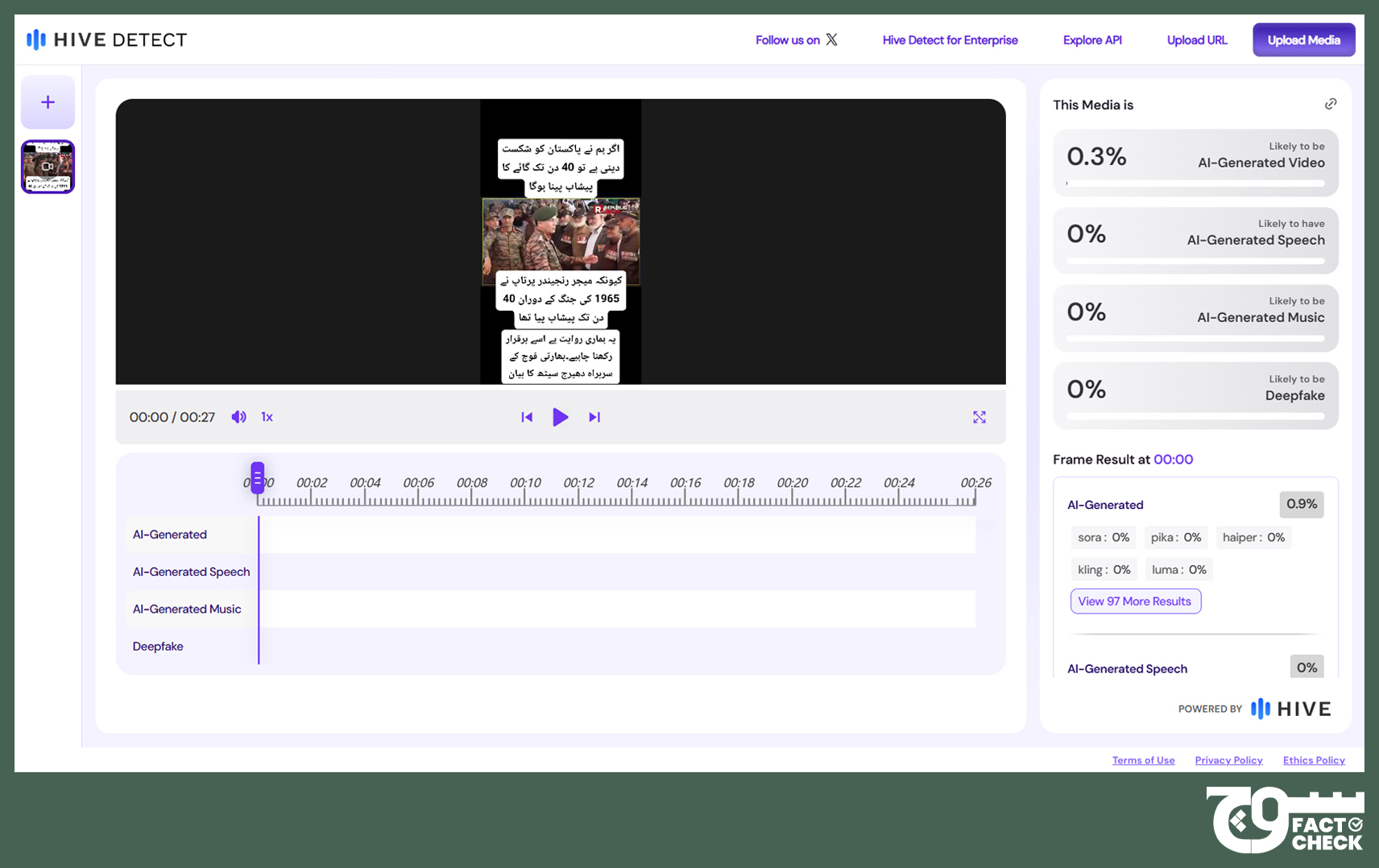
Results from Hive Detect
NVIDIA Synthetic Video Detector said the sample is authentic, with a synthetic score of 17.7%, which is “lower than threshold (30%), meaning it’s likely a real video”.
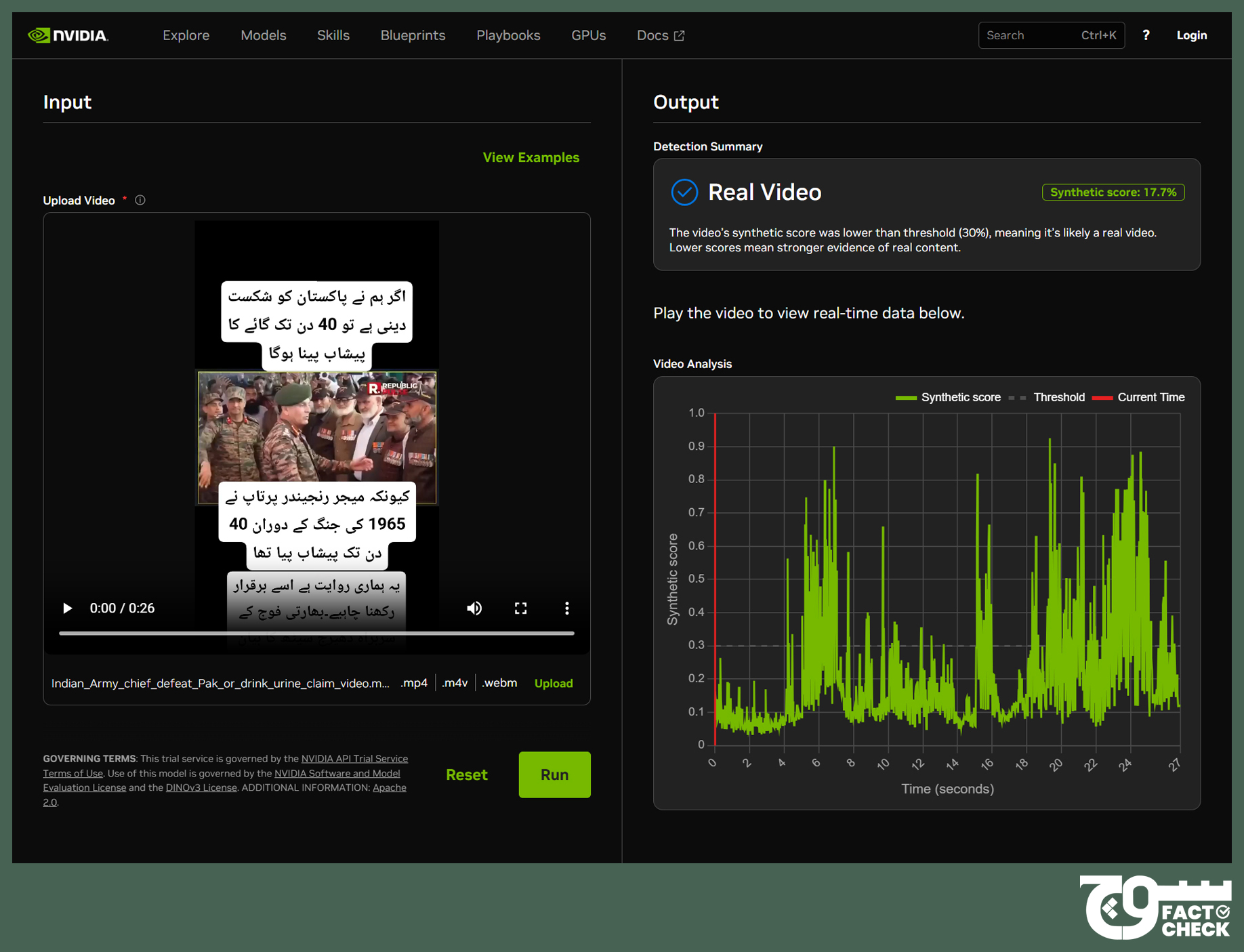
Results from NVIDIA Synthetic Video Detector
DeepFake-O-Meter — a tool developed by the University at Buffalo’s Media Forensics Lab (UB MDFL) — labelled the video “likely AI-generated,” with “moderate” confidence. According to the 10 detectors we used, the probabilities of the sample being created synthetically are 100%, 99.9%, 99.6%, 96%, 87.3%, 84.8%, 76.3%, 56%, 40.4%, and 35.5%.
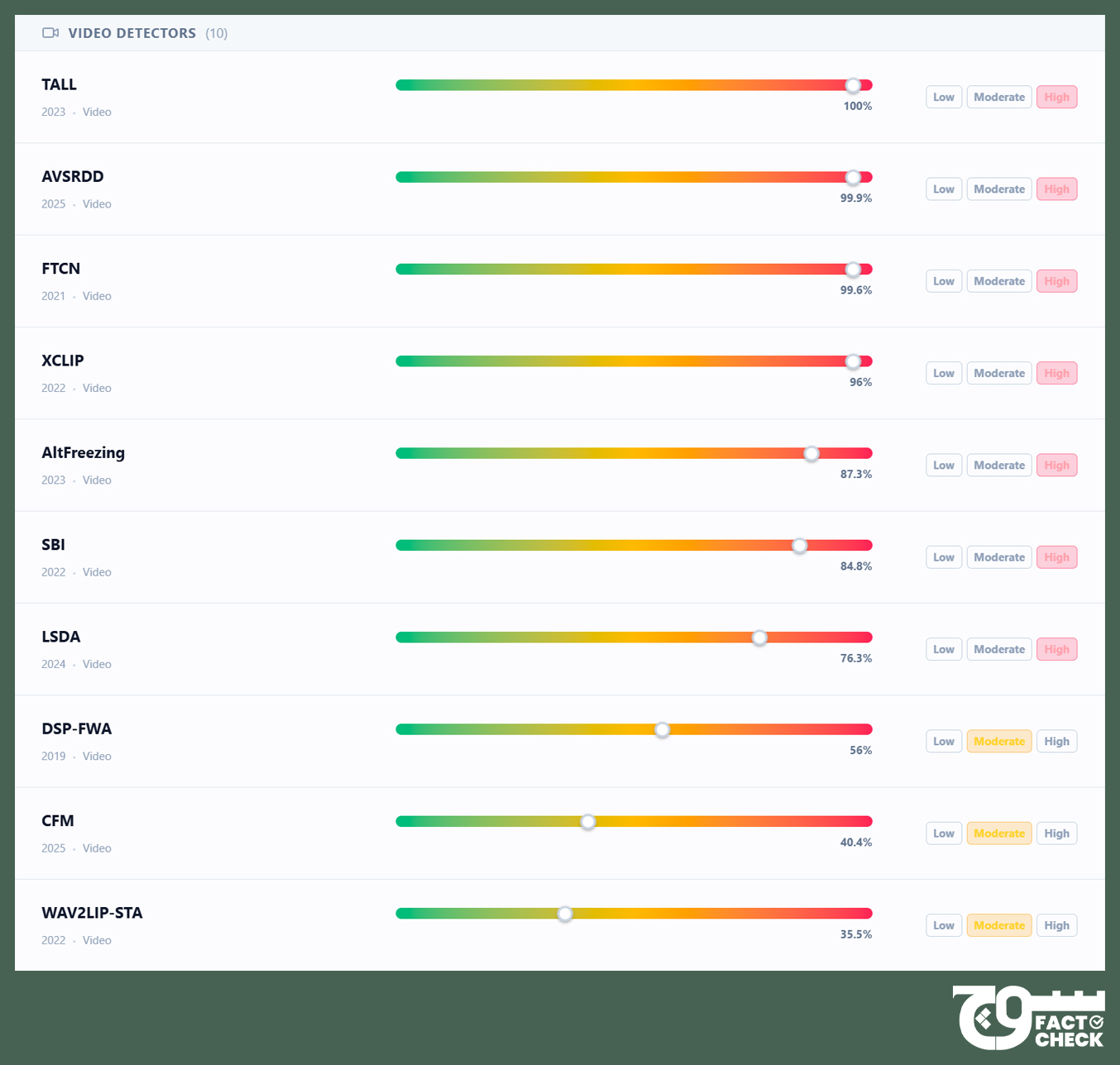
Results from DeepFake-O-Meter
DetectVideo AI said it “found manipulation evidence at 76% probability”, with a “high” confidence level of 92%.
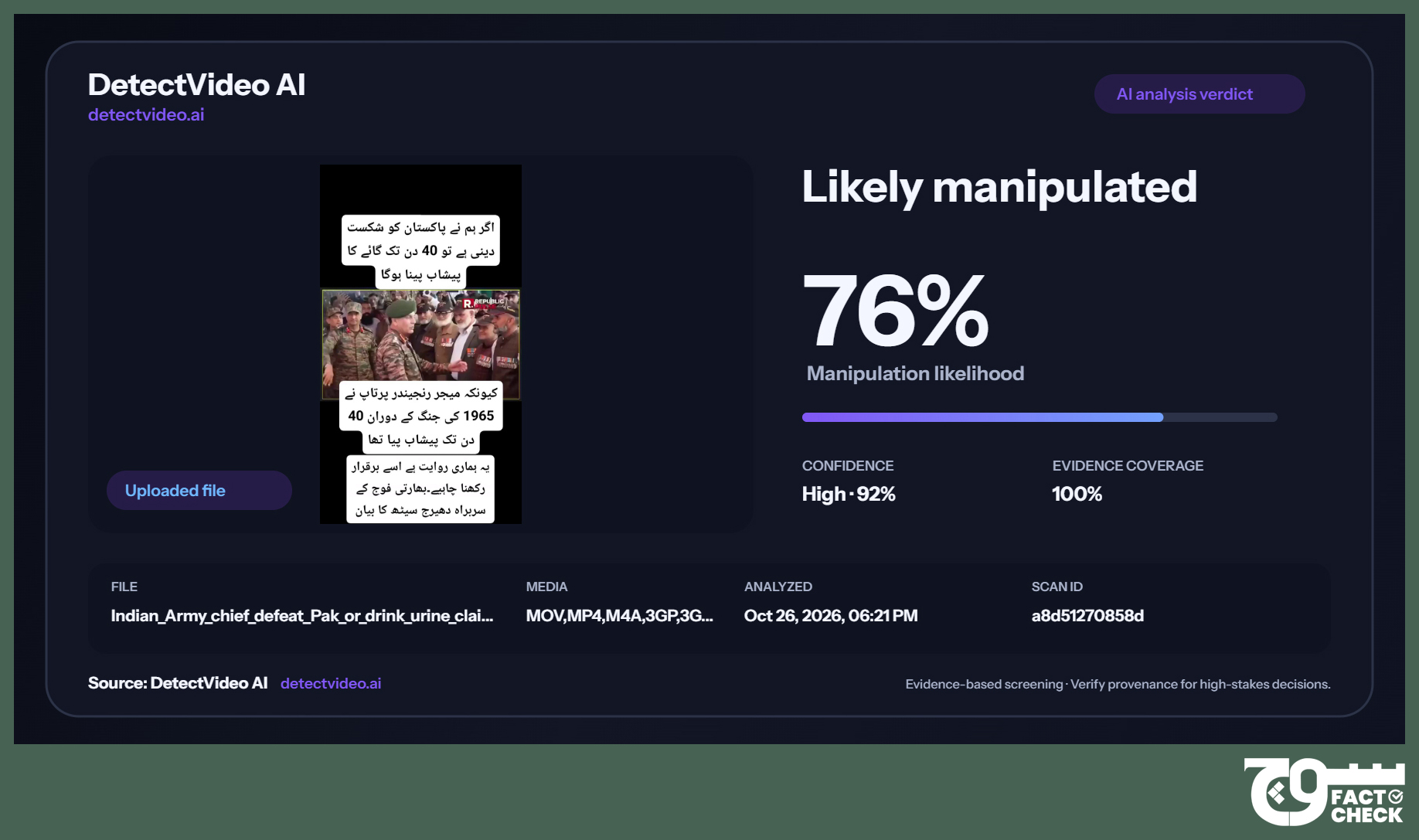
Results from DetectVideo AI
Moreover, Global Online Deepfake Detection System (GODDS) — a tool developed by Northwestern University’s Security & AI Lab (NSAIL) that uses a combination of various models along with human analysis to provide a holistic summary of the results — also found evidence of AI manipulation.
The tool employed 22 deepfake detection algorithms for the visual content and 70 for the audio component, while two trained analysts also examined the clip.
All predictive models for the visual and audio content said the video “is likely to be fake”:
- The video is likely to be fake with a probability above 0.5, according to nine of the 22 predictive models; it is likely to be fake with a probability below 0.5, according to the 13 other predictive models.
- The audio is likely to be fake with a probability above 0.5, according to 62 of the 70 predictive models; it is likely to be fake with a probability below 0.5, according to the eight remaining predictive models.
According to GODDS’ human analysts, the video contains “several indicators” that show it may be artificially manipulated. For example:
- At 00:21-00:22, the video appears to shift forward and backward between frames. This may indicate video manipulation to accommodate fabricated speech that exceeds the duration of the corresponding reference footage.
- At 00:05, a large pixelated artefact briefly emerges from the speaker’s mouth before disappearing in the subsequent frame.
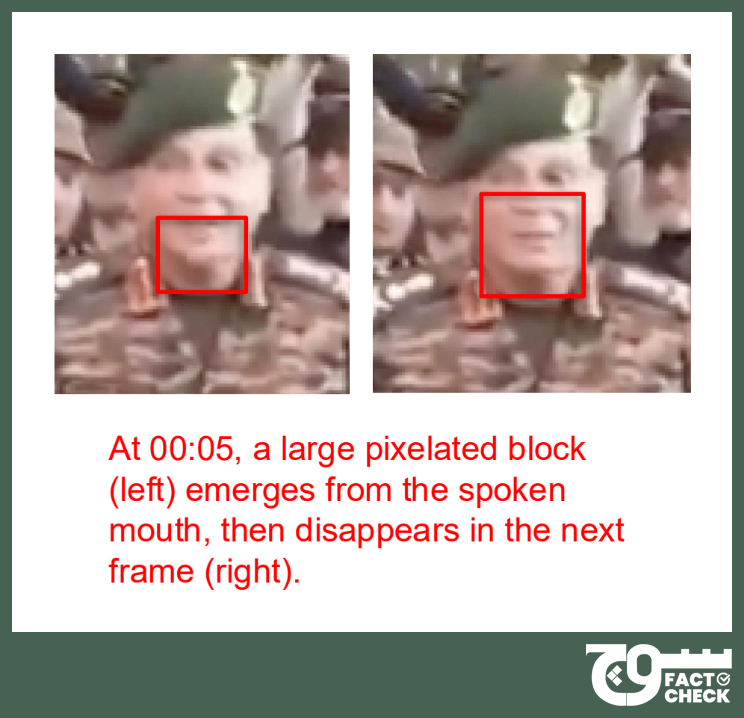
Manipulation identified by GODDS analysts
“The Indian Army’s official fact-check X account issued a statement claiming that the video of Dhiraj Seth mentioning cow urine was digitally altered. The original video was linked,” the analysts said.
Soch Fact Check, therefore, concludes that the viral clip of Gen Seth promoting the practice of drinking cow urine is AI-manipulated as we traced the original footage and found some evidence in the analyses provided by the deepfake detectors and our sound engineer.
Virality
Soch Fact Check found the video shared multiple times on Facebook, seven times on Instagram, thrice on Threads, and twice on X, YouTube, and TikTok each.
Conclusion: Gen Dhiraj Seth’s speech is doctored. In the original video from 25 September 2026, he did not make any such remarks.
Background image in cover photo: @adgpi
To appeal against our fact-check, please send an email to appeals@sochfactcheck.com