
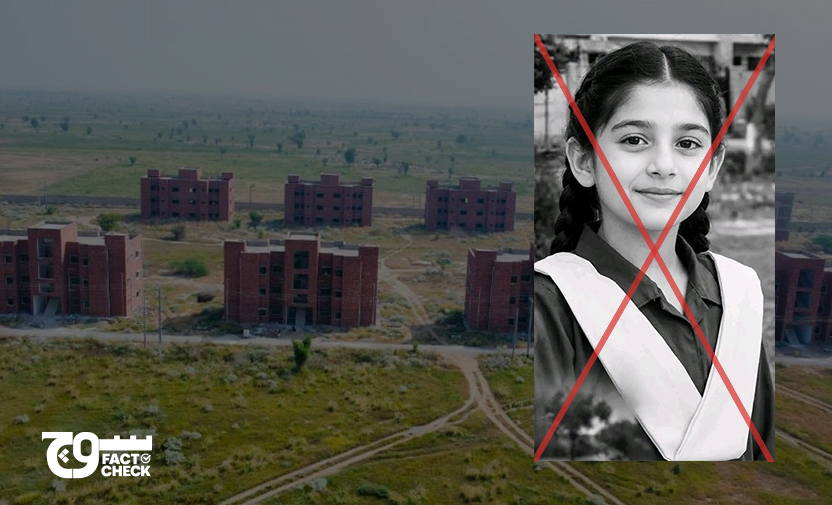
Claim: Images are being circulated of Daanish School student Khansa Noorin.
Fact: OpenAI and Google verification tools linked the photos to AI generation or editing. Whether genuine photographs of Khansa were used to create them remains unclear.
On 30 September 2026, Facebook page Taunsa News shared a black-and-white photo alongside a post about Khansa Noorin, a Class VI student who died at Daanish School in Taunsa on 29 September 2026. The post presented this image as a photo of Khansa.
Similar posts subsequently circulated with different images attributed to the student, including portraits showing a similar-looking child in blue and green uniforms.
Soch Fact Check examined the blue and black-and-white portraits, as well as a Taunsa News graphic containing the green-uniform image. Verification results linked the blue and black-and-white portraits to AI generation or editing, while Google detected AI involvement in the graphic containing the green-uniform image.
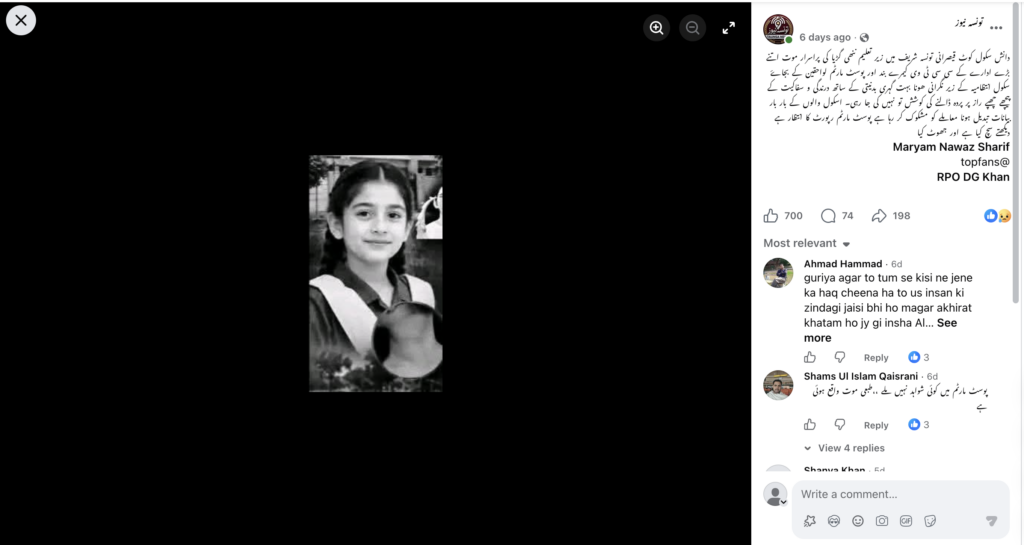
Screenshot of a Taunsa News Facebook post sharing an apparent photo of Khansa Noorin.
Khansa Noorin’s death
Khansa Noorin, a newly enrolled Class VI student from Chah Khaliwala, died on 29 September 2026. Dawn reported that she was found unconscious on the grounds of Daanish School in Kot Qaisrani, Taunsa Sharif, and taken to Tehsil Headquarters Hospital Taunsa, where doctors pronounced her dead. Police subsequently moved her body to the mortuary for a post-mortem examination.
Rizwan Khalid, a spokesperson for the Daanish School Authority, told Dawn that Khansa’s classes had begun on 1 September. According to his account, she was called from the school hostel for a morning walk, collapsed while walking, received first aid, and was taken to hospital. Khalid attributed her death to cardiac arrest and rejected the family’s allegations that she had been subjected to violence. He said the post-mortem examination had been conducted and its findings were awaited.
Khansa’s relatives disputed this account. They told the media that they had observed marks on her body, suspected that she had been subjected to violence, and alleged that the school administration was not revealing the truth. These remain allegations pending the medical and police investigations. Daily Jang reported that the family demanded a complete, transparent, and impartial investigation into her death.
Jang reported that Khansa’s body was found on the school’s walking track, while Dawn reported that she was found unconscious on the school grounds. According to Jang, Retra police opened an investigation and transferred her body to Tehsil Headquarters Hospital Taunsa, where a post-mortem examination was conducted. Forensic samples were sent to Lahore for further analysis, and her body was later released to her family. The commissioner of Dera Ghazi Khan Division visited the hospital, while the assistant commissioner of Taunsa met Khansa’s family there. Jang reported that the cause of death was expected to be determined after the forensic reports were received.
On 29 September, the deputy commissioner of Dera Ghazi Khan constituted a five-member inquiry committee to examine the circumstances surrounding Khansa’s death and submit a fact-finding report within three days.
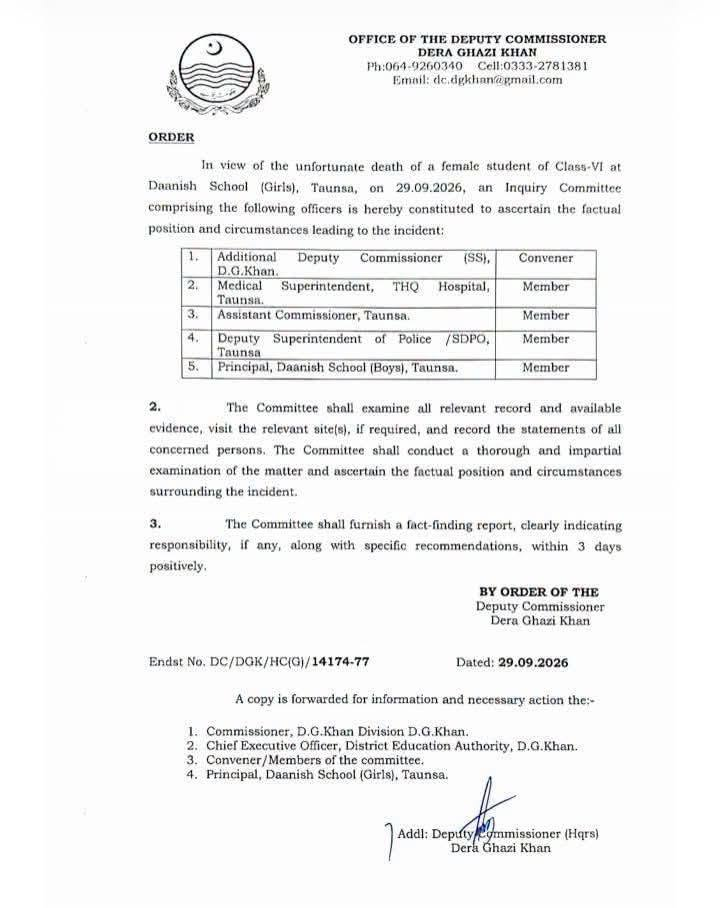
Order issued by the Office of the Deputy Commissioner, Dera Ghazi Khan, on 29 September 2026, constituting a five-member inquiry committee into the death of the Class VI student at Daanish School (Girls), Taunsa.
Neither published report cited a completed post-mortem or forensic report establishing the cause of Khansa’s death. As of 5 October 2026, Soch Fact Check could not locate a publicly available post-mortem or forensic report stating the final cause of death. This fact-check examines the authenticity and attribution of the photos circulating in Khansa’s name and does not aim to determine the circumstances or cause of her death.
Fact or Fiction?
Soch Fact Check was unable to trace the coloured or black-and-white photos to Khansa’s family, her school, the district administration, or another reliable original source. Some circulating versions showed Meta’s “AI content” label.
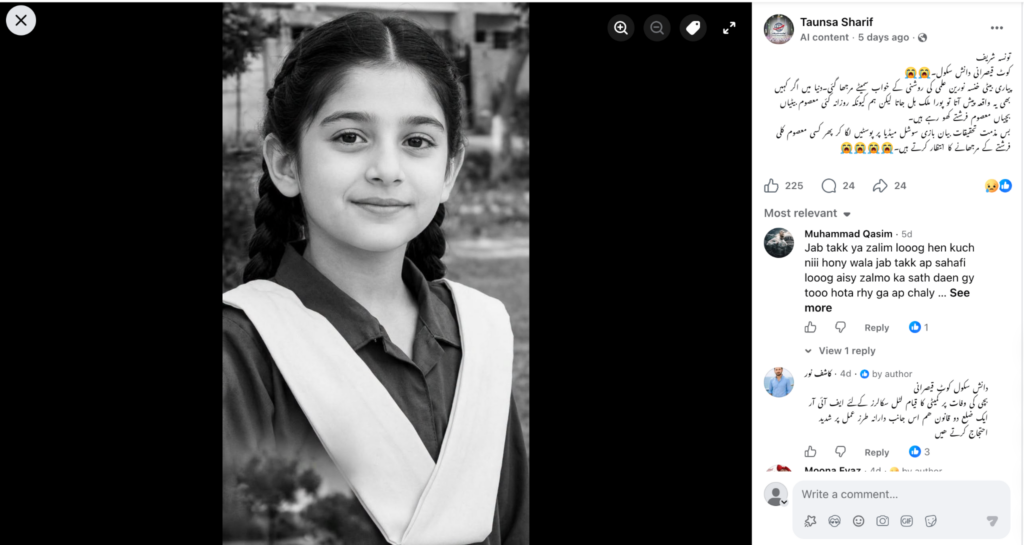
Facebook displayed an “AI content” label on a Taunsa Sharif post sharing the black-and-white photo as an image of Khansa Noorin.
We also contacted journalists from Taunsa and the surrounding region about the circulating images. Azmat Buzdar, a Taunsa-based journalist with Channel 24, told us that the image shown to him was AI-generated and not a real photograph. Shahid Awan, a journalist from the Taunsa region, separately told us that the images going viral were not of Khansa.
These statements and the differences between the circulating photos did not, on their own, establish that the images were generated or edited using AI. They raised questions about their provenance and prompted us to examine the two files using verification tools from OpenAI and Google, with Hive Moderation and veraAI used as supplementary AI-content detection tools.
The findings below concern the blue and black-and-white portraits and the Taunsa News graphic containing the green-uniform image. The verification results do not establish the provenance of every image circulating in Khansa’s name.
Blue-uniform photo
The first photo shows a girl with braided hair wearing a blue uniform and a white sash. OpenAI’s content verification tool returned the result: “Generated with OpenAI tools.”
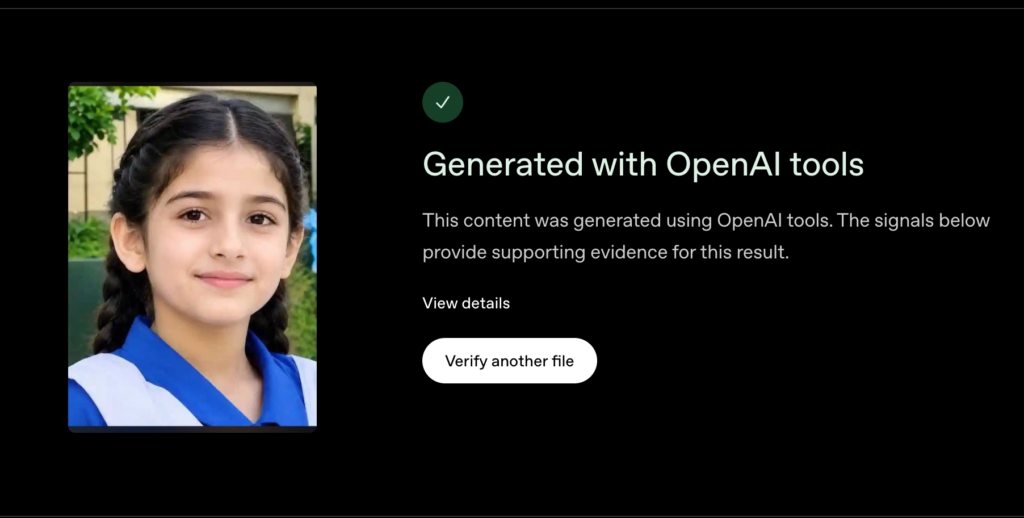
OpenAI’s verification tool identified the blue-uniform photo as generated with OpenAI tools.
OpenAI’s documentation says its verifier looks for provenance signals associated with its tools, including C2PA Content Credentials and SynthID watermarks. OpenAI says a detected signal indicates that the content likely originated from its tools and that false positives are rare.
The company also says its verifier can detect a new file generated when a user asks an OpenAI model to modify an uploaded image. The result therefore establishes that OpenAI tools were involved in generating the blue portrait, but does not establish whether the depicted face was created from scratch or whether an existing photograph was used as input.
Soch Fact Check also analysed the blue uniform photo using the veraAI Verification Plugin, a verification tool developed through European research projects to assist with the analysis of potentially manipulated and synthetic media. Its B-Free detector returned a score of 81%, which the tool classified as “strong evidence” that the image is synthetic.
B-Free is an AI-generated image detector designed to focus on subtle artefacts introduced during synthetic image generation while reducing the influence of unrelated differences such as image content, format, or resolution. Its developers reported that the method was trained to distinguish real and generated images while reducing these dataset biases.
However, veraAI cautions that the detector can produce false positives, while the other models used by the tool returned weaker, non-conclusive results for the portrait. We therefore treated the result as supporting evidence rather than proof on its own. Separately, We analysed the blue uniform photo using Hive Moderation’s AI-generated image detector, which assessed it as 99.8% likely to be AI-generated. Hive’s documentation describes these outputs as confidence scores for its classifications. We treated the Hive result as supporting evidence rather than proof of provenance.
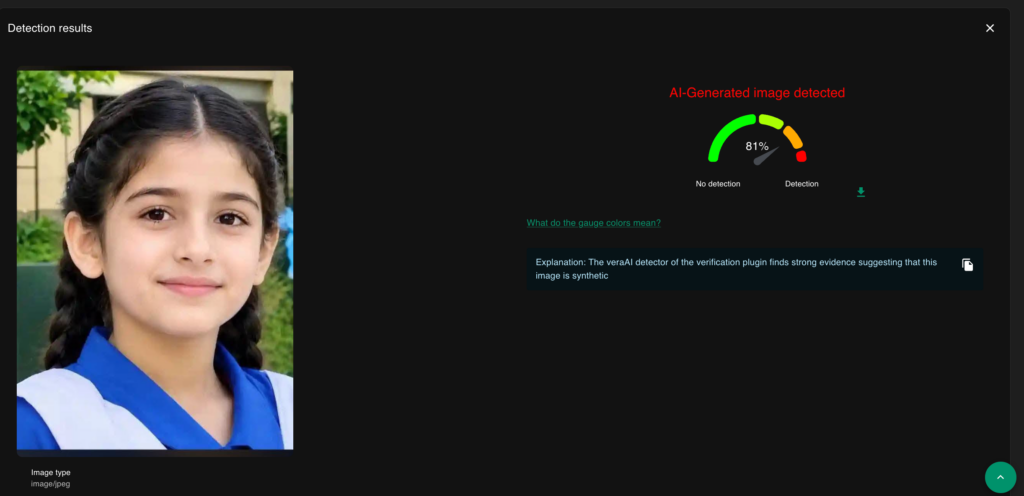
veraAI’s B-Free detector returned an 81% score, which the tool classified as “strong evidence” that the image is synthetic.
Green-uniform photo
A separate image circulating in Khansa’s name shows a similar-looking girl wearing a green uniform and white sash. Unlike the blue and black-and-white portraits, this version appeared within a Taunsa News memorial graphic rather than as a standalone, full-sized photograph.
The girl’s facial appearance also differs subtly from the other circulating portraits, including differences in the shape and proportions of some facial features. The images additionally show the apparent student wearing different-coloured uniforms. These visual differences do not, on their own, establish that the images were generated or edited using artificial intelligence, as pose, expression, image quality and subsequent editing can alter a person’s appearance. However, they raised further questions about the provenance of the different images being attributed to Khansa.
Soch Fact Check analysed the Taunsa News graphic using Google’s Gemini app. Gemini detected a SynthID watermark and reported that all or part of the image had been edited or generated using Google AI.
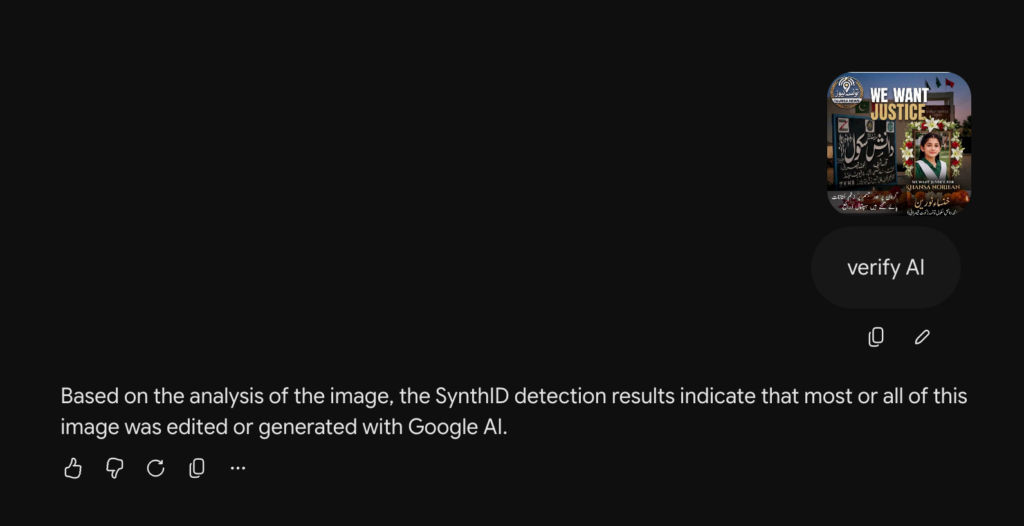
Google’s Gemini app detected a SynthID watermark in the Taunsa News graphic and found that all or part of it had been generated or edited using Google AI.
Hive Moderation separately assessed the graphic as 99.9% likely to be AI-generated. Its generation-source analysis gave a Gemini model the highest score among the listed generators. We treated Hive’s result as supplementary evidence rather than proof of provenance.
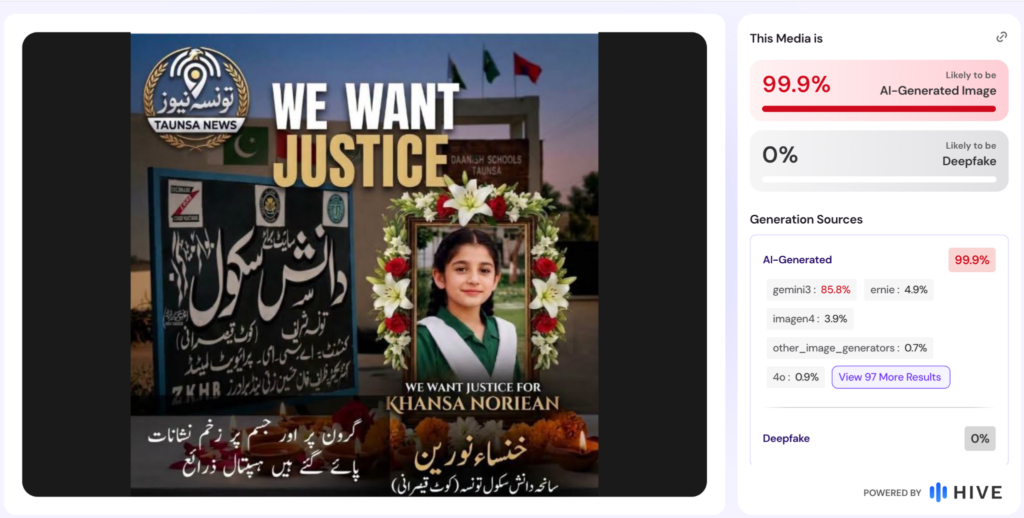
Hive Moderation assessed the Taunsa News graphic containing the green-uniform portrait as 99.9% likely to be AI-generated.
However, the tested file is a composite graphic containing the portrait alongside text, flowers, logos and background imagery. The verification results therefore establish AI involvement somewhere in the graphic but do not, on their own, establish that the green-uniform portrait itself was generated or edited using AI.
Black-and-white photo
The second photo, which circulated in black and white, shows a girl wearing a school uniform. Google’s Gemini app returned the result: “This image appears to have been edited or generated with Google AI.”
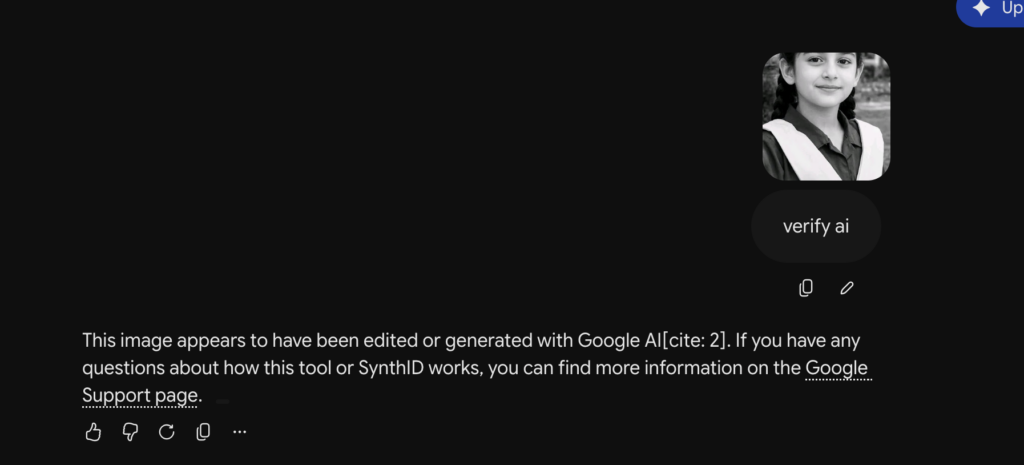
Google’s Gemini verification tool found that the black-and-white portrait had been generated or edited using Google AI.
Google’s verification guidance explains that a detected SynthID watermark means all or part of an image was generated or edited by Google AI. This does not identify the original image or establish how much of the portrait was changed.
Google DeepMind says these watermarks are embedded in the content and designed to survive changes such as filters and compression. Google’s guidance also mentions recolouring. A black-and-white version can therefore retain a watermark, although this does not reveal what the image looked like before the AI process.
Hive Moderation separately assessed the black-and-white photo as 99.9% likely to be AI-generated. As with the coloured photo, we treated this probabilistic result as supporting evidence rather than proof of provenance.
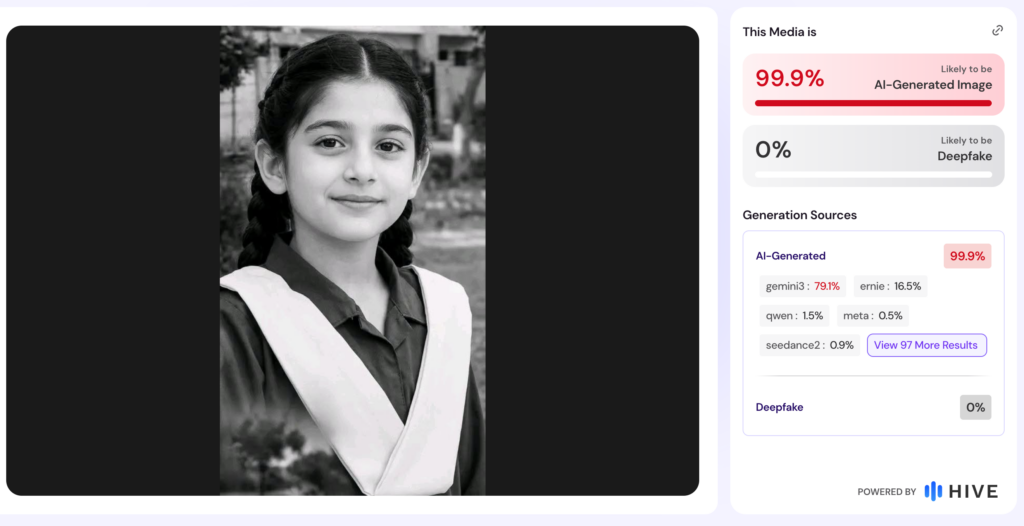
Hive Moderation assessed the black and white-uniform photo as 99.9% likely to be AI-generated.
What the results do not establish
The verification results concern AI involvement in the files. They do not establish whether either photo accurately depicts Khansa’s likeness, which parts were changed, or whether the process began with a genuine photograph.
Soch Fact Check could not obtain a reliably sourced original photograph of Khansa against which to compare the AI-generated images. Differences in clothing, pose, or colour are not, on their own, proof of AI generation. The absence of an original photograph also does not establish that the face is genuinely Khansa’s.
Virality
We found the photos shared in at least 13 posts across Facebook and X (formerly Twitter). Twelve Facebook posts collectively received 2,104 reactions, 289 comments, and 847 shares.
The photo also appeared in one post on X, where it received approximately 10,600 views.
Conclusion: The photos being shared of Khansa are not genuine. OpenAI’s verification tool identified the coloured photo as generated with OpenAI tools, while Google’s Gemini app found that the black-and-white photo was generated or edited using Google AI. Supplementary checks by veraAI and Hive Moderation supported these findings. However, Soch Fact Check could not establish whether genuine photographs of Khansa were used in order to generate these images.
To appeal against our fact-check, please send an email to appeals@sochfactcheck.com