
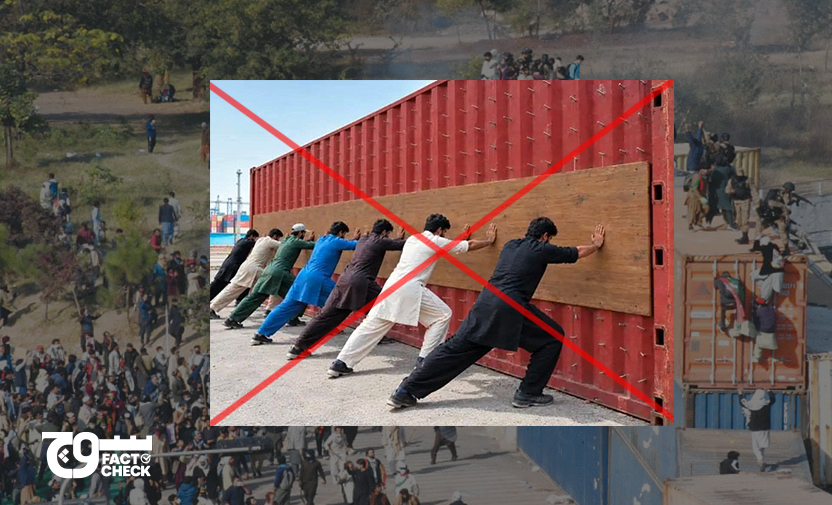
Claim: An image shows men using a wooden board to push aside a nail-studded shipping container ahead of a PTI protest.
Fact: The image contains OpenAI provenance signals and is AI-generated. The Facebook version is a cropped and annotated derivative of the wider image.
On 19 September 2026, a Facebook account named Shahid Isf Charsadda posted an image showing several men appearing to push against a red shipping container fitted with nails or spikes, using a wooden board placed between themselves and the container.
The Urdu caption read:
عوام نے کنٹینر میں کیل کا حل نکال دیا! 🔥
زیادہ سے زیادہ شیئر کریں!
ہزار کنٹینر لگاؤ، ہزار کیل لگاؤ!
یہ قوم رکنے والی نہیں!
حکومت نے سوچا تھا کنٹینر پر کیل لگا کر عوام کو روک لیں گے۔
لیکن یہ باشعور قوم ہے، یہ غلام نہیں!
دیکھو کیسے بہادر نوجوانوں نے تختے لگا کر کیلوں کو ناکام بنا دیا!
[Translation: “The public has found a solution to the nails on the container! Share this as widely as possible! Put up a thousand containers, install a thousand nails! This nation will not be stopped! The government thought it could stop the public by putting nails on the containers. But this is an aware nation, not a nation of slaves! Look how these brave young men defeated the nails by putting up wooden boards!”]
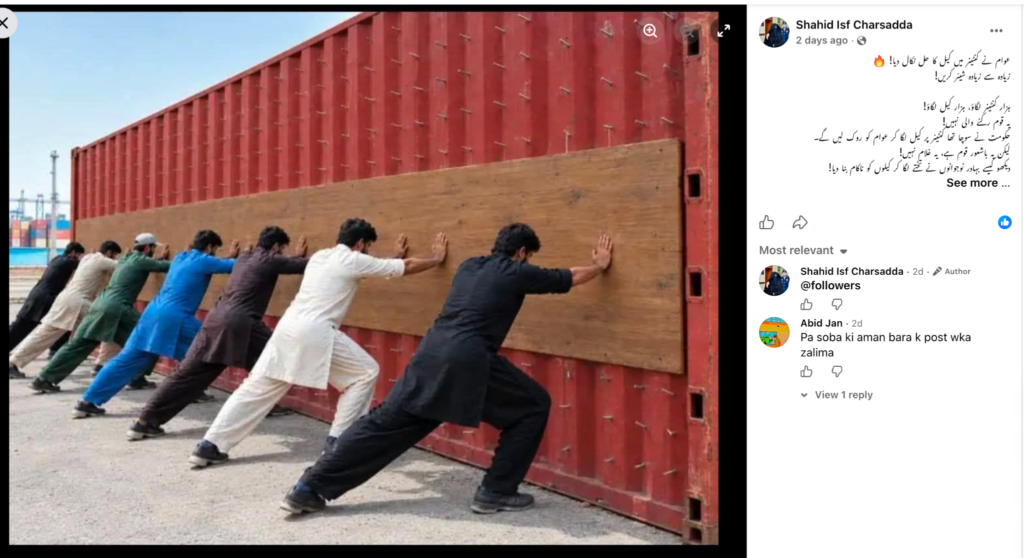
A Facebook post falsely presenting an AI-generated image as a genuine photograph of men pushing a spiked shipping container.
Measures taken ahead of PTI protest
Pakistan Tehreek-e-Insaf announced a nationwide protest, including a march towards Islamabad on 27 September 2026, to demand the release of party founder and former Prime Minister Imran Khan and, according to the party, mobilise supporters for the “supremacy of the Constitution”. PTI described the planned demonstration as peaceful, while federal and provincial authorities began making security and law-and-order preparations several weeks before the protest.
By early September, Islamabad police had already begun taking possession of shipping containers. On 9 September, the All Pakistan Goods Transport Owners Association told Dawn that police had impounded container vehicles ahead of the planned protest and called for their release. Two days later, Dawn reported that contractors had been asked to arrange more than 1,000 containers of different sizes for the capital. According to police sources quoted in the report, the containers were intended to seal the Red Zone, High Security Zone, entry and exit points, and major roads and highways used by protesters travelling towards Islamabad. More than 100 containers had already been placed near locations including Faizabad, Tarnol, Sangjani, and the Islamabad Traffic Police headquarters by 11 September.
The preparations extended beyond roadblocks. Islamabad police’s anti-riot unit was instructed to audit its equipment and seek additional supplies, including long- and short-range tear gas shells and tear gas guns. Police intelligence units and the Special Branch were also asked to gather information about preparations for the protest and the activities of PTI leaders, workers, and activists. At the same time, the Rawalpindi administration issued 30-day preventive detention orders for more than 30 PTI workers and activists under Section 3 of the Maintenance of Public Order Ordinance.
Restrictions were also introduced elsewhere in Punjab. On 14 September, Dawn reported that the Punjab Home Department had imposed Section 144 across the province until 17 September, prohibiting gatherings of five or more people as well as the carrying or public display of weapons. Officials cited intelligence about possible security threats to large gatherings as the reason for the restrictions. The same report said preventive detention orders had been issued against dozens of PTI workers in different parts of Punjab, while Rawalpindi police cancelled officers’ leave ahead of the planned demonstration.
The Islamabad High Court also issued directions concerning the planned protest. In an order announced on 14 September and detailed later that week, the court held that political parties and their leadership could not occupy roads, highways, interchanges, toll plazas, or public buildings in a way that obstructed citizens’ movement, business activity, or access to hospitals and educational institutions. The court also directed provincial governments not to use public funds, officials, vehicles, machinery, or other government resources to facilitate the march, according to Dawn’s report on the ruling.
On 18 September, Interior Minister Mohsin Naqvi said the government would stop anyone attempting to march towards Islamabad “in every possible way” and said contempt proceedings would be initiated against those who violated the IHC ruling. Dawn reported that his remarks came as the federal government and law-enforcement agencies continued preparations for the protest. A separate report said that the entrance to Islamabad’s Red Zone had been sealed with containers by 19 September.
Imran Khan’s family, supporters detained
Authorities also made further arrests and detention orders ahead of 27 September. On 20 September, the Lahore deputy commissioner ordered the detention of Imran Khan’s sister Aleema Khan for 30 days under the Maintenance of Public Order Ordinance. Police sources told Dawn that she was taken to Kot Lakhpat Jail.
The following day, Imran’s other sisters, Dr Uzma Khan and Noreen Niazi, were also detained under the same law. PTI and Imran’s son Kasim Khan alleged that several other family members had also been taken into custody. Kasim wrote on X that Uzma, Noreen, and his cousins Shershah and Shahrez had been taken away “with no explanation”.
Amnesty International said on 21 September that the targeting of Imran’s family and PTI activists was a “flagrant violation of their rights to liberty, freedom of expression, association and peaceful assembly”, and called for the immediate release of his relatives and PTI workers. Amnesty also noted that the arrests came ahead of the planned 27 September protests and warned that “a protest cannot be deemed violent before it has even started.
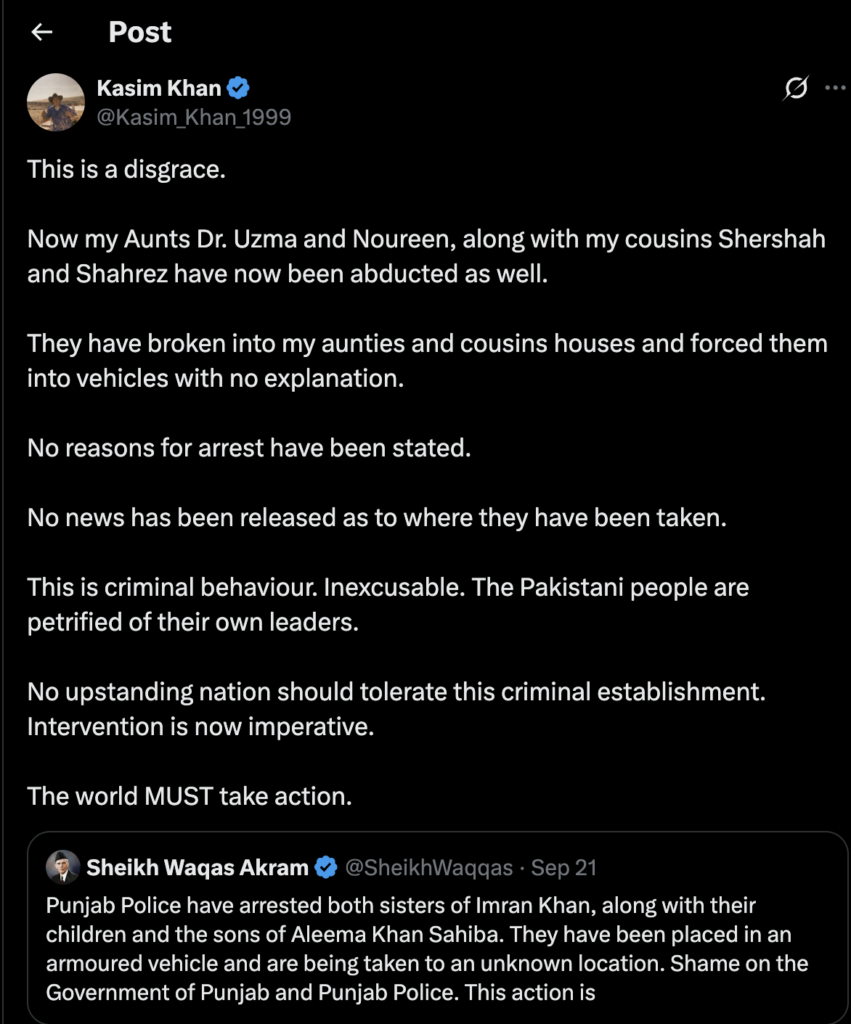
Kasim Khan alleged on X that his aunts and cousins had been detained without explanation ahead of the 27 September protest.
By 21 September, the planned security deployment had grown considerably. Dawn reported that more than 22,000 security personnel had been called for deployment in Islamabad, while 30,000 personnel were being assembled in Attock, a key route between Khyber Pakhtunkhwa and Punjab. Rawalpindi police had also requested 9,000 additional personnel. Authorities planned to block 30 entry points to the twin cities, including 11 in Rawalpindi, and containers were being seized and positioned alongside highways and in open spaces for possible use as roadblocks. Leaves for Rawalpindi police personnel had also been cancelled until 1 October, except in emergencies.
Fact or Fiction?
The image raised several red flags. In the wider version, seven men appear in unusually similar pushing positions, while several hands and fingers are poorly defined or appear to merge into the wooden board. The objects presented as nails or spikes also vary in shape, direction, and apparent attachment to the container.
Separately, news reports indicate that authorities were deploying containers fitted with spikes in Rawalpindi and Islamabad ahead of the planned protest. On 19 September, The Express Tribune reported that large containers fitted with eight-inch spikes were being installed at entry points to the twin cities, including Faizabad, Chungi No. 26, Rawat, Chakri, Adiala Road, Pirwadhai, Bharakahu, and 17-Mile. Pakistan Today similarly reported that spiked containers were being placed at key entry points.
However, Soch Fact Check has not independently verified the provenance of separate images and videos circulating online that purport to show these spiked containers. This investigation is limited to the viral image showing men using a wooden board to push against a container. To verify that image, Soch Fact Check traced earlier versions, reverse-searched it for an authentic source, compared the wider and cropped copies, examined their file information, checked social media disclosures, and submitted both files to OpenAI’s content verification tool.
OpenAI provenance signals detected
Soch Fact Check submitted both the wider image and the cropped version – which includes an “insaf official” watermark – to OpenAI’s content verification tool. Both returned “Generated with OpenAI tools”, with the tool detecting a SynthID watermark.
SynthID is an invisible watermarking technology developed by Google DeepMind. OpenAI now uses SynthID alongside C2PA Content Credentials as a provenance signal for supported content generated through its tools. OpenAI states that its verification tool checks uploaded files for both types of signals and that a detected signal indicates that the content likely originated from OpenAI tools. It says detected signals are reliable and false positives are rare.
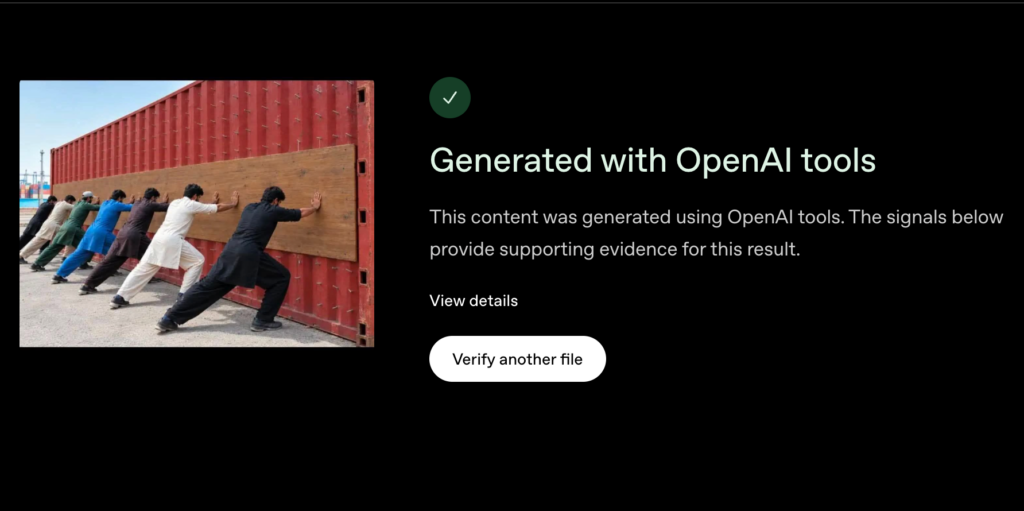
OpenAI’s verification tool identified the wider image as “Generated with OpenAI tools”.
Unlike C2PA metadata, which can be removed when a file is processed or reposted, SynthID is embedded directly into the media. Google DeepMind says the watermark is designed to remain detectable after modifications such as cropping, adding filters, and lossy compression.
Neither social media copy examined by Soch Fact Check retained detectable C2PA metadata. However, OpenAI’s verifier detected the SynthID watermark in both the wider image and the cropped, annotated version.
OpenAI cautions that a positive result does not establish who created the image, how it was subsequently used or modified, or whether the content is factually accurate. The verifier can also detect content produced when a user uploads an existing image and asks an OpenAI tool to modify it.
The provenance result therefore does not, by itself, establish whether the scene was generated entirely from scratch or created by modifying an existing photograph. However, Soch Fact Check found no authentic photograph or news-agency image predating the AI-labelled versions of the scene.
Facebook image is cropped from wider version
A comparison of the two images shows that the square “insaf official” version is derived from the wider image rather than being a separate recreation. The same wood grain, container markings, clothing folds, hand positions, shadows, and body contours align across both versions.
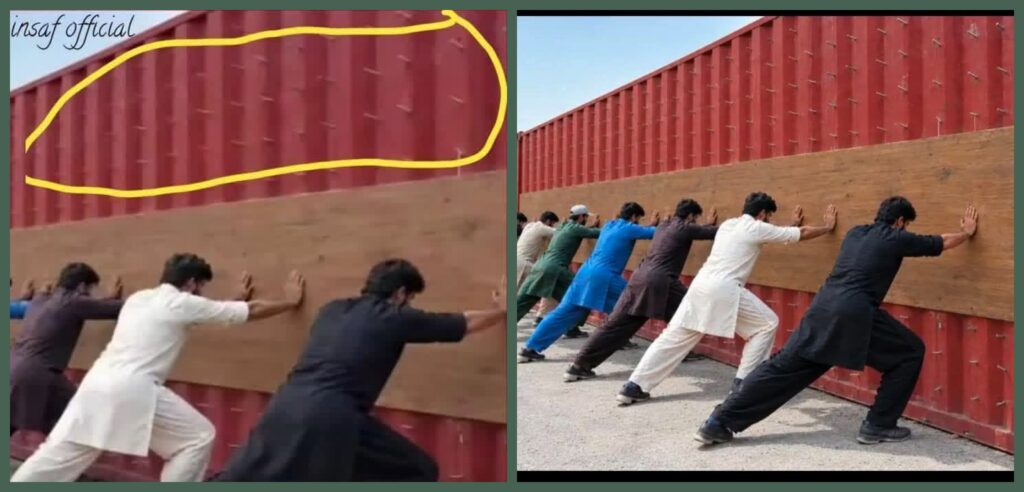
The square Facebook image, left, corresponds to the right-hand portion of the wider image, left. The later copy also contains a yellow outline and the words “insaf official”.
The 720 × 720 Facebook image corresponds to the right-hand portion of the 1080 × 842 wider frame, removing several people visible on the left. The square version was also annotated with a yellow outline and the words “insaf official”.
Earlier TikTok uploads carry AI labels
The earliest version Soch Fact Check could verify was posted on TikTok by @khankakhiladi1 on 18 September 2026. It shows the wider version of the image without the “insaf official” text or yellow annotation and carries an AI-generated-content label.
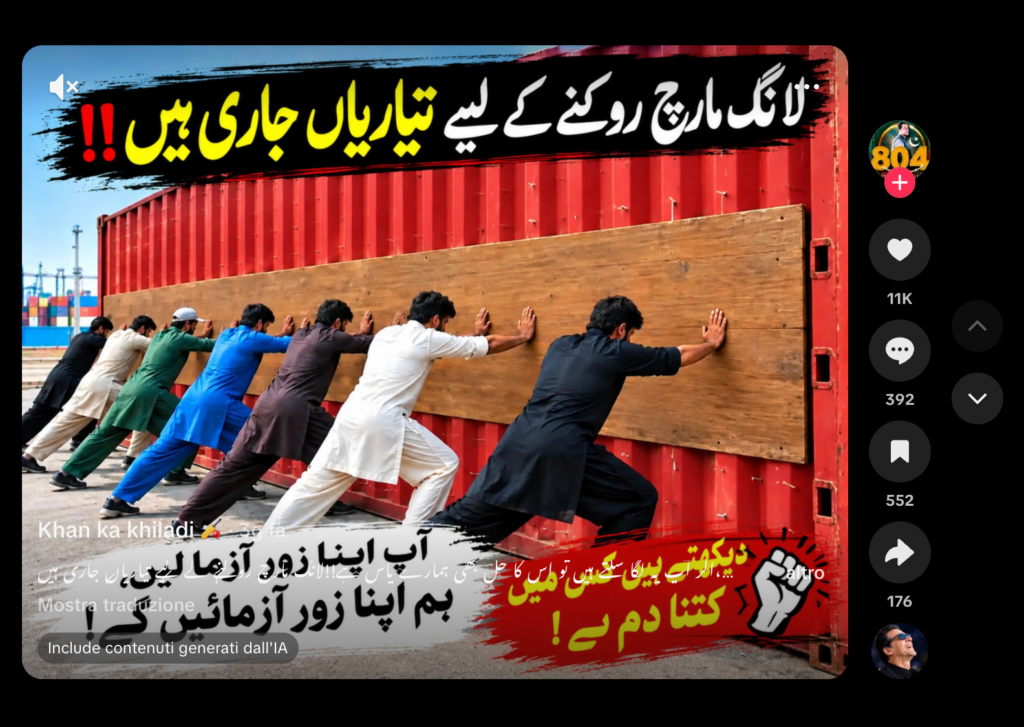
A TikTok upload of the wider image carries an AI-generated-content label and had around 11,000 likes when checked on 21 September 2026.
TikTok states that creators can label their own posts as AI-generated, while the platform may also automatically apply labels when it detects that content was generated or significantly edited using AI, including through Content Credentials.
A second TikTok upload by @804kamrankhan1 also carries the label “Contains AI-generated media”.
Soch Fact Check found no older authentic photograph or news report showing the same scene. The first TikTok post is therefore the earliest version we could verify, but this does not establish who originally created the image.
Visual inconsistencies in the wider image
The wider image contains several irregularities. The seven men appear in unusually similar pushing positions, while some hands and fingers are poorly defined or appear to merge into the wooden board. The objects presented as nails or spikes also vary in shape, direction, and apparent attachment to the container, with some appearing blurred into the corrugated surface.
These details do not establish AI generation on their own, particularly because the image has been compressed through social media. However, they are consistent with the provenance evidence detected by OpenAI’s verification tool.
Hive returns 85.1% AI confidence score
Soch Fact Check also tested the wider image using Hive’s AI-generated image detector, which returned an 85.1% confidence score for AI-generated content. Hive says its detector is trained on millions of AI-generated and human-created images and analyses files for patterns associated with synthetic media. However, Hive recommends a 0.9 threshold for classifying an image as AI-generated. Soch Fact Check therefore treated the result as supporting evidence rather than proof.
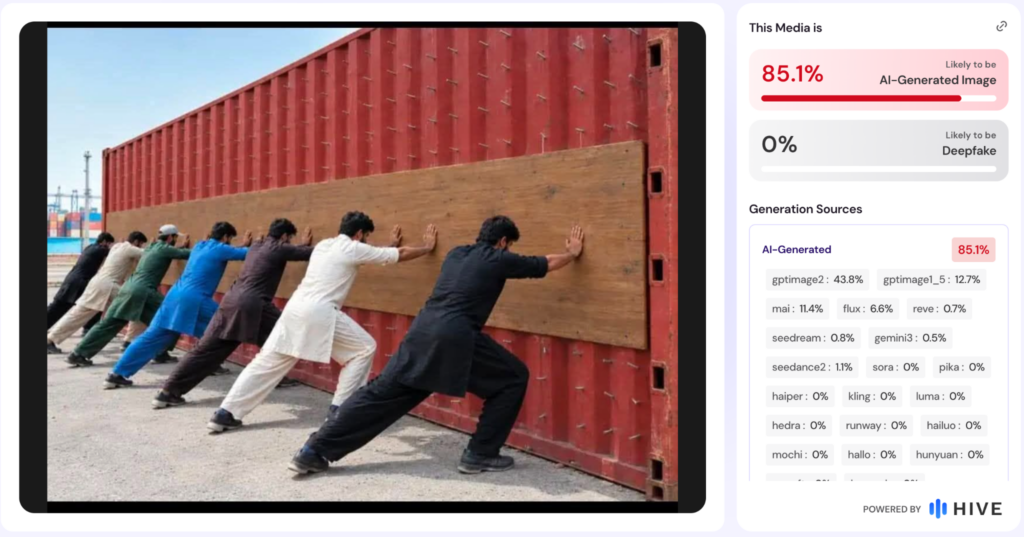
Hive’s AI detector gave the wider image an 85.1% confidence score for AI-generated content.
Virality
Soch Fact Check identified 21 posts across Facebook, Instagram, and TikTok sharing the image or scene. As of 21 September 2026, a widely shared Facebook post had received approximately 1,200 reactions, 26 comments, and 387 shares. The earliest identified TikTok upload had accumulated approximately 11,000 likes, 392 comments, 549 saves, and 175 shares.
Conclusion: The claim is false. The viral image does not authentically show men using wooden boards to push aside a nail-studded container ahead of a PTI protest. OpenAI’s verifier identified both versions as “Generated with OpenAI tools”, while earlier TikTok uploads carry AI-content labels. Soch Fact Check found no authentic earlier photograph of the scene, and the square Facebook copy was cropped and annotated from the wider image.
To appeal against our fact-check, please send an email to appeals@sochfactcheck.com