
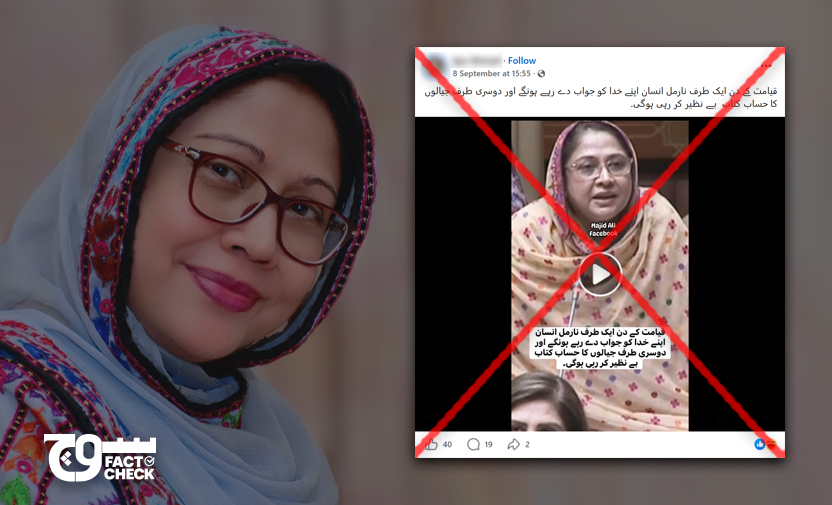
Claim: A video shows Sindh lawmaker Faryal Talpur saying that “normal people will be answerable to their God” on Doomsday, while deceased former Prime Minister Benazir Bhutto will be the one to judge PPP supporters.
Fact: The video is manipulated using artificial intelligence (AI) tools. The visuals used are from her speech in 2019.
On 8 September 2026, social media users shared a video of Pakistan People’s Party (PPP) lawmaker Faryal Talpur addressing the Sindh Assembly, where she appears to make controversial remarks while discussing the potential administrative restructuring and redrawing of provincial boundaries under the potential 28th Constitutional Amendment, which is said to be in its initial stages.
“On the Judgement Day, on the one hand, normal people would be answerable to their God and, on the other hand, Benazir will be carrying out the reckoning of the jiyalas,” says Talpur, who is also the president of the PPP’s Women Wing and the sister of President Asif Ali Zardari.

Screenshot of the viral video.
The word “jiyala” refers to the PPP’s supporters.
The 28th Constitutional Amendment
The potential 28th Amendment to the Constitution of Pakistan has been in discussion throughout 2026.
In November 2025, Senator Rana Sanaullah — a Pakistan Muslim League-Nawaz (PML-N) leader and Special Assistant to the Prime Minister on Political Affairs — had said a hypothetical 28th Amendment, focusing on “public issues such as local bodies, population, the National Finance Commission … health-related issues”, could be implemented if there was political consensus.
One of the main — and contentious — proposals in its initial stages is a restructuring of administrative boundaries and a possible change in resource distribution between the federal and provincial governments.
Planning and Development Minister Ahsan Iqbal has “proposed creating 12 to 15 new provinces or setting up 160 empowered district governments” for better governance, while Interior Minister Mohsin Naqvi “raised the idea of an administrative ‘reset’” in July 2026, according to a DW report. The publication added that Defense Minister Khawaja Asif “has called for greater decentralisation and devolution of power to the grassroots”.
However, the PPP, to which President Zardari belongs, and some other political parties have opposed the creation of new provinces.
On 3 September, PPP leader Nisar Ahmed Khuhro moved a resolution in the Sindh Assembly, invoking Article 239(4) of the Constitution to reject “any proposal to divide the province or alter its territorial limits”. While Opposition members walked out, it was passed “unanimously” by those “present in the house”.
The same day, Talpur gave a charged speech against the province’s possible division, warning that “we will not allow it to be divided” and saying they would not hesitate to resign from assembly membership or “sacrifice our lives for the protection of Sindh”.
She then made a statement that has led to a lot of backlash:
“Oh my [fellow] members, what answer will you give to Benazir Bhutto? On the Day of Judgement, will she not hold us by our collars and ask us: I gave my life, my father gave his life, what did you all do? What did you do to Sindh? What did you do with Sindh? How did you sell off Sindh? So, no, Sindh is our mother, we are standing with Sindh, we are the children of Sindh, we are with Sindh, and it will not be broken apart and we will not let that happen. Bibi [Benazir Bhutto] is with us in spirit, which is our faith. I’m a Muslim. I feel she’s always there because I believe that in our Islam, a shaheed [martyr] remains a shaheed, remains alive, and does not die.”
Talpur’s remarks can be heard at the here and here, as well as at the 3:58, 3:21, 4:20, 0:27, and the 0:53 marks in YouTube videos uploaded by different media outlets. The politician’s Facebook page also posted a clip of her comments in the Sindh Assembly.
Fact or Fiction?
Soch Fact Check first observed that Talpur’s clothing is different in the viral video compared to those she wore on 3 September 2026, as are the frames of her eyeglasses.
We then reverse-searched keyframes from the viral video and found that her attire matches what she wore over six years ago while giving a speech on 16 September 2019.

Screenshots from the viral video (L), footage of Talpur’s remarks in September 2026 (C), and the clip of her 2019 speech broadcast by GNN (R), comparing the politician’s attire and the frames of her eyeglasses
The first match came up in a Dawn article published the same day with the title, “‘Witch-hunt’ of politicians, businessmen will lead to ‘economical meltdown’: Faryal Talpur.”
Taking cues from this, we searched for videos of Talpur’s speech from 16 September 2019 and found multiple versions of them uploaded on YouTube by Capital TV, GNN, and HUM News. Moreover, SAMAA TV broadcast the entire almost two-hour-long Sindh Assembly session, where she spoke at the 31-minute mark.
The speech is also available on the Facebook pages of Talpur and the PPP.
In the 2019 speech, the PPP leader did not make any remarks about Judgement Day.
Deepfake detection tools
Soch Fact Check first tested the audio in Hiya Deepfake Voice Detector using two samples: “Normal people would be answerable to their God and…” and “On the other hand, Benazir will be carrying out the reckoning of the jiyalas.”
According to the tool, the first one scored 22 out of 100, indicating that the “sampled voice is likely a deepfake”. The second, however, turned up 60 out of 100, showing that its “models are uncertain about this voice”.
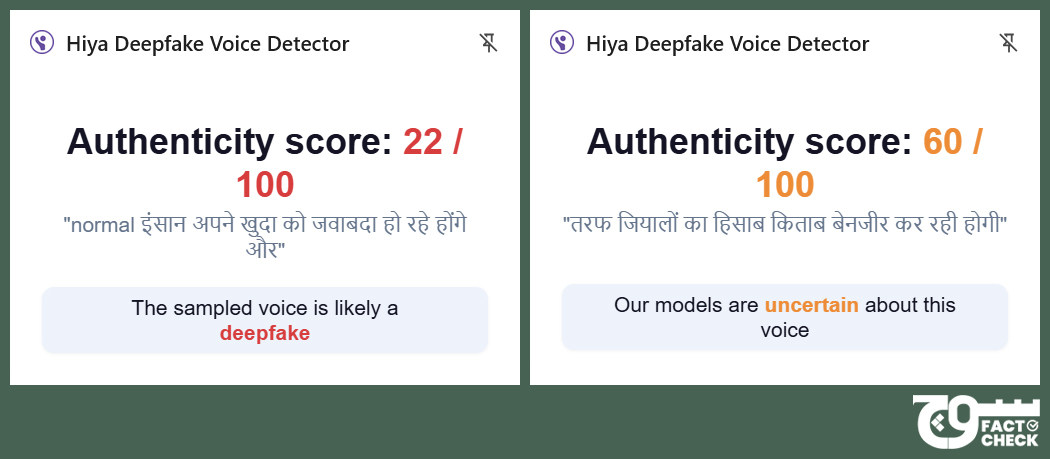
Results from Hiya Deepfake Voice Detector
We then ran the viral video through multiple deepfake detectors such as Hive Detect, NVIDIA Synthetic Video Detector, and DeepFake-O-Meter.
According to Hive Detect’s results, the sample is 1.3% likely to be an AI-generated video, 97% likely to have AI-generated speech, and 0.4% likely to be a deepfake.
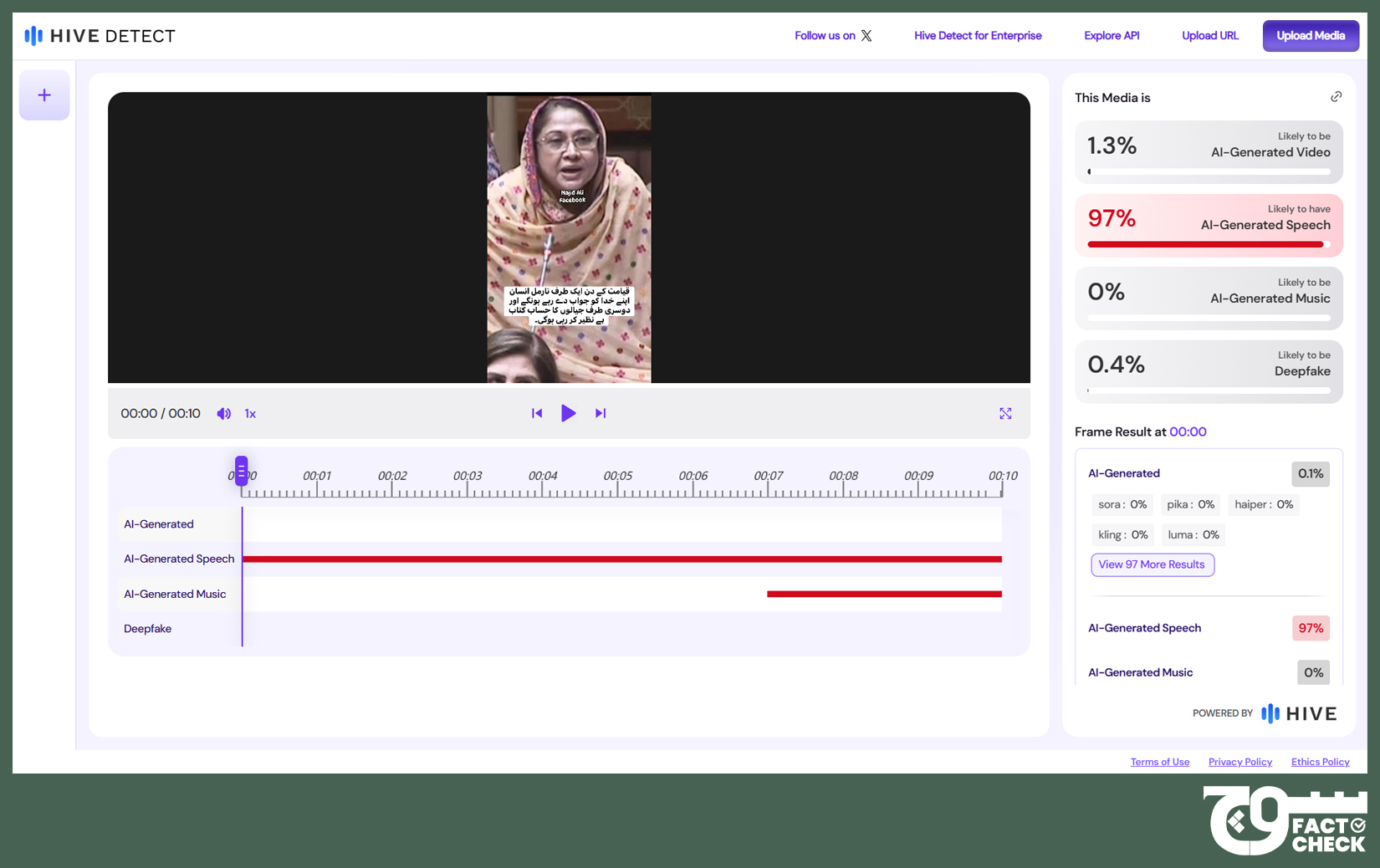
Results from Hive Detect
NVIDIA Synthetic Video Detector found the video to be real, with a synthetic score of 18.4%, which is “lower than threshold (30%), meaning it’s likely a real video”.
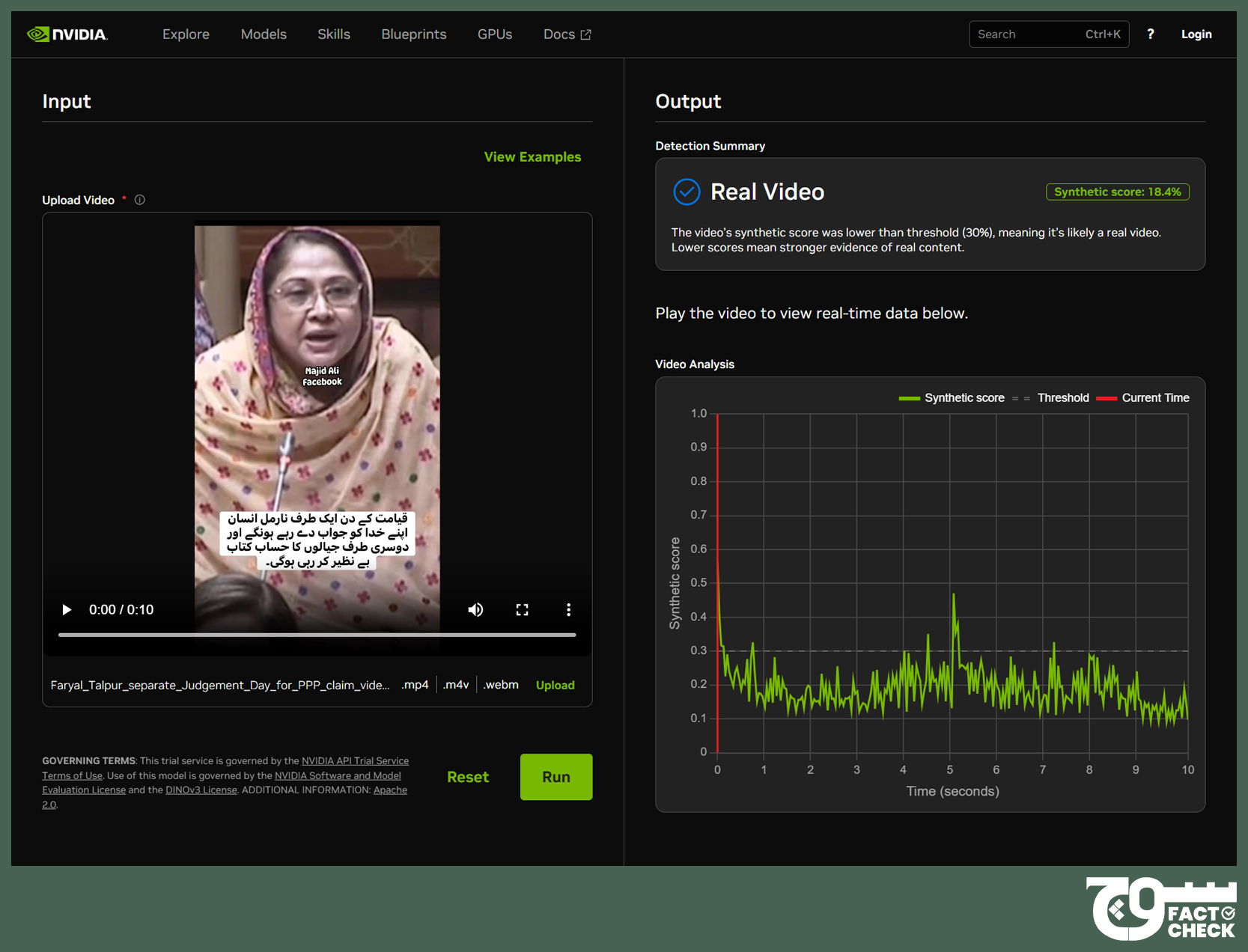
Results from NVIDIA Synthetic Video Detector
However, according to DeepFake-O-Meter, a tool developed by the University at Buffalo’s Media Forensics Lab (UB MDFL), the video is “likely AI-generated”, with “moderate” confidence. The six detectors we used showed the probability of 99.9%, 99.9%, 99.8%, 99.8%, 71.4%, and 58.3%.
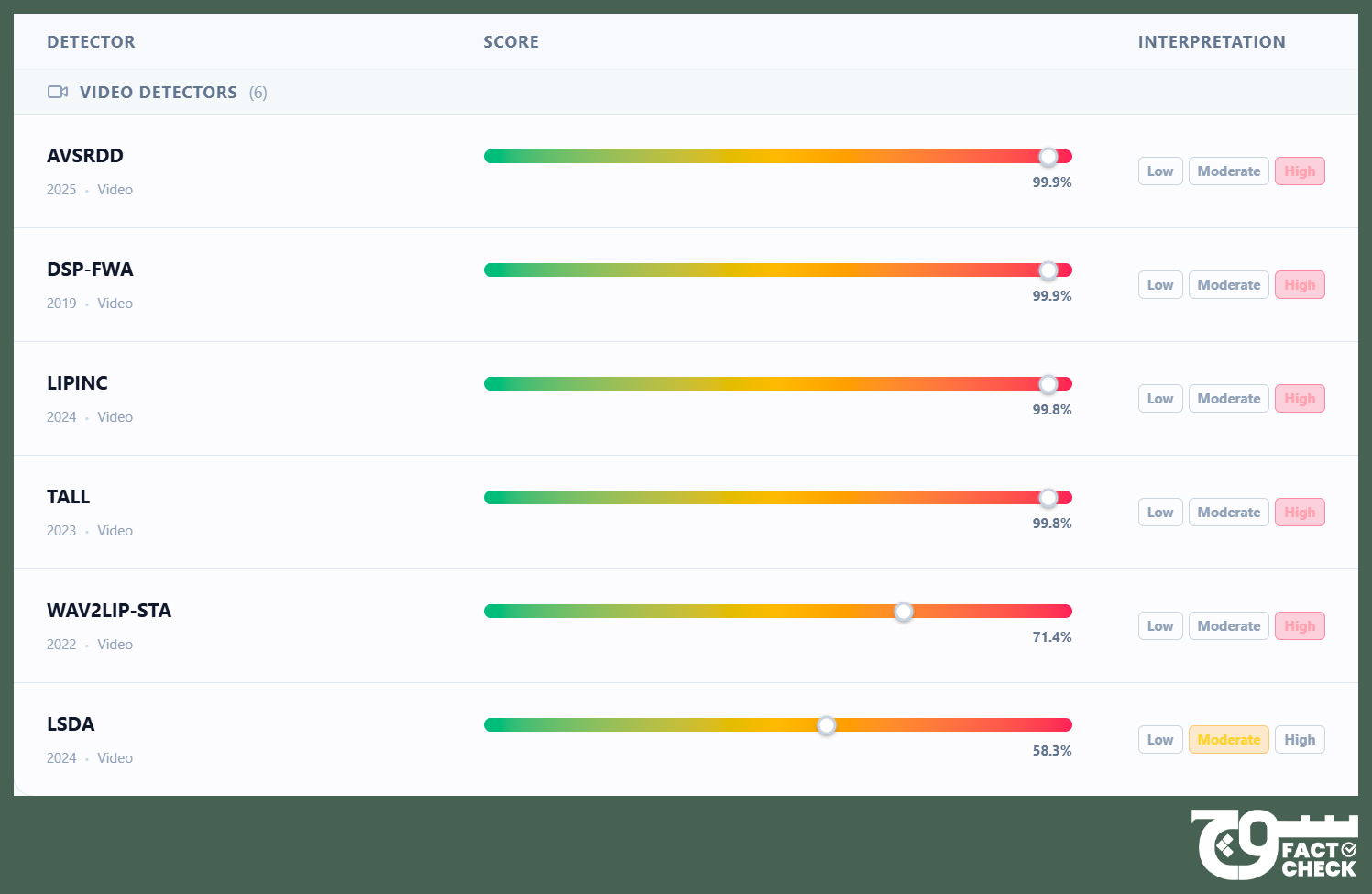
Results from DeepFake-O-Meter
Soch Fact Check then decided to test the video in Google AI’s SynthID detection tool.
According to Google DeepMind, “SynthID embeds digital watermarks directly into AI-generated images, audio, text or video. The watermarks are embedded across Google’s generative AI consumer products and are imperceptible to humans – but can be detected by SynthID’s technology.”
The tool confirmed that the audio and video in the sample were made with Google AI. It further said that the SynthID watermark was “detected in the blue sections”, which were in the first eight seconds of the video and the entire audio.
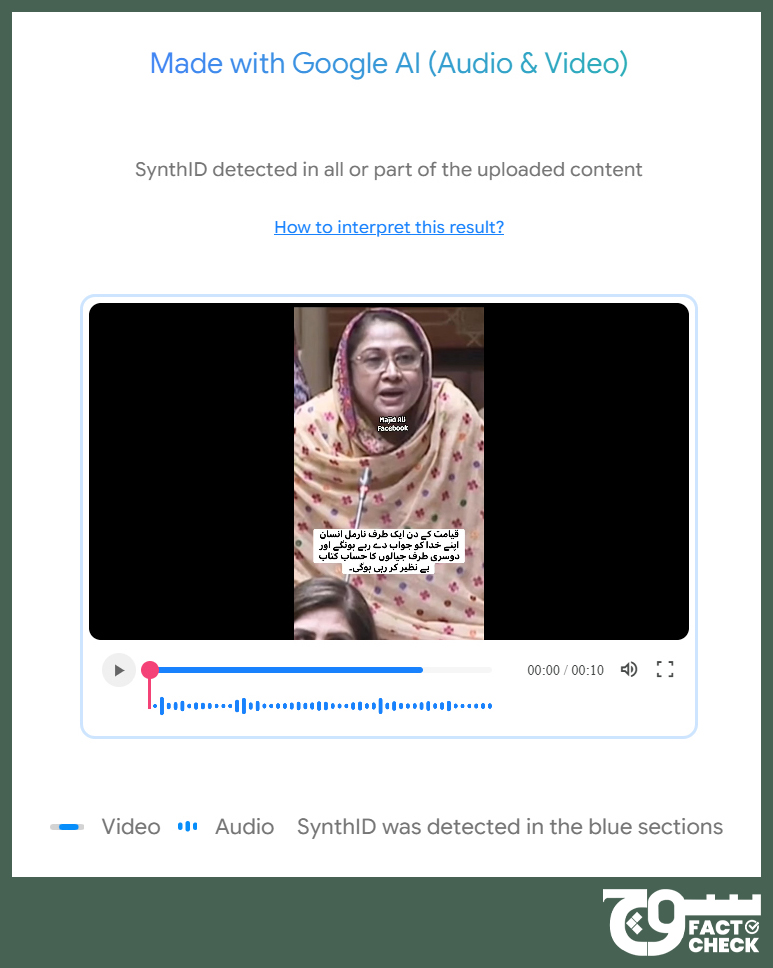
Results from Google AI’s SynthID detection tool
Sound engineer’s analysis
To corroborate our suspicions about AI manipulation, we sought a comment from Shaur Azher, a lecturer who teaches sound design and sound recording at the University of Karachi and the Shaheed Zulfikar Ali Bhutto Institute of Science and Technology (SZABIST). He also works as an audio engineer at our sister organisation, Soch Videos, and specialises in mixing and mastering audio.
Azher explained that for comparison purposes, Sample A is the claim and Sample B is Talpur’s actual speech from 2019. He said that the forensic data “definitively proves Sample A is a synthetic deepfake”.
“The two samples are acoustically inconsistent with each other on multiple independent metrics,” he explained. “Sample B aligns with a natural, lower-pitched, hoarser delivery recorded at modest level with ordinary room tone. Sample A is heavily level-boosted, limited, mid-emphasised, and higher-pitched; it also carries a different residual noise and reverb character.
“These differences exceed what would be expected from ordinary microphone or gain variations of the same speaker under similar conditions.”
To support his conclusion, he provided the following observations:
- Loudness and levels
-
- Sample A measures -14.51 LUFS, with a True Peak (TP) at -0.66 decibels relative to full scale (dBFS)
- Sample B measures -35.17 LUFS, with a True Peak at -19.81 dBFS
The integrated loudness difference between the two samples is 20.66 dB, whereas the TP difference is approximately 19.15 dB. Sample A is heavily level-boosted and limited almost to full-scale; however, Sample B retains substantial natural headroom.
- Noise floor
- Using a 50-millisecond frame RMS and the 5th-percentile value as the noise floor estimate:
-
-
- Sample A ≈ -45 dBFS
- Sample B ≈ -62 dBFS
-
This brings the difference to 17 dB. Sample A’s noise floor is clearly louder and it contains more continuous broadband heating, ventilation, and air conditioning (HVAC) noise; Sample B is quieter overall, though some low-level microphone or electrical components are still present inside the speech.
- Dynamics
Both files show relatively low Loudness Range (LRA), with Sample A’s approximately 3.2 Loudness Units (LU) and that of Sample B approximately 4.5 LU.
Crest factors — which is the ratio of a waveform’s peak amplitude to its root-mean-square (RMS) — are similar, almost between 17 and 19 dB. Sample A is more aggressively compressed in absolute terms, while Sample B’s lower overall level makes its dynamics appear more natural on a waveform view even though short-term compression is still present.
- Frequency content
Both recordings contain usable energy from upwards of roughly 20 hertz (Hz). Sample A’s significant energy — within ~40 dB of its spectral peak — rolls off earlier, around 9-10 kilohertz (kHz). However, Sample B extends more usefully to ~15-16 kHz.
Sample A concentrates a larger share of its energy in the low-mid and mid bands (250 Hz-2 kHz); Sample B distributes energy more evenly and retains relatively more high-frequency content. The denser mid-band coefficients observed in Sample A are consistent with stronger compression or equalisation rather than a fundamentally wider bandwidth.
- Pitch and tonality
The median fundamental frequency for Samples A and B is approximately equal to 232 Hz and between 178 and 181 Hz, respectively.
Sample A is higher than Sample B by about 4.5 semitones. The pitch offset is consistent and large enough to be audible as a distinctly-different vocal placement. Sample B exhibits the hoarser, lower, and more characteristic timbre associated with the reference voice; Sample A does not match that baseline tonality.
- Reverb and spatial character
Sample A carries a more uniform, slightly artificial-sounding reverb tail. Sample B has a shorter, more natural room/dome-type decay, consistent with a live or lightly-treated acoustic space.
Likely original creator
Lastly, in some of the viral videos, the text “Majid Ali Facebook” is visible in the centre. This allowed us to trace what appears to be the original creator of the clip with the same name on the Meta-owned platform.
The user ‘Majid Ali’ describes themselves as a “Digital Creator” who creates “Social Media Content” and “Vlogging-Ai Videos” and their profile and cover pictures state the same. The original video — posted on 7 September — has so far gained over 1.1 million views.
In a comment, the user justified creating the clip by writing:
“یہ ویڈیو صرف اس وجہ سے بنائی گئی ہے ، کیوں کہ پچھلے دنوں ان لوگوں نے اسمبلی میں کہا تھا کہ کراچی کو الگ کر کے سندھ کو توڑو گے تو قیامت کے روز بینظیر کو کیا جواب دوگے، ان کو صرف یاد دہانی کرنی تھی بینظیر اس وقت خود مغفرت کے دعا کی محتاج ہے، جواب صرف اپنے خدا کی ذات کو دینی ہے ان لوگوں نے بےنظیر اور بھٹو کو ایسے پیش کیا ہے جیسے یہ مرینگے تو وہ انکے انتظار میں ہے بتاؤ کیا کیا سندھ کے ساتھ ظالموں، یہ حساب کتاب تم لوگوں سے خدا کریگا کہ تمنے عوام پر اتنا ظلم ڈھایا ، قتل عام کیا
[This video was made only for this reason, because these people had recently said in the assembly that if you separate Karachi and divide Sindh, then what will you tell Benazir [Bhutto] on the Day of Judgement? They only had to be reminded that Benazir herself is in need of prayers for forgiveness at this time, which can only be granted to her by God. These people have presented Benazir and [former Prime Minister Zulfikar] Bhutto as if they both will be waiting for them when they die. Explain what you did to Sindh, you oppressors. God will hold you accountable for the injustice you have done to the people and the massacres you have committed.]”
The Facebook user has also added an AI label to the video themselves, indicating that “AI may have been used for a wide range of purposes, from photo retouching to generating entirely new content”.
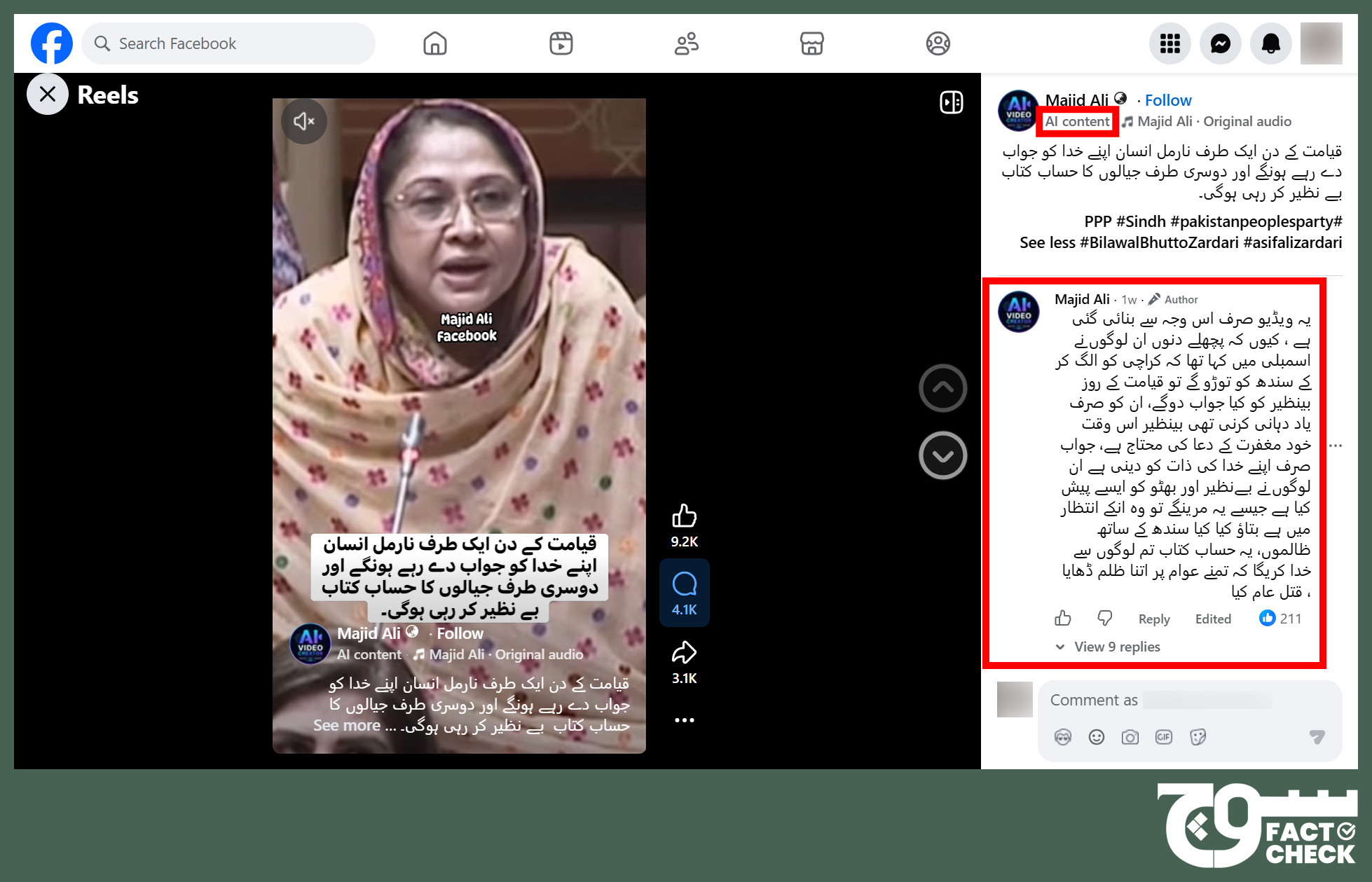
Screenshot of the Facebook post by user ‘Majid Ali’, who added an AI label to it and provided an explanation in the comments about why he created the viral AI-generated video of Talpur
Soch Fact Check, therefore, concludes that the viral video of Talpur saying “normal people will be answerable to their God” and “Benazir will carry out the reckoning of the jiyalas” on the Day of Judgement is AI-manipulated.
Virality
Soch Fact Check found the video posted multiple times on Facebook, including in numerous public groups.
It was also shared on @mock_istan, the Instagram account of its suspected creator.
The clip was also shared on TikTok by user @mj_baloch92, who has the same bio as the suspected creator, indicating that it may likely be the same person behind the account. It has gained over 349,900 views so far.
Conclusion: The video is AI-manipulated. It uses visuals from Faryal Tarpur’s speech in 2019 to misrepresent her comments around her recent criticism of the proposed 28th Amendment.
Background image in cover photo: MPAFaryalTalpurpk
To appeal against our fact-check, please send an email to appeals@sochfactcheck.com