
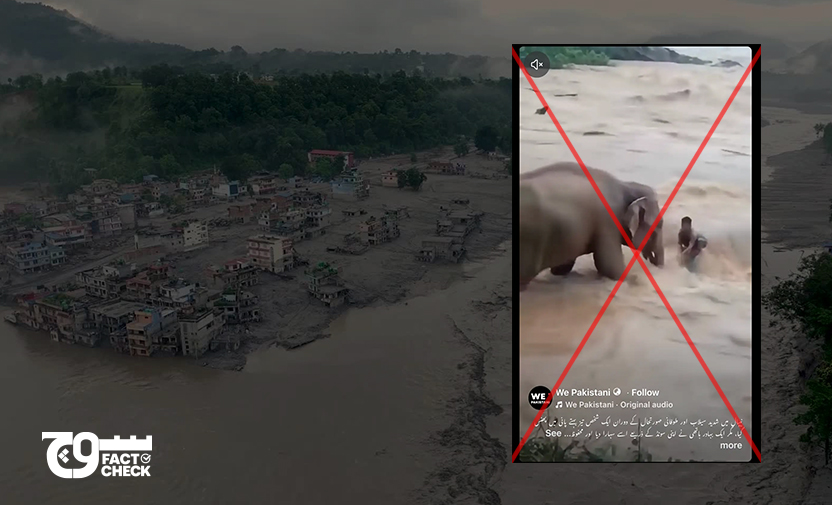
Claim: A video shows an elephant rescuing a man during the 26 August 2026 floods in Nepal.
Fact: The video was circulating online from as early as 9 August 2026, over two weeks before the floods struck Nepal. Separate analyses found indications of possible AI manipulation, but the video’s authenticity could not be conclusively established.
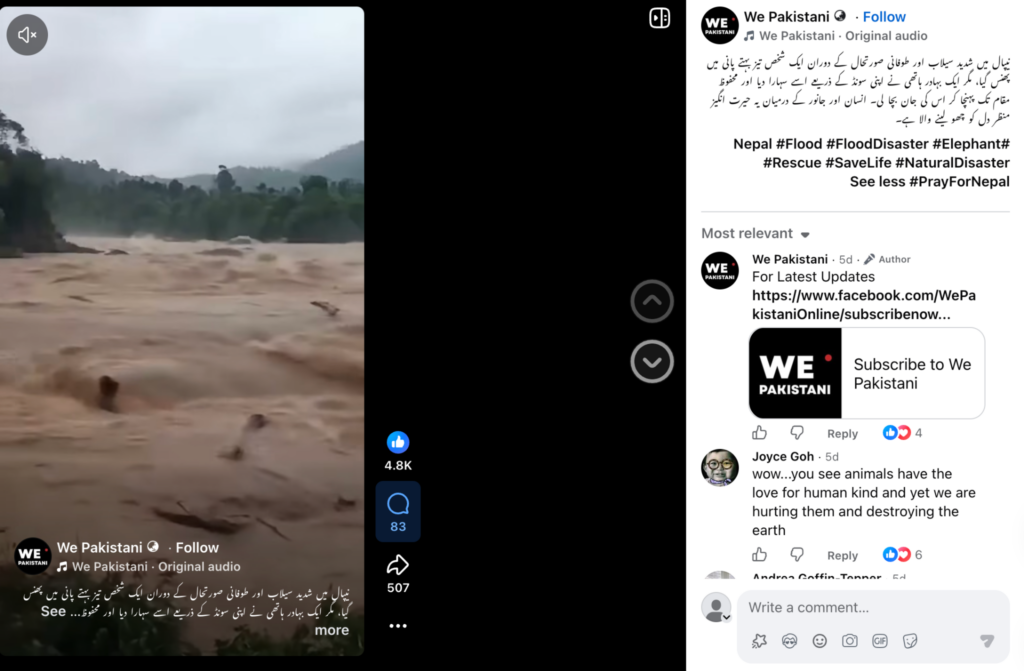
Screenshot : Facebook
On 29 August 2026, the Facebook page We Pakistani shared a 20-second video claiming to show an elephant rescuing a man during the floods in Nepal. The footage shows a man being swept through fast-moving muddy water before an elephant enters the floodwaters and approaches him. The man is later seen alongside the elephant.
The Urdu caption accompanying the post stated:
“نیپال میں شدید سیلاب اور طوفانی صورتحال کے دوران ایک شخص تیز بہتے پانی میں بہہ گیا، مگر ایک بہادر ہاتھی نے اپنی سونڈ کے ذریعے اسے سہارا دیا اور محفوظ مقام تک پہنچا کر اس کی جان بچا لی۔ انسان اور جانور کے درمیان یہ حیرت انگیز منظر دل کو چھو لینے والا ہے۔”
[Translation: “During severe flooding and stormy conditions in Nepal, a man was swept away by fast-moving water, but a brave elephant supported him with its trunk and brought him to a safe place, saving his life. This remarkable scene between a human and an animal is heart-touching.”]
August 2026 Nepal floods
On 26 August 2026, a catastrophic flash flood struck Nepal’s Rasuwa district near the country’s border with China’s Tibet Autonomous Region. Nepal’s Ministry of Home Affairs said the Bhote Koshi River began flooding at around 8:40 am, severely affecting communities along the river in Rasuwa as well as downstream areas of Nuwakot, Dhading, and Gorkha districts. The government launched search, rescue, and emergency relief operations and began moving survivors from affected areas.
Reuters reported that the flood followed the collapse of a huge mass of ice, mud, and rock in the Himalayan border region, which sent water, sediment, boulders, and other debris downstream through river systems connecting Tibet and Nepal. The torrent devastated villages, damaged homes, roads, bridges, and hydropower facilities, and badly damaged the strategically important Gyirong-Rasuwagadhi border crossing linking Nepal with Tibet. Scientists examining the disaster said unusually warm conditions and the instability of Himalayan glaciers may have contributed to the collapse, although investigations into the precise sequence of events is ongoing.
The International Centre for Integrated Mountain Development (ICIMOD) reported that the flood sent a powerful surge of water, sediment, and boulders through the Bhote Koshi and Trishuli river systems and raised concerns about further downstream flooding. The disaster also disrupted a major route used for cross-border trade and by pilgrims travelling between Kathmandu and Tibet.
The scale of the disaster became clearer over the following days as rescue teams searched damaged settlements, riverbanks, and hydropower facilities. By 3 September, Reuters reported at least 1,252 people had died in Nepal and more than 4,200 remained missing, while around 20,000 homes required rebuilding in flood-affected areas along the country’s northern border. Thousands of Nepali security personnel and rescue workers remain involved in search operations.
Fact or Fiction?
To investigate the claim, Soch Fact Check extracted keyframes from the viral footage and conducted reverse image searches. The searches led to a 29-second video posted on Facebook by the West Bengal-based news outlet Ei Samay on 9 August 2026.
Soch Fact Check compared the Ei Samay upload with the viral 20-second clip and found the same sequence of events. Both versions show the man being carried by the current, the elephant approaching him, and the man later appearing alongside the animal. Ei Samay also included a disclaimer stating it had not verified the video’s authenticity.
Further searches led to another video uploaded to YouTube by the Bangladeshi news outlet Nagorik Protidin on 9 August. Bengali text overlaid on the video described a pet elephant rescuing its owner from floodwaters. Soch Fact Check confirmed it contained the same footage.
The Indian news page Sanjay Pera News also posted the video on 9 August and claimed it showed flooding in Assam, India. However, the page did not provide evidence corroborating the location. Soch Fact Check therefore used these uploads only to establish when the video was circulating online, not where it originated or where the incident occurred.
These directly examined uploads prove that the footage was online from as early as 9 August 2026, more than two weeks before the floods struck Nepal on 26 August. The video therefore cannot be related to the 26 August floods. However, there is not enough evidence to establish where the footage originated or whether it shows a genuine rescue.
Dismislab separately traced the footage to the same 9 August uploads by Ei Samay and Sanjay Pera News. Full Fact also established that the video predated the Nepal floods and identified the Nagorik Protidin upload, independently corroborating Soch Fact Check’s findings.
AI detection and visual consistency
Soch Fact Check also examined whether the footage had been generated or manipulated using artificial intelligence.
A frame-by-frame examination found blurred and poorly resolved details around the man, the elephant and the surrounding water. Between approximately 4.3 and 4.8 seconds, the man’s lower body, a grey surface beside him and the floodwater appear to merge because their boundaries are unclear. Similar loss of detail appears as the man makes contact with and climbs onto the elephant near the end of the video.
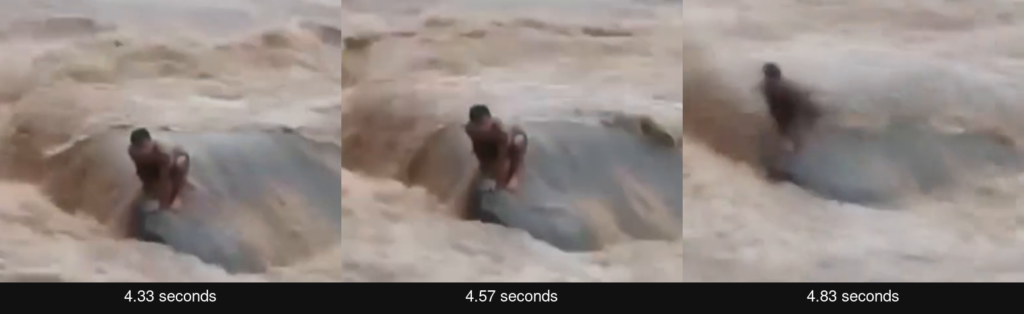
Source : Soch Fact Check
However, these abnormalities do not persist across consecutive frames. The man’s limbs, the elephant’s anatomy and trunk, the background, floating debris and the direction of the water remain broadly consistent. Motion blur, spray, partial submersion, compression and repeated social media processing could plausibly explain the poorly resolved details. Soch Fact Check therefore found no visual feature that conclusively established AI generation.
Soch Fact Check analysed the video using Hive Moderation’s AI-generated content detection system. Hive classified the complete video as “not likely” to contain AI-generated or deepfake content and assigned it a 36.3% likelihood of being AI-generated. Its timeline nevertheless displayed stronger AI-generation indicators at several points. These segment-level signals do not establish that any part of the video was generated using AI.
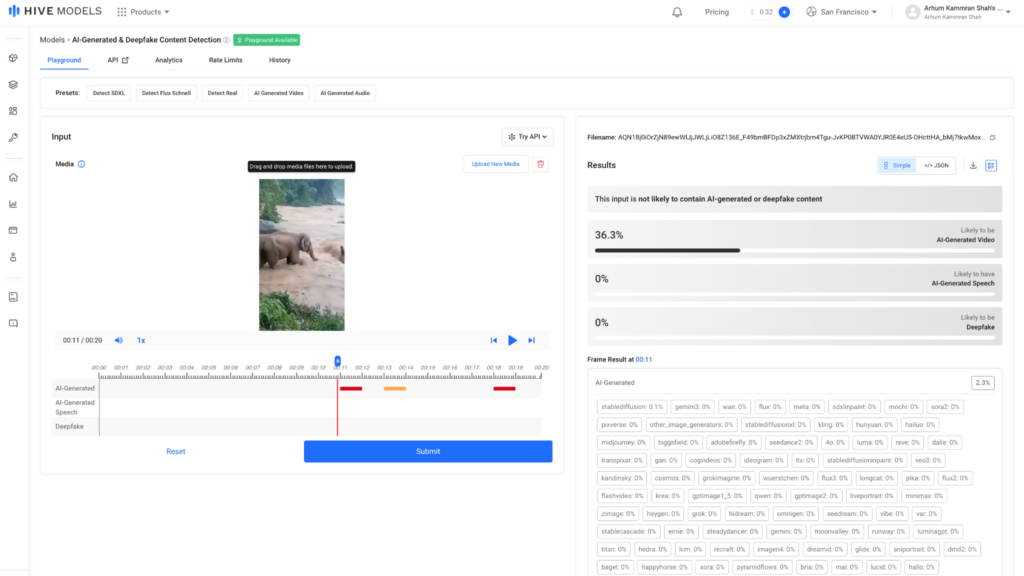
Screenshot : HiveModeration
Soch Fact Check also tested the video using FauxLens, which returned a “likely AI-generated” label with a 90% confidence score. Its metadata check stated that the file’s origin could not be established, while its visual analysis was flagged. The absence of provenance metadata does not itself prove that the footage was artificially generated.

Screenshot : FauxLens
The conflicting automated results did not allow Soch Fact Check to determine conclusively whether the footage was generated or manipulated using AI. However, this uncertainty does not affect the central finding: that the video was circulating online from 9 August 2026, 17 days before the floods struck Nepal on 26 August.
Virality
The claim circulated widely on Facebook. As of 3 September 2026, the 21 reels identified by Soch Fact Check had collectively received approximately 47,300 reactions, at least 924 comments, and approximately 5,100 shares.
Conclusion: The viral video does not show an elephant rescuing a man during the August 2026 floods in Nepal. Soch Fact Check found the footage was online from 9 August, predating the disaster by more than two weeks. We were also unable to pinpoint the location of the video or the veracity of the incident. While visual and automated analyses indicated possible AI manipulation, the video’s authenticity remains unverified.
To appeal against our fact-check, please send an email to appeals@sochfactcheck.com