
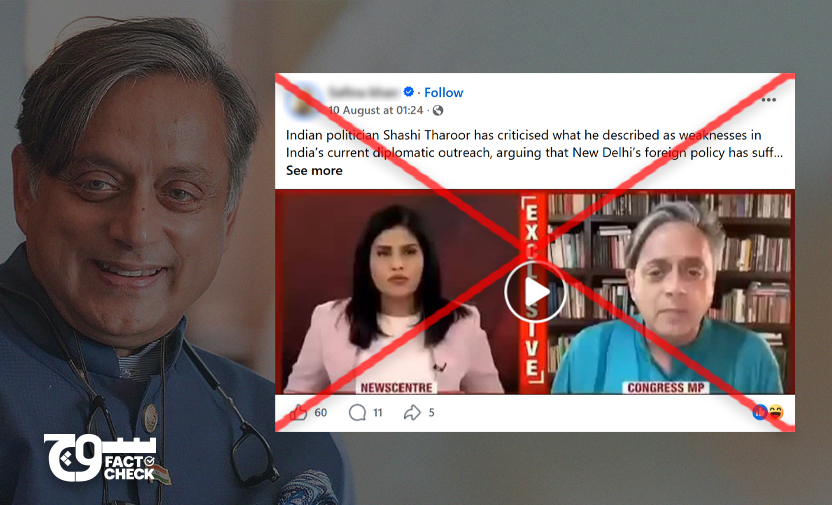
Claim: In an interview, Indian politician Shashi Tharoor spoke in favour of Pakistan’s foreign policy after the signing of “Mecca Joint Defence Agreement” and criticised Prime Minister Narendra Modi’s diplomacy as “completely ineffective”.
Fact: The viral video is AI-manipulated. It was created using an authentic interview of Tharoor from April 2026.
On 10 August 2026, multiple Facebook users shared a video showing Indian politician Shashi Tharoor speaking in favour of Pakistan’s foreign policy and criticising Prime Minister Narendra Modi’s diplomacy as “completely ineffective”.
In an interview with NDTV anchor and Politics Editor Vasudha Venugopal, Tharoor — who is also a member of the Indian National Congress (INC) representing the Thiruvananthapuram city — reportedly said, “Pakistan has forces in Bahrain, it has moved closer to Bangladesh, and, now, this pact happened today, with Turkey also joining it along with Saudi Arabia. So Pakistan is expanding its diplomatic clout.
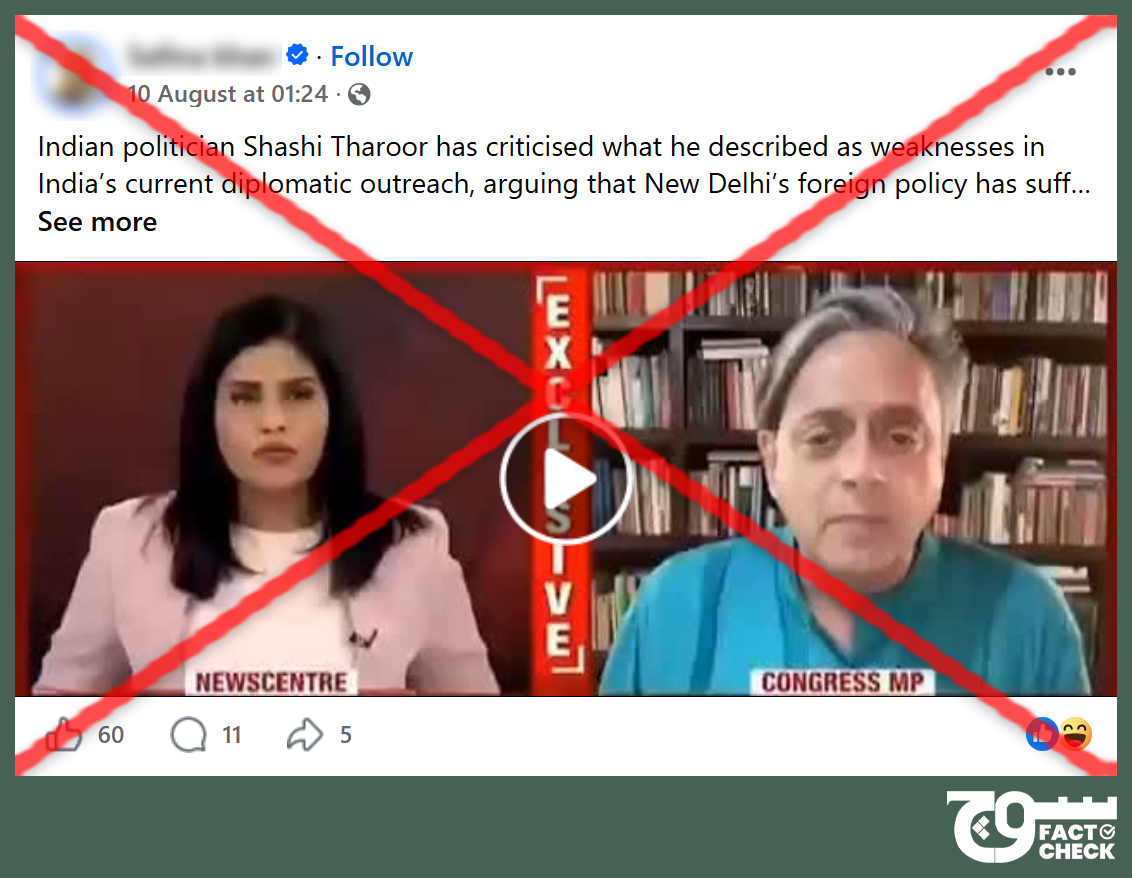
“And where do we stand today, compared to Pakistan? Modi ji visits smaller countries, comes back, and does not even give a briefing. Today, India and Indian diplomacy have become completely ineffective and this is a major concern,” he added.
Mecca deal between Pakistan, Türkiye, and Saudi Arabia
On 7 August 2026, Pakistan, Saudi Arabia, and Türkiye signed a joint defence pact at Al-Safa Palace in Mecca, one of the holiest cities in Islam.
Known as the “Mecca Joint Defence Agreement,” the pact was signed by Pakistan’s Prime Minister Shehbaz Sharif, Saudi Arabia’s Crown Prince Mohammad bin Salman, and Turkish President Recep Tayyip Erdogan during the Makkah Al-Mukarramah Summit for Joint Defence.
Pakistan’s Foreign Ministry said in a press release that the agreement — “intended to strengthen collective deterrence against any act of aggression” — and ensures that “any armed attack against any one of the three States shall be regarded as an attack against them all”.
Fact or Fiction?
Soch Fact Check reverse-searched keyframes from the viral video and found that Tharoor’s interview with Venugopal predates the “Mecca Joint Defence Agreement” signed in August 2026.
The full interview, which is over 20 minutes long and was aired on NDTV on 9 April 2026, features the Indian politician talking about Pakistan’s role in mediating peace between the US and Iran. Articles on the publication’s website about the same can be found here and here.
A snippet of Tharoor’s remarks can be seen on NDTV’s Facebook page and the full interview is available on YouTube as well.
On 8 April, Pakistan-led mediation efforts had culminated in a two-week ceasefire, with the “Islamabad Talks” scheduled for later the same month, according to an announcement by PM Sharif.
Sharif had expressed “deepest and sincere gratitude to our brotherly countries” — Türkiye, China, Egypt, and Saudi Arabia — “for extending invaluable and all out support” in achieving the ceasefire.
Deepfake detection tools
Soch Fact Check ran the viral video through multiple deepfake detection tools to confirm if it was generated using artificial intelligence (AI) tools.
According to the NVIDIA Synthetic Video Detector, the clip is “real”, with a synthetic score of 13.9%, which is “lower than threshold (30%), meaning it’s likely a real video”.
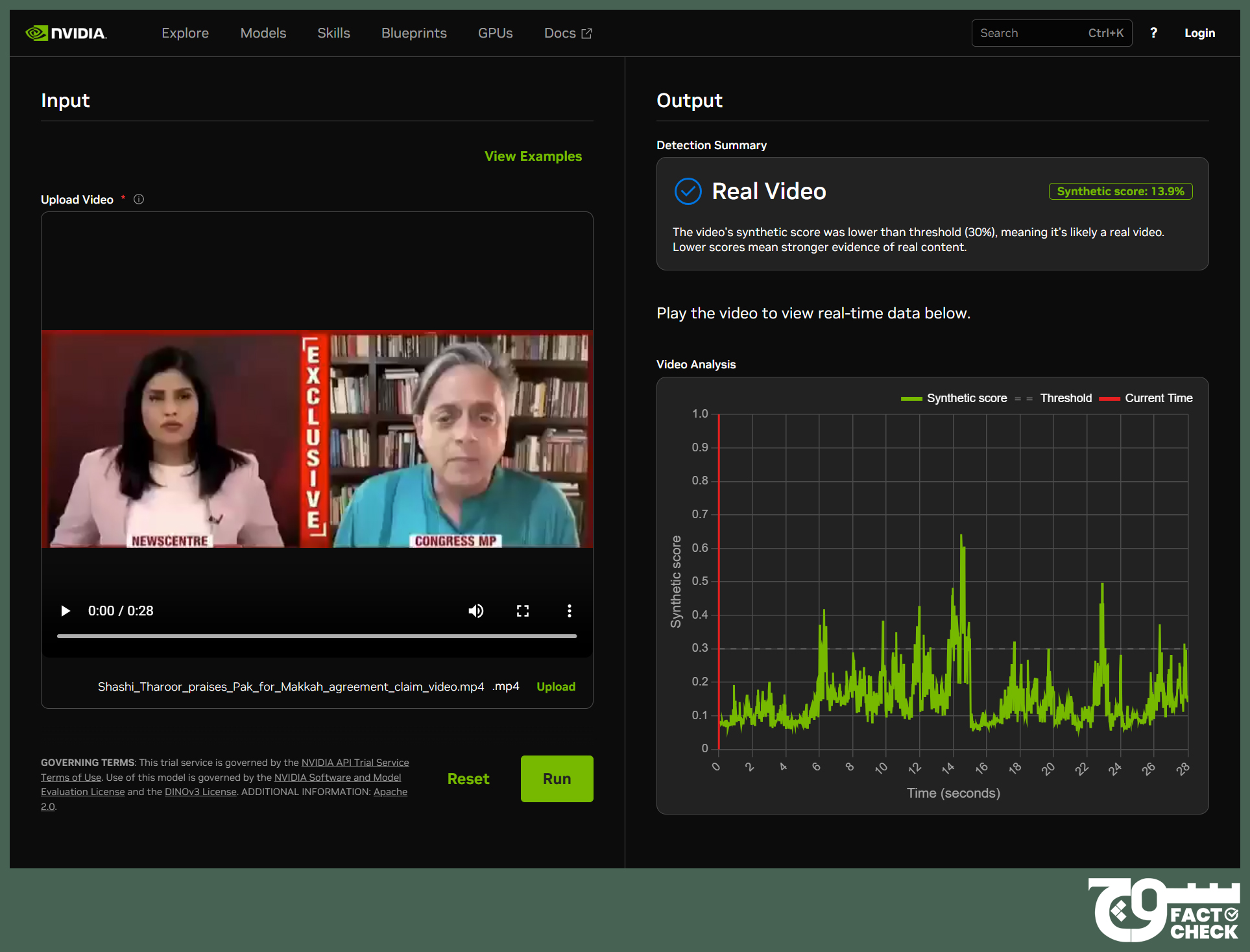
Results from NVIDIA Synthetic Video Detector
However, Hive Detect’s results stated that the video is 98.7% likely to contain AI-generated speech.
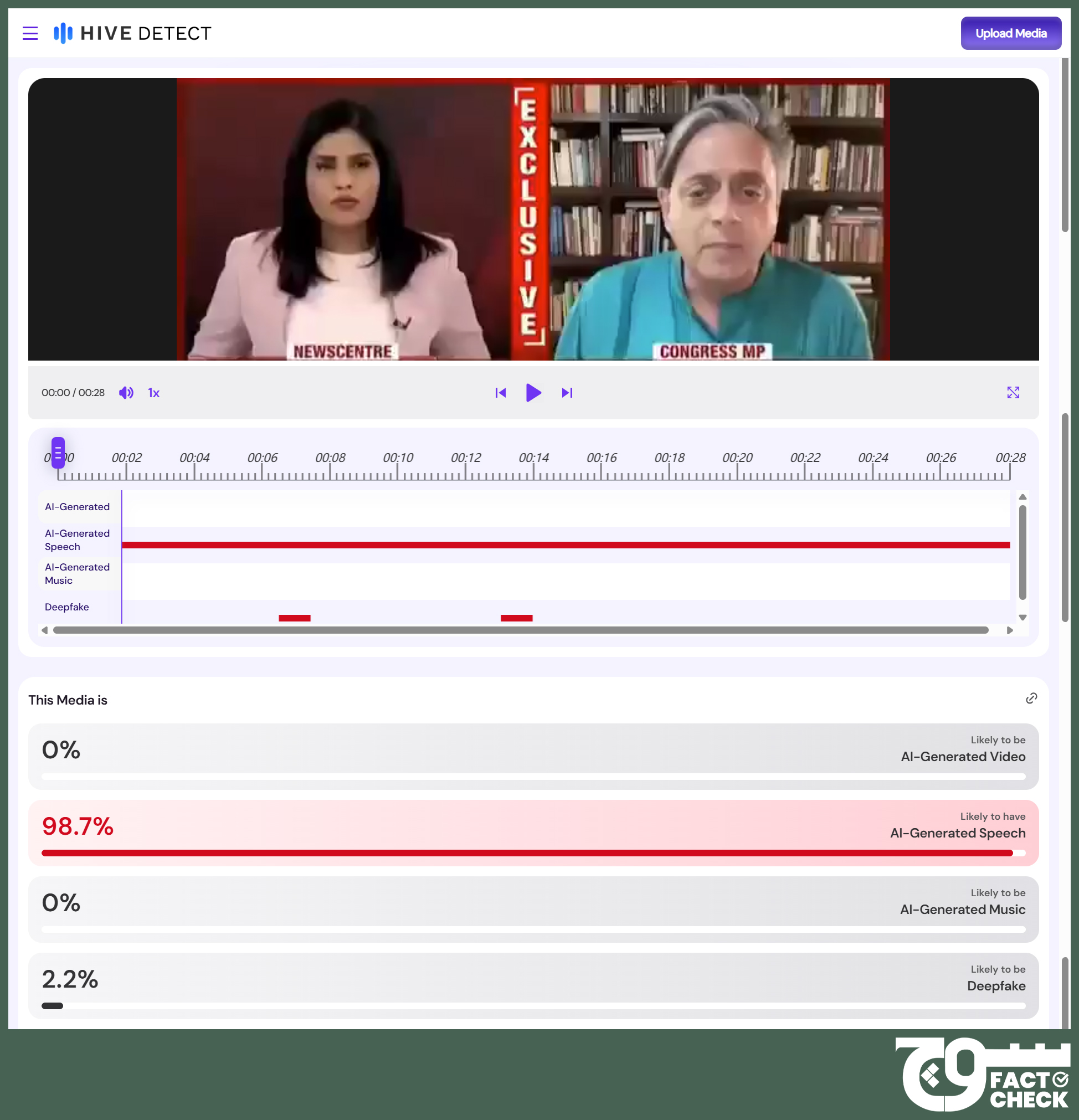
Results from Hive Detect
We also ran the viral clip through Global Online Deepfake Detection System (GODDS), a tool developed by Northwestern University’s Security & AI Lab (NSAIL) that uses a combination of various models along with human analysis to provide a holistic summary of the results.
GODDS employed 22 deepfake detection algorithms for the visual content and 70 for the audio component, while two trained analysts also examined the clip.
All predictive models for the visual and audio content said the video “is likely to be fake”:
- The video is likely to be fake with a probability above 0.5, according to seven of the 22 predictive models; it is likely to be fake with a probability below 0.5, according to the 15 other predictive models.
- The audio is likely to be fake with a probability above 0.5, according to 61 of the 70 predictive models; it is likely to be fake with a probability below 0.5, according to the nine remaining predictive models.
According to GODDS’ human analysts, the video contains “several indicators” that show it may be artificially manipulated. For example:
- Between the 0:27 and the 0:28 marks, the right eye appears to change shape.
- Between the 0:18 and the 0:19 marks, both eyes appear warped.
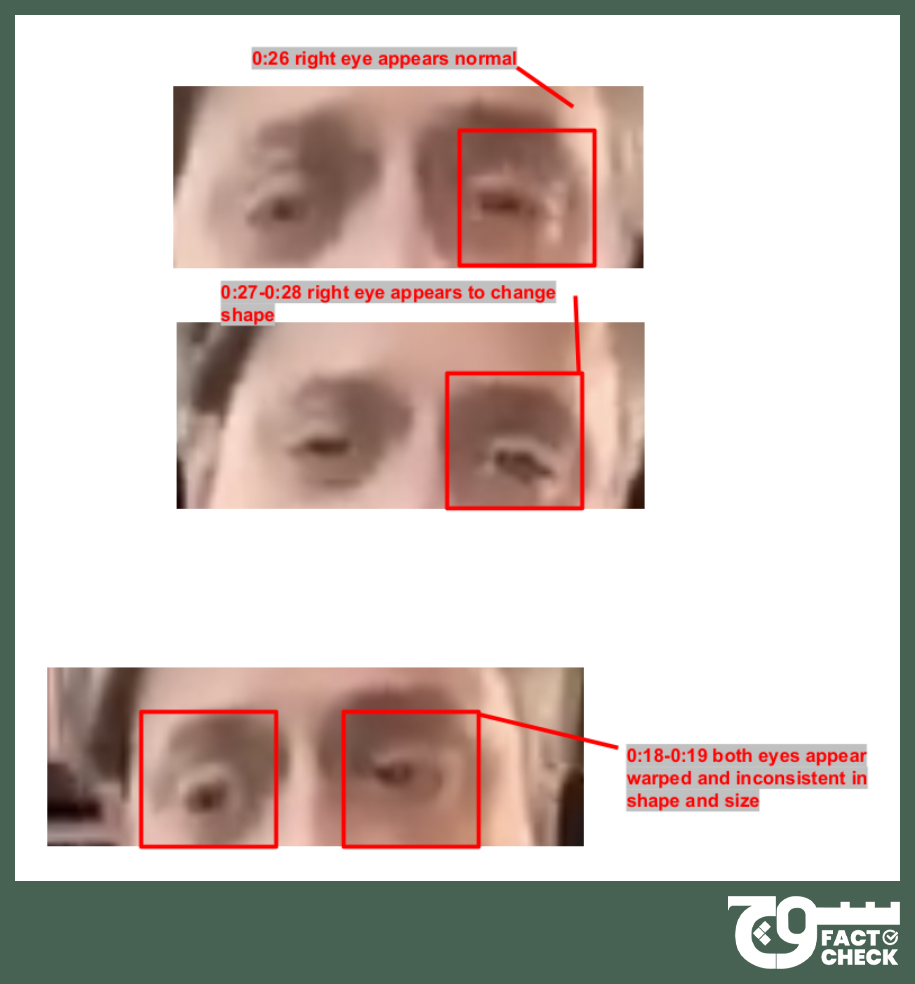
Results from GODDS
However, the analysts said, “The artefacts are largely obscured by poor video quality, despite the majority of the video’s features remaining detailed and clear. It is difficult to discern possible artefact manipulation because of the poor video quality. It is plausibly explainable by other factors such as motion blur as well.”
They concluded that the video “is likely manipulated via artificial intelligence”.
Sound engineer’s analysis
To corroborate our suspicions about AI manipulation, we sought a comment from Shaur Azher, a lecturer who teaches sound design and sound recording at the University of Karachi and the Shaheed Zulfikar Ali Bhutto Institute of Science and Technology (SZABIST). He also works as an audio engineer at our sister organisation, Soch Videos, and specialises in mixing and mastering audio.
Azher explained that for comparison purposes, Sample A is the claim and Sample B is the actual interview aired by NDTV.
“When examining how the audio physically behaves, the evidence is undeniable,” he said. “The robotic speed with a lack of variation, a complete absence of natural breathing and human mouth sounds, and the artificial background static all prove that Sample A is a deepfake. It was entirely synthesised by software and evaluated directly against the authentic, real-world recording of Sample B.”
To support his conclusion, he provided the following observations:
- The voice fingerprint: The underlying mathematical structure of Sample A shows obvious spectral patterns that fundamentally differ from the genuine biological signature found in Sample B.
- Breathing and speed: Sample B shows Tharoor speaking at a natural, emotional pace where the cadence is high, with the speaker organically pausing, emphasising words, and taking normal human breaths. Sample A rushes through the words unnaturally fast, exhibiting much less variation and skipping natural breathing spaces altogether.
- Missing mouth sounds: Real people make tiny noises when they speak, like lips parting or slight tongue clicks. These are clearly present in Sample B. On the other hand, Sample A is suspiciously smooth and completely missing these normal human imperfections, as software models inherently polish out microscopic wet sounds.
- Fake background static: A genuine recording captures the natural echo of the physical room a person is sitting in, establishing a true-room tone fingerprint. Sample A covers up the fact that it was not recorded in a real room by laying down a blanket of artificial, constant static — a noise flood — over the voice to hide rendering glitches.
- Unnatural pitch: In Sample A, the bands artificially boost the higher pitches of the voice in a way that a physical microphone simply does not do. This algorithmic elevation gives Sample A a slightly synthetic when compared to the grounded resonance of Sample B.
Soch Fact Check, therefore, concludes that the viral video of Shashi Tharoor speaking in Pakistan’s favour and criticising Indian diplomacy is AI-manipulated.
Virality
Soch Fact Check found the video shared multiple times on Facebook, once each on Instagram and Threads, and at least six times on X (formerly Twitter).
On X, the video has garnered over 59,700 views so far.
Conclusion: The viral video is AI-manipulated. It was created using an authentic interview of Tharoor from April 2026.
Background image in cover photo: ShashiTharoor
To appeal against our fact-check, please send an email to appeals@sochfactcheck.com