
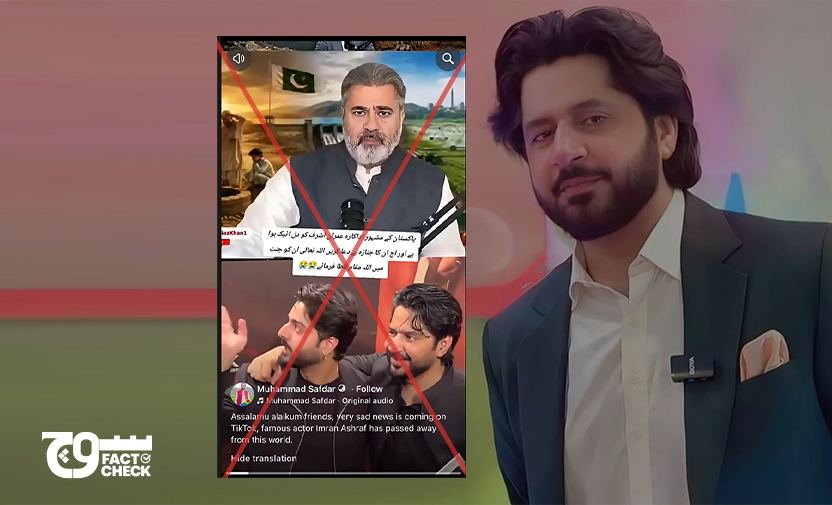
Claim: Pakistani actor Imran Ashraf died after suffering a heart attack.
Fact: Imran Ashraf publicly dismissed reports of his death as fake, saying he was “absolutely fine”. Soch Fact Check traced the main clip to genuine footage of Imran Riaz Khan and found evidence of AI-generated speech.
On 17 August 2026, Facebook user Muhammad Safdar shared a video claiming that Pakistani actor and television host Imran Ashraf had died. The video appeared to show journalist Imran Riaz Khan announcing that Ashraf had suffered a heart attack and that his funeral would take place that day. It also contained footage of Ashraf and displayed the following Urdu text:
“پاکستان کے مشہور اداکار عمران اشرف کو دل اٹیک ہوا ہے اور آج ان کا جنازہ ہے دعا کریں اللہ تعالیٰ ان کو جنت میں اعلیٰ مقام عطا فرمائے”
[Translation: “Pakistan’s famous actor Imran Ashraf suffered a heart attack, and his funeral is today. Pray that Allah Almighty grants him a high place in Paradise.”]
The accompanying caption stated:
“السلام علیکم دوستو بہت ہی افسوسناک خبر ٹک ٹوک پہ ارہی ہے مشہور اداکار عمران اشرف اس دنیا سے وفات پا گئے ہیں”
[Translation: “Peace be upon you, friends. Very sad news is circulating on TikTok. Famous actor Imran Ashraf has passed away.”]
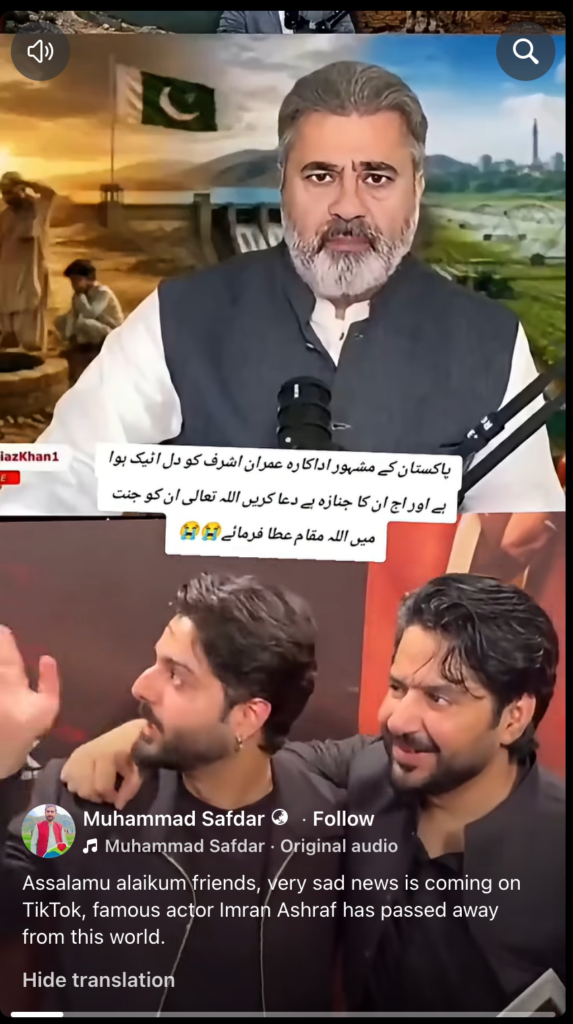
Screenshot of a viral post claiming Ashraf passed away.
Fact or Fiction?
The claim is false. On 17 August 2026, Ashraf responded through a story on his official Instagram account. He wrote, “ALHAMDULILLAH I AM ABSOLOUTLY FINE ITS A FAKE NEWS NEED YOUR PRAYERS.”
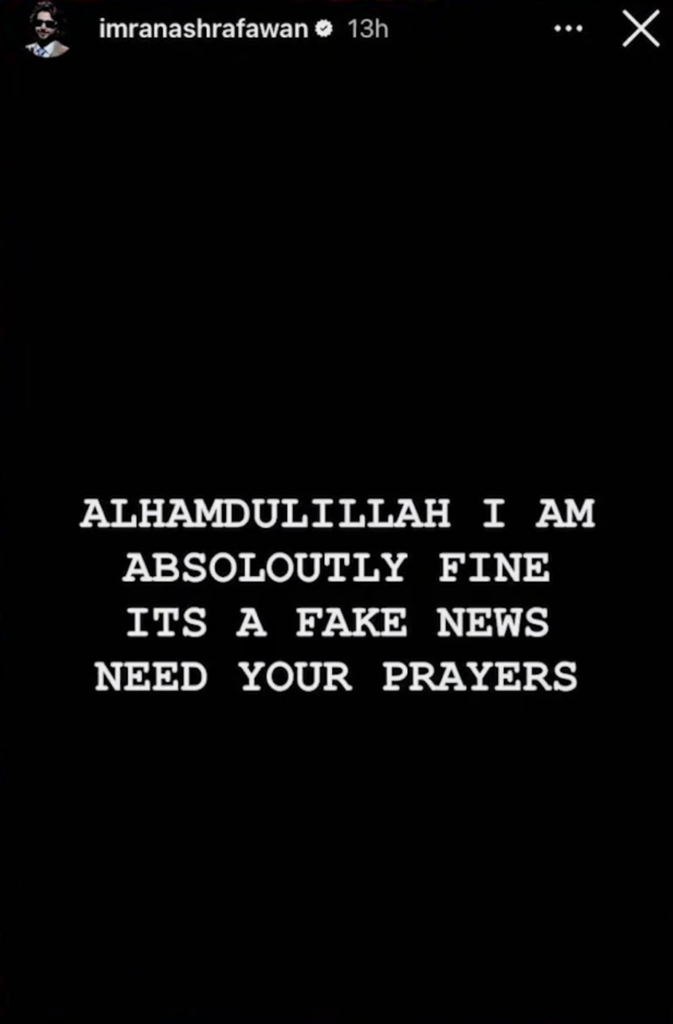
Screenshot of Imran Ashraf’s Instagram Story on 17 August 2026, in which he said he was “absolutely fine” and described reports of his death as fake.
Ashraf also addressed the rumour in a video posted to Facebook. He said he was “completely fine” and added, “Alhamdulillah, I am alive and breathing.” He said an account had made the false report viral by “creating several AI videos” claiming that he had died. Ashraf added that he was asleep when the rumour began circulating and was therefore unable to answer calls from family and friends.
Screenshot from a video posted by Imran Ashraf on 17 August 2026, in which he said he was alive and addressed the false reports of his death.
Soch Fact Check traced the footage of journalist Imran Riaz Khan used in the viral clip to a video published on his official YouTube channel on 9 August 2026, more than a week before the false report about Ashraf’s death circulated.
The footage used in the viral clip appears at approximately 19:06 in the original video. At that point, Riaz says, “دیکھیں پانی جو ہے نا، واٹر از لائف۔ پاکستان کے لیے آنے والے سالوں میں سب سے بڑا مسئلہ جو ہے وہ پانی کا بننے والا ہے۔”
[Translation: “Look, water is life. In the coming years, the biggest problem Pakistan will face is going to be water.”]
The same grey waistcoat, white kurta, microphone, Pakistan flag, and agricultural backdrop appear in both videos. The viral clip uses footage from the final section of Riaz’s original video, but crops it vertically, replaces his original speech with different audio, and adds text. The original recording discusses Pakistan’s water shortage, water storage, farming practices, and agricultural reforms. Riaz does not mention Imran Ashraf, a heart attack, his death, or a funeral.
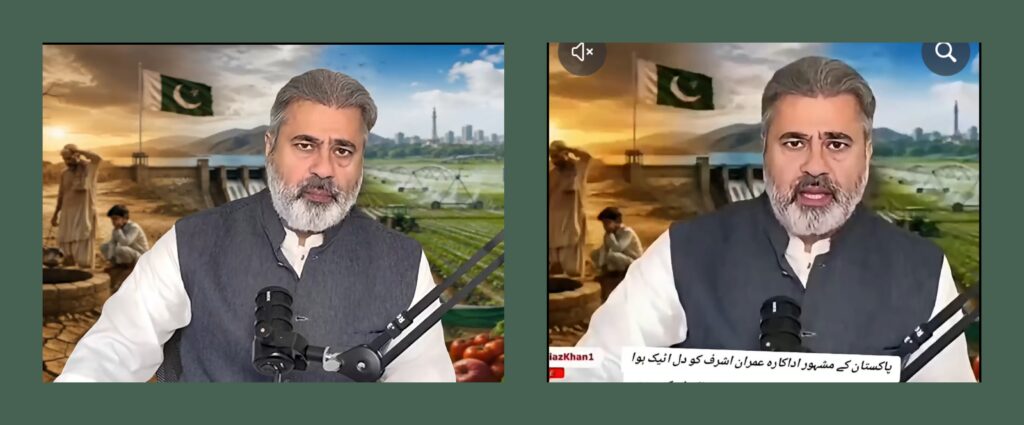
Left: Imran Riaz Khan’s original video from 9 August 2026.
Right: The viral clip falsely claiming Ashraf has passed away.
An official Facebook upload of the complete video, also dated 9 August 2026, further corroborates the source of the footage.
AI analysis
Soch Fact Check analysed the main viral video, which is 15 seconds long, using AI detection tools.
Hive Moderation assessed the clip for signs of AI-generated video, AI-generated speech, and deepfake content. It returned a 98.6% likelihood for AI-generated speech. The result therefore indicates that the speech in the clip was likely synthetically generated. It does not indicate that the visual footage itself was AI-generated or manipulated as a deepfake.
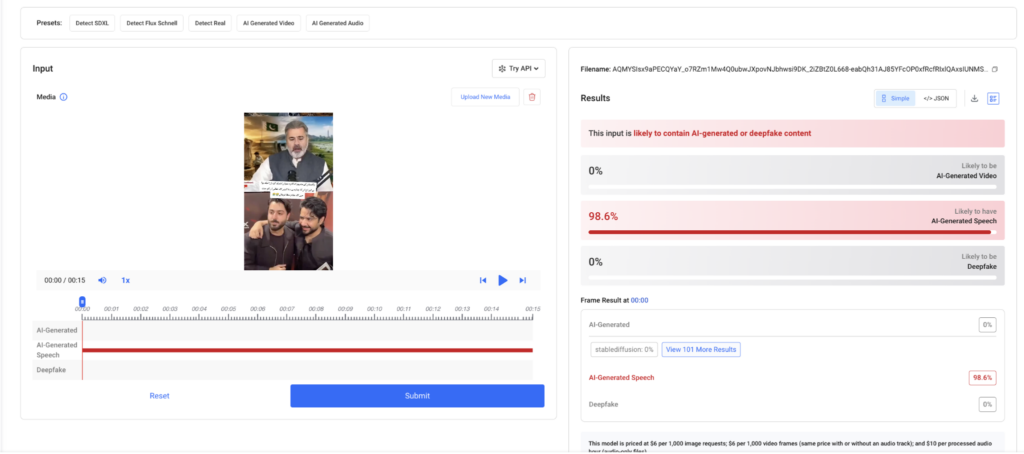
Screenshot of Hive Moderation’s analysis, which assessed the clip’s speech as 98.6% likely to be AI-generated.
Soch Fact Check also analysed the clip using Detect Video AI. The tool assessed several available signals, including visual and temporal characteristics, audio, compression and source information, audio and video synchronisation, and frame-level AI indicators. Detect Video AI classified “AI-generated” as the leading category with a 71% likelihood, compared with 29% for “authentic” and 0% for “manipulated”. The report assigned the available evidence a confidence level of 85%, while describing the overall analysis conditions as moderate.
The tool also noted that evidence branches that were unavailable or not applicable were excluded from the calculation. The 71% figure therefore represents its likelihood assessment based on the evidence it could analyse; it does not mean that 71% of the video was generated using AI, nor does the result establish that every element of the clip was synthetic.
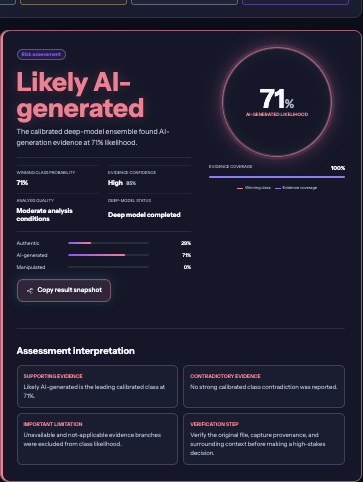
Risk analysis ran on Detect Video AI
Taken together, the two analyses provide further evidence that synthetic media was used in the main viral clip, particularly its speech. Hive Moderation assessed the speech as highly likely to be AI-generated, while Detect Video AI classified “AI-generated” as the most likely overall category. Neither result, however, establishes that every element of the video was generated or manipulated using AI. The findings are also consistent with Ashraf’s statement that an account had created several AI videos to spread the false report of his death.
Geo News reported that the wider hoax also included AI-generated videos announcing Ashraf’s supposed death from cardiac arrest. According to the report, the TikTok account responsible for the material had published additional clips that appeared to show journalists, actors, and cricketers offering condolences.
Minute Mirror reported that the fabricated videos included digitally generated versions of actor Bilal Abbas, former cricketer Shahid Afridi, and journalist Mansoor Ali Khan. Another video purported to show Ashraf’s funeral.
The same Facebook user who shared the main claim later published a correction, saying that the video circulating on TikTok was false and that Ashraf was alive.
Virality
Soch Fact Check found at least 12 posts on Facebook and TikTok carrying versions of the claim.
Collectively, the posts had approximately 110,100 reactions and likes, and more than 2,800 comments as of 4:28 pm on 19 August 2026.
The Facebook posts also accumulated at least 25 shares and approximately 35,100 views, while the TikTok posts had at least 6,582 saves.
Conclusion: The claim that Pakistani actor Imran Ashraf died after suffering a heart attack is false. Ashraf dismissed the report on 17 August 2026, saying he was “absolutely fine”. Soch Fact Check traced the viral clip to an earlier video in which journalist Imran Riaz Khan was discussing Pakistan’s water shortage, not Ashraf. The clip reused that genuine footage with different audio, which AI-detection tools assessed as likely synthetic.
To appeal against our fact-check, please send an email to appeals@sochfactcheck.com