

Claim: A viral audio recording captures PTI Secretary General Salman Akram Raja and Senator Mashal Yousafzai arguing in a party WhatsApp group.
Fact: DeepFake-O-Meter returned high AI-generation scores, while GODDS found signs of artificial manipulation and concluded that the recording was likely generated using AI.
On 10 August 2026, Instagram page Pakistan Connect shared an audio recording purportedly capturing a heated exchange between Pakistan Tehreek-e-Insaf (PTI) Secretary General Salman Akram Raja and Senator Mashal Yousafzai in a WhatsApp group.
In the recording, a voice attributed to Yousafzai accuses Raja of taking money in connection with Pakistan Bar Council election tickets, appointing or backing lawyers without links to PTI or the Insaf Lawyers Forum (ILF), receiving consultancy fees worth tens of millions of rupees, engaging in lobbying and conspiracies, and using PTI founder Imran Khan’s social media account for his own benefit.
A voice attributed to Raja responds by defending his integrity, asking the other speaker to identify what conspiracy he had committed, and saying his life was an “open book”.
Pakistani news organisations, including Geo News Urdu, Express News, Jang, and 24 News, subsequently reported on the recording while generally describing it as alleged.
Fact or Fiction?
Soch Fact Check examined reports about the purported recording published by several Pakistani news organisations. None of the reports reviewed provided the original audio file, metadata, a documented chain of custody, or other material that independently established its origin.
Geo News Urdu, Express News, and Jang described the recording as alleged or purported. MM News also stated on 11 August that it could not independently verify its authenticity.
Soch Fact Check contacted Raja and Yousafzai to ask whether the voices attributed to them were genuine and whether the conversation took place. Neither has responded.
The recording was also analysed using DeepFake-O-Meter, a deepfake detection platform developed by the University at Buffalo Media Forensics Lab. The platform assessed the audio as “Likely AI-Generated” with high confidence.
Six models returned high AI-generation likelihood scores. LFCC-LCNN, which analyses frequency-based cepstral features, returned 100%. RawNet2, which works directly with the raw audio waveform to detect spoofing cues, also returned 100%. The Whisper-based detector returned 100%, while AASIST, which analyses spectral and temporal features, returned 99.9%. RawNet3, another raw-waveform model, returned 96.9%, while RawNet2-Vocoder, which looks for artefacts associated with neural vocoders used to synthesise speech, returned 79.1%.
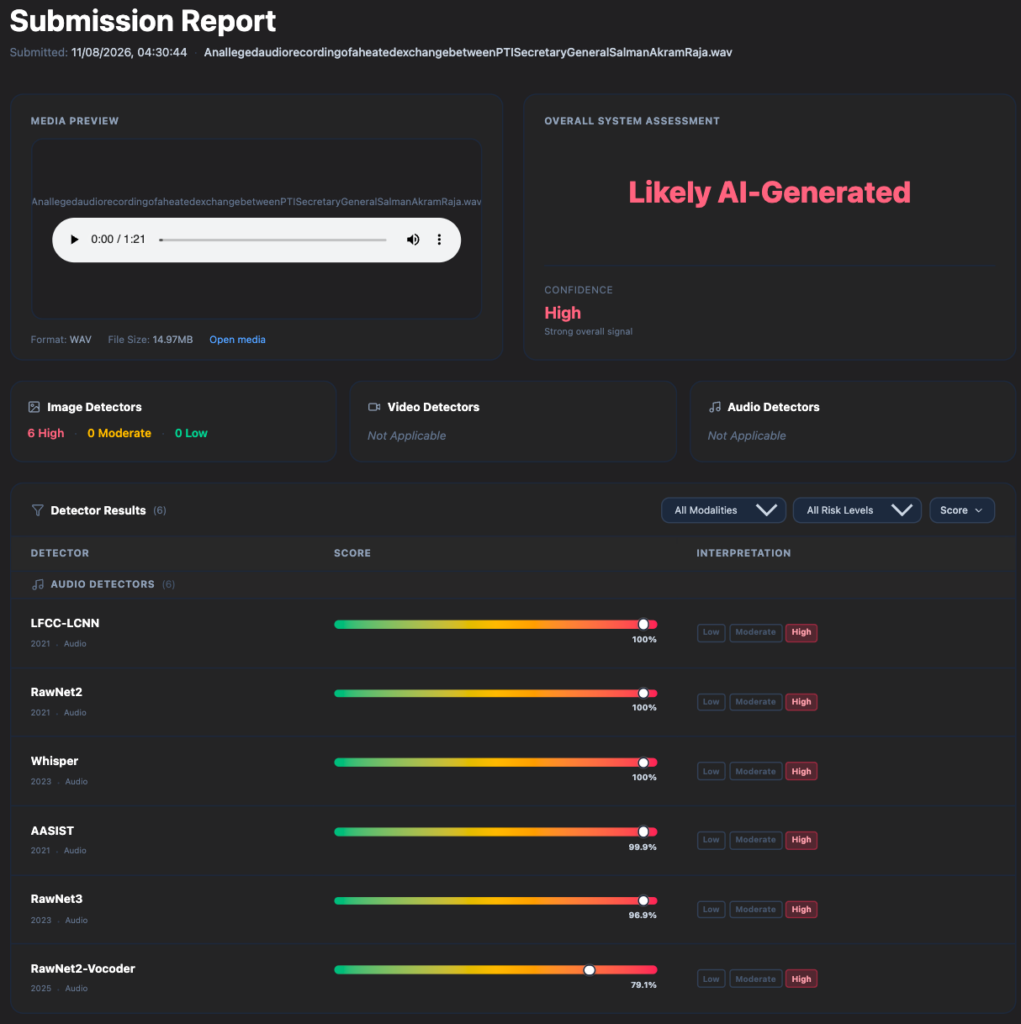
DeepFake-O-Meter classified the submitted WAV file as “Likely AI-Generated” with high confidence. Its six listed audio detectors returned scores ranging from 79.1% to 100%.
Soch Fact Check also submitted the recording to Hive Moderation, an automated system that analyses audio in separate segments. The platform classified the submitted file as likely to contain AI-generated content and returned a 61.5% likelihood of AI-generated speech at 0:09.
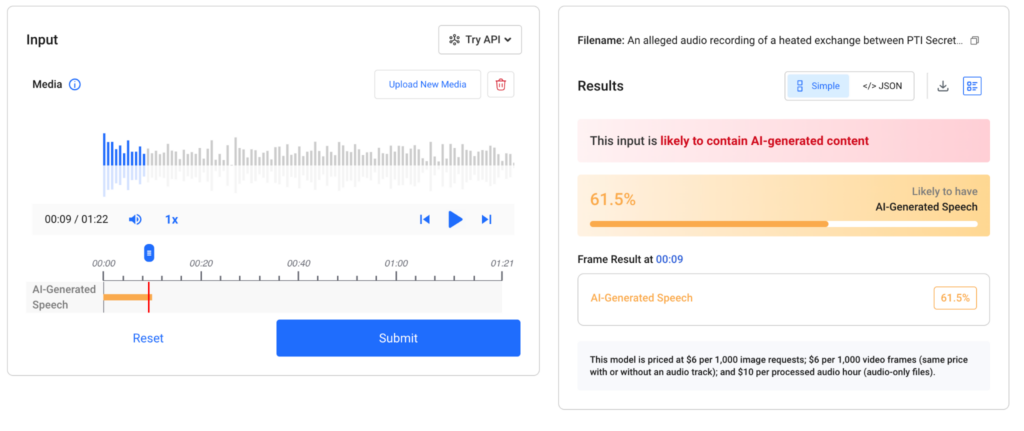
Hive Moderation classified the submitted recording as likely to contain AI-generated content and returned a 61.5% likelihood of AI-generated speech at 0:09.
Soch Fact Check then submitted the recording to the Global Online Deepfake Detection System (GODDS) at Northwestern University, which combines automated deepfake detection with human analysis. GODDS tested the full recording using 70 deepfake detection algorithms and separately analysed two segments, from 0:00 to 0:25 and 0:26 to 0:51. Two analysts trained to detect deepfakes also examined the recording.
For the full recording, 45 of the 70 models assessed it as likely fake with a probability above 0.5, while 25 returned a probability below 0.5. For the first segment, 63 models returned a probability above 0.5 and seven returned a probability below it. For the second segment, 39 returned a probability above 0.5 and 31 returned a probability below it.
Human analysts for GODDS also identified “several indicators” of possible artificial manipulation. They said the two sections did not exhibit the acoustic characteristics of a genuine conversation and instead appeared to be separate recordings joined together. They also found that the background noise differed between the sections and that the first contained no detectable background noise. GODDS concluded that the recording was “likely generated via artificial intelligence.” The analysis did not establish whether the entire recording was synthetically generated or whether AI-generated material was combined with edited or existing audio.
Virality
The purported recording circulated across Facebook, Instagram, and X from 10 August 2026.
Soch Fact Check identified at least 20 Facebook and Instagram posts sharing or reporting on the recording. One such video posted on Facebook had approximately 18,000 views, 360 reactions, and 20 comments when reviewed by Soch Fact Check.
Conclusion: The viral recording is likely fake. Neither Salman Akram Raja nor Mashal Yousafzai confirmed or denied the audio’s authenticity. Analysis by multiple deepfake detection systems suggest that it was manipulated: DeepFake-O-Meter returned high AI-generation scores and GODDS found signs of artificial manipulation, concluding that the recording was “likely generated via artificial intelligence”. The allegations heard in the audio remain unverified.
To appeal against our fact-check, please send an email to appeals@sochfactcheck.com.