
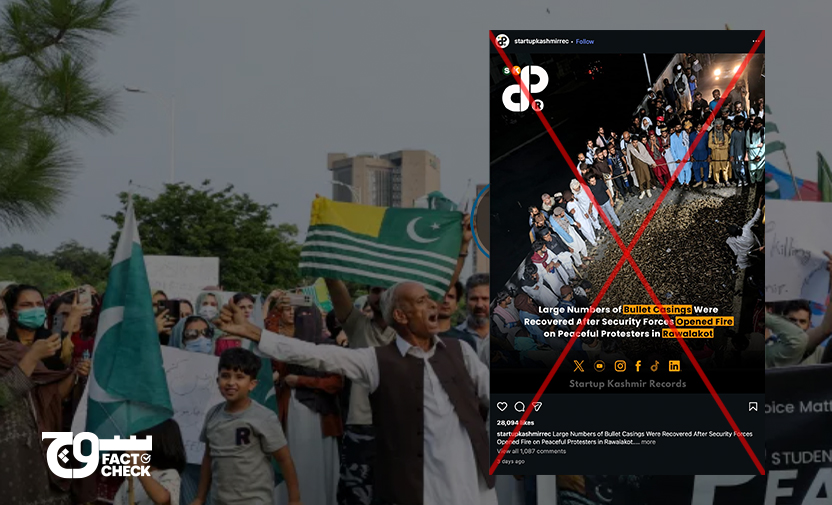
Claim: An image shows bullet casings recovered after security forces opened fire on protesters in Rawalakot.
Fact: The image is AI-generated.
On 29 July 2026, Instagram user Startup Kashmir Records posted an image with the caption:
“Large Numbers of Bullet Casings Were Recovered After Security Forces Opened Fire on Peaceful Protesters in Rawalakot.”
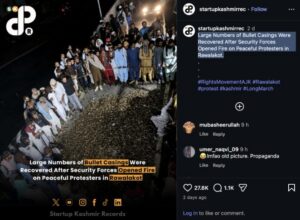
Screenshot of the Instagram post by Startup Kashmir Records accompanied by the AI-generated image.
Unrest in Rawalakot and across AJK
The image circulated amid prolonged unrest in Pakistan-administered Jammu and Kashmir also known as Azad Jammu and Kashmir (AJK), where the Joint Awami Action Committee (JAAC), an alliance of civil society groups, has led protests over longstanding economic and political grievances. The movement emerged from public anger over high electricity prices and perceived economic neglect before increasingly focusing on electoral reform and political representation.
A central dispute concerns 12 of the 45 directly elected seats in the AJK Legislative Assembly, which represent constituencies of refugees from Indian-administered Kashmir settled elsewhere in Pakistan. The JAAC argues that the arrangement weakens the representation of people living in AJK and allows political parties in Islamabad to influence the formation of the regional government. Pakistani government officials have rejected this allegation. The confrontation intensified after talks between the JAAC and the government broke down in late May and the JAAC announced a territory-wide strike for 9 June. The AJK government declared the organisation proscribed under anti-terrorism legislation on 5 June, while the Supreme Court of AJK subsequently ruled on 7 June that the 12 seats could not be abolished without a constitutional amendment..
On 9 June, Amnesty International issued a statement, detailing that the authorities had arrested more than 100 JAAC members and supporters on 6 and 7 June and sealed its central office in Muzaffarabad.
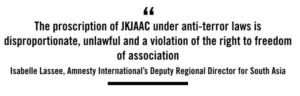
Amnesty International criticised the decision to proscribe the JKJAAC under anti-terrorism legislation. Source: Amnesty International, 9 June 2026.
The statement further reported that JAAC activist Shahzeb Habib was shot during an encounter with the police on 5 June and later died from his injuries. People gathered outside the Combined Military Hospital in Rawalakot on 7 June, where his body had been taken for a post-mortem, it added.
According to Amnesty, police confirmed that at least eight protesters and four police officers were killed during the clashes that followed at the time. A further 50 protesters and 23 police officers were reported injured. Its statement called for independent investigations into Habib’s death, the deaths of protesters, and the reported deaths of police officers.
The unrest and the response to it severely disrupted civilian life across AJK. On 19 June, Reuters reported that at least 24 people had been killed during nearly two weeks of protests. Government officials told the news agency that at least 20 civilians had died between 6 and 14 June, while the regional police chief said four police officers had been killed, 97 had been injured, and 515 people had been detained. The authorities closed roads, blocked internet access, and restricted media access. Banking services, ATMs, businesses, public transport, and fuel supplies were also affected, leaving many daily wage workers unable to earn an income, the report added.
Further deadly clashes occurred on 14 July. Poonch Divisional Commissioner Waheed Khan told Reuters that six protesters and one police officer were killed in Tararkhal, while a protester and a security official died in a separate clash in Rawalakot. Khan alleged that protesters had blocked a security convoy and attacked officials, prompting personnel to respond in self-defence. Reuters reported that conservative local estimates placed the number of people killed in the unrest since June at around 30.
Meanwhile, the AJK Legislative Assembly elections were originally scheduled to take place in one round on 27 July but were later divided into three phases because of security concerns. The successive elections were nonetheless marred by sporadic instances of violence.
The first phase took place in Mirpur division on 27 July, while protests and clashes were reported in Rawalakot. Accounts of the violence varied sharply. Amnesty International said the JAAC claimed that 19 people were killed and dozens injured after security forces fired at protesters. JAAC leaders later told Reuters that more than 30 people had been killed around Rawalakot. Reuters could not independently verify this figure because internet, road, and banking disruptions had restricted the flow of information.
The authorities presented a different account. AJK Police spokesperson Senior Superintendent of Police Khawar Ali Shaukat alleged that armed individuals occupied buildings and fired automatic weapons at security personnel. These allegations have not been independently verified. Reuters reported that one security official was killed and five others were injured in the clashes on 27 July.
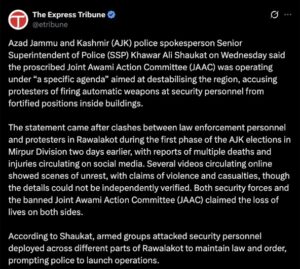
The Express Tribune reported AJK Police spokesperson Khawar Ali Shaukat’s allegation that armed groups fired at security personnel in Rawalakot. The account has not been independently verified. Source: The Express Tribune on X.
On 28 July, the Human Rights Commission of Pakistan (HRCP) posted on X, expressing alarm over reports of deaths and injuries in Rawalakot and called for an immediate end to the violence. It urged the authorities to exercise restraint and called for a prompt, impartial, and independent investigation into the reported casualties and any unlawful use of force.
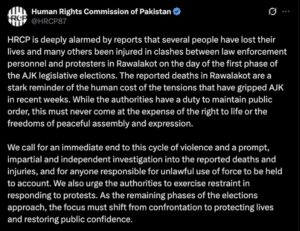
HRCP called for a prompt, impartial, and independent investigation into reported deaths and injuries during the Rawalakot clashes. Source: HRCP’s official X account.
Amnesty International separately called for a prompt, independent, and transparent investigation into the reported use of force. It said the communications blackout was severely impeding independent verification and urged the authorities to restore communications and allow journalists and independent observers into the affected areas.
Internet services were restored in parts of Muzaffarabad division on 29 July after a 54-day suspension, although it was initially unclear how widely access had been restored, and users continued to report slow cellular data. The Associated Press of Pakistan reported that on 30 July, the AJK Legislative Assembly adopted a resolution calling for a Truth and Reconciliation Commission, transparent elections, and the suspension of further action in Rawalakot while confidence-building measures were pursued.
The available reporting, therefore, establishes that Rawalakot and other parts of AJK have experienced serious and repeated instances of violence, confirmed deaths and injuries among protesters and law enforcement personnel have been reported on widely, alongside mass detentions, communications restrictions, and extensive disruption to civilian life. The precise casualty toll from the clashes on 27 and 28 July, the circumstances of individual deaths, and responsibility for specific acts of violence remain disputed.
The authenticity of the viral image is separate from the documented unrest in Rawalakot. This fact-check examines whether the image genuinely shows cartridge cases recovered after the reported firing. It does not examine the full casualty toll, establish responsibility for the wider violence, or assess any of the allegations concerning the use of force.
Fact or Fiction?
For the first step of this investigation, Soch Fact Check reverse-image searched the visual to try to locate the source. However, the search did not yield any results.
As a communications blackout is currently imposed in Rawalakot,Soch Fact Check first reached out to an independent journalist Jalaluddin Mughal, who is currently based in Muzaffarabad, and specifically covers Pakistan-Administered Kashmir. He has reported on Pakistan-Administered Kashmir for The New York Times .He remarked on the picture, saying:
“I haven’t seen any other such image so I don’t have enough ground to say it is a genuine image and it does look like it is AI generated.”
Additionally, Soch Fact Check communicated with Danish Irshad, a freelance reporter covering Pakistan-Administered Kashmir. He has worked in Islamabad and Muzaffarabad, while contributing to regional publications like the Kashmir Times and has also authored the book “Azaadi ke Baad” [“After Independence”]. His comment on the image was in Urdu which has been transcribed as follows:
یہ اے آئی جنریٹڈ پکچر ہے۔
یا پھر کہیں اور کی ہو۔سکتی ہے۔ یہ تصویر راولاکوٹ کی نہیں ہے
[Translation: “This is an AI-generated picture.
Or it could be from somewhere else. This picture is not from Rawalakot.”]
The comments from the reporters in Muzzafarabad, strongly indicated that the image may not be from Rawalakot, and instead, is AI-generated.
Visual inconsistencies
Soch Fact Check examined a higher-resolution copy of the image and identified several visible inconsistencies. The numbers below correspond to the marked areas in the accompanying image.
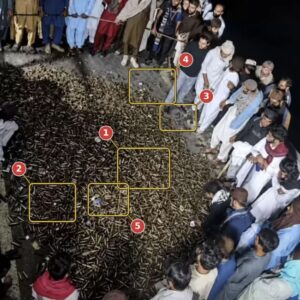
Annotations highlight visible inconsistencies in the objects presented as spent cartridge cases. (Source: Facebook; annotations by Soch Fact Check)
-
The objects vary considerably in size
The supposed cartridge cases lying beside one another are not consistently sized. Some appear much longer and wider than others, even when positioned on the same section of the road.
For comparison, an official Pakistan Ordnance Factories (POF) catalogue lists the overall length of its 7.62 × 39mm rifle ammunition as 55mm to 56mm. It lists its 7.62 × 51mm ammunition as 70.36mm to 71.12mm long.
Some objects in the viral image appear unusually large when compared with nearby footwear. However, because the photograph was taken from an angle and does not contain a ruler or another fixed measuring reference, their exact lengths cannot be calculated reliably.
-
The objects do not have consistent shapes
The POF catalogue shows that ammunition of the same type is manufactured within a defined range of measurements. For example, it gives an overall length of 55mm to 56mm for its 7.62 × 39mm ammunition and 70.36mm to 71.12mm for its 7.62 × 51mm ammunition.
In the viral image, neighbouring objects repeatedly change in length, width, and shape. Some have pointed ends and resemble complete cartridges, while others appear hollow, blunt, bent, or irregularly tapered. Even if more than one calibre were present, the objects do not form clearly recognisable groups of consistently shaped ammunition.
-
Some objects appear unusually large compared with ordinary rifle ammunition
POF also produces the much larger 12.7 × 108mm round, which its catalogue lists as 147mm long. The catalogue says this ammunition is used in Type 54 heavy machine guns against aerial and ground targets. This measurement refers to the complete cartridge, including its projectile, rather than the empty case alone.
The comparison provides context for how unusually large some of the objects appear relative to nearby footwear. It does not establish their actual dimensions or indicate that 12.7 × 108mm ammunition was used in Rawalakot.
-
Some objects resemble complete cartridges rather than spent cases
The Punjab Forensic Science Agency distinguishes between cartridge cases, which it describes as “empties”, and bullets, which strike the target. The viral image is claimed to show spent cases, yet some objects have pointed, projectile-like ends while others appear open-ended. They therefore do not consistently resemble a pile of fired cartridge cases.
The viral image allegedly shows spent cases left after firing. However, some objects appear pointed as though projectiles remain attached, while others appear open-ended like empty cases. The objects therefore do not consistently resemble spent cartridge cases.
-
Objects merge into the road and one another
Across the centre of the pile, some objects lack clear boundaries. Several appear fused together, embedded in the road, or joined at unclear angles. Others abruptly change width along their length.
In the most densely covered areas, the supposed cases resemble a repeated metallic pattern rather than numerous separate objects lying naturally on the ground.
Visual irregularities alone cannot establish that an image was generated using artificial intelligence because compression, resizing, blur, and repeated uploads may also produce distortions. However, the inconsistent dimensions and construction of the supposed ammunition, together with areas where objects appear to merge into the road or one another, support the separate digital provenance evidence found during the investigation.
Results from AI Detection Tools
According to Google DeepMind, SynthID embeds digital watermarks directly into AI-generated images, audio, text, and video. The watermarks are embedded across Google’s generative AI consumer products, and are imperceptible to humans but can be detected by SynthID’s technology. Soch Fact Check then ran the image through OpenAI’s tool designed to check if it was created using the American company’s artificial intelligence tools. The results confirmed that a SynthID watermark originating from OpenAI was found in the image, proving that an existing picture has been manipulated or has been modified using AI.

OpenAI’s verification tool reported that the image contained a SynthID watermark associated with images generated using OpenAI tools. Source: OpenAI.
Based on comments from the reporters based in Muzaffarabad, our independent observations on the visual inconsistencies in the image, and the presence of a SynthID watermark in the image, Soch Fact Check concludes that the image of bullet casings is AI-generated.
Virality
On X, the post with the highest interaction garnered 1,136 views.
On Instagram, the most viral post received 27.8K likes while another one received about 71.8K likes.
On Facebook, the most popular post gained 697 likes and was reshared 716 times.
Conclusion: The claim that an image shows a pile of bullet casings left behind by the security forces in Rawalakot is false. The image is entirely AI-generated.
To appeal against our fact-check, please send an email to appeals@sochfactcheck.com