
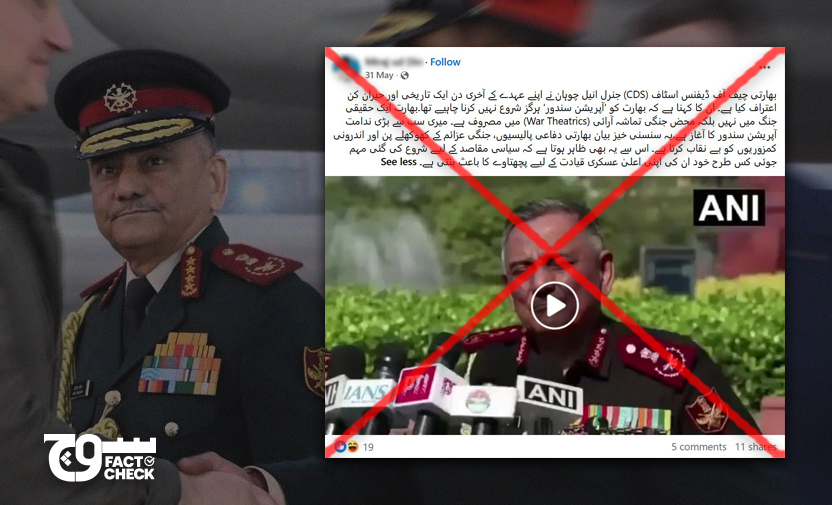
Claim: A viral video shows India’s former defence chief Gen Anil Chauhan discussing professional regrets and operational failures while comparing Pakistan and India’s civil and military leadership during his farewell speech.
Fact: The clip was manipulated using artificial intelligence (AI) tools.
On 31 May 2026, multiple Facebook users posted a video of India’s ex-defence chief Gen Chauhan speaking during his farewell address. In his speech, the officer appears to express professional regrets regarding relations between his country’s civil and military leadership as well as operational failures.
In the video, Gen Chauhan allegedly highlights a lack of “political parity” in India compared to Pakistan, stating that his country’s armed forces were restricted by political leadership.
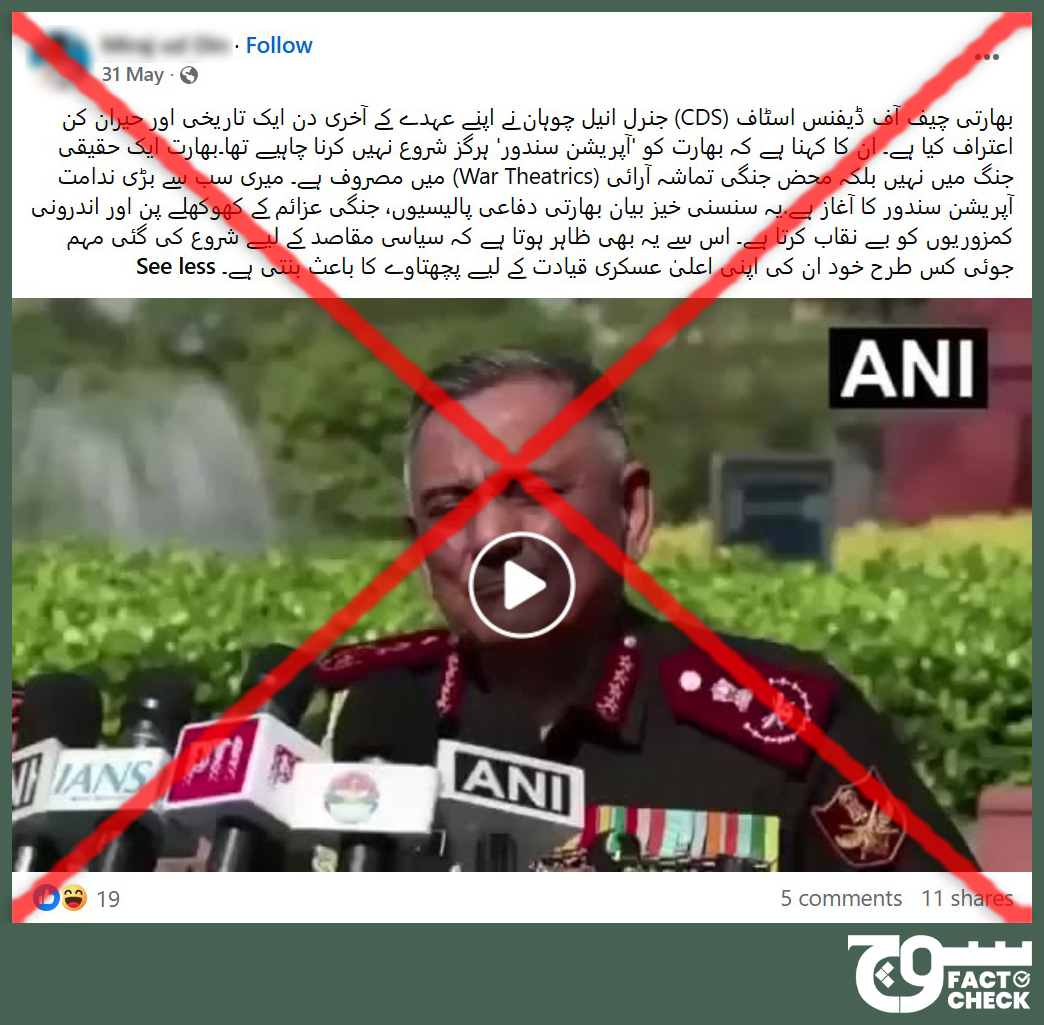
Screenshot of the viral post
His exact remarks are as follows:
“My biggest regret would be not getting political parity, which Pakistan seems to enjoy. In Pakistan, when you enter the war, the army gets full nod from the top. In fact, it is the military which remains at the top of hierarchy. They are the ones driving decision-making. While, in India, we are asked to swim with our hands tied. I could not complete Operation Sindoor and I was asked to resign because of the fallout from political decisions. In hindsight now, I feel that I should not have even started Operation Sindoor because we did not get any free hand. Soldiers are meant to fight but as long as political leadership keeps us in the domain of war theatrics and not the actual war, we are going to suffer and we suffered badly globally after this.”
India-Pakistan conflict of May 2025
In May 2025, India and Pakistan engaged in the most intensive four-day conflict in decades, exchanging drones, fire, shelling, and missiles that brought the two nuclear-armed nations to the brink of an all-out war.
The conflict was triggered by the killing of at least 26 people by assailants at a resort in Pahalgam in the Indian-administered Jammu and Kashmir on 22 April 2025. New Delhi blamed Pakistan for the attack, a claim Islamabad has consistently denied.
During the four-day conflict, India also sent Israeli-made Harop drones to Pakistan, which were reportedly shot down by the army. Soch Fact Check visited and investigated two crash sites each in Karachi, Rawalpindi, and Lahore; read our on-ground report here.
On 10 May, US President Trump announced a ceasefire, which was then confirmed by Pakistan’s Foreign Minister Ishaq Dar and later by India’s Foreign Secretary Vikram Misri.
Trump’s announcement came after US State Secretary Marco Rubio spoke separately to Pakistan Army Chief Field Marshal Syed Asim Munir, Foreign Minister Dar, and Indian External Affairs Minister Subrahmanyam Jaishankar.
On the other hand, Pakistan expressed gratitude to the US, with Prime Minister Shehbaz Sharif thanking Trump “for his leadership and proactive role” as well as Vice President JD Vance and Rubio “for their valuable contributions for peace in South Asia”.
Fact or Fiction?
Soch Fact Check reverse-searched keyframes from the viral video and traced it to the retired Gen Chauhan’s farewell address from 30 May 2026.
According to a video of his speech posted by the Asian News International (ANI) on YouTube and X (formerly Twitter), his remarks are as follows:
“It’s a matter of great honour for me to superannuate with a tri-services guard of honour. I thank the three services and Headquarters IDS for it. With the conclusion of the guard of honour, I bid farewell to my colleagues in uniform, comrades in arms, forever. I just laid the wreath at the War Memorial for the last time in uniform as a humble tribute to those who laid down their lives in the line of duty. After the wreath-laying, I was welcomed by my friends, relatives, and well-wishers. This is symbolic of my transition from uniform to civilian life. I had a very satisfying and excellent tenure. Thank you.”
Nowhere in his speech did India’s former defence chief mention anything about his “biggest regret”, “Pakistan”, “decision-making” or “Operation Sindoor”.
Comparing the video in the claim with the speech posted by ANI shows that while Chauhan’s movements match, the remarks are not the same. This led us to suspect manipulation using AI tools.
Sound engineer’s forensic analysis
To corroborate our suspicions about AI manipulation, we sought a comment from Shaur Azher, a lecturer who teaches sound design and sound recording at the University of Karachi and the Shaheed Zulfikar Ali Bhutto Institute of Science and Technology (SZABIST). He also works as an audio engineer at our sister organisation, Soch Videos, and specialises in mixing and mastering audio.
Azher explained that for comparison purposes, Sample A is the claim and Sample B is the actual speech uploaded by ANI. He concluded that the viral video is an “AI-manipulated deepfake of Anil Chauhan” that uses altered audio to misrepresent his authentic speech from May 2026.
Azher provided the following observations to support his findings:
- Sample A has an ambience that is quite subtle and windy and stays between the range of 20 to 300 hertz (Hz), indicating artificial balance. However, in Sample B, the sounds of a fountain and birds are audible at multiple points.
- Sample A has a true peak at -5.3 decibels (dB) with -21.8 dB Loudness Units relative to Full Scale (LUFS), whereas Sample B is at -12 dB with 31.4 dB LUFS. This indicates that both videos have different loudness ranges.
- Sample A is stereo audio and Sample B is mono audio. In most professional settings, all audio content recorded on a microphone is sent to post-processing in a mono audio form; this indicates that the two audio samples are completely different.
- In Sample A, the coefficients for the frequency bands seem more balanced and synthetic, whereas, in Sample B, they seem far more natural as Chauhan’s voice is being suppressed by the ambience noise.
- Sample A’s variance on nearly every coefficient is 30-40% higher than that of Sample B, meaning that Sample A’s frame-to-frame timbral fluctuation is larger.
Deepfake detectors
Soch Fact Check then ran the audio component of the viral video in Hiya Deepfake Voice Detector using four phrases: “in India, we are asked to swim with our hands”, “to resign because of the fallout from political decision”, “I should not have even started Operation Sindoor”, and “leadership keeps us in the domain of war theatrics and not the”.
The tool provided the following analyses:
- The first sample “is likely a deepfake”, with an authenticity score of 18 out of 100
- “Our models are uncertain” about the second sample, with an authenticity score of 57 out of 100
- The third sample “is likely authentic”, with an authenticity score of 71 out of 100
- The fourth sample “is likely a deepfake”, with an authenticity score of 16 out of 100
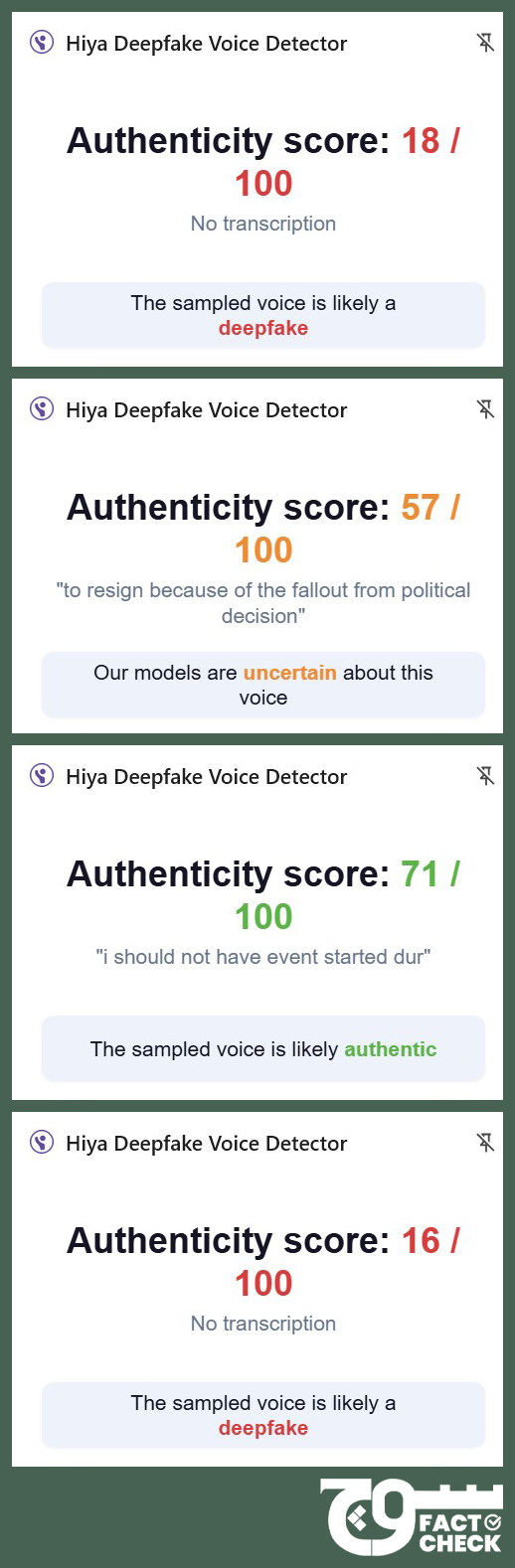
Results from Hiya Deepfake Voice Detector
DeepFake-O-Meter, a tool developed by the University at Buffalo’s Media Forensics Lab (UB MDFL) that analyses both the video and audio components, said the content is likely AI-generated with “high” confidence. We used seven detectors, which yielded probabilities of the video being AI-generated of 100%, 100%, 95.3%, 93.6%, 93.4%, 75.2%, and 62.5%.
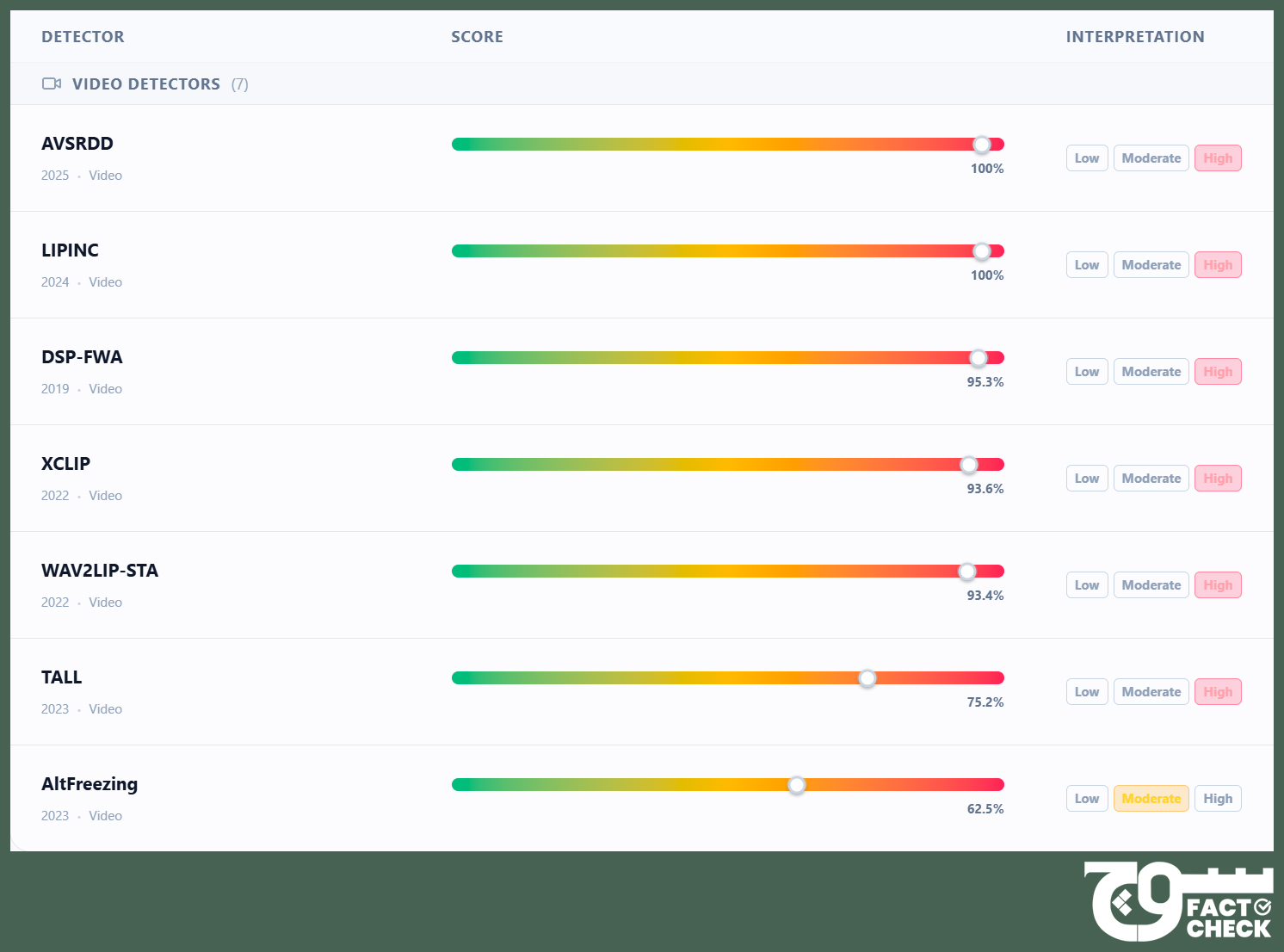
Results from DeepFake-O-Meter
We also tested the viral clip in Global Online Deepfake Detection System (GODDS), a tool developed by Northwestern University’s Security & AI Lab (NSAIL) that uses a combination of various models along with human analysis to provide a holistic summary of the results.
GODDS used 22 deepfake detection algorithms for the visual content and 70 for the audio component, while two trained analysts also examined the clip.
All predictive models for the visual and audio content said the video “is likely to be fake”:
- The video is likely to be fake with a probability above 0.5, according to 13 of the 22 predictive models; it is likely to be fake with a probability below 0.5, according to the nine other predictive models.
- The audio is likely to be fake with a probability above 0.5, according to 55 of the 70 predictive models; it is likely to be fake with a probability below 0.5, according to the 15 remaining predictive models.
According to GODDS’ human analysts, the video contains “several indicators” that show it may be digitally manipulated via AI. For example:
- 0:00-0:19: No visible facial artefacts observed
- 0:19-0:57: A facial filter-like effect becomes visible
- The facial filter-like effect is not visible in the original video (posted by ANI)
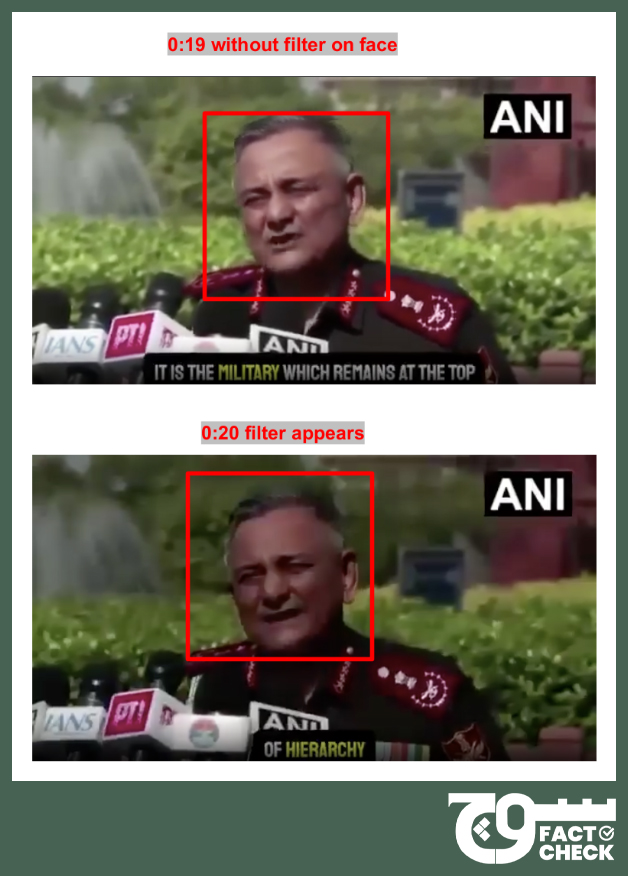
Visual markers as identified by GODDS
“The artefacts are largely obscured by poor video quality, despite the majority of the video’s features remaining detailed and clear. It is difficult to discern possible artefact manipulation because of the poor video quality. It is plausibly explainable by other factors such as motion blur as well,” they said.
The analysts also observed that “no reputable fact-checking organisations have reported on the authenticity of this media” but there would have been greater coverage if it was real given Chauhan’s political status. They added that the Fact Check Unit of India’s Press Information Bureau (PIB) “claimed that the video is both fake and an artificial-generated deepfake”.
“This artefact shares the same visual component as a video of General Chauhan from his retirement video, barring the filter. In the original video, General Chauhan does not mention Operation Sindoor either. This suggests the possibility of audio manipulation based on the original video,” they said.
Noting that the viral video “could be part of a larger pattern of misinformation”, the GODDS analysts concluded, “We believe this media is likely manipulated via artificial intelligence.”
Soch Fact Check, therefore, concludes that the viral video is AI-manipulated.
Virality
Soch Fact Check found the video shared in multiple Facebook and Instagram posts.
One Threads post gained over 160 reactions.
One X post garnered 65,000 views, while another one on TikTok gained significantly higher, going upwards of 87,700.
Conclusion: The clip was manipulated using AI tools.
Background image in cover photo: DefenceMinIndia
To appeal against our fact-check, please send an email to appeals@sochfactcheck.com