
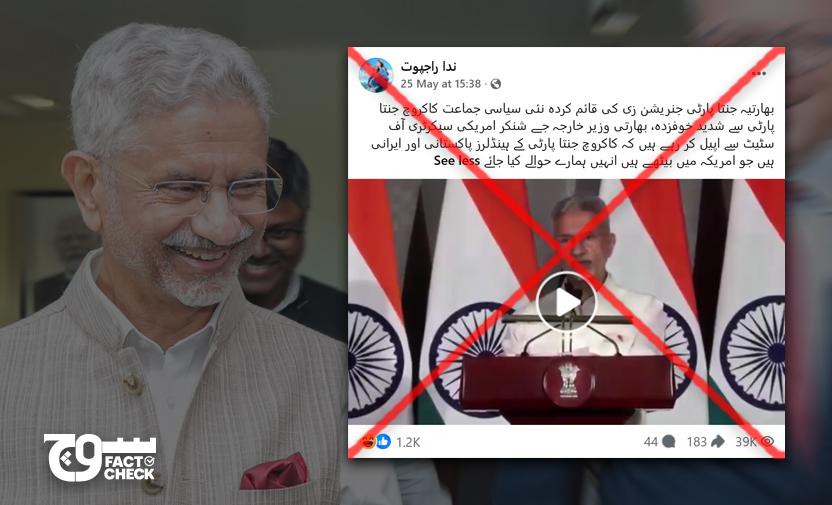
Claim: Indian External Affairs Minister Dr Subrahmanyam Jaishankar has accused the United States of hosting “non-state actors” who launch “anti-India movements” like the Cockroach Janta Party (CJP), whose leadership is “acting as proxies of Iran and Pakistan”. He also requested US President Donald Trump to hand over such people.
Fact: The video is altered, likely using artificial intelligence (AI) tools.
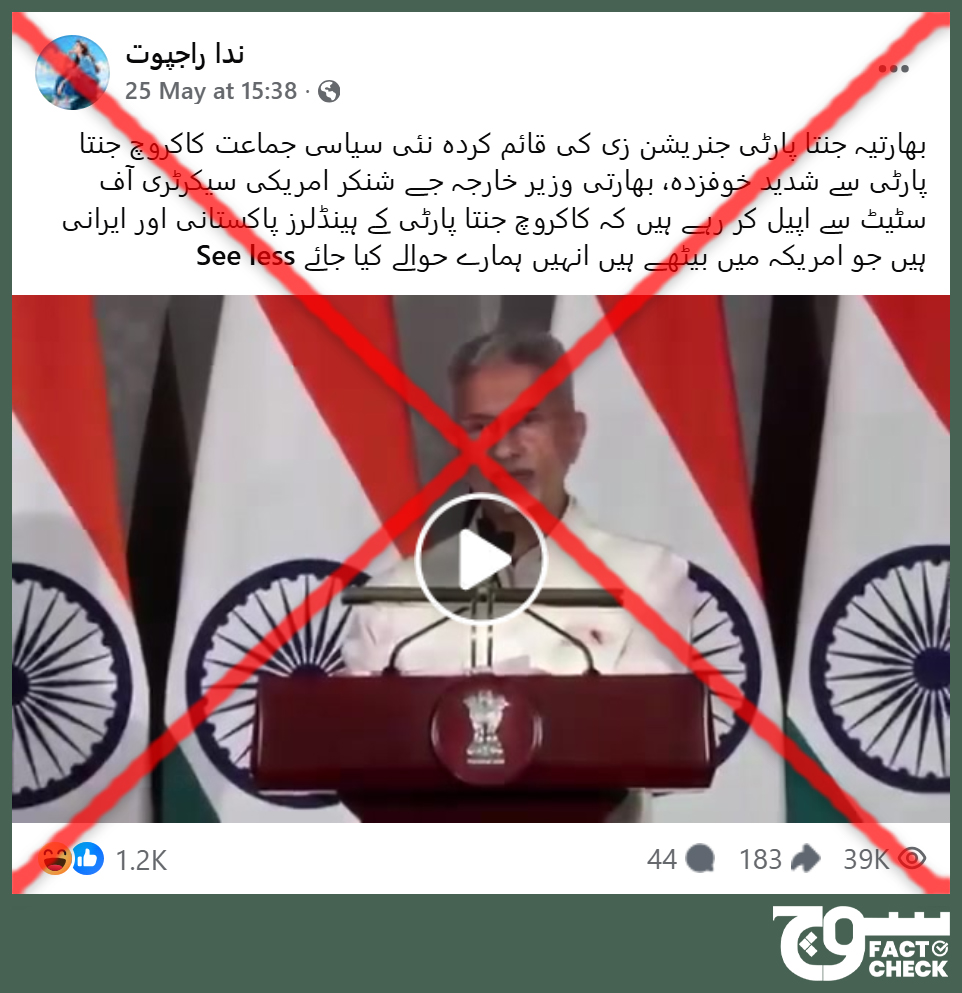
On 25 May 2026, Facebook user ‘ندا راجپوت’ posted a video showing Indian External Affairs Minister Jaishankar speaking at a joint press conference with US Secretary of State Marco Rubio about the CJP, a youth-led reactionary satirical movement.
In the video, Jaishankar says:
“Today, as I welcome Mr Marco Rubio with honours since he’s our guest, I also have to put forward a request: some non-state actors in the United States are using America as a launch platform for anti-India movements, the most recent one being Cockroach Janta Party.
“I never expected US to host individuals like Abhijeet Dipke who have contacts with Iranian Ayatollah regime and are running a campaign on their behalf. While India stayed loyal to USA and Israel and left our relationship with Iran, the US soil kept hosting Cockroach Janta Party.
“I want to request honourable President Trump to hand over incumbent nincompoop leadership of Cockroach Janta Party as they are acting as proxies of Iran and Pakistan. They should be handed over to India.”
The video by ‘ندا راجپوت’ is accompanied by the following caption:
“بھارتیہ جنتا پارٹی جنریشن زی کی قائم کردہ نئی سیاسی جماعت کاکروچ جنتا پارٹی سے شدید خوفزدہ، بھارتی وزیر خارجہ جے شنکر امریکی سیکرٹری آف سٹیٹ سے اپیل کر رہے ہیں کہ کاکروچ جنتا پارٹی کے ہینڈلرز پاکستانی اور ایرانی ہیں جو امریکہ میں بیٹھے ہیں انہیں ہمارے حوالے کیا جائے
[The Bharatiya Janata Party is deeply afraid of the new political party Cockroach Janata Party founded by Generation Z, Indian Foreign Minister Jaishankar is appealing to the US Secretary of State to hand over the Cockroach Janata Party’s handlers, who are Pakistanis and Iranians and who are living in the US.]”
The Cockroach Janta Party (CJP) — which is a parody of the ruling Bharatiya Janata Party (BJP), to which Prime Minister Narendra Modi belongs — was born out of a satirical response to Indian Chief Justice Surya Kant’s remarks on his country’s youth.
In May 2026, the Indian chief justice appeared to compare unemployed youth to “cockroaches” despite a lot of existing “parasites” attacking the judiciary, as reported by The Indian Express.
The CJP, whose founder is the 30-year-old Abhijeet Dipke, appears to be a channel for the youth’s dissatisfaction and concerns. According to Encyclopaedia Britannica, the online movement “has garnered more than 20 million followers on Instagram — eclipsing those of the ruling Bharatiya Janata Party and the Indian National Congress, India’s biggest political entities”.
The BJP-led Indian government appears to be frustrated with the CJP, with the Internet Freedom Foundation (IFF) — an organisation focused on digital rights issues — noting that the youth-led party’s X (formerly Twitter) handle “was withheld in India under Section 69A of the Information Technology Act, 2000”.
Fact or Fiction?
Soch Fact Check reverse-searched keyframes from the viral video to ascertain the origin of the clip and found that it actually shows the joint press conference from 24 May 2026 by Jaishankar and Rubio during the latter’s visit to India.
A video of the event is available on Jaishankar’s Facebook page and the Indian External Affairs Ministry’s YouTube account and a transcript of his speech can be found here.
A transcript from the same event is also available on the US State Department’s website.
According to the footage on the Indian minister’s Facebook page, he starts by saying, “Secretary Rubio and I have held our bilateral talks this morning; in fact, we’re midway through it…” He does not commence his remarks with “Today, as I welcome Mr Marco Rubio with honours since he’s our guest…”
Soch Fact Check scoured through both the transcripts but did not find the remarks attributed to Jaishankar in the viral video.
Sound engineer’s analysis
To corroborate our suspicions that the video was manipulated using AI tools, we reached out to Shaur Azher, a lecturer who teaches sound design and sound recording at the University of Karachi and the Shaheed Zulfikar Ali Bhutto Institute of Science and Technology (SZABIST). He also works as an audio engineer at our sister organisation, Soch Videos, and specialises in mixing and mastering audio.
Azher explained that for comparison purposes, Sample A is the claim and Sample B is the original broadcasted interview. He provided the following observations:
- Spectral bandwidth
Audio from a press conference recorded at 48 kHz should contain meaningful signal energy up to at least 16-18 kHz.
Sample A is dead above 10 kHz. The signal at 15 kHz is at -95 dB relative to peak noise floor territory. Sample B’s left channel (Rubio’s microphone) maintains active content at 15 kHz at -38 dB. This is an irreconcilable difference that cannot be explained by any legitimate recording circumstance. Sample A’s bandwidth is consistent with a low-bitrate MP3 encode (approximately 96 kbps or below) or deliberate low-pass filtering applied during post-processing.
- Edit splice detection
Sample A has a single internal energy discontinuity of >20 dB within 10 ms located at 0.22 seconds a spliced edit point at the opening of the file, consistent with a clip being cut from a longer recording. Sample B’s three discontinuities occur only at 0.00s (recording start), 0.01s (stabilization), and 237.13s (recording end), which are the natural start/end artefacts of a continuous raw recording.
- Absence of natural voice signatures
Sample A contains no audible breath artefacts, no sibilance, no microphone handling clicks, and no room ambience cross-bleed between speakers. These are present in Sample B. Their complete absence in Sample A is consistent with noise-suppression and artefact removal post-processing. In an authentic live press conference recording, it is not possible for all of these organic characteristics to be absent simultaneously.
- Digital clipping in Sample B right channel
The right channel of Sample B (Jaishankar’s microphone) contains 265 clipped samples distributed across 41 burst events, beginning at 22.16 seconds. This is a characteristic artefact of a close proximity microphone signal that exceeded the input gain of the recording device at peaks of vocal delivery. This type of clipping is not present in post-processed audio, where gain management would have corrected it. Its presence in Sample B is an authenticity indicator, corroborating that Sample B is an unaltered raw capture.
- L-R channel correlation and mid/side analysis
A legitimate stereo recording of two people speaking at a podium with two separate microphones as in the press conference scenario will have two genuinely independent signals in the L and R channels. The L-R correlation of a real dual-microphone recording will typically be low, near-zero, or even negative, because the two microphones are capturing different audio sources.
- Phase coherence analysis
The phase coherence data reinforces the L-R correlation finding. Sample A’s coherence values of 1.0000 in the bass bands are the mathematical signature of an identical signal in both channels. Sample B’s coherence values of 0.0128 (sub-bass) and 0.0464 (presence band) are the signature of two microphones capturing independent acoustic sources, which is exactly what a press conference dual mic setup produces.
- Jitter and shimmer
Since both samples are compressed MP3 recordings from a live podium environment, both exceed clinical voice perturbation norms; this is expected and explained by MP3 encoding artefacts inflating the fundamental frequency tracker. The diagnostically relevant comparison is the delta between samples, which aligns with Sample B’s degraded off-axis capture conditions.
Elevated jitter/shimmer in Sample A was noted without full context. With the benefit of the spectral and correlation analysis, the correct interpretation is that Sample A’s slightly lower jitter values (0.603 ms vs 0.973 ms) are consistent with post-processing noise reduction smoothing the waveform envelope, which artificially suppresses perturbation scores.
- MFCC spectral envelope analysis
The MFCC C1 (spectral energy coefficient) delta of 5.25 is now understood to reflect Sample A’s low-pass filtered, bandwidth-limited character rather than any difference in the acoustic source. A broadband signal (Sample B) has energy spread across a wider frequency range, resulting in a lower overall energy coefficient.
A bandwidth-limited signal (Sample A, rolled off at 10 kHz) concentrates its energy in a narrower band, producing a higher C1 value. This is fully consistent with Sample A being a processed derivative of Sample B’s content.
The close agreement of C2 C13 between both samples (delta < 1.0 in 11 of 12 coefficients) confirms that the underlying phonetic content originates from the same press conference event.
Deepfake detectors
Soch Fact Check also ran the video in various deepfake detection tools.
In Deepfake-O-Meter, a tool developed by the University at Buffalo’s Media Forensics Lab (UB MDFL), we used five detectors, which yielded probabilities of the video being AI-generated of 100%, 89.3%, 80.9%, 66.1%, and 63.6%.
We tested three of Jaishankar’s phrases in Hiya Deepfake Voice Detector: “recent one being Cockroach Janta Party. I never…”, “individuals like Abhijeet Dipke who have contacts with”, and “India stayed loyal to USA and Israel and”.
For all three samples, the detectors said the “voice is likely a deepfake”, with scores of 20, 1, and 4 out of 100.
Soch Fact Check also tested the viral clip in Global Online Deepfake Detection System (GODDS), a tool developed by Northwestern University’s Security & AI Lab (NSAIL) that uses a combination of various models along with human analysis to provide a holistic summary of the results.
GODDS used 22 deepfake detection algorithms for the visual content and 70 for the audio component, while two trained analysts also examined the clip.
All predictive models for the visual and audio content said the video “is likely to be fake”:
- The video is likely to be fake with a probability above 0.5, according to eight of the 22 predictive models; it is likely to be fake with a probability below 0.5, according to the 14 other predictive models.
- The audio is likely to be fake with a probability above 0.5, according to 52 of the 70 predictive models; it is likely to be fake with a probability below 0.5, according to the 18 remaining predictive models.
According to GODDS’ human analysts, the video contains indicators that show it may be artificially manipulated. For example:
- 0:04: The subject’s lower teeth protrude unnaturally and appear abnormally exposed.
- 0:57: The subject’s teeth look like a flat white band and the lower mouth boundary is unclear.
- The artefacts are largely obscured by poor video quality, despite the majority of the video’s features remaining detailed and clear. It is difficult to discern possible artefact manipulation because of the poor video quality. It is plausibly explainable by other factors such as motion blur and microphone occlusion as well.
“Given the political importance of this content, it is likely that there would be greater news coverage were this media authentic,” the analysts said, adding that the video “is likely manipulated via artificial intelligence”.
Soch Fact Check, therefore, concludes that the video is AI-manipulated.
Virality
Soch Fact Check found the video shared dozens of times on different social media platforms, including Facebook, Instagram, and Threads.
On X, the clip gained more than 128,000 views, with former Information Minister Fawad Chaudhry advising “immediate stress management” to Jaishankar as “Pakistan is getting on his nerves”.
Conclusion: The video is altered, likely using AI tools.
Background image in cover photo: drsjaishankar
To appeal against our fact-check, please send an email to appeals@sochfactcheck.com