
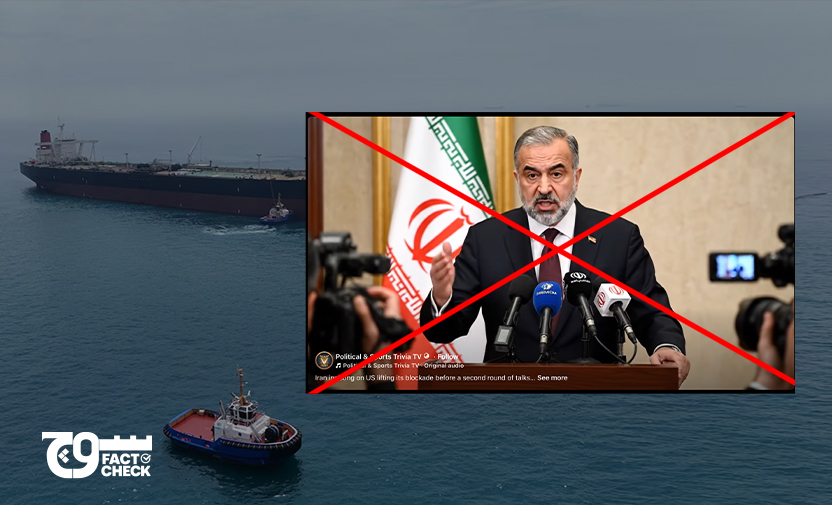
Claim: A video shows an apparent Iranian official saying that there will be no negotiations until the blockade is lifted, likely referring to the blockade of Iranian ports by the United States.
Fact: The video is AI-generated.
On 20 April, a video was posted on a Facebook page called Political & Sports Trivia TV.
It shows an official addressing the press with the Iranian flag in the background. He is apparently referring to the blockade of ships in the Strait of Hormuz by the United States government, saying, “Let me be clear, there will be no negotiations until the blockade is lifted. We insist on this point before any talks can resume.”
The caption of the post says:
Iran insisting on US lifting its blockade before a second round of talks Iran’s participation in the next round of negotiations in Islamabad is conditional upon the US lifting the naval blockade on its ports. This is what a well-informed source told Al Jazeera, and it’s also the same position taken by Iran’s ambassador to Pakistan. The foreign minister and prime minister of Pakistan called Iran’s president and foreign minister to try to convince them to take part in the next round of negotiations. The Supreme National Security Council of Iran also convened to decide on this. However, Iran is sceptical, and at the same time, concerned that this is not going to end with the deal they want to have. First of all, they are concerned that this could be a deal that would be followed by several months of negotiations, and then the sanctions will not be lifted, and the frozen money will not be unfrozen.
US-Israel war on Iran
On 28 February 2026, the US and Israel launched a joint offensive codenamed “Operation Epic Fury” and “Operation Roaring Lion,” respectively, and assassinated Iran’s Supreme Leader Ayatollah Ali Khamenei and his family members, as well as numerous top military and security officials, leading to the appointment of his son, Mojtaba Khamenei, as the successor on 9 March.
The conflict has seen significant casualties, with Iran’s Health Ministry reporting over 2,000 deaths — including 160 children in a school bombing in Minab — and 26,500 wounded people, as well as the displacement of 3.2 million people, alongside the targeting of the historic Golestan Palace.
In retaliation, Iran closed the Strait of Hormuz to most international traffic and launched drone and missile strikes against US bases and regional targets, causing casualties across Israel and the Gulf states.
Islamabad Talks
Pakistan-led mediation efforts eventually culminated in a two-week ceasefire on 8 April, with the “Islamabad Talks” announced by Prime Minister Shehbaz Sharif. The discussions were held on 11 April.
The Iranian delegation, composed of the Speaker of the Iranian Consultative Assembly Mohammad Bagher Ghalibaf and the Iranian Foreign Minister Abbas Araghch. On the other hand the US delegation included US Vice President JD Vance, US Envoy to the Middle East Steve Witkoff and Jared Kushner.
The discussions ended after 21 hours without reaching a deal. However, another round of dialogue is on the table, and is being actively pursued by Pakistan. White House Press Secretary Karoline Leavitt also mentioned during a presser on 15 April 2026 that the next round of talks will likely be held in the “same place as before,” hinting US delegation’s another trip to Islamabad.
Vance and his team were expected to travel to Islamabad, however, Trump cancelled the trip. While speaking to reporters on 25 April outside the Air Force One aircraft in Florida, the US president said, “We’re not going to spend 15 hours in airplanes all the time going back and forth to be giving a document that was not good enough, and so we’ll deal by telephone, and they can call us anytime they want.”
However, while Araghchi did meet PM Sharif and Field Marshal Munir again before heading to Oman and Russia, talks with the US were stalled.
On 19 April, the US seized Iran’s Touska merchant ship after attacking it with a guided-missile destroyer, a move for which Tehran vowed retaliation. The same day, Trump issued another warning on his Truth Social platform, saying:
“We’re offering a very fair and reasonable DEAL, and I hope they take it because, if they don’t, the United States is going to knock out every single Power Plant, and every single Bridge, in Iran.”
Fact or Fiction?
The US blocked Iranian ports on 13 April. After this Iran has shown reluctance to negotiate, saying the US should lift the blockade first. On 25 April the Iranian president told the Pakistani premier over the phone that Tehran would not negotiate with the US under threats or blockade, Khaleej Times, a UAE-based publication, quoted an Iranian statement as stating.
Although Iran has actually shown reluctance to negotiate till the blockade is lifted, Soch Fact Check suspected the video to be fake as the person speaking does not look like any of the Iranian officials who have recently appeared in public. Moreover, the blue microphone has a name written on it that appears unclear. Secondly, AI search results from Google states that the person speaking is Iranian Foreign Minister Abbas Araghchi but the person who can be seen speaking in the video does not look like Araghchi.
To make sure, we ran the video through two AI detection tools online.
First, we ran it through Hive Moderation.
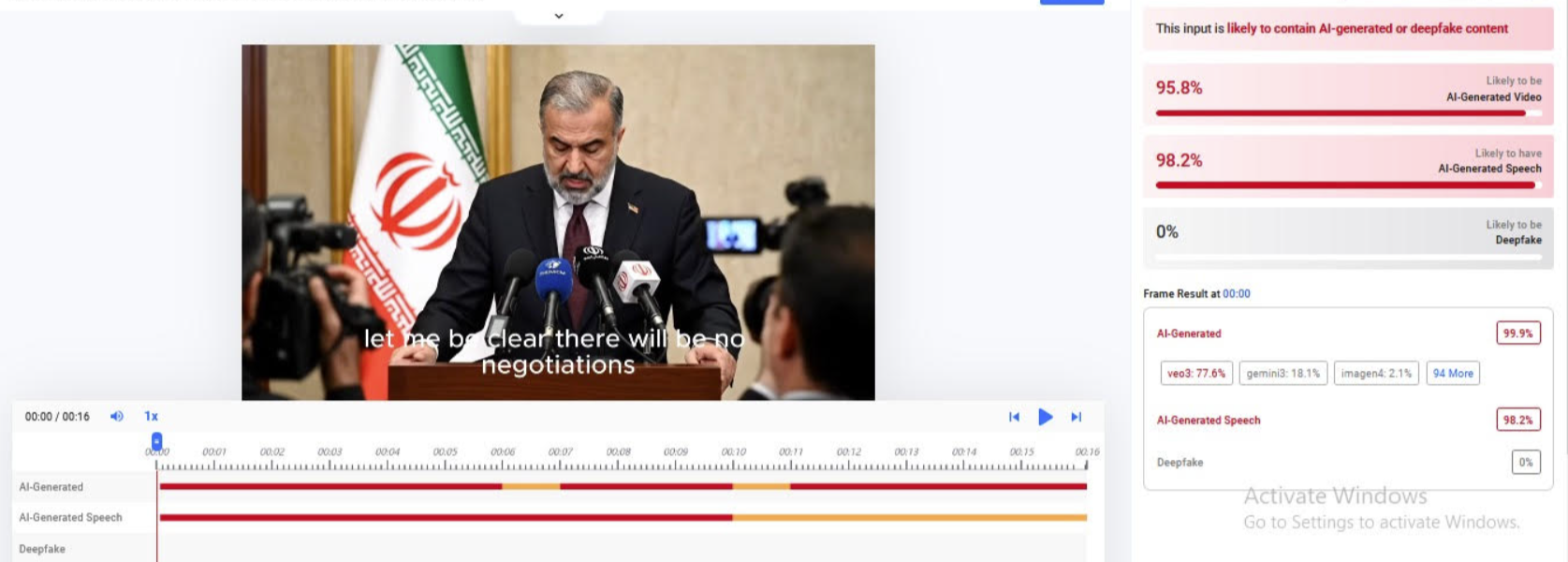
A screenshot of the result from Hive Moderation
It showed that the video and the speech are 95.8% and 98.2% likely to be generated by AI, respectively.
We also put it in DeepFake-O-Meter to check whether it is AI generated or not.

A screenshot of the result from DeepFake-O-Meter
The results from two detectors, LIPINC and AVSRDD, the video is highly likely to be AI generated.
- LIPINC (2024) showed a result of 100%. It stands for LIP-syncing detection based on mouth inconsistency. This one mainly focuses on even the slightest movements of a person’s mouth to see if they look natural or robotic.
- AVSRDD (2025) gave a 99.9% result for the video being fake. It stands for Audio-Visual Speech Representation Deepfake Detection. This detector checks if the subject is real by checking the coordination between their voice and lip movement.
Therefore, based on our observations and results obtained by the AI-detection tools, Soch Fact Check concludes that the video is AI-generated.
Virality
The AI-generated video can be found posted here, here, here, here, here, here, here, here, and here on Facebook.
Conclusion: The video of an apparent Iranian official talking about the US blockade in the Strait of Hormuz is AI-generated.
Background image in cover photo: Reuters
To appeal against our fact-check, please send an email to appeals@sochfactcheck.com