
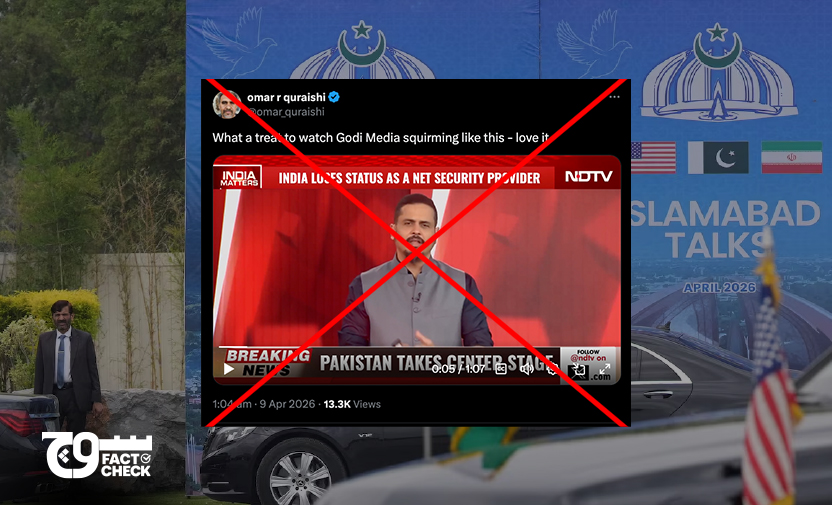
Claim: In the context of the US-Israel war with Iran, Indian journalist Shiv Aroor said that Pakistan has taken centre stage globally while India has lost its status as the net security provider.
Fact: The video of the journalist is fake and most likely AI-generated.
On 9 April, an X user posted a clip in which an Indian journalist, Shiv Aroor, can be seen saying that Pakistan has taken centre stage in the United States-Israel war with Iran, while India lost its status as a net security provider.
The caption of the post reads, “What a treat to watch Godi Media squirming like this – love it”.
The video is apparently from the show, India Matters, on news channel New Delhi Television Limited (NDTV), as can be seen on the tags in the clip.
In the video, Aroor says:
“In fresh news stemming from [the] Pakistani prime minister’s tweet, President Donald Trump stated that the Pakistani prime minister and field marshal have done their best to end the Iranian war. As I am speaking on this, I feel a bit betrayed by the actions of the Indian government. I have never criticised Prime Minister Modi in the past, but I believe now is the right time to do so. We are seeing Pakistan take centre stage across the world, being globally recognised as a net stability provider. While India, on the other hand, has lost its status as a net security provider.”
Aroor can also be seen mentioning the latest Bollywood movie, Dhurandar 2. The first part of this movie featured Pakistani city Karachi’s neighbourhood, Lyari. It ignited controversy in Pakistan as it depicted Lyari as a hub of gang wars and international terror networks.
“People are busy watching Dhurandar 2, which is an excellent movie, I must say. But what is happening in the real world is not in India’s favour. We have lost on this global diplomatic front. And today I feel that our country is no different from African countries that have no role to play. I have never criticised the BJP in the past, but I am getting inclined to do so. Between what is happening in geopolitics and Bollywood, I am personally suffering a huge amount of grief from all of this. I am literally standing up in shock while reading this news.”
Pakistan mediates ceasefire, hosts peace talks
Towards the end of the US-Israel war against Iran that started on 28 February and lasted over five weeks, US President Donald Trump repeatedly threatened the Islamic Republic with destruction.
Pakistan hosted high-level negotiations, the “Islamabad Talks,” between the US and Iran in the federal capital on 10 and 11 April 2026, after brokering a two-week ceasefire. The development came after Rapid Response 47, the official account for White House’s urgent statements, shared US President Donald Trump’s statement on 8 April 2026. Trump openly credited Pakistan for being a mediator for the ceasefire.
The Iranian delegation, composed of the Speaker of the Iranian Consultative Assembly Mohammad Bagher Ghalibaf and FM Araghchi, arrived during the early hours of 11 April 2026. The US delegation, including US Vice President JD Vance, US Envoy to the Middle East Steve Witkoff and Jared Kushner, also arrived later that day.
The Islamabad Talks then ended after 21 hours without reaching a deal. Before leaving for the US, VP Vance conducted a press briefing on the morning of 12 April 2026 and announced, “We have not reached an agreement, and I think that’s bad news for Iran much more than it’s bad news for the United States of America.”
However, on 15 April 2026, White House Press Secretary Karoline Leavitt mentioned during a presser that the next round of talks will likely be held in the “same place as before,” hinting US delegation’s another trip to Islamabad. Following the update, the Red Zone area of Islamabad was sealed, along with several other routes for security purposes.
Vance was expected to arrive with his delegation on 22 April 2026 but the White House abruptly changed plans. On the other hand, the Iranian delegation also delayed its decision on participation.
After a lot of back and forth, the Iranian delegation, led by foreign minister Abbas Araghchi, arrived on the night of 24 April 2026. They arrived after Leavitt confirmed Jared Kushner and Steve Witkoff’s participation from the US. However, Trump canceled the US envoy’s trip at the last minute, saying that they would “be wasting too much time.”
Fact or Fiction?
Soch Fact Check ran the video through AI detection tools to check whether the video was real or not.
We used DeepFake-O-Meter to check whether the video is digitally manipulated or not.
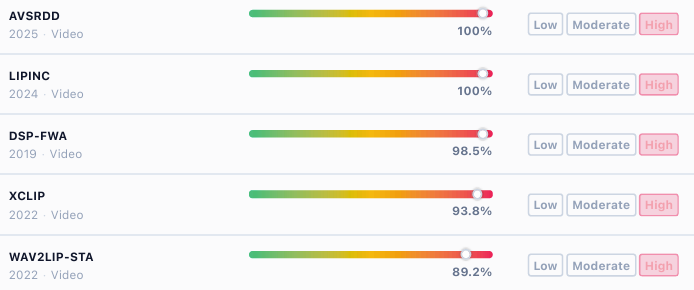
(A screenshot of the result from DeepFake-O-Meter)
As per the detectors:
- AVSRDD (2025) gave a 100% result for the video being fake. It stands for Audio-Visual Speech Representation Deepfake Detection. This detector checks if the subject is real by checking the coordination between their voice and lip movement.
- LIPINC (2024) too showed a result of 100%. It stands for LIP-syncing detection based on mouth inconsistency. This one mainly focuses on even the slightest movements of a person’s mouth to see if they look natural or robotic.
- DSP-FWA (2019) gave a 98.5% result. It stands for Dual Spatial Pyramid for Exposing Face Warp Artifacts. It looks for blurry edges that appear when an AI tries to resize a fake face to fit on a real one.
- XCLIP (2022) gave a result of 93.8%. This one analyses human behaviour.
- WAV2LIP-STA (2022) gave a result of 89.2%. It is a lip-sync fraud detector.
We also tested the video using Global Online Deepfake Detection System (GODDS), a tool developed by Northwestern University’s Security & AI Lab (NSAIL) that uses a combination of various models along with human analysis to provide a holistic summary of the results.
GODDS used 22 deepfake detection algorithms for the visual content and 70 for the audio component. Two trained analysts also examined the clip.
All predictive models for the visual and audio content said the video “may be artificially manipulated”, concluding that:
- The video is likely to be fake with a probability above 0.5, according to 13 of the 22 predictive models. It is likely to be fake with a probability below 0.5, according to the 9 other predictive models.
- The audio is likely to be fake with a probability above 0.5, according to 63 of the 70 predictive models. It is likely to be fake with a probability below 0.5, according to the 7 remaining predictive models.
 (A screen shot from the result by GODSS)
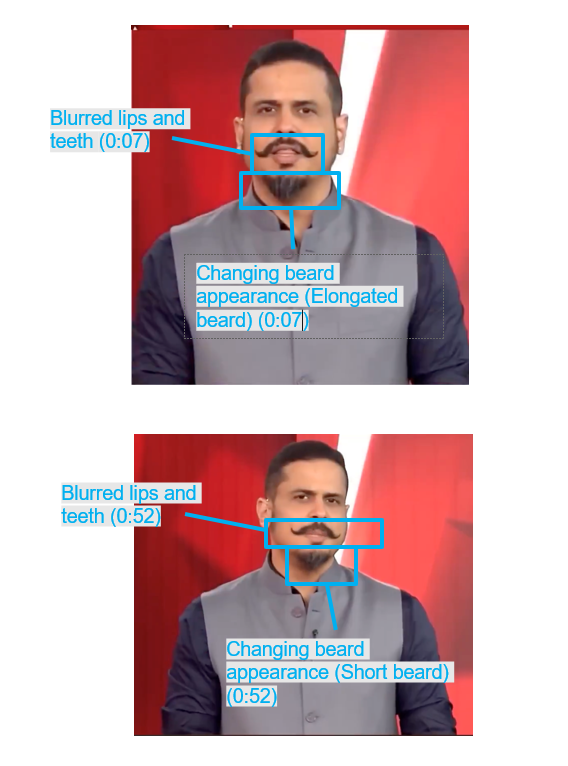
According to the human analysts, there are several indicators that the video may be artificially manipulated:
- As the subject speaks, his teeth seem to change shape and often appear blurry (e.g., 0:04, 0:07*-0:09, 0:15, 0:21, 0:52-0:53, etc.).
- Occasionally, the subject’s beard appears to change length and size as he speaks (e.g., 0:15, 0:22, 0:30, 0:33, etc.).
- Throughout the video, the subject seems to blink at high frequencies, appearing unnatural.
- At 0:55, the subject’s hairline is interrupted by a visual “glitch,” appearing unnatural.
- The subject’s voice seems to lack natural tonal and cadence variations characteristic of human voices.
They have also stated that as Aroor speaks, his jaw seems to move in an exaggerated manner, almost appearing puppet-like.
We also ran the video through Hive Moderation. It showed the video is likely to have 98.6% AI-generated speech.
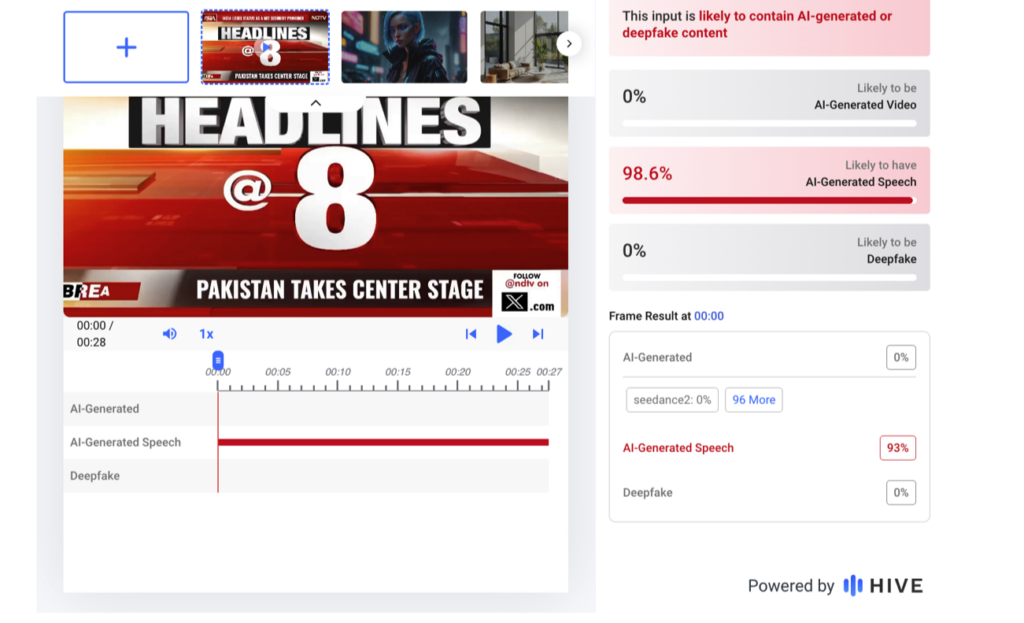
(A screenshot of the result from Hive Moderation)
Based on the analysis by three AI-detection tools that ran the video through multiple detectors, Soch Fact Check concludes that the video is fake.
Virality:
The viral video can be found posted here, here, here, here, here and here on X.
On Facebook and Instagram it can be seen here and here respectively.
Conclusion: Indian journalist Shiv Aroor did not say that Pakistan has taken centre stage globally while India has lost its status as the net security provider in the context of the Iran war.
Background images in cover photo: Reuters
To appeal against our fact-check, please send an email to appeals@sochfactcheck.com