
Claim: The Council of Common Interests (CCI) has cancelled the Six Canals Project on the Indus River after widespread protest in Sindh. No new canals will be built over the river.
Fact: Whilethe project was temporarily paused in April 2025, it has not been formally cancelled. The CCI “decided that the federal government will not move further until mutual understanding is evolved among the provinces.”
A year after the very public controversy around the Six Canals Project, Soch Fact Check decided to sort through the misinformation.
Following the CCI’s meeting on 28 April 2025, several mainstream media channels published headlines stating the CCI had agreed to “cancel” or “annul” the federal government’s plans to build six canals on the Indus River under the Green Pakistan Initiative (GPI).
Variations of the same claim were reported by other news channels. Aaj News published a headline in English stating that there will be “No Canals over Indus River – CCI accepts Sindh’s stance” while Geo News’ headline stated, “CCI rejects Centre’s plan to construct contentious canals on Indus River.” These headlines imply the project has been brought to a complete end.
The claims contradict the CCI’s conditional stance, and also fuelled claims on social media of an alleged “victory” for the PPP and Sindh.
On 21 May 2025, a protester was killed in Sindh after police resorted to baton-charge and fired gunshots to disperse a demonstration against the proposed construction of the six canals over Indus River. Protesters had gathered in the city of Moro, Naushahro Feroz, blocking traffic on the motorway bypass road and resisted the police’s attempts to break up the protests. At least six people were injured in the crackdown, including three protesters and the Deputy Superintendent of Police (DSP), Dawn reported.
In the past few months, Sindh has witnessed widespread protests over the proposed construction of the canals by residents, farmers, political parties, and other key stakeholders including the PPP. Amid this contentious environment and India’s sudden suspension of the Indus Waters Treaty, the government announced last month that it was halting the project until all four provinces had arrived at a “mutual understanding” on the issue.
Despite this announcement, protests and sit-ins were organised by the legal fraternity and other stakeholders across Sindh in early 2025, demanding a cancellation and a permanent end to the project.
Six Canals on the Indus River
The project dates back to 2023, when the incumbent government announced its plans to construct a network of six canals on the Indus River across Pakistan, as part of the Green Pakistan Initiative (GPI), launched by Chief of Army Staff General Asim Munir and Prime Minister Shehbaz Sharif in July 2023.
 Chief of Army Staff General Asim Munir hands over the inaugural scroll of the Green Pakistan Initiative to Prime Minister Shehbaz Sharif in July 2023. Source: AlJazeera
The GPI aims to cultivate vast barren desert lands into fertile farmland with the intent to boost Pakistan’s food security. In particular, 4.8 million acres (1.94 million hectares) of “barren wasteland” has been identified which will then be made cultivable through irrigation systems, and this task lies with the army-owned private company, The Green Corporate Initiative (GCI).
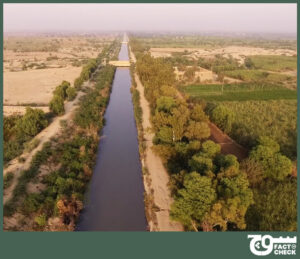 Chashma Canal flows through the Punjab province before traversing parts of Khyber Pakhtunkhwa. Source: Asian Development Bank
Government sources and nationalist party leaders in Sindh, alleged that President Asif Ali Zardari approved the project in 2024 – a claim Zardari and the PPP deny. The construction of the six canals is hailed by supporters as a transformative step towards creating “modern farms”. However, this state-sponsored modernisation project could spell disaster for Sindh, and other southern parts of the country that lie downstream of the Indus River, according to the multiple stakeholders in the province.
The project has drawn criticism and uproar from all across Sindh, particularly over the first half of 2025. From Sindh’s nationalist parties and farmers to human rights activists, lawyers, and students, swathes of demonstrators have decried the water project. Local communities of farmers, fishers as well as environmental experts insist the canals will exacerbate water shortages in Sindh, a region which is historically marred by water shortages and droughts. In March 2025, Director Operation of the Indus River System Authority (IRSA) Khalid Idrees Rana issued a memo to provincial irrigation departments, projecting that Sindh will face a 30 to 35% shortfall of water for the remainder of this season.
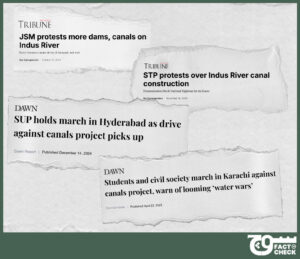 Major stakeholders across Sindh protested the construction of the six canals throughout 2024 and 2025. Source: Dawn, Express Tribune
Arguably, water scarcity has more of a negative impact in Sindh where 77% of the agricultural land in the interior depends on systems of irrigation, and cities, like Karachi, already lack access to sufficient drinking water.
Consequently, farmers, activists and nationalist parties in the province have posed questions and suspicions around where the largest of these six canals, the Cholistan Canal Project, will get its water. Launched by Chief Minister Punjab Maryam Nawaz and COAS General Asim Munir on 15 February 2025, the plan to irrigate Cholistan is deemed as a disaster for Sindh as it would further reduce the flow of water to the water-scarce province.
Fears center around the diversion of water from Sindh’s Sukkur Barrage. Given the province’s existing water shortages, any further reductions from what is supplied by the Sukkur Barrage could result in the collapse of the ecology of the province, activists and environmental experts have alleged.
“It will require water from the Indus River to be redirected to the barren lands of Cholistan, a move which will deprive the already water-scarce region of Sindh,” according to Indus River System Authority’s (IRSA) Sindh representative Ehsan Leghari.
While the proposed plan for the project reportedly states that it will be fed by the floodwaters released from India’s river Sutlej, environmental specialists have noted that this is unsustainable. Especially now, with India suspending the Indus Waters Treaty, the plan appears more precarious than ever.
Little else has been declared by the government and the army on how water will be sourced for Cholistan, according to critics.
Despite these existing challenges, the construction of the Cholistan canal was approved by the Indus River System Authority (IRSA), reportedly in January 2024, and then by the Executive Committee of the National Economic Council (ECNEC) in February that same year. The approval was issued without the consensus of the stakeholders, Sindh’s nationalist parties, farmers, and activists have claimed.
Citing these concerns, the Sindh government passed a unanimous resolution in the provincial assembly on 18 March 2026, calling for an immediate halt to the project until a fair consensus is reached among all provinces. Additionally, the Sindh High Court issued a stay order halting the construction of the Cholistan canal a few weeks later, on 7 April.
The timing and impact of this resolution, however, was deemed ineffective as it came after months of protests and well after the launch of the Cholistan Canal Project.
Mainly, the plan to construct six canals over the Indus has reignited the lower riparian community’s longstanding distrust in the government’s promises that the canals will distribute water fairly and equitably to all provinces. For Sindh’s small farmers, nationalist parties and activists, this instance harkens back to their past opposition to the construction of similar large-scale dams, like the Kalabagh which had sparked the same concerns around depriving Sindh of its rightful share of water instead of boosting the region’s water storage capacity.
Fact or Fiction
Soch Fact Check investigated the claim as the federal government has not previously expressed its intention to scrap the six canals project at any point since its approval in 2024.
On 24 April 2025, Prime Minister Shehbaz Sharif and Chairman of the PPP Bilawal Bhutto-Zardari announced that the construction of the canals will be brought to a temporary halt, and the fate of the project will be decided in a Council of Common Interests (CCI) meeting slated for 2 May 2025. However, the CCI meeting was called urgently on the night of 28 April 2025 after which Prime Minister Shehbaz Sharif and PPP Chairman Bilawal Bhutto-Zardari announced that the project was shelved.
Members of the PML-N and federal ministers have made statements in the past assuring that Sindh’s rightful share to water will not be compromised but none said the government intends to terminate the project permanently. Historically, disputes over the construction of large-scale dams and water distribution projects in Pakistan have often culminated in a temporary suspension or a halt to the project and not a complete cancellation.
Seeing this, Soch Fact Check perused the CCI’s official press release about the meeting and found that this project too has been brought to a temporary halt. It has not been cancelled. In particular, the press release stated:
“The CCI endorses the policy of the federal government as given below: Federal government has decided that no new canals will be built without mutual understanding from CCI. It has been decided that the federal government will not move further until mutual understanding is evolved among the provinces.”
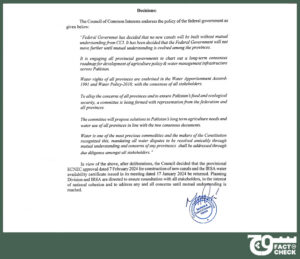 A copy of the CCI’s Statement, issued 28 April 2025, obtained by Soch Fact Check
Additionally, the council decided to return the water availability certificate issued by the Indus River System Authority (IRSA) and the Executive Committee of the National Economic Council (ECNEC) approval. While the construction of the canals cannot be carried out without these approvals, the CCI instructed The Planning Division and IRSA “to ensure consultation with all stakeholders, in the interest of national cohesion and to address any and all concerns until mutual understanding is reached.”
At no point in the statement does the CCI announce a complete cancellation of the project. In fact, it has announced a temporary halt. There is mention in the press release that the project will not resume or that the certificates of approval by the ECNEC and IRSA cannot be reissued until a “mutual understanding is reached.”
To decide the future of the project, the council has urged the formation of a committee “to chart out a long-term consensus roadmap for development of agriculture policy & water management infrastructure across Pakistan.”
As of the time of writing, there are no follow-up recent news reports or government press releases confirming that such a committee was formed. Instead, we found news reports that Prime Minister Shehbaz Sharif had summoned a meeting with key government ministers on 29 January 2026 to hold consultations on the canals’ issue in light of the CCI’s decision.
We also reviewed reports on the decision published by mainstream news outlets in mid 2025.
Dawn’s headline stated the CCI had announced halting the project “until ‘mutual understanding’ among provinces”. The report added, “The CCI also endorsed the government’s move to engage all provincial governments to chart out a long-term consensus roadmap for the development of agriculture policy and water management infrastructure across Pakistan,” while emphasizing the project was not terminated.
The Express Tribune reported that the CCI’s meeting “fell short of clearly announcing that the six-canal project was being completely abandoned, rather it simply endorsed an earlier stance of the federal government that the project will only proceed if a consensus among the provinces and the CCI is achieved.”
Soch Fact Check thus concludes that the fate of the six canals project is currently uncertain. Claims alleging that the government has entirely cancelled or scrapped its plan to build the canals are misleading.
All-Encompassing Protests Across Sindh
Since the Indus River System Authority (IRSA) issued the water availability certificate, essentially giving its greenlight to the construction of the Six Canals, widespread protests and sit-ins have been staged across Sindh. Starting from the Babarloi Bypass in Khairpur, Sukkur to the National Highway, marches across the province have called for a complete end to the project.
The bid to stop the construction of the six canals has gathered steam especially since November 2024, drawing members from different parts of society under banners such as ‘Save Indus River Movement’, the ‘Anti-Canal Action Committee’, ‘Save Sindh, Save the Indus’, among others.
 Protests staged under the banners of ‘Save Indus River Movement’, the ‘Anti-Canal Action Committee’, ‘Save Sindh, Save the Indus’. Source: Dawn
Farmers’ Associations response
In November 2024, farmers’ lobbying group the Sindh Abadgar Board rejected the construction of the “six strategic canals” at a board meeting in Hyderabad and called for protests in collaboration with other growers organisations under the banner of the Anti-Canals Action Committee.
What does civil society think?
Thousands of women activists from the Sindhiani Tehreek and Awami Tehreek led the “Save Earth and River March” in Karachi that same month, protesting the construction of the canals as well as the corporate farming taken up under the GPI. On 23 November of last year, prominent women activists from The Sindh Rawadari Committee, including Irfana Mallah, Amar Sindhu, and others, made their way to the Hyderabad Press Club chanting slogans and condemned the plan for the canals’ construction.
Women and representatives of the transgender community once again gathered in Karachi on Women’s Day to raise concerns against the environmental impact of the six canals project. The march, which was also attended by activists from the Human Rights Commission of Pakistan (HRCP), and the Fisherfolk Forum (PFF), was organised by the National Trade Union Federation (NTUF) and the Home Based Workers Federation.
In April 2025 , women lawyers from Sukkur also registered their demand to halt the irrigation project during a sit-in.
The vehement movement against the six canals also drew large swathes from the legal fraternity in Karachi, Hyderabad, and other cities of Sindh, blocking major highways which lead to Punjab. “Lawyers held rallies in their respective cities and towns to express solidarity with their colleagues holding a prolonged sit-in at Babarloi Bypass against the controversial canals project,” Dawn wrote in a report from 23 April 2025.
The lawyers’ sit-in had entered its seventh-consecutive day when PPP Sindh President Nisar Ahmed Khuhro invited the lawyers to participate in the party’s procession in Sukkur.
Along with lawyers, students from across the province have also protested against the Cholistan Canal. Students from Sindh University, belonging to the Jeay Sindh Students Federation (JSSF) and Jeay Sindh Qaumi Mahaz (JSQM), led a protest against the proposed canals at the National Highway earlier in March when they clashed with the police.
Around the same time, Save Indus Students Alliance and Karachi Bachao Tehreek issued a joint call to protest the potential impact of the canals on Karachi’s water supply. A leader of the Save Indus Student Alliance and a student from Hala, who spoke to Dawn, added, “Karachi’s water is sourced from the Sindhu River, and the construction of new canals will drastically reduce the city’s supply. If that happens, water wars could erupt and spread across Karachi like civil unrest.”
However, police significantly cracked down on student protests. In March, Dawn reported that Jamshoro police baton-charged and attacked the students from Jeay Sindh Students Federation (JSSF) and Jeay Sindh Qaumi Mahaz (JSQM) with tear-gas shells, a move which was immediately condemned by the Human Rights Commission of Pakistan (HRCP). On 26 April 2025 the Save Indus Students Alliance published a statement condemning police violence at the Karachi protest where Defence police officials shot five students. During the protest on 23 April, a student named Shahbaz Khaskheli was allegedly shot by the police in the head and was later shifted to Jinnah Hospital in Karachi, the statement alleged.
Pushback from nationalists and opposition parties
Nationalist, and opposition parties in Sindh have aggressively opposed the project since last year, claiming it will render vast tracts of Sindh’s land barren and pose a significant threat to the country’s economy. In September 2024, Chairman of the left-wing Sindh Taraqqi Pasand Party Qadir Magsi declared that his party and people of Sindh will not accept the project of constructing six canals on the Indus. He additionally announced the mobilisation of a public campaign against the project. Subsequently, in October 2025, the Grand Democratic Alliance’s Chief Pir Pagara also rejected the federal government’s plans to construct the canals, adding that they “will not permit any theft of Sindh’s water.
Save Indus River Movement (SIRM), a coalition including the Grand Democratic Alliance (GDA), Pakistan Tehreek-e-Insaf (PTI), Sindh United Party (SUP) as well as religious conservative parties like the Jamaat-e-Islami (JI) and Jamiat Ulema-i-Islam-Fazl (JUI-F) among others, have been rallying across Sindh since November. The Save Indus River Movement (SIRM) took to the streets as early as September 2024 and has consistently campaigned across various cities in Sindh, for over six months.
The movement not only demands a halt to the construction of the canals but also the return of indigenous land in Sindh that it alleges was sold off to “outsiders” under the Green Pakistan Initiative (GPI) for corporate farming.
Under this umbrella, senior members of the Grand Democratic Alliance (GDA), President of Sindh United Party (SUP), and PTI’s Haleem Adil Sheikh have particularly criticised the PPP-led Sindh Government for secretly backing the six canals project and bartering the land that originally belongs to the people of Sindh.
GDA Information Secretary Sardar Abdul Rahim highlighted the adverse impact of the project on Karachi’s access to water, adding that “Karachi receives 85 per cent of its water from the river and that without downstream flow, water supply to the city would become impossible”.
The PPP’s Sindh-faction also joined the movement last month, albeit well after the project was given a green light by the IRSA in January 2024. The party, which maintains its position within the ruling coalition, maintains it has rejected the plan unequivocally since its approval, but it stayed away from street-protests for a larger part of these six months. Eventually though, it led its first phase of protests across Sindh at the end of March, and then announced a second phase of demonstrations scheduled for 1 April.
PPP vs. the Centre
Sindh’s ruling party, the Pakistan People’s Party (PPP) distanced itself from the project and amped up its efforts to protest against the construction of the canals more recently.
On 18 April, the party’s Chairman Bilawal Bhutto-Zardari threatened to exit the government if the project continued. Addressing a large gathering at the Hatri Bypass Ground in March, the Chairman asserted his party would not go along with the federal government if it didn’t end the controversial projects, even after acknowledging the PPP’s objections.
The Punjab government and the Centre have nonetheless insisted over the past year that water will not be diverted away from Sindh.
Addressing the National Assembly on 8 April 2025, Deputy Prime Minister and Foreign Minister Ishaq Dar reassured members that Sindh’s share of water would not be compromised.
In February this year, the Federal Minister for Planning and Development Ahsan Iqbal addressed the water dispute at a press conference and assured that not a single drop of Sindh’s share will go to any other province.
Azma Bokhari, a spokesperson for the Punjab government, retorted to the protests in Sindh in November last year, saying, “Water management is our right, and no one can stop it. If Punjab manages water within its own boundaries, there should be no objections.”
 Federal Minister for Planning and Development Ahsan Iqbal and Sindh Chief Minister Syed Murad Ali Shah addressed a joint press conference in Karachi on 24 February 2025 (top). Source: Samaa. PPP Chairman Bilawal-Bhutto Zardari addresses a rally at the Hatri Bypass Ground in April 2025 (bottom). Source: Dawn
Speaking to Al Jazeera, an Islamabad-based environmental specialist Naseer Memon noted the military and Punjab’s government lack of transparency on how irrigation water would be sourced, the publication wrote in March.
Last year, PPP Senator Sherry Rehman, Head of the Senate Standing Committee on Climate Change and Environmental Coordination, commented on the potential desertification of Sindh’s fertile lands.
When the Sindh Assembly unanimously passed a resolution against the construction of six new canals in March, CM Sindh Syed Murad Ali Shah stated, “We are being told that water will be taken from Punjab’s most fertile lands and diverted to Cholistan and that we should not object.” He further asked if Punjab would allow its most productive regions, like Chaj Doab and Rachna Doab, to dry up just to irrigate a desert.
Earlier in December 2025, the Chief Minister had claimed that “No work is currently being carried out on the canals”. However, President of the Sindhi nationalist party SUP Syed Zain Shah shared a since-deleted video on social media in March which showed that digging for the six canals had already begun. Soon after the circulation of this video, a team of irrigation experts sent to the area by the Chief Minister also found that “Work on a small stretch of the contentious Cholistan Flood Feeder canal had been initiated before construction was stopped,” according to a 21 April 2025 report by Dawn.
Recent Developments
On 28 April 2025, the Council of Common Interests (CCI) announced its decision to halt the construction of the canals until consensus was reached among all four provinces. After an urgent meeting, the council announced a revocation of IRSA’s and ECNEC’s approval to construct canals in Sindh.
Throughout April, protesters had paralysed cross-country traffic by blocking national highways in parts of Sindh, with manufacturers saying they had been forced to halt production due to a shortage of raw material. “The road closures in several parts of Sindh were due to continuing protests against the controversial proposal to build new canals on the River Indus,” Dawn reported at the end of April 2025.
Citing the massive protests and road blockages, the Sindh government announced on 28 April 2025 that the CCI’s meeting, which was initially scheduled for 2 May, would be held later that night. After this meeting, which was attended by all four chief ministers, the CCI unanimously decided to halt the project (Editor’s Note: Refer to the Fact or Fiction section for further details of the meeting and the CCI’s statement on the project.).
Following CCI’s decision, major protests cleared up and two-way traffic was restored on the National Highway.
But the lawyers’ sit-in, blocking major highway routes from Sindh to Punjab, continued for another day despite the announcement. On 30 April, however, the lawyers community met with a delegation of the Sindh government and announced an end to the 14-day long Khairpur sit-in. According to Dawn, “The lawyers’ leaders said the government had pledged to provide the necessary legal documentation by May 7.”
Yet parts of the activist community remain dissatisfied with the CCI’s decision. In particular, the Save Indus Students Alliance called for a complete abolition of the six canals project as well as the corporate farming initiatives announced under the GPI. Founder of environmental organisation Bulhan Bachao Tehreek and activist Zulfikar Ali Bhutto Jr expressed his disappointment over the CCI’s announcement, asserting that it did not address their demands to end the project permanently. “The government is also not listening to the people’s wishes because this CCI meeting was called in an emergency in fear of the people,” he said, according to a report by The Express Tribune.
The Save Indus Movement, which is composed of leaders from Sindh’s nationalist and opposition parties, has announced a public rally in Karachi on 11 May as the threats to Sindh’s water remain unresolved. The Movement condemned the CCI’s notification, terming it “unconstitutional” and “illegal”, while demanding “the immediate cancellation of land leases granted to foreign companies under corporate farming initiatives”, The News reported on 2 May of last year.
On the other hand, the Chief Minister of Sindh has reiterated that the Green Pakistan Initiative’s corporate farming projects will continue, adding that “the PPP [provincial] government itself will launch a project of corporate farming to cultivate unproductive and infertile land in Sindh”.
According to latest news reports, PM Shehbaz Sharif had summoned a key meeting on 29 January this year to discuss the building of the new canals. However, no further developments have been reported as of the time of publishing this article.
History of Sindh-Punjab Water Disputes
Distribution of water and the construction of large-scale dams have been longstanding points of dispute among Pakistan’s provinces. For one, the disagreements emerge from the imbalance of power that typically exists between upstream and downstream riparians. Historically, Punjab has been blamed for its tendency to overextract water from dams and rivers, while the communities in Sindh and Balochistan, located downstream, often accuse Punjab of taking a larger share of water especially in times of shortage. Sindh’s politicians and nationalists have claimed that Punjab diverts its water and irrigates its own fields.
But these disagreements are not new. They can be traced as far back as the colonial period when the British government built irrigation systems that overwhelmingly benefited central Punjab in order to establish its control over the region. In 1887-89, the Sadiqia Shariqia and Sadiqia Ghariba canals were excavated in Cholistan to respond to the settlers’ demands, which paved the way for the excavation of regular canals in Southern Punjab as well.
However, for the better part of the early 20th century, the colonial authorities took several steps and formed commissions to prioritise the water needs of Sindh, invoking protests from Southern Punjab over its own water needs. The 1901 Irrigation Commission bound Punjab to obtain approval from Sindh before undertaking any irrigation projects on the Indus. Proposals of irrigation projects from Southern Punjab to in 1919 were rejected by the British government. Punjab was prohibited from undertaking any projects until Sukkur Barrage was completed.
Post-partition, the controversial case of the Kalabagh Dam brought the Sindh-Punjab water dispute to the forefront again. An irrigation project that was initially proposed to meet Pakistan’s hydroelectric power needs in 1953, it was vehemently opposed by Sindh and eventually later suspended decades later in 2008. Similar to claims about the Six Canals Project, Sindh’s politicians protested that the Kalabagh Dam would strip them of their rights to water and decimate downstream water access. However, in the case of the Kalabagh even upper stream riparians in Khyber Pakhtunkhwa had objected, citing fears of losing major chunks of its agricultural land to flooding from the dam’s construction.
Water-Sharing Agreements
To mitigate these conflicts among the four provinces, several water-sharing agreements and monitoring authorities have been put into place:
During the colonial period, water disputes between Sindh and Punjab were addressed in 1945 when chief engineers from both provinces drafted the Sindh-Punjab Agreement which was said to prioritise the lower-riparian Sindh.
After partition, however, a permanent legal framework was not found for all four provinces until the Nawaz Sharif-led government signed the Indus Water Accord, known as the Water Apportionment Accord (WAA) in Karachi in 1991. Instead of allocating water on an ad-hoc basis, the WAA 1991 allocated its share to each province based on the total water available in the Indus River System at the time, which was estimated to be 114.35 MAF.
Sindh, however, alleges unfair water distribution to date as its ownership was reduced to only 40 percent under the WAA 1991, while the province was the owner of 75 percent of the Indus River waters in the past.
Then, the Indus River System Authority (IRSA) was established to ensure the implementation of the Water Apportionment Accord 1991. The IRSA has also served as a negotiation platform to generate consensus among the provinces on water allocation. But disputes that cannot be resolved by the IRSA are ultimately referred to the Council of Common Interests (CCI).
Since the signing of the WAA in 1991, Sindh has also consistently alleged Punjab’s failure to release the share of water as agreed under the Accord, and blamed the IRSA for its partiality towards the Punjab provincial government. On the other hand, Balochistan has blamed Sindh for the same.
Virality
Soch Fact Check found the claim posted here, here, here and here on Facebook, here on Instagram, here, and here on YouTube.
On 29 April 2025, Pakistan Press International News Agency (PPI News Agency) reported that CCI had decided to “Scrap Controversial Canal Project”. Daily Pakistan reported on 28 April 2025 that the CCI had approved “termination of canals project on Indus River”.
Conclusion: While the project is temporarily paused, it has not been formally cancelled or terminated. The CCI announced a halt to the project in April 2025 “until mutual understanding is evolved among the provinces.” According to recent reports, PM Shehbaz Sharif had summoned a key meeting on 29 January this year to discuss building the new canals. However, no further developments have been reported as of the time of publishing.