
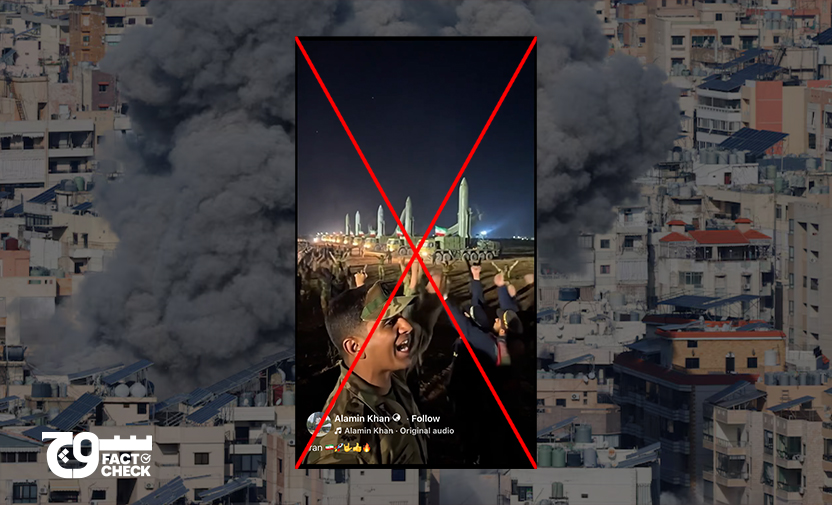
Claim: A video circulating online shows Iranian soldiers launching missiles amid chants of Allahu Akbar.
Fact: The video is a compilation of two clips, both of which are AI-generated.
On 5 March a Facebook user posted a video with emojis of the Iranian flag, rocket, fire and a thumbs up sign as the caption. The video shows a group of soldiers chanting “Allahu Akbar” (God is great) as several missiles are launched in the background. The soldiers are wearing uniforms that resemble the one worn by Iranian soldiers. The missile launchers in the background also have Iranian flags on them.
The same video has been posted on X with a caption in Arabic:
“الصواريخ الحيدرية و الطايرات المسيره الايرانية تدك الكيان الصهيوني المجرم الله اكبر عاشو زلم علي”
[Translation: “The Haydari rockets and Iranian drones are pounding the criminal Zionist entity. God is great! Long live the iron men!”]
The second part of the video being fact-checked has been posted on many social media platforms. It shows a soldier recording the firing of missiles on his phone. He is also wearing the uniform worn by Iranian soldiers. However, unlike the soldier’s uniform in the first part, his uniform has the flag of Iran on the arm of the shirt. The launchers in the background have an Iranian flag on their doors.
Some of the captions accompanying such posts are as follows:
- Dubai suffers an attack
- People of Iran raise their voices for freedom,justice & Human Rights
- Iran suffers an attack
- #IranWar
- Iran Revolutionary Guard out at night
US, Israel attack Iran
The viral video is posted at a time when tension in the Gulf is high following airstrikes by the United States and Israel on Iran.
On 28 February 2026, the US and Israel launched coordinated airstrikes across multiple locations in Iran, reportedly targeting military installations and strategic infrastructure. The attacks marked a dramatic escalation in regional tensions and triggered a broader conflict between Iran and US and Israel. In the opening hours of the campaign, a missile strike destroyed the Shajareh Tayyebeh girls’ elementary school in Minab in southern Iran. The strike occurred during school hours and caused the collapse of the building’s roof, killing at least 165 people, mostly schoolchildren, and injuring dozens more. Investigations by international journalists and open-source analysts later indicated that the strike was likely caused by a US Tomahawk missile aimed at a nearby military facility.
Following the airstrikes, Iran retaliated with missile and drone attacks against US military bases and infrastructure across the Gulf including installations in countries hosting American forces. The conflict has also spread to Israeli territory through Iranian missile launches. Over 1,300 have died in Iran while US forces have reported at least 13 military personnel killed during the escalation. The fighting has also displaced millions of civilians, damaged infrastructure across several parts of the region, and caused air travel disruptions around the world.
Iran has also sought to exert economic pressure by disrupting shipping through the Strait of Hormuz – one of the world’s most critical oil transit routes through which roughly one-fifth of global oil and liquefied natural gas shipments pass. Disruptions in the strait have therefore triggered a sharp increase in global oil prices and heightened volatility in energy markets. For Pakistan, which relies heavily on imported fuel from Gulf suppliers, the surge in oil prices has had immediate economic consequences. Rising global prices have already contributed to increase in domestic petrol and diesel prices, while economists warn that prolonged disruptions could widen Pakistan’s trade deficit, place additional pressure on the rupee, and intensify inflation in an already fragile economic environment.
However, Pakistan has said it is ready to host talks to end the US-Israel war on Iran.
On 29 March, talks began in Islamabad, the capital city of Pakistan, where diplomats from Saudi Arabia, Egypt, and Turkey gathered in an attempt to de-escalate the conflict. The effort is being led by the Pakistani Foreign Minister Ishaq Dar, who said that the diplomats spoke about all possibilities to end the war in the region soon.
Fact or Fiction?
Soch Fact Check noted that the video contains several signs of AI-generated content. For example, once the missile is fired, some people standing around it appear unnaturally static. Other than this, fire at the end of the missile also looks artificial.
Soch Fact Check then reverse-searched keyframes from the video and found that the Facebook user who posted the video that is being fact-checked also posted another AI generated video with the caption “IR” accompanied by emojis of a rocket and fire. We also saw two parts of the video being fact-checked posted separately on various social media platforms. All the results that came up after reverse-searching the keyframes mainly reiterated the claim i.e. Iranian soldiers celebrating the firing of missiles. We could not find the video shared in any other context.
We then ran both the parts on two AI detections tools.
According to Hive Moderation, 81.2% of the first part of the video is AI-generated while the second part is 83.6% AI.
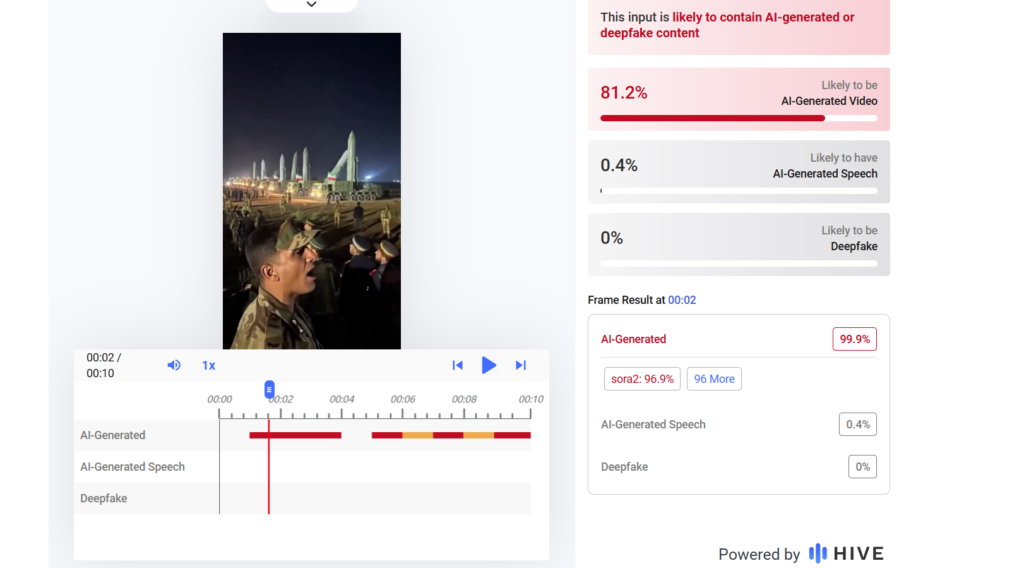
A screenshot of the result from Hive Moderation for the first part of the video
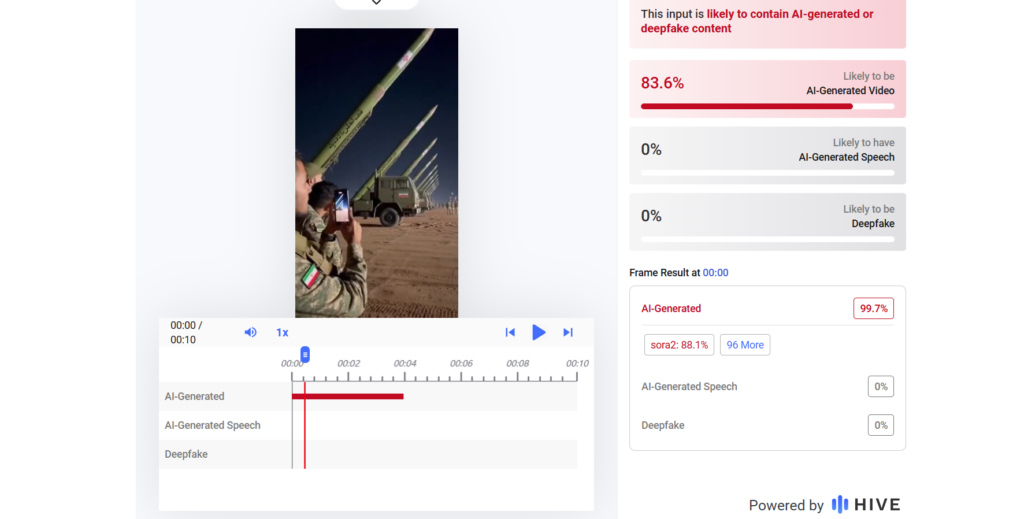
A screenshot of the result from Hive Moderation for the second part of the video
Both parts were run separately through another tool, DeepFake-O-Meter, which analysed it using multiple AI-based detection models.
We first used the AVSRDD 2025 model, which analyses the relationship between speech and mouth to see if they correspond to each other naturally or if they have been synthesized. It rated the video as 100% fake.
After this, the FTCN 2021 model was used to analyse the video for subtle and unnatural discrepancies in motion. It rated the video as 100% fake.
Then, we used the AltFreezing 2023 model, which captures inconsistencies in the image and motion. As per this mode, the video is 92% fake.

A screenshot of the result from DeepFake-O-Meter for the first part of the video
The second part of the video is 100% and 50.9% AI-generated as per AVSRDD and WAV2LIP-STA (2022), respectively.
The WAV2LIP-STA 2022 model looks for lip-syncing deepfakes. The video starts with a soldier saying, “Ready? It’s almost time.” After this, no one can be seen moving their lips in the video. This is why the model rates the video as being 50.9% fake because there is only one instance in the video where anyone can be seen talking.

A screenshot of the result from DeepFake-O-Meter for the second part of the video
Based on the results of the AI detection tools and our analysis of the signs of AI-generated elements present in the clips, Soch Fact Check concludes that the viral video is AI-generated.
Virality
Both the parts of the fact-checked video can be found on Facebook here, here, here, and here.
On Instagram, they can be found here, here, here, here, and here.
They can be found here and here on TikTok.
On X, they can be found here and here, and on Threads, they can be seen here and here.
Conclusion: Both clips in the viral video are AI-generated.
Background image in cover photo: Reuters
To appeal against our fact-check, please send an email to appeals@sochfactcheck.com