
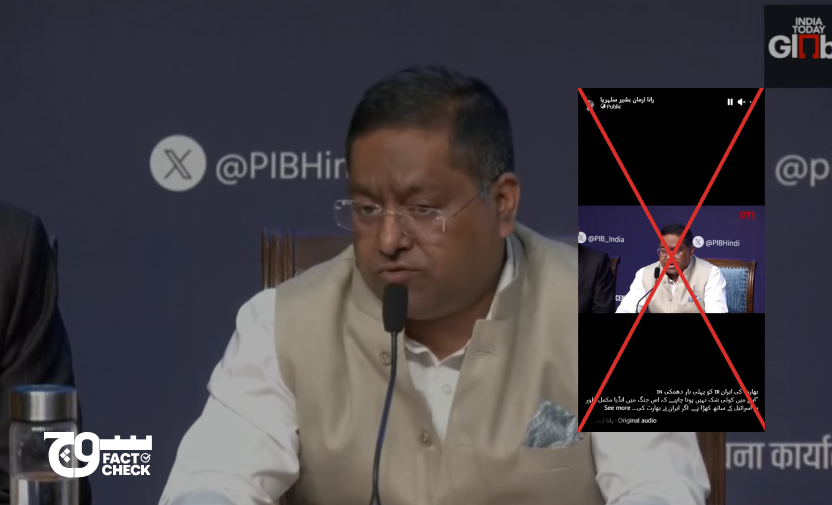
Claim: A video shows India’s Ministry of External Affairs Spokesperson Randhir Jaiswal threatening Iran with aggression if the latter attacked ships coming towards India.
Fact: The viral clip is likely a deepfake.
A Facebook user shared a video with the following caption:
“بھارت کی ایران 🇮🇷 کو پہلی بار دھمکی 🇮🇳
”اس میں کوئی شک نہیں ہونا چاہیے کہ اس جنگ میں انڈیا مکمل طور پر اسرائیل کے ساتھ کھڑا ہے۔ اگر ایران نے بھارت کی طرف آنے والے بحری جہازوں کو نشانہ بنایا تو اسے پاکستان سے زیادہ سخت جواب دیا جائے گا”
[Translation: India threatens Iran 🇮🇷 for the first time 🇮🇳
There should be no doubt that in this war, India stands fully with Israel. If Iran targets ships heading toward India, it will receive a stronger response than Pakistan.]
In the video, the Indian official says:
“To answer your question, India completely and unequivocally stands with Israel in this war. I believe Prime Minister Modi has made this clear multiple times, so there should not be any doubts. We have heard of conflicting reports, which claim that Iran has targeted some commercial ships coming towards India. As far as our position is concerned, there should be no doubt that India will first confirm that Iran is involved in doing such attacks. And if confirmed, Iran will get a reply harsher than Pakistan. India does not endorse terrorism, and Iran will not be spared for any act of aggression towards India. I hope this answers your query.”
US-Israel war with Iran
On 28 February 2026, the US and Israel launched coordinated airstrikes across multiple locations in Iran, reportedly targeting military installations and strategic infrastructure. The attacks marked a dramatic escalation in regional tensions and triggered a broader conflict between Iran and US and Israel. In the opening hours of the campaign, a missile strike destroyed the Shajareh Tayyebeh girls’ elementary school in Minab in southern Iran. The strike occurred during school hours and caused the collapse of the building’s roof, killing at least 165 people, mostly schoolchildren, and injuring dozens more. Investigations by international journalists and open-source analysts later indicated that the strike was likely caused by a US Tomahawk missile aimed at a nearby military facility.
Following the airstrikes, Iran retaliated with missile and drone attacks against US military bases and infrastructure across the Gulf including installations in countries hosting American forces. The conflict has also spread to Israeli territory through Iranian missile launches. “At least 1443 have been killed, including 217 children since the conflict began on 28 February,according to figures compiled by the rights group HRANA.” The fighting has also displaced millions of civilians, damaged infrastructure across several parts of the region, and caused air travel disruptions around the world. As of 25 March, “Israel’s Health Ministry said that at least 5,165 people have been injured in Iranian attacks since late last month.”
Iran has also sought to exert economic pressure by disrupting shipping through the Strait of Hormuz – one of the world’s most critical oil transit routes through which roughly one-fifth of global oil and liquefied natural gas shipments pass. Disruptions in the strait have therefore triggered a sharp increase in global oil prices and heightened volatility in energy markets. For Pakistan, which relies heavily on imported fuel from Gulf suppliers, the surge in oil prices has had immediate economic consequences. Rising global prices have already contributed to increases in domestic petrol and diesel prices, while economists warn that prolonged disruptions could widen Pakistan’s trade deficit, place additional pressure on the rupee, and intensify inflation in an already fragile economic environment.
The conflict has also involved maritime incidents, notably the sinking of the Iranian warship Iris Dena on 4 March in international waters off Sri Lanka’s southern coast. According to the BBC, “Indian Foreign Minister S Jaishankar said Iran had sought permission for three of its ships to dock at Indian ports on 28 February – the day the US and Israel began a war on Iran – and permission was granted by India on 1 March.” Iris Dena had at least 130 members on board and was struck by a US submarine, resulting in the deaths of 87 of those members. The submarine that sank IRIS Dena fired a torpedo and “left the area without conducting search and rescue operations,” leaving the Sri Lankan Navy to recover survivors and bodies alone. The incident marked an escalation beyond air and missile exchanges. It raised concerns about the widening scope of the war and its implications for regional security and shipping routes.
On 14 March 2026, regional actors initiated efforts to broker a ceasefire between Iran, the US, and Israel, reported Reuters. However, these efforts stalled as Iran rejected the possibility of a ceasefire unless US and Israel halted strikes. On 23 March 2026, the US announced a five-day pause on strikes targeting Iran’s energy infrastructure, claiming it would facilitate diplomatic engagement, but Israeli military operations continued.
By 24 March, discussions around a temporary cessation of hostilities began. However, Iran publicly denied any formal talks or ceasefire agreements while missile exchanges between Iran and Israel continued.
Pakistan has since emerged as a key intermediary in the negotiation efforts and actively facilitated communication between Washington and Tehran. Along with countries such as Türkiye and Egypt, Pakistan has been relaying messages and exploring the possibility of negotiations in Islamabad. However, no direct talks between the US and Iran have been confirmed.
Iran has rejected the ceasefire proposal forwarded to it through intermediary parties with Iranian state media citing senior officials who described the US plan as “one‑sided and unfair.” Tehran has instead outlined its own set of five conditions for ending the conflict, which it says must be met before it will consider negotiations or a ceasefire agreement. These conditions include demands for a complete halt to all hostilities and assassinations by the opposing side, the establishment of guarantees preventing the resumption of war, payment of war damages and reparations to Iran, the end of fighting across all fronts and allied groups throughout the region, and international recognition of Iran’s sovereign authority over the Strait of Hormuz.
Fact or Fiction?
Noticing the “PTI” logo in the top-right corner of the viral clip, we narrowed our search to the Press Trust of India to trace the original footage. However, we were unable to locate the exact clip on any of PTI’s official social media platforms.
Then a reverse-search of the keyframes led us to extended footage of Jaiswal’s press conference held on 13 March. It was shared by multiple Indian news outlets. We reviewed the complete press conference and found that Randhir Jaiswal did not make the statement attributed to him in the viral clip, nor did he speak about any form of aggression toward Iran. Instead, he addressed the evolving situation in the Gulf and issued advisories for Indian citizens residing in the region. He also stated that India was working to facilitate the safe return and repatriation of its nationals.
Additionally, Soch Fact Check conducted a keyword search to check whether any credible Indian or international media outlets had reported such remarks. However, we did not find any reports.
Suspecting that the viral clip is manipulated, we tested the video through DeepFake-O-Meter, which analysed it using multiple AI-based detection models. The results for the video are as follows:
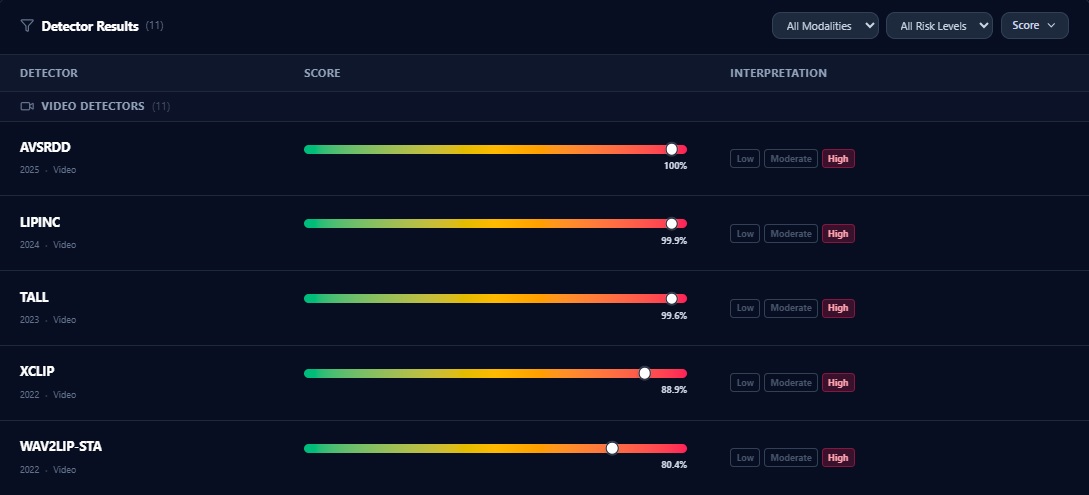
DeepFake-O-Meter results
We first used the AVSRDD (2025) model, which is an AVSR-based audio and visual deepfake detection method that leverages speech correlation. The model uses dual-branch encoders for audio and video to support independent detection of each modality. It rated the likelihood of the video being 100% fake.
The LIPINC (2024) model is a deep learning based method to detect lip-syncing deepfakes by identifying the spatial-temporal discrepancies in the mouth region of deepfake videos. This model rated the video 99.9% fake.
Next, we used the TALL (2023) model as it focuses on checking online videos, which are often compressed or altered in ways that hide fine details. By testing whether the video remains coherent after details are removed, TALL helps reveal manipulation that may not be obvious to the eye. It rated the probability of the video being 99.6% fake.
The video was also analysed using the XCLIP (2022) model, which rated the likelihood of the video being fake at 88.9%. This model uses cross-frame attention to analyse how frames relate to each other over time. This makes it good at spotting inconsistencies in facial movements, expressions, and temporal flow, which are common signs of deepfakes.
Lastly, we used the WAV2LIP-STA (2022) detection model, which is designed to catch lip-sync based deepfakes, where the mouth movements don’t quite match the speech. It rated the clip 80.4% indicating a high likelihood of manipulation.
Given that the original press conference does not contain any threats toward Iran and multiple DeepFake-O-Meter models indicate that the video is likely fake, Soch Fact Check concludes that the viral clip is manipulated.
Virality
The viral clip was shared here, here, here, here, here, and here on Facebook. Archived here, here, here, here, here, and here.
On X, it was shared here (archive).
Conclusion: The viral clip is likely a deepfake.
–
Background image in cover photo:
To appeal against our fact-check, please send an email to appeals@sochfactcheck.com