
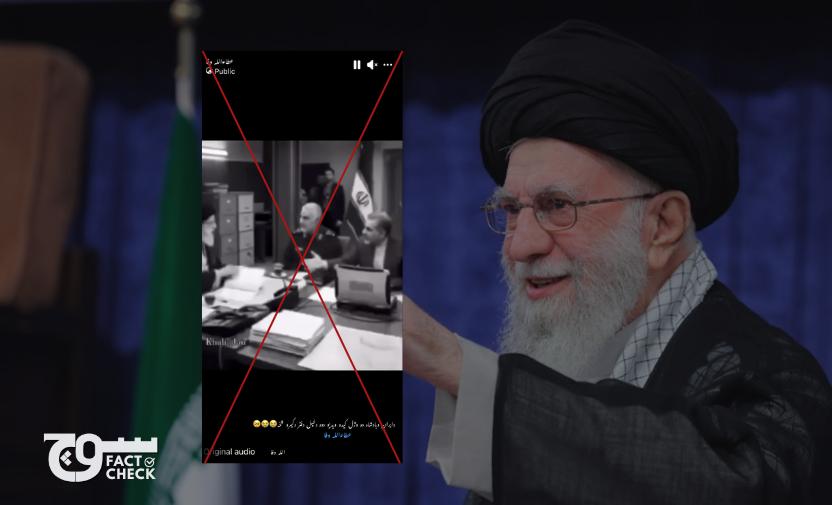
Claim: Video shows Iranian Supreme Leader Ayatollah Ali Khamenei’s final moments before he was killed by a US-Israel air-strike.
Fact: The viral clip is AI-generated.
Following Khamenei’s death in a US-Israeli air-strike, a video was shared online claiming to show his last moments. It contained the following text: “ایرانی سپریم لیڈر آیت اللہ علی خامنائی پر مبینہ میزائل حملے کی ویڈیو سوشل میڈیا پر وائرل ہو گئی”
[Translation: A video of an alleged missile attack on Iranian Supreme Leader Ayatollah Ali Khamenei has gone viral on social media.]
US-Israel launch strikes in Iran
On 28 February 2026, President Donald Trump announced on his social media platform, Truth Social, that “one of the most evil people in history, is dead”, following airstrikes on the Supreme Leader’s compound in Tehran as part of attacks codenamed Operation Epic Fury by the US and Operation Roaring Lion by Israel. He also urged “the Iranian people to take back their Country”, terming the moment as the “single greatest chance” to do so.
Alongside Khamenei, members of his family — including “his daughter, son-in-law, and grandson were also killed” in the joint attack by the US and Israel, according to Al Jazeera. Additionally, Defence Council Secretary Ali Shamkhani, army chief Abdolrahim Mousavi, Defence Minister Aziz Nasirzadeh, and Islamic Revolutionary Guard Corps (IRGC) Commander-in-Chief Mohammad Pakpour were also assassinated.
More than 860 people have died in Iran due to the relentless bombing by the US and Israel, according to Anadolu Agency, which cited Iranian Health Ministry spokesperson Hossein Kermanpour. On the other hand, The Wall Street Journal quoted rights group Human Rights Activists in Iran as saying over 1,000 civilians have been killed.
Israel had last attacked Iran in June 2025, bombing multiple military and nuclear installments in the Islamic Republic and killing multiple senior politicians in what later came to be known as the 12-Day War. The US had joined Israel in last year’s conflict.
War justifications
However, the US has not provided clear justifications for its attack on Iran, according to CNN, which said “the [Trump] administration has delivered anything but clarity”, “declined to enunciate a consistent set of goals and motivations”, and “spent the three days since shifting the goalposts and contradicting itself”.
On 1 March, Reuters reported citing sources that during closed-door briefings to Congress staff, Trump administration officials acknowledged “there was no intelligence suggesting Iran planned to attack US forces first”. Then, on 2 March, according to ABC News, the US president laid out four objectives, saying, “First, we’re destroying Iran’s missile capabilities […] and their capacity to produce brand new ones and pretty good ones they make. Second, we’re annihilating their navy. […] Third, we’re ensuring that the world’s number one sponsor of terror can never obtain a nuclear weapon … And finally, we’re ensuring that the Iranian regime cannot continue to arm, fund and direct terrorist armies outside of their borders.”
And subsequently, on 3 March, US Secretary of State Marco Rubio told reporters that Israel was going to attack Iran anyway so the American forces joined in expecting retaliation from Tehran.
Impact and casualties
In the initial days, the two countries also bombed the Shajareh Tayyebeh girls’ school in the southeastern city of Minab, killing over 160 children. The United Nations noted that it was “deeply disturbed”, while Israel said it was “investigating the incident”. Meanwhile, Rubio explained that American forces “would not deliberately target a school”.
The strikes also targeted the historic Golestan Palace, a UNESCO World Heritage site in Tehran. On the other hand, Iran launched “hundreds of missiles and unmanned drones” in attacks on US military bases in the Middle East, with one strike near a luxury hotel in Dubai where four people were injured, CNN and the BBC reported. “Qatar, Bahrain, Jordan, and Kuwait […] said they had intercepted missiles fired towards them,” the BBC added.
“Eleven people were killed in Israel, officials said, and deaths were reported in the United Arab Emirates [UAE], Kuwait and Bahrain,” NBC News reported. According to the Central Command (CENTCOM), as of 2 March, “six US service members have been killed in action”. Forbes reported that at least 11 people died in Israel, three in the UAE, two in Iraq, and one each in Bahrain, Oman, and Kuwait. “Israeli strikes on Lebanon reportedly killed at least 52 people,” it added.
Fact or Fiction?
Soch Fact Check doubted the authenticity of the video as the versions circulating online were either black-and-white or overlaid with a sepia filter. Reverse-searching its keyframes did not lead to any credible source. If verified footage of Khamenei’s last moments actually existed, it would’ve been widely reported by global media outlets. A review of Iranian news outlets and other reliable sources also did not yield any footage documenting the purported event.
Notably, the video in the claim replicates the appearance of CCTV footage. However, it lacks typical signs such as timestamps or date markers.
Crucially, we spotted elements that indicated that the video is likely AI-generated. For instance, while Khamenei and the two men sitting across him can be seen moving and speaking, the three men standing in the background appear static. They remain almost completely motionless even as the explosion occurs. This lack of natural movement is a common indicator in AI-generated videos where background elements often fail to animate realistically.
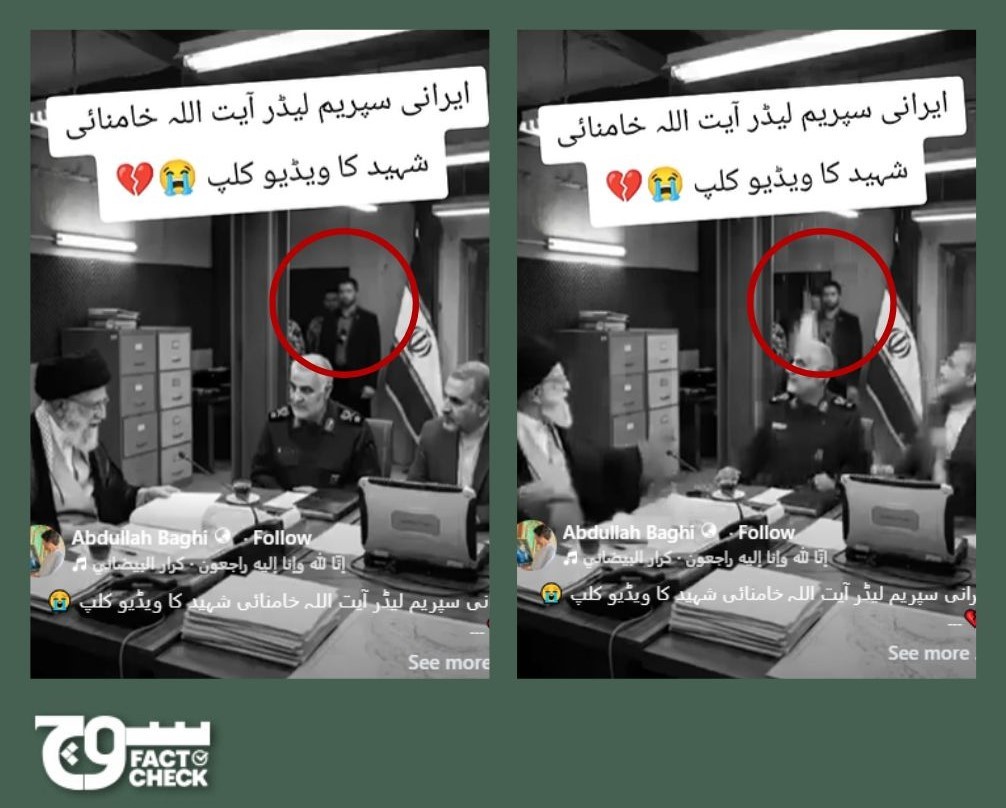
Visual inconsistencies in the viral clip
Additionally, the video does not contain natural audio and has been overlaid with Arabic narration and crying sounds.
Suspecting that it is likely AI-generated, we tested the clip using Sight Engine, which is an AI-powered content analysis platform that helps detect, filter, and moderate images and videos. It uses machine learning to identify deepfakes and AI-generated media.
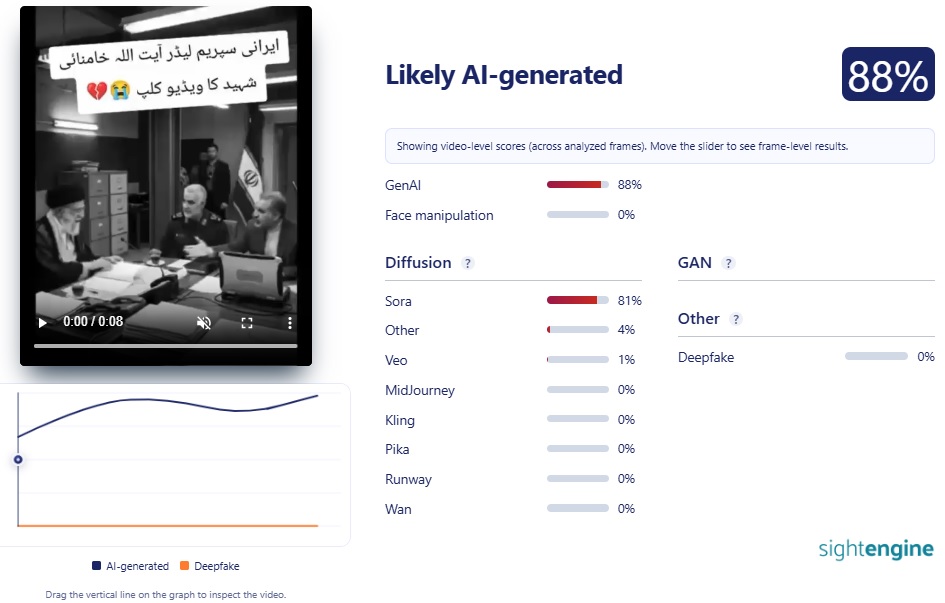
Sight Engine results
Based on a frame-by-frame analysis, the results suggested that the video is likely 88% AI-generated. It attributed most of that likelihood to diffusion-based AI models with 81% probability linked to Sora-style generation, meaning that the content was most likely created using a diffusion-based generative video model such as OpenAI’s Sora. The model creates realistic videos from text prompts. It is designed to simulate real-world motion, lighting, and environments making the output look cinematic and detailed.
We then analysed the video using DeepFake-O-Meter, which analysed it using multiple AI-based detection models. The result for the video is as follows:
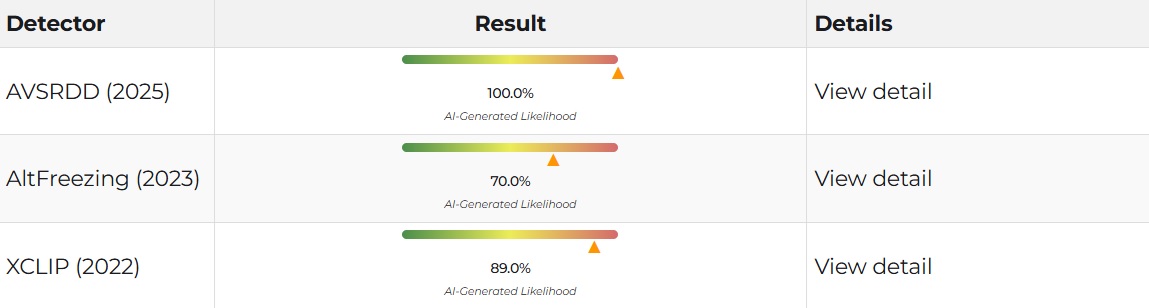
DeepFake-O-Meter results
We first used the AVSRDD (2025) model, which is an AVSR-based audio and visual deepfake detection method that leverages speech correlation. The model uses dual-branch encoders for audio and video to support independent detection of each modality. It rated the video 100% fake.
Next, the AltFreezing (2023) model was used. It is a deep-learning tool designed to detect fake videos. It works by analysing both visual details and changes to spot signs of manipulation. The model estimated a 70% likelihood that the video is fake.
Lastly, we used the XCLIP (2022) model, which rated the likelihood of the video being 89% fake. This model uses cross-frame attention to analyse how frames relate to each other over time. This allows it to spot inconsistencies in facial movements, expressions, and temporal flow.
Virality
The viral clip was shared here, here, here, and here on Facebook. Archived here, here, here, and here.
On Instagram, it was shared here (archive) and here (archive).
Conclusion: The viral video claiming to show footage of Ayatollah Khamenei moments before the US-Israeli air-strike is AI-generated. Multiple AI detection tools, visual inconsistencies, and the absence of reports from credible outlets confirm that the clip does not depict real events.
–
Background image in cover photo:
To appeal against our fact-check, please send an email to appeals@sochfactcheck.com