
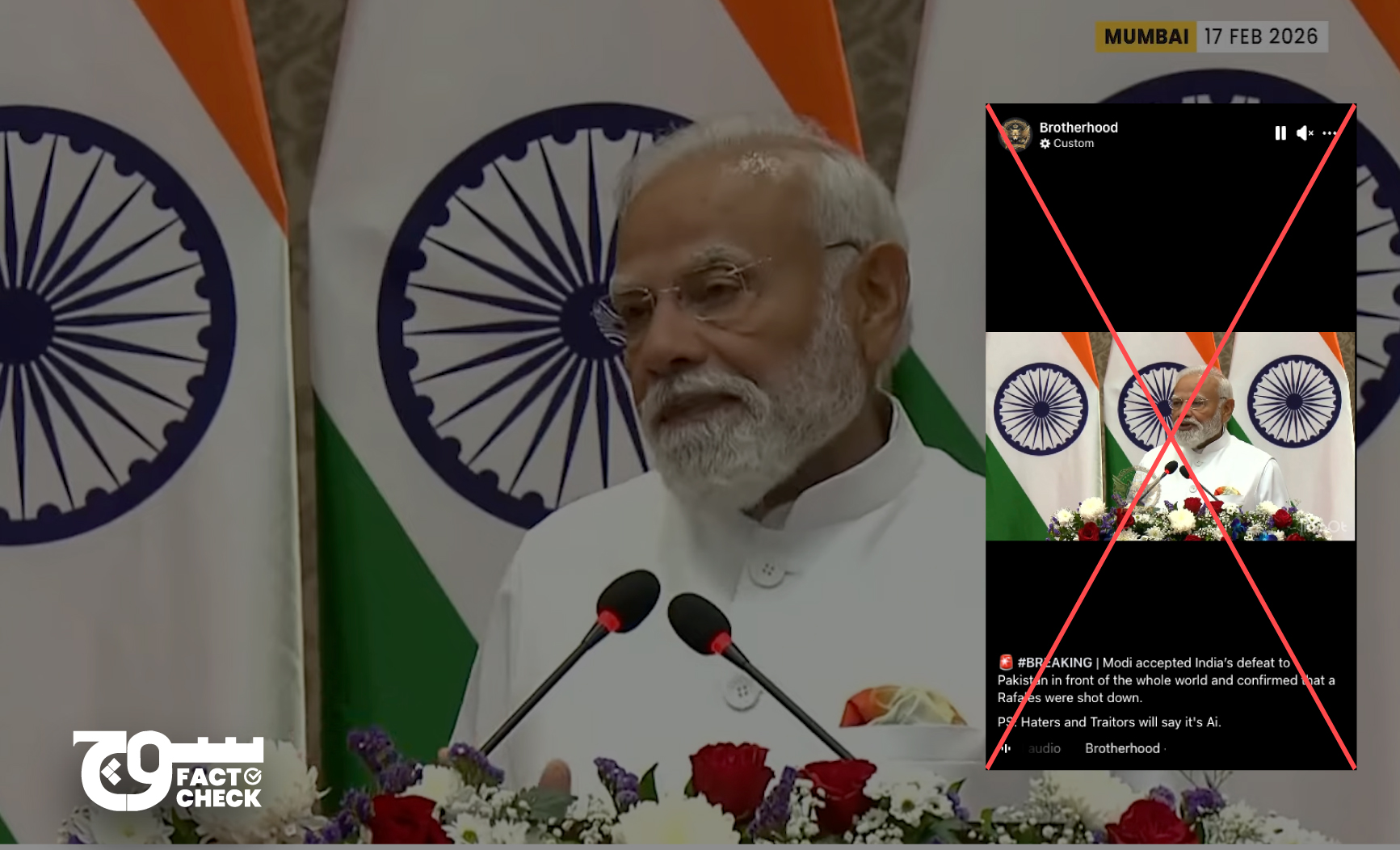
Claim: Indian Prime Minister Narendra Modi admitted that Pakistan shot down Indian Rafale fighter jets during the May 2025 conflict.
Fact: The claim is false. The viral video is a deepfake.
On 18 February, Facebook account Brotherhood shared a video of Narendra Modi delivering a speech with the following caption:
“🚨 #BREAKING | Modi accepted India’s defeat to Pakistan in front of the whole world and confirmed that a Rafales were shot down.
PS: Haters and Traitors will say it’s Ai.”
The following is our translation of what he says in the viral clip:
“When Pakistan destroyed our Rafale aircraft, the whole world began mocking India. People started saying, what kind of a leader is India? No one would even want to enter into a venture with India. At that time, we told respected Mr Macron that India is going through a difficult phase. If we are being mocked, you are also partly responsible. If you do not stand with us, then we will end up using the remaining Rafale aircraft as horsecarts in India.
When I made this request to him with my 56-inch chest, I also want to acknowledge that Mr Macron agreed. Now whether Pakistan shoots down 10 of our aircraft or 200, it does not matter to India because France is now our defence partner.”
Pahalgam Attack
In May 2025, India carried out strikes in Pakistan’s major cities as part of Operation Sindoor. It alleged the operation was a response to the killing of 26 people, mostly tourists, in Pahalgam in Indian-administered Kashmir on 22 April 2025. India blamed Pakistan for the attacks. Pakistani, however, denied any involvement and demanded a neutral investigation.
The Resistance Front – a group that Indian officials maintain is a proxy front for the Pakistan-based militant group Lashkar-e-Taiba (LeT) – initially claimed responsibility for that attack but later retracted its statement.
India attacked Pakistani military bases
According to Pakistan Army spokesperson Lt Gen Ahmed Sharif Chaudhry, India attacked different Pakistan Air Force (PAF) airbases, including Nur Khan in Chaklala, Rawalpindi, Murid in Chakwal, and Rafiqui, formerly known as Shorkot, in Jhang. Chaudhry said the Pakistani military intercepted a “majority” of India’s missiles and “successfully prevent[ed] the desired objectives of India”.
The missiles that did make it inside the Pakistani territory were not able to “cause any damage” to the country’s assets, Chaudhry maintained. The PAF was able to figure out “from where they [Indian missiles] were initiated and what was targeted” through electronic signatures, he added. Pakistan Army, Chaudhry said, was “vigilant and thwarting all these cowardly acts of aggression by Indians”.
Operation Bunyan-um-Marsoos
On 10 May 2025, the Pakistan Army announced a counterattack against India at 4:38 AM — named “Operation Bunyan-um-Marsoos”. They added that the action was “part of the military conflict Marka-e-Haq”.
The military’s media wing, the Inter-Services Public Relations (ISPR), said Pakistan targeted “26x military targets as well as facilities that were used to target Pakistani citizens and those enterprises that were responsible for fomenting terrorism in Pakistan”. The targeted airbases include those at “Suratgarh, Sirsa, Bhuj, Naliya, Adampur, Bhatinda, Barnala, Halwara, Awantipura, Srinagar, Jammu, Udhampur, Mamun, Ambala, and Pathankot”, it said. “[The] BrahMos storage facilities at Beas and Nagrota were also destroyed.”
Pakistan claimed to have hit “multiple targets in India and India-administered Kashmir”, CNN reported. “The Pakistan military said that, in an ‘eye for eye’ retaliation, they targeted the Indian air bases that were used to launch missiles against Pakistan,” it added.
On the other hand, the Indian Defence Ministry said Pakistani drones were “sighted at 26 locations along the International Border and LoC with Pakistan” and that “these include suspected armed drones”. India’s missile attacks and Pakistan’s response marked “the most significant escalation so far in the conflict between the two nuclear-armed neighbours”, according to The Guardian.
Ceasefire announcement
On the evening of 10 May 2025, a ceasefire was announced by US President Donald Trump, who wrote on his Truth Social platform: “After a long night of talks mediated by the United States, I am pleased to announce that India and Pakistan have agreed to a FULL AND IMMEDIATE CEASEFIRE. Congratulations to both Countries on using Common Sense and Great Intelligence. Thank you for your attention to this matter!”
Trump’s announcement came after US State Secretary Marco Rubio spoke separately to Pakistan Army Chief General Syed Asim Munir, Pakistani Foreign Minister Muhammad Ishaq Dar, and Indian External Affairs Minister Subrahmanyam Jaishankar. The ceasefire between the two nuclear-armed neighbours was confirmed by Dar, who wrote: “Pakistan and India have agreed to a ceasefire with immediate effect. Pakistan has always strived for peace and security in the region, without compromising on its sovereignty and territorial integrity!”
India’s Foreign Secretary Vikram Misri also confirmed the same, saying his country and Pakistan would “stop all firing and military action on land, air, and sea” with effect from 5 pm IST, or 4:30 pm PKT.
In an X post, Jaishankar wrote, “India and Pakistan have today worked out an understanding on stoppage of firing and military action. India has consistently maintained a firm and uncompromising stance against terrorism in all its forms and manifestations. It will continue to do so.”
Shortly afterwards, CNN reported an Indian source that the ceasefire was “worked out ‘directly between’ India and Pakistan, despite US President Donald Trump’s announcement that the ceasefire was the result of a night of US mediation”. Misri and New Delhi’s Ministry of Information reiterated the same. The ceasefire between the two countries has largely been upheld.
Fact or Fiction?
Soch Fact Check reverse-searched keyframes from the viral clip to trace the Indian prime minister’s full speech. We found that it is originally from a press conference delivered by Narendra Modi and Emmanuel Macron in Mumbai on 17 February 2026. A review of complete coverage of the event by Indian news outlets ANI News and DD India revealed that he did not make the statement attributed to him in the viral video.
At no point did he mention Rafale aircraft or Pakistan. Instead, he spoke about India and France’s shared commitment to democratic values, the rule of law, reform of global institutions, counterterrorism, and peace across regions. He also emphasised strong cultural and historical ties, ongoing heritage collaborations, and a renewed commitment to strengthening the India-France strategic partnership for global stability and prosperity.
Crucially, the clip being fact-checked carries an InShot watermark, a video-editing application that allows users to trim, merge, and enhance footage with text, filters, effects, and other modifications. The presence of the watermark suggested that it may have been altered. The clip also displayed visual inconsistencies such as his mouth movements appear unnatural, his teeth are not clearly visible while speaking, and at moments his beard appears to blend into his clothing.
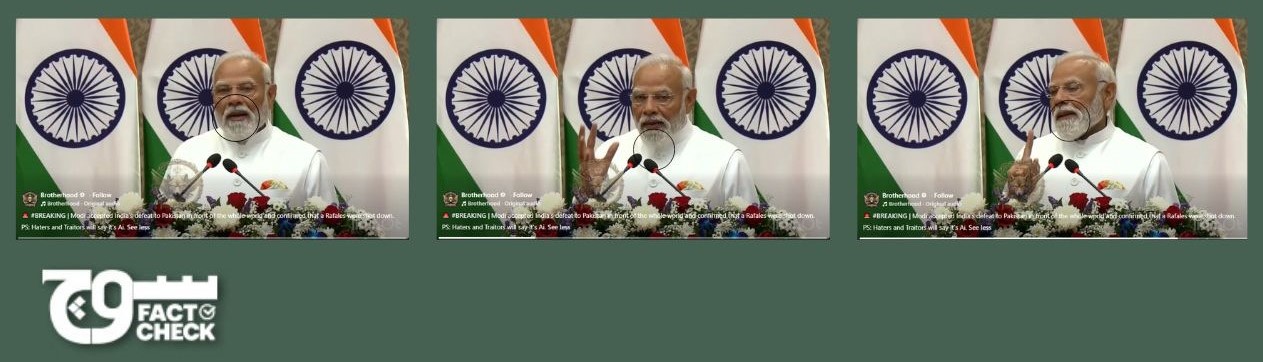
Visual inconsistencies in the viral clip
Suspecting that the video is manipulated, we tested it through DeepFake-O-Meter, which analysed it using multiple AI-based detection models. The results for the video are as follows:
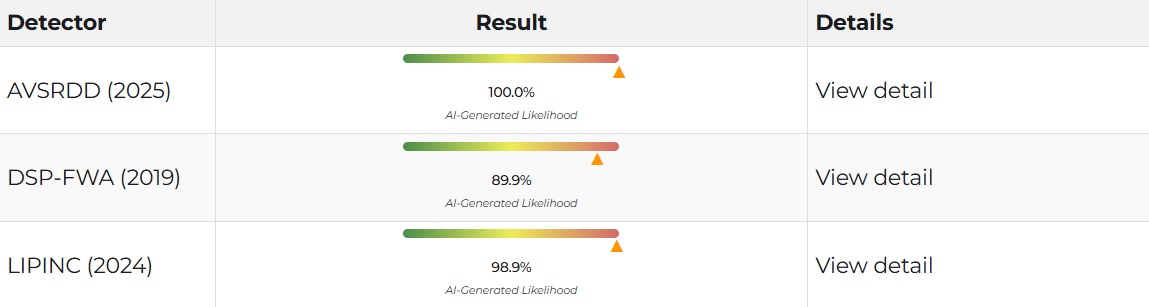
DeepFake-O-Meter results
We first used the AVSRDD (2025) model, which is an AVSR-based audio and visual deepfake detection method that leverages speech correlation. The model uses dual-branch encoders for audio and video to support independent detection of each modality. It rated the likelihood of the video being fake at 100%.
Next, the DSP-FWA (2019) model was used. It focuses on detecting deepfakes by identifying face-warping artifacts introduced during the deepfake generation process. It rated the video’s probability of being 89.9% fake. This model uses digital signal processing (DSP) techniques to spot inconsistencies caused when synthesised faces are resized and blended into original images or videos.
Lastly, we used the LIPINC (2024) model. It is a deep-learning method to detect lip-synced deepfakes by identifying the spatial-temporal discrepancies in the mouth region of deepfake videos. This model rated the video 98.9% fake.
Audio forensic analysis
Shaur Azher an audio engineer at our sister company Soch Videos analysed the viral clip against an extended, original footage of Modi’s speech. His analysis is as follows:
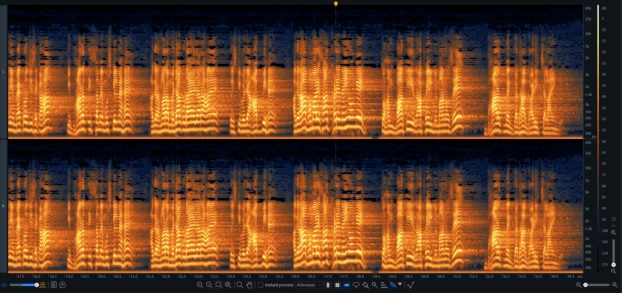
Spectrogram of the viral clip
1. Jitter and Shimmer measurement
A. Jitter (Frequency Instability): The jitter levels are unnaturally low and consistent. In a natural human speech of this emotional intensity, we expect micro-variations in pitch. This sample shows a “robotic” stability in the fundamental frequency ($F_0$).
B. Shimmer (Amplitude Instability): The shimmer values are nearly flat. Natural speech has inherent fluctuations in loudness between cycles; the lack thereof suggests a mathematical distribution common in Neural Text-to-Speech (TTS).
2. Phase coherence analysis
A. The phase alignment between various frequency bands is perfectly synchronised.
B. Natural human speech involves complex phase shifts due to the physical shape of the vocal tract. The “perfect” phase coherence here is a hallmark of digital signal reconstruction from a vocoder.
3. Breath signature comparison
A. There is a total absence of physiological breath markers.
B. The speech includes pauses, but the pauses lack the “pre-phonation” inhalation or the “post-utterance” exhalation characteristic of a person speaking with the passion heard in the tone. The transitions are digitally “clean,” which is inconsistent with natural human biology.
4. Room tone fingerprint comparison
A. The audio lacks a consistent “noise floor” or environmental reverb that matches the supposed setting of a public speech.
B. The background silence is mathematically “zero,” suggesting the voice was generated in a digital vacuum rather than recorded via a physical microphone in a room.
5. Cepstral coefficient deviation (MFCC Analysis)
A. The Mel-frequency cepstral coefficients (MFCCs) show significant “binning” in the higher frequencies.
B. In the 20 ms window frames analysed, the spectral envelope is overly smooth. Human vocal cords produce “spectral tilt” and noise components are missing here, resulting in a “hollow” digital signature.
Low variance in higher coefficients: In natural speech, the higher-order coefficients contain stochastic “noise” from the physical movement of the tongue and teeth. The audio file showed unnaturally smooth values here.
Harmonic oversaturation: The DCT output showed a lack of the “spectral tilt” typically found when a human raises their voice. The AI model perfectly replicated the pitch but failed to replicate the non-linear distortion of a human shouting.
Given that Modi did not make the statement attributed to him in the viral clip, and based on results from DeepFake-O-Meter and Azher’s analysis, Soch Fact Check concludes that it is a deepfake.
Virality
The claim was shared here, here, and here on Facebook. Archived here, here, and here.
On Instagram, it was shared here (archive).
Conclusion: Indian Prime Minister Narendra Modi did not admit that Pakistan shot down its Rafale jets during the May 2025 conflict. The viral clip is a deepfake.
–
Background image in cover photo:
To appeal against our fact-check, please send an email to appeals@sochfactcheck.com