
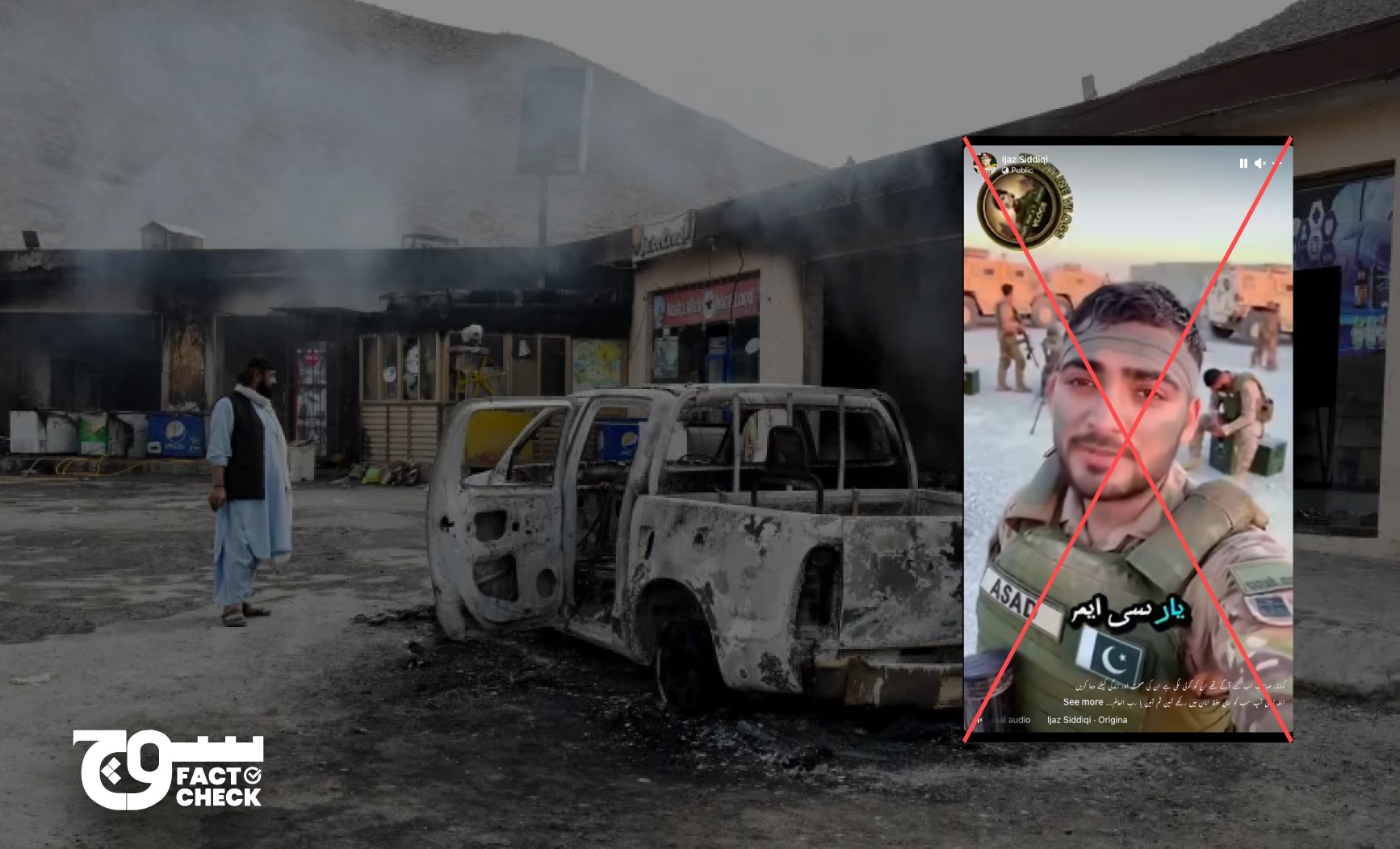
Claim: A video shows a soldier praising his commander amid the recent attacks across Balochistan.
Fact: The viral clip is likely AI-generated.
Following the recent wave of deadly attacks across Balochistan, a clip of a Pakistan Army soldier praising his commander was shared online. The video, which shows the soldier acknowledging that a “mission” was fulfilled, was shared with the following caption:
“کمانڈر صاحب اب سے آگے تھے ان کو گولی لگی ہے ان کی صحت اور زندگی کیلئے دعا کریں
اللہ تعالیٰ آپ سب کو اپنی حفظ امان میں رکھے آمین ثم آمین یا رب العالمین
پاک افواج زندہ باد ❤️❤️❤️
اسلام پاکستان”
[Translation: Commander Sahib was ahead of now. He has been shot. Pray for his health and life.
May Allah Almighty keep you all in His protection. Amen and Amen, O Lord of the Worlds.
Long live Pak Army ❤️❤️❤️
Islam Pakistan]
Attacks in Balochistan
On 31 January 2026, several police stations in Balochistan’s Quetta were targeted by armed gunmen in an attack that began at about 3 am local time, according to Al Jazeera. “Grenade and gun attacks in the provincial capital Quetta and cities and towns across the province targeted hospitals, schools, banks and markets, Pakistan’s junior interior minister Talal Chaudhry said,” BBC reported. “In each case, the attackers came in dressed as civilians and indiscriminately targeted ordinary people working in shops,” he said, adding that the attackers had used civilians as human shields, the report added.
“The attacks killed at least 15 security personnel and 18 civilians, the military said. Officials said 92 militants including ‘“three suicide bombers”’ were also killed,” reported France 24. The report further added that, “the dead included 18 civilians, among them three women and three children, in the city of Gwadar in Balochistan, police official Ibad Khan said. Khan said police quickly responded to the attack and killed all the attackers.”
The banned separatist group Balochistan Liberation Army (BLA) claimed responsibility for the attacks during which some of the banks were also robbed. Chief Minister of Balochistan Sarfaraz Bugti said Pakistani security forces killed 145 militants in a 40-hour battle. 17 law enforcement personnel and 31 civilians were killed in the militant attacks as of 1 February, he added.
Fact or Fiction?
Soch Fact Check has previously debunked similar fabricated videos of soldiers. The viral clip contains multiple visual inconsistencies, which suggest that it was likely generated using an AI text-to-video model.
A prominent sign is the static background. While the soldier speaks to the camera, a soldier seated behind him remains completely motionless, along with two other soldiers on the left side of the screen. In contrast, two other soldiers can be seen walking in the background. This inconsistency in natural movement is a common indicator of AI-generated videos where background elements often fail to animate realistically.
A closer examination of the soldier’s uniform revealed other signs of AI. The patch on his left arm does not contain a legible name, logo or designation. Instead, the text appears garbled. AI-generated content frequently struggles to render text correctly, particularly on clothing, badges, and signage.
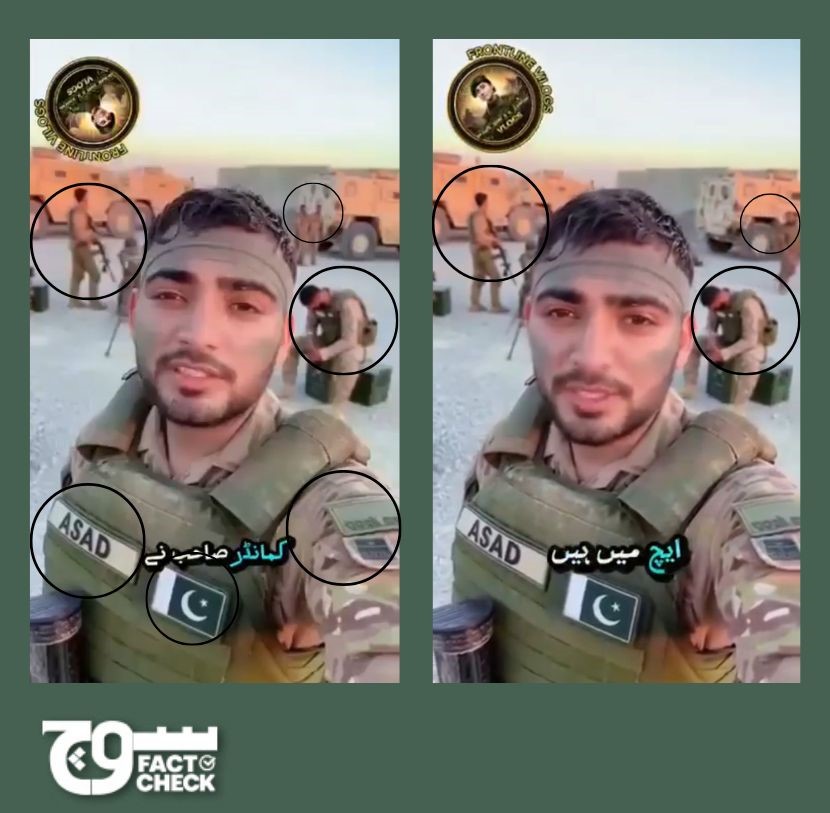
Visual inconsistencies in the viral video
Additionally, soldiers’ combat vests do not typically contain a name badge or the Pakistani flag, based on the photographs of the official uniform available online from news sites and social media. In fact, Pakistani soldiers’ uniforms typically display the wearer’s name along with “Pak Army” while the flag patch is normally seen on the arm.
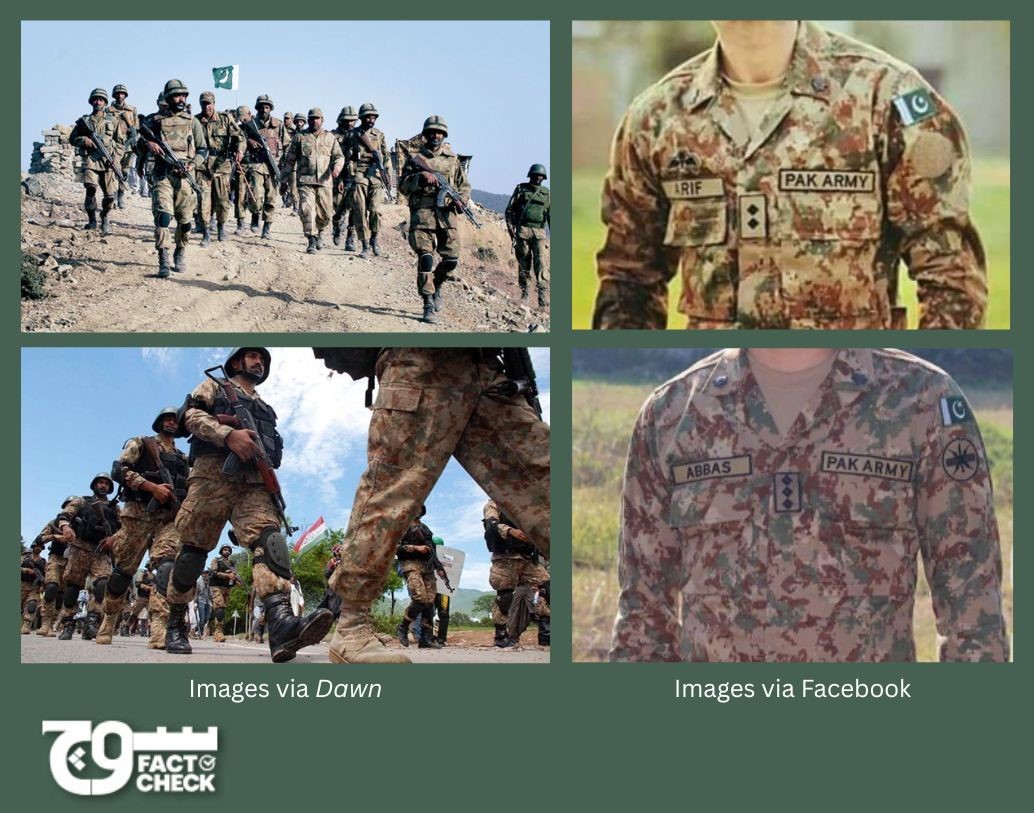
Pakistan Army uniform
Crucially, the reel included a logo reading “Frontline Vilogs,” indicating that it may have been processed or edited. We located the Frontline Vlogs page on Facebook and found multiple similar videos on the account that also appeared to be AI-generated.
Soch Fact Check then tested the video through DeepFake-O-Meter, which analysed it using multiple AI-based detection models. The results for the video are as follows:
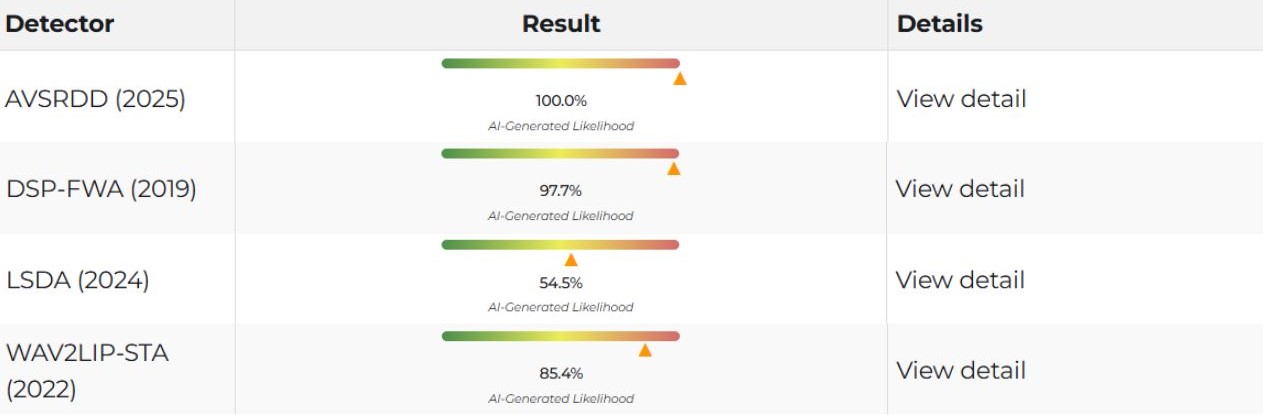
DeepFake-O-Meter results
We first used the AVSRDD (2025) model, which is an AVSR-based audio and visual deepfake detection method that leverages speech correlation. The model uses dual-branch encoders for audio and video to support independent detection of each modality. It rated the likelihood of the video being fake at 100%.
Next, the DSP-FWA (2019) model was used. It focuses on detecting deepfakes by identifying face-warping artifacts introduced during the deepfake generation process. It rated the video’s probability of being fake at 97.7%. This model uses digital signal processing (DSP) techniques to spot inconsistencies caused when synthesised faces are resized and blended into original images or videos.
The video was also analysed using LSDA (2024), a deepfake-detection model designed to assess whether a video or image is fully or partially synthesised using AI. The model evaluates visual and temporal cues, such as facial movements, lip synchronisation, and texture consistency, to estimate the likelihood of synthetic manipulation. It rated the clip’s probability of being fake at 54.5%.
Lastly, we used the WAV2LIP-STA (2022) detection model, which is designed to catch lip-sync based deepfakes, where the mouth movements don’t quite match the speech. It rated the clip at 85.4%, indicating a high likelihood of manipulation.
Virality
The clip was shared here, here, here, here, and here. Archived here, here, here, here, and here.
On X, it was shared here (archive) and here (archive).
On Instagram, it was shared here (archive).
Conclusion: The viral clip showing a soldier praising his commander after the attacks in Balochistan is likely AI-generated.
–
Background image in cover photo: AFP
To appeal against our fact-check, please send an email to appeals@sochfactcheck.com