
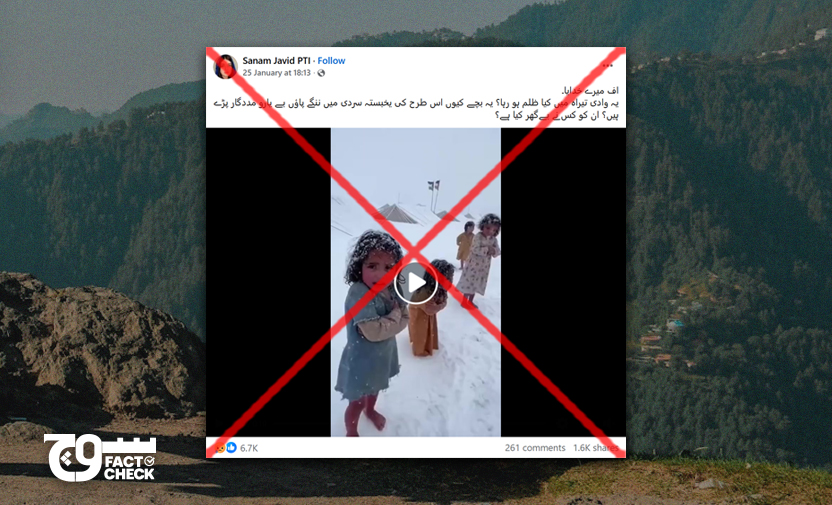
Claim: A video shows children from the Tirah Valley in thin, worn-out clothes standing and shivering in an open area amid heavy snowfall. They are among the thousands displaced due to an army operation in the area.
Fact: The video was likely created using AI tools.
In late January 2026, multiple social media users shared a video showing children in an open-air setting, bent over and shivering due to the cold weather. The posts claimed that it depicted the current reality of the people from Tirah Valley where the Pakistan Army has allegedly launched an operation against terrorists (archived here, here, and here, respectively).
Tirah Valley displacement
Since January 2026, “thousands” of people have been displaced from Tirah Valley, a region in the Khyber district of Pakistan’s Khyber Pakhtunkhwa (KP) province, due to what multiple news reports have claimed is a military operation targeting terrorists and militant groups.
Currently, families that were promised assistance have been soldiering through the harsh weather conditions, including heavy snowfall that has blocked roads leading out of the area.
“The government says it aims to remove armed groups accused of destabilising the region. Many families have been forced to gather their belongings and leave their homes due to these operations,” Al Jazeera reported on 23 January.
A 25 January deadline was set for the evacuation but the move was suspended and then extended to 5 February.
In a statement on 25 January, the Information and Broadcasting Ministry said that “misleading claims” were circulating about the “alleged ‘depopulation’ from Tirah Valley on the orders of the Army”. It added that neither the federal government nor the armed forces had issued any such directive.
“The Law Enforcement Agencies are routinely conducting targeted, intelligence-based operations strictly against terrorist elements, with full care to avoid disruption to peaceful civilian life for which no depopulation or migration is needed or being undertaken. It may be noted that the local population is increasingly concerned over [the] presence of Khwarij and desire peace and stability in Tirah,” the ministry said.
It added that the KP Relief, Rehabilitation, and Resettlement Department (RRSD) had “issued a notification for the release of funds on 26 Dec 2025 (reportedly Rs 4 Billion) for anticipated temporary and voluntary movement of population from certain localities of Tirah (Bagh)”.
“Fitna al-Khawarij” is a term the government uses to refer to the banned Tehreek-e-Taliban Pakistan (TTP), also known as the Pakistani Taliban.
Authorities have, however, set up centres for the displaced individuals, with Bara Assistant Commissioner Talha Rafiq saying the registration of almost 9,000 families hailing from Tirah Valley was complete, according to a 25 January report by The Express Tribune.
As per a report, Pakistan Army also conducted “relief activities to assist the local population and help restore daily life in the region”.
A representative jirga, or assembly of community elders, was held in Bara, Tribal News Network (TNN) reported on 26 January, adding that the body — chaired by former minister Hamidullah Jan Afridi — issued a unanimous declaration, urging “the government to fulfill its promise of the displaced returning from 1 April”.
On the other hand, KP Chief Minister Sohail Afridi’s Special Assistant for Information and Public Relations, Shafi Jan, criticised the federal government, saying its statement regarding the Tirah Valley evacuation was “baseless, fabricated, contrary to facts and a nefarious attempt to mislead the people”.
Afridi himself also rejected the government’s stance of displacement being voluntary as “misleading and factually incorrect”, according to The Express Tribune.
In a press conference on 27 January 2026, Defence Minister Khawaja Asif — alongside Information and Broadcasting Minister Attaullah Tarrar and Prime Minister’s Coordinator on Information for KP Affairs, Ikhtiar Wali Khan — ruled out the purported military operation in Tirah Valley and termed the displacement of the region’s residents as “routine” seasonal migration, The Express Tribune reported.
The issue “which has been characterised as a crisis is actually no crisis”, he said, adding that the Pakistan Army “has abandoned operations in the favour of IBOs for a long time … There is no question of [an] operation there”.
According to a Dawn report, Asif “acknowledged the presence of around 400 to 500 members of the banned Tehreek-i-Taliban Pakistan (TTP) in the valley” and said the issue was being “politicised”.
State Minister for Interior Tallal Chaudhry reiterated Asif’s remarks in a televised message, the state-run Radio Pakistan reported on 28 January, adding that if there was a need for an operation, “all the stakeholders will be taken on board”.
So far, over 70,000 people have fled the region, The Associated Press (AP) reported on 28 January. “Authorities say many TTP leaders and fighters have found sanctuary in Afghanistan and that hundreds of them have crossed into Tirah, often using residents as human shields when militant hideouts are raided,” it added.
Fact or Fiction?
Soch Fact Check observed some inconsistencies in the footage. Firstly, the feet of the girl in the front appear to be smudged, a tell-tale sign of content generated using artificial intelligence (AI). Moreover, the fourth child in the background is seemingly unaffected by the harsh cold weather.
Interestingly, we also noticed that the two flags in the background featured three stripes with a triangular shape on the stick end; they resemble those of Jordan, Kuwait, Palestine, and Sudan.
A reverse-search of the video’s keyframes led to the TikTok account @best.clips013, which had posted the clip twice on 9 and 10 January 2026 (archived here and here, respectively). In both instances, the platform flagged it as containing “AI-generated media”.
We then ran the video through two deepfake detection tools to check the likelihood of it being AI-generated.
According to five detectors in DeepFake-O-Meter, the probabilities of the clip being AI-generated are 61.5%, 94.8%, 100.0%, 46.0%, and 96.2%.
Hive Moderation, on the other hand, yielded a likelihood of 99.9%.
GODDS’ analysis
We also tested the video in the Global Online Deepfake Detection System (GODDS), a tool developed by Northwestern University’s Security & AI Lab (NSAIL) that uses a combination of various models along with human analysis to provide a holistic summary of the results.
GODDS used 22 deepfake detection algorithms for the visual content and 70 for the audio component. Two trained analysts also examined the clip.
All predictive models for the visual and audio content said the video “is likely to be fake”:
- The video is likely to be fake with a probability above 0.5, according to 6 of the 22 predictive models; it is likely to be fake with a probability below 0.5, according to the 16 other predictive models.
- The audio is likely to be fake with a probability above 0.5, according to 12 of the 70 predictive models; it is likely to be fake with a probability below 0.5, according to the 58 remaining predictive models.
According to the human analysts, the video contains “several indicators” that show it may be digitally manipulated via AI.
They said that the presence of instrumental music in the background “makes it difficult to discern possible audio manipulations” but emphasised that “occasionally”, it may “be a tactic used to obscure media manipulations”.
“The camera angle pans in and out without disruption or shaking. This appears unnatural considering the alleged extreme temperatures. The background subjects’ facial features are fully obscured, despite the first subject’s facial features remaining clear. Obscuring facial features can also be used as a strategy to hide media manipulations (e.g., 0:00, etc.).
“Despite the audio of the subjects shivering [in the video], the front subject’s mouth appears not to move to make any sound. Similarly, the subject does not blink the entire video despite forceful snow and wind. Throughout the video, the background subjects’ hands appear malformed or fully blurred together.
“From 0:02-0:03, the first subject’s eyebrows change shape and then return to [their] previous form,” the analysts said. They concluded, “We believe this media is likely generated or manipulated via artificial intelligence.”
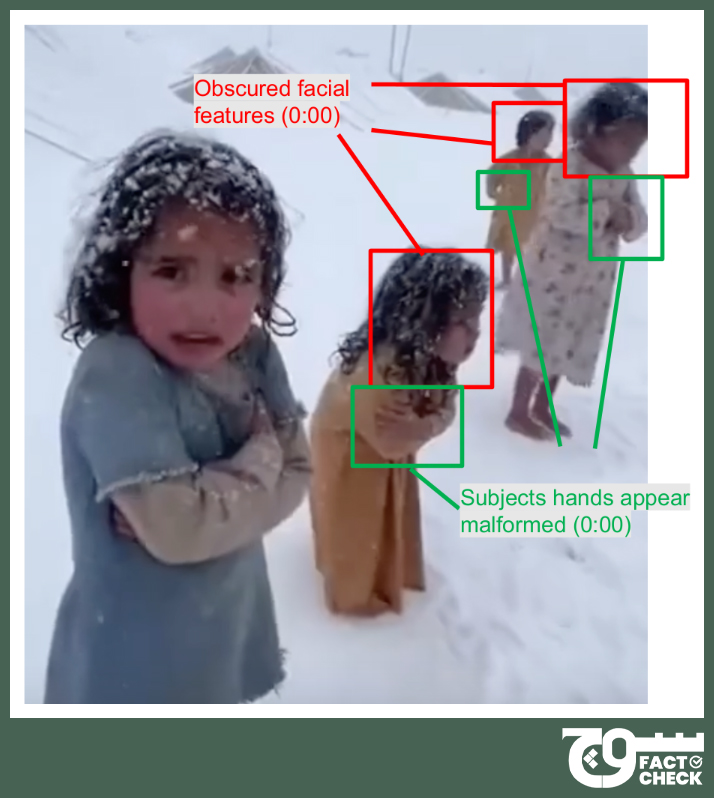
In this image provided to Soch Fact Check by GODDS’ analysts, some of the indicators of the video being AI-generated are highlighted.
Interestingly — and probably due to the flags in the background — the video has also been shared on social media in the context of Palestine, as evidenced here, here, and here.
Soch Fact Check, therefore, concludes that the video was likely created using AI tools.
Virality
Soch Fact Check found the claim circulating here, here, and here on Facebook.
It was also shared here on X (formerly Twitter), here, here, and here on Instagram, and here on YouTube.
Conclusion: The video was likely created using AI tools.
Background image in cover photo: Kashif Afridi
To appeal against our fact-check, please send an email to appeals@sochfactcheck.com