
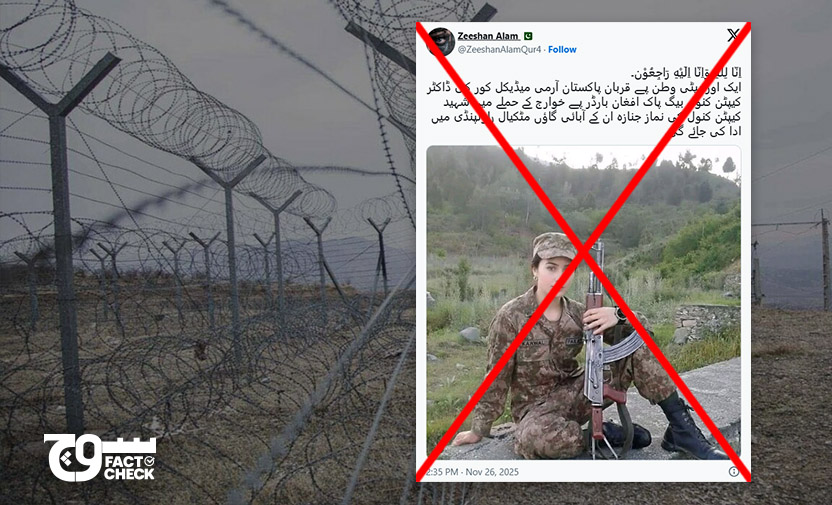
Claim: An image going viral on social media claims that it shows a female Pakistani military doctor who has been martyred at the Pak-Afghan border.
Fact: The claim is false. The image is AI-generated using Google’s Gemini model. There are no credible reports of any such incident. Additionally, the Pakistan Army does not deploy women officers at border posts; their roles are limited to administrative, medical, and support positions.
On 27 November 2025, an account on X (formerly Twitter) posted an image with the caption,
اِنّا لِلّٰهِ وَاِنّا اِلَيْهِ رَاجِعُوْن۔
ایک اور بیٹی وطن پے قربان پاکستان آرمی میڈیکل کور کی ڈاکٹر کیپٹن کنول بیگ پاک افغان بارڈر پے خوارج کے حملے میں شہید کیپٹن کنول کی نماز جنازہ ان کے آبائی گاؤں مٹکیال راولپنڈی میں ادا کی جائے گی۔
Translation: [Indeed, to Allah we belong, and to Him we shall return.
Another daughter sacrificed for the homeland: Doctor Captain Kanwal Baig of the Pakistan Army Medical Corps was martyred in an attack by Khawarij on the Pak-Afghan border. Captain Kanwal’s funeral prayer will be offered in her native village, Matkyal, Rawalpindi.]
The image shows a woman wearing a Pakistan Army uniform and posing with a rifle in front of hilly mountains. The claim was shared in the context of recent escalations between Pakistan and Afghanistan.
Clashes between Pakistan and Afghanistan
Relations between Pakistan and Afghanistan deteriorated sharply in early October. On October 9, Pakistan launched airstrikes on suspected Tehrik-i-Taliban Pakistan (TTP) hideouts in Kabul, Khost, and Paktika. The situation escalated on October 11–12, when Afghan forces retaliated by targeting Pakistani military posts, resulting in what officials termed the “most serious fighting” since the Taliban’s return to power.
Dawn reported that the military claims 23 soldiers and over 200 militants were killed in the exchange. Although a ceasefire agreement was signed in Doha on October 19, the subsequent peace talks in Istanbul concluded on October 30 without a permanent resolution.
Diplomatic Relations and Renewed Hostilities
Hostilities resumed in November after a second round of peace talks (Nov 6–8) stalled indefinitely due to security disagreements. Tensions reached a breaking point on November 11 following a suicide bombing at the District Judicial Complex in Islamabad that killed 12 people. In a statement reported by Dawn, Defense Minister Khawaja Asif declared that a “state of war” effectively exists on the border, signaling that Pakistan would no longer seek cooperation from the current regime in Kabul.
Violence escalated further on November 24 when suicide bombers attacked the Federal Constabulary (FC) headquarters in Peshawar. Radio Pakistan confirmed that three security personnel were killed in the assault. Hours later, on the night of November 25, the Afghan Taliban accused Pakistan of launching fresh airstrikes in the Khost and Paktika provinces. The Guardian reported claims by Taliban spokespersons that the strikes killed 10 civilians, including women and children. Pakistan maintained that the operations were precision strikes against militant networks. As of now, the situation remains unchanged.
Fact or Fiction?
To investigate the authenticity of the claim, Soch Fact Check conducted a keyword search using the terms “Dr Kanwal Baig,” “military doctor,” and “martyred.” However, we found no credible news report or official announcement confirming any such incident.
During a visual analysis, we observed an emoji superimposed on the corner of the image, a tactic often used to conceal watermarks. We also noted significant visual inconsistencies typical of AI generation: the name “Kanwal” appears distorted on the uniform, with the letter ‘N’ resembling an ‘H’, and the spelling of “Pak Army” is unclear.
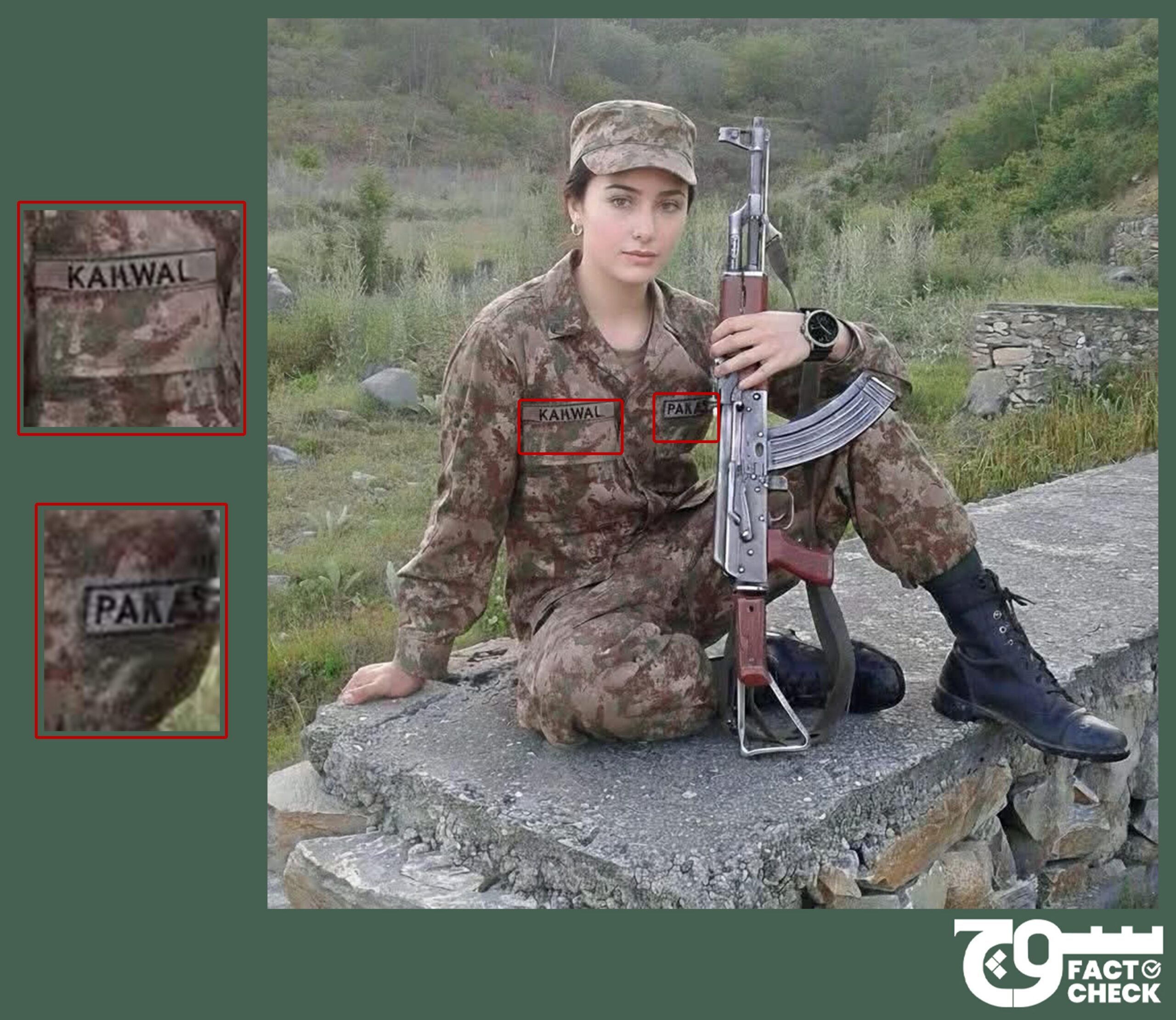
Highlighted areas showing visual inconsistencies in the image
To verify the image’s origin, we ran it through Google Reverse Image Search and examined the “About this image” section. The tool identified that the visual was created using Google AI, citing the detection of a SynthID watermark.
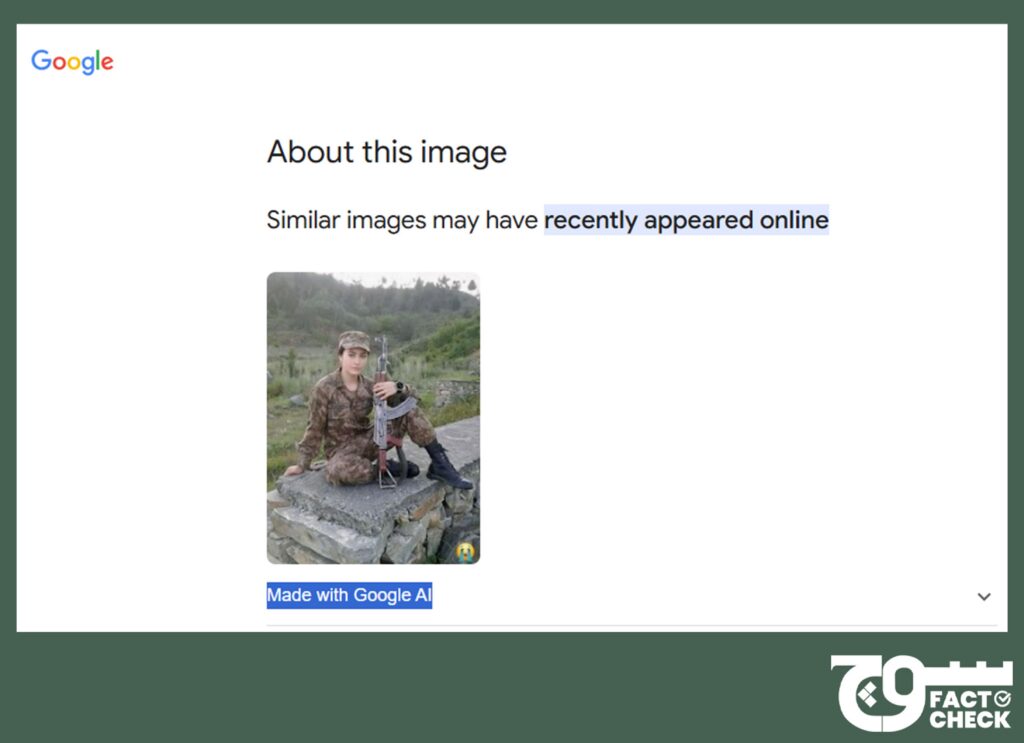
Screenshot of “About this Image” section on Reverse Image Search by Google showing the presence of SynthID watermark
SynthID, introduced by Google in 2023 and widely integrated into its Google products by 2025, is a technology that embeds imperceptible digital watermarks directly into AI-generated content (images and videos). While invisible to the human eye, these watermarks are detectable by verification tools, such as Reverse Image Search, which confirms that the image is AI-generated rather than a genuine photograph.
Furthermore, we cross-referenced the image using another AI-detection tool, Copyleaks, which also identified the image as AI-generated (image below):
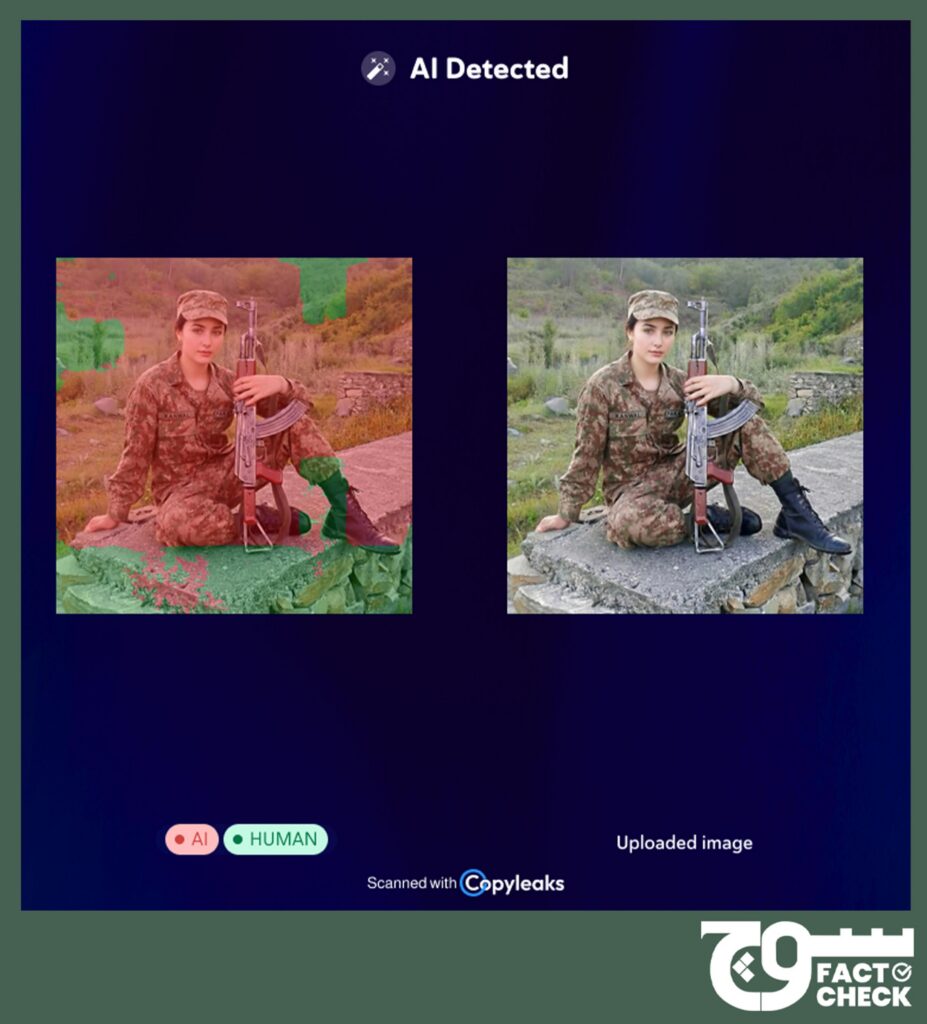
Copyleaks’ detection of AI-generated content in the image
For further confirmation, Soch Fact Check contacted a military source, who clarified that while women serve in the Pakistan Army Medical Corps, they are primarily deployed in administrative or support roles, rather than in active combat zones. The source added that female physicians are not typically dispatched to high-tension border areas.
Virality
The viral image was shared by Pakistani, Indian, and pro-Afghan accounts on social media.
It can be seen here, here, here and here on X by Indian and pro-Afghan accounts, while here, here, and here by Pakistani accounts.
It was also shared here and here on Instagram and here, here, and here on Facebook.
Conclusion: Social media posts claiming that a female military doctor was martyred during recent border clashes between Pakistan and Afghanistan are false. The viral image is AI-generated, confirmed by a Google SynthID watermark.
Background image in cover photo: Anadolu Agency
To appeal against our fact-check, please send an email to appeals@sochfactcheck.com